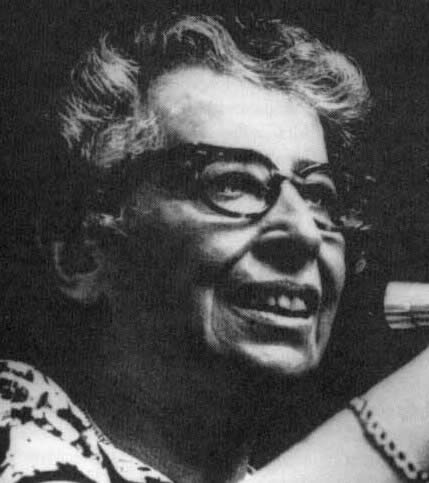
A political theorist with a flair for grand historical
generalization, Hannah Arendt exhibited the conceptual brio of a cultivated
intellectual, the conscientious learning of a German-trained scholar, and
the undaunted spirit of an exile who had confronted some of the worst
horrors of European tyranny. Her life was enriched by innovative thought
and ennobled by friendship and love. Although her books addressed a general
audience from the standpoint of disinterested universalism, Jewishness was
an irrepressible feature of her experience as well as a condition that she
never sought to repudiate.
Hannah Arendt was born on October 14, 1906, in Hanover,
in Wilhelmine Germany. Raised in Konigsberg, she was the only child of Paul
and Martha (Cohn) Arendt, both of whom had grown up in Russian-Jewish homes
headed by entrepreneurs. Arendt's childhood was punctuated with grief and
terror. Her father, an engineer, died of paresis (syphilitic insanity) when
Hannah was seven, and episodic battles between Russian and German armies
were fought near their home soon thereafter. Her mother married Martin
Beerwald in 1920, providing Hannah with two older stepsisters, Eva and
Clara Beerwald.
After graduating from high school in Koenigsberg in
1924, Arendt began to study theology that fall with Rudolf Bultmann at the
University of Marburg. Also on the faculty was the young philosopher Martin
Heidegger, whose lectures, which would form the basis of Sein und Zeit [Being and time] (1927), were already inspiring allegiance to and interest
in the emerging Existenzphilosophie. Her brief but passionate affair
with Heidegger, a married man and a father, began in 1925 but ended when
she went on to study at the University of Heidelberg with Karl Jaspers. A
psychiatrist who had converted to philosophy, he became her mentor.
In September 1929, Arendt married Günther Stern, who
wrote under the name of Günther Anders. That year, she also completed her
dissertation on the idea of love in the thought of St. Augustine and earned
her doctorate. However, the rising anti-Semitism afflicting the German
polity distracted her from metaphysics and compelled her to face the
historical dilemma of German Jews. By writing a biography of Rahel
Varnhagen, a Jewish salon hostess in Berlin in the early 1800's, Arendt
sought to understand how her subject's conversion to Christianity and
repudiation of Jewishness illuminated the conflict between minority status
and German nationalism. Rahel Varnhagen: The Life of a Jewish Woman was not published until 1958. By then, Arendt's great historical subject
was no longer the question of whether Jews were fit to enter the salons,
but the question of whether Jews were fit to inhabit the earth.
As the National Socialists grasped power, Arendt became
a political activist and, beginning in 1933, helped the German Zionist
Organization and its leader, Kurt Blumenfeld, to publicize the plight of
the victims of Nazism. She also did research on anti-Semitic propaganda,
for which she was arrested by the Gestapo. But when she won the sympathy of
a Berlin jailer, she was released and escaped to Paris, where she remained
for the rest of the decade. Working especially with Youth Aliyah, Arendt
helped rescue Jewish children from the Third Reich and bring them to Palestine.
In Paris, she met Heinrich Blücher, a formally
uneducated Berlin proletarian, a communist who had been a member of Rosa
Luxemburg's defeated Spartacus League, and a gentile. After both had
divorced, Arendt married Blücher on January 16, 1940. When the Wehrmacht
invaded France less than half a year later, the couple was separated and
interned in southern France along with other stateless Germans. Arendt was
sent to Gurs, from which she escaped. She soon joined her husband, and in
May 1941, both managed to reach neutral America, where her mother was able
to reunite with them. While living in New York during the rest of World War
II, Arendt envisioned the book that became The Origins of
Totalitarianism. It was published in 1951, exactly a decade after she
arrived in the United States and the same year she secured United States
citizenship.
From two separate launching pads, Arendt's career as an
American intellectual took off. Her writing appeared early in Jewish
journals such as Jewish Social Studies, and she was befriended by
the editor and historian Salo W. Baron and his wife, Jeanette M. Baron. In
magazines such as Jewish Frontier and Aufbau [Reconstruction], Arendt argued on behalf of a Jewish army and expressed
the hope that Arabs and Jews might live together in a postwar Palestinian
state. She also served as an editor at Schocken Books, a German Jewish
publishing firm that reestablished itself in New York and in Palestine, and
brought to the attention of English readers the diaries of Franz Kafka and
the fin de sìecle Jewish polemics of Bernard Lazare. After the Holocaust,
Baron put Arendt in charge of Jewish Cultural Reconstruction, the effort to
locate and redistribute the shards of Judaic artifacts and other treasures
that had been salvaged from a doomed civilization. Her second launching pad
was a circle of mostly leftist intellectuals associated with Partisan
Review, especially non-Jews such as Dwight Macdonald and Mary McCarthy.
The critic Alfred Kazin, however, was also invaluable in enhancing the
prose of The Origins of Totalitarianism, the work that made Arendt
an intellectual celebrity in the early years of the Cold War.
No book was more resonant or impressive in tracing the
steps toward the distinctive twentieth-century tyrannies of Hitler and Stalin, or in measuring how grievously wounded Western civilization and the
human status itself had become. She demonstrated how embedded racism was in
Central and Western European societies by the end of the nineteenth
century, and how imperialism experimented with the possibilities of
unspeakable cruelty and mass murder. The third section of her book exposed
the operations of "radical evil," arguing that the huge number of
prisoners in the death camps marked a horrifying discontinuity in European
history itself. Totalitarianism put into practice what had been imagined
only in the medieval depictions of hell. In the 1950s, The Origins of
Totalitarianism engendered much doubt, especially by drawing parallels
between Nazi Germany and Stalinist Russia (despite their obvious
ideological conflicts and their savage warfare from 1941 to 1945). The
parallelism continues to stir skepticism in some readers, especially
because of the unavailability and unfamiliarity of Russian sources when the
book was researched and written. But Arendt's emphasis on the plight of the
Jews amid the decline of Enlightenment ideals of human rights, and her
insistence that the Third Reich was conducting two wars—one against the
Allies, the other against the Jewish people—have become commonplaces of
Jewish historiography. Much of her book is stunningly original, and
virtually every paragraph is ablaze with insight. More than any other
scholar, Arendt made meaningful and provocative die idea of
"totalitarianism" as a novel form of autocracy, as springing from
subterranean sources within Western society, but pushing to unprecedented
extremes murderous fantasies of domination and revenge. An expanded edition
of The Origins of Totalitarianism was published in 1958, taking into
account the Hungarian Revolution of two years earlier.
Arendt's next three books--The Human Condition (1958), Between Past and Future (1961), and On Revolution (1968)--could be characterized by a yearning to reconstruct political
philosophy rather than to explore the devolution of political history.
Remarkably enough, in 1963 she also published what proved to be the most
controversial work of her career: Eichmann in Jerusalem. In 1960,
Israeli security forces had captured the S.S. lieutenant colonel who had
been responsible for transporting Jews to the death camps. The following
year, he was tried in Israel, where Arendt covered the trial as a
correspondent for The New Yorker. Her articles were then revised and
expanded for Eichmann in Jerusalem.
Her portrayal of a bureaucrat who did his duty and
followed orders, rather than a raving ideologue animated by demonic anti-Semitism, was strikingly original. Far from embodying "radical
evil," Eichmann exemplified "the banality of evil," Arendt
argued-and thus the danger could not be confined to the political
peculiarities of the Third Reich. While accepting the validity of Israeli
jurisdiction and considering the Israeli court's verdict imposing the death
sentence on Eichmann just, Arendt also offered her own justifications for
capital punishment. Eichmann had not wanted to share the earth with the
Jews; therefore, the Jewish state had no reason to share the earth with
him. Almost in passing, she also claimed that fewer than six million Jews
would have died if the Jewish councils had not collaborated to various
degrees with Nazis like Eichmann. Even anarchy and noncooperation would
have been better, she stated, than the effort to act as though the
occupiers were traditional anti-Semites who might somehow be bribed or
appeased. Her attribution of some responsibility for the catastrophe to the
councils (Judenräte) not only met sharp criticism, but also
provoked a considerable historical literature that investigated the
behavior of Jewish communities under Nazi occupation. The subsequent debate
has often reinforced the picture of venality, delusion, fear, and
selfishness that Arendt briefly presented.
The storm over the book's apparent elevation of Eichmann's character and denial of Jewish innocence frayed whatever bonds
still tied Arendt to the organized Jewish community. Some segments mounted
a propaganda campaign against the arguments that she advanced. Although Eichmann in Jerusalem is hardly free of factual error or bias, Arendt's
critics tended to miss her subtlety and to ignore the relation between her
book and the grandeur of her philosophy. She held the victims of the Final
Solution accountable for inadequate and ill-conceived political action, and
offered the perpetrators a measure of empathy and an effort to
understand-lest the horrors be repeated under different historical
conditions. But Arendt also wrote as though the modernization associated
with the rise of mass society made problematic the classical injunction to
think clearly and to act according to conscience. Partisanship and
nationalism (even sometimes on behalf of Jews) had obscured the ideals of
rational speech and meaningful deeds that she especially celebrated in The
Human Condition. But nearly all of her books suggest a struggle to
reclaim the possibilities of freedom grounded in the sense of a shared
world.
According to Arendt, then, Eichmann had done evil not
because he had a sadistic will to do so, nor because he had been deeply
infected by the bacillus of anti-Semitism, but because he failed to think
through what he was doing (his thoughtlessness). This theory led Arendt to
conceptualize the neo-Kantian meditations on judgment in her posthumously
published lecture collection The Life of the Mind (1978). While in
Aberdeen, Scotland, to deliver these Gifford Lectures, she suffered a heart
attack. A second coronary failure on December 4, 1975, while entertaining
Salo and Jeanette Baron in her New York City apartment, proved fatal.
(Blucher, to whom The Origins of Totalitarianism had been dedicated,
had died in 1970.)
For well over two decades, Hannah Arendt was one of the
nation's most prominent intellectuals. However, she was also a notoriously
private person who shielded herself as ferociously from interviewers and
television cameras as she resisted Anglo-American philosophical tendencies
such as pragmatism, empiricism, and liberalism. The first woman to become a
full professor (of politics) at Princeton University, she subsequently
taught at the University of Chicago, Wesleyan University, and finally the
New School for Social Research. Her articles in the New York Review of
Books in the 1960s and early 1970s criticized military intervention in
Vietnam and the abuses of executive power associated, for example, with the
"imperial presidency." Her books exerted a major impact on
political theory, particularly in North America, Europe, and Australia,
where scholarly conferences and subsequent anthologies have been devoted to
her work (as have over a dozen other books and numerous dissertations). In
1975, the Danish government awarded Arendt its Sonning Prize for
Contributions to European Civilization, which no American and no woman
before her had received. Her life even inspired a roman à clef, Arthur A.
Cohen's An Admirable Woman (1983), possibly because her allure was
more than austerely intellectual-her suitors included Hans J. Morgenthau,
Leo Strauss, and W.H. Auden, who was homosexual.
While her work has not yet been given any major feminist
readings, Arendt's critical intelligence has enriched Jewish studies.
Jewish identity was so inescapable an aspect of her sensibility that, when
beginning a lecture in Cologne less than a decade after World War II, she
announced: "I am a German Jew driven from my homeland by the
Nazis." Her thought also registered the impact of Bernard Lazare,
whose polemics combined hostility to anti-Semitism with opposition to the
timorous parvenus who often fancied themselves the representatives of the
Jewish masses. As her friend Mary McCarthy once recalled, Israel was
"the prime source of her political concern," and Arendt remarked
that "any real catastrophe in Israel would affect me more deeply than
anything else." When such a disaster was avoided in 1967, the victory
of the Israel Defense Forces in the Six-Day War thrilled her.
Yet her own knowledge of Judaism was apparently slight,
and not always accurate. Arendt died unconsecrated by a religious ceremony
(her ashes are buried at Bard College, where Blucher taught), and the
obituary in the New York Times tersely noted that she had "no
religious affiliation." Her dissertation topic had been a Christian
saint, and she later wrote dazzlingly on the goodness of Jesus. Yet it
could be argued that the primary influences upon her thought were Hellenic
philosophy-and German philosophy itself. Arendt denied harboring any
special love for the Jewish people (ahavat Yisrael). Since Diaspora Jewry
had been denied the public space in which she believed human excellence
should be cultivated, Arendt admitted that she could neither admire nor
"love" a collective so deprived of political possibilities. By
1950 or so, her disappointment with the dead-on-arrival idea of a
binational state in the Near East quietly distanced her from the organized
Jewish community, whose resources would henceforth be mounted on behalf of
Jewish sovereignty in Palestine.
Although Arendt deeply appreciated the refuge that the
United States provided (an appreciation that its academic institutions and
audiences reciprocated by recognizing her gifts), it is difficult to detect
any significant American influences upon her work. Arendt was supremely a
product of Weimar culture. She had its awareness of both the brilliance of
Jewish achievement and the fragility of the Jewish status. She shared its
modernist sense of the disrupted ties to the classical heritage that her
own political philosophy helped to elucidate, and its apocalyptic
pessimism. Finally, she reflected its disdain for the petty compromises of
electoral politics, and its valorization of creative thought and
cosmopolitanism that transcend the tastes of the masses. Like Heidegger,
she was entranced by the poetic and philosophical resources of the German
language, and in 1967, the Deutsche Akademie fur Sprache und Dichtung
honored the excellence of her German prose. Like many other Jewish
intellectuals, Arendt noticed the strangeness of the familiar and sought to
clarify the senselessness of modern history. But like very few others,
Arendt managed to stamp with individual authority a body of work that is
saturated with speculative daring.