Robert Bárány
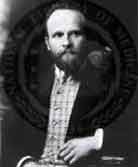
(1876 - 1936)
Robert Bárány was born in Vienna, Austria on April 22, 1876. Bárány
first became interested in medicine following his development of tuberculosis.
In 1900, he graduated with a medical degree from Vienna University.
After graduating, Bárány became a doctor in Vienna.
During one visit from a patient, Bárány
began syringing fluid into the inner ear of a patient to get rid of
the patient’s vertigo and nystagmus (involuntary eye movement).
At first Bárány injected fluids that were too cold. Consequently,
he warmend the fluid for the patient, which caused the patient to experience
nystagmus in the opposite direction.
He was awarded the Nobel
Prize for Medicine in 1914
for his work on the physiology and pathology of the vestibular apparatus
of the inner ear, which helps to provide balance. Bárány
theorized that the fluid in the inner ear was sinking when it was cool
and rising when it was warm, and thus the direction of flow of the fluid
was providing the signal to the vestibular organ. He followed up on
this observation with a series of experiments on what he called the
caloric reaction. The research resulting from his observations made
surgical treatment of vestibular organ diseases possible. Bárány
also investigated other aspects of equilibrium control, including the
function of the cerebellum (region of the brain important for the integration
of sensory perception).
During World
War I, he served in the Austrian army
as a civilian surgeon and was captured by the Russian Army. When his Nobel Prize was awarded in
1914, Bárány was in a Russian prisoner of war camp. He
was released in 1916 following diplomatic negotions with Russia conducted by Prince Carl of Sweden and the Red Cross. He was then able
to attend the Nobel Prize awards ceremony in 1916, where he was awarded
his prize.
After having his work critized by his Vienna colleagues,
Bárány accepted the position of Principal and Professor
of an Otological Institute in Uppsala. From 1917 until his death, he
was professor at Uppsala University. Barany died on April 8, 1936.
Sources: Wikipedia;
Nobel
Prize Biography; Picture courtesy of: National
Institutes of Health |