Hans Bethe
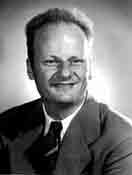
(1906 - 2005)
Hans Albrecht Bethe was born on July 2, 1906, in Strassburg, Germany (now Strassburg, France). He studied physics
at Frankfurt and obtained his doctorate from the University of Munich
with supervisor Arnold Sommerfeld, after which he did postdoctoral stints
in Cambridge and at Enrico Fermi's laboratory in Rome.
He left Germany in 1933 when the Nazis came to
power and he lost his job (his mother was Jewish) at the University
of Tubingen, moving first to England where he held a provisory position of Lecturer for the year 1933-1934
and in the fall of 1934, a fellowship at the University of Bristol.
In England, Bethe worked with the theoretician Rudolf Peierls on a comprehensive
theory of the deuteron.
In 1935, Bethe moved to the United
States, where he joined the faculty at Cornell University, a position
that he occupied throughout his career. At Cornell, Bethe became known
as one of the leading theoretical physicists of his generation, and
along with other upcoming physicists like Stanley Livingston (a cyclotron
pioneer) and later, experimentalist Robert Wilson and theoretician Robert
Bacher, put Cornell on the world physics map. He published a series
of articles on nuclear physics, summarizing most of what was known until
that time, an account that became informally known as “Bethe's
Bible,” and remained the standard work on the subject for many
years. In this account, he also continued where others had left off,
and filled in gaps from the older literature.
From 1935 to 1938, he studied nuclear reactions and
reaction cross sections (carbon-oxygen-nitrogen cycle), leading to his
important contribution to stellar nucleosynthesis. This research was
later useful to Bethe in more quantitatively developing Niels
Bohr's theory of the compound nucleus. In 1941, he became a naturalized
citizen of the United States.
When the war began, Bethe wanted to contribute to
the war effort. Following the advice of the Caltech aerodynamicist Theodore
Von Karman, Bethe collaborated with his friend Edward
Teller, then at George Washington University, on a theory of shock-waves
which are generated by the passage of a projectile through a gas. This
work was later useful to researchers investigating missile reentry.
Bethe also worked on a theory of armor penetration.
During the summer of 1942, he served as part of a
special session at the University of California, Berkeley at the invitation
of Robert Oppenheimer, which outlined the first designs for the atomic
bomb. Initially, Bethe had been skeptical about the possibility of making
a nuclear weapon from uranium (in fact, in the late 1930s, he had written
a theoretical paper that argued against fission), but when Teller showed
him the atomic pile that Enrico Fermi was building in a squash court
under the football stands at the University of Chicago, he became convinced
that such a project might actually be feasible. When Oppenheimer started
the secret weapons design laboratory, Los Alamos, he appointed Bethe
as Director of the Theoretical Division, a move that irked Teller who
had coveted the job for himself. During the project, Klaus Fuchs who
was leaking nuclear secrets to the Russians, was also in Bethe's division.
Like everyone else, Bethe never had the slightest idea that Fuchs was
a spy.
When the first atomic bomb was detonated in the New
Mexico desert in July, 1945, Bethe's only immediate concern at the time
was for its efficient working, and not for its moral implications. After
the war, Bethe argued that a crash project for the hydrogen bomb should
not be attempted, though after President
Truman announced the beginning of such a project, and the outbreak
of the Korean War, Bethe signed up and played a key role in the weapon's
development. Though he would see the project through to its end, in
Bethe's account he personally hoped that it would be impossible to create
the hydrogen bomb.
Bethe later campaigned together with Albert
Einstein in the Emergency Committee of Atomic Scientists against
nuclear testing and the nuclear arms race. He influenced the White House
to sign the ban of atmospheric nuclear tests in 1963 and Anti-Ballistic
Missile Treaty (SALT I) in 1972.
Bethe received the Max Planck medal in 1955. In 1961,
he was awarded the Eddington Medal of the Royal Astronomical Society
for work in identifying the energy generating processes in stars. In
1967, Bethe was awarded the Nobel
Prize in Physics "for his contributions to the theory of nuclear
reactions, especially his discoveries concerning the energy production
in stars.” He had postulated that the source of this energy are
thermonuclear reactions in which hydrogen is converted into helium (stellar
nucleosynthesis).
Bethe was also noted for his theories on atomic properties.
In the late 1940s, he provided the first way out of the infinities that
plagued the explanation of the so-called Lamb shift. This work was the
impetus for the pioneering later work done by Richard Feynman, Julian
Schwinger and others which marked the beginning of modern quantum electrodynamics.
In 1954, Bethe testified on behalf of Oppenheimer,
who was on trial for being labeled a security risk. During this event,
Bethe and his wife also tried hard to convince Edward Teller against
testifying. However, Teller did not agree, and his testimony played
a major role in the revocation of Oppenheimer's security clearance.
While Bethe and Teller had been on very good terms during the pre-war
years, the conflict between them during the Manhattan Project, and especially
during the Oppenheimer episode, permanently marred their relationship.
In 1960, Bethe, along with IBM physicist Richard Garwin,
wrote an article criticizing in detail the anti-ICBM defense system
that the Government was planning to install. In the article, which was
published in Scientific American, the two physicists described
in detail how almost any countermeasure that the U.S. could take would
be futile, as the enemy would be able to thwart the system through the
use of suitable decoys. He was one of the prime scientific voices behind
the signing of the 1963 Partial Test Ban Treaty that prohibited atmospheric
testing of nuclear weapons.
During the '80s and '90s, Bethe campaigned for the
peaceful use of nuclear energy. After the Chernobyl accident, Bethe
put together a committee of experts that analyzed the incident, and
concluded that a similar episode would not happen in any good U.S. reactor,
as the Russian reactor suffered from a fundamentally faulty design and
human error also had significantly contributed to the accident. Throughout
his life, Bethe remained a strong advocate for electricity from nuclear
energy.
In the 1980s, he, along with other physicists opposed
the Strategic Defense Initiative missile system that was being conceived
by the Reagan administration, arguing against the enormous sums of money
spent on it and the feelings of instability and animosity that it would
foster. In 1995, at the age of 88, Bethe wrote an open letter calling
on all scientists to "cease and desist" from working on any
aspect of nuclear weapons development and manufacture. In 2004, he signed
a letter, along with 47 other Nobel laureates, endorsing John Kerry
for president of the United States, citing Bush's misuse of science.
He continued to do research on supernovae, neutron
stars, black holes, and other problems in theoretical astrophysics into
his late nineties. In doing this, he collaborated with Gerald Brown
of SUNY-Stony Brook. The asteroid 30828 Bethe is named after him. In
his 80s, he wrote an important article about the solar neutrino problem.
Bethe's hobbies included a passion for history and
also stamp-collecting. About the latter, he wryly remarked that it was
the only instance where all the countries in the world could coexist
by each other's side in peace. Bethe was also known for his great sense
of humor. He was coauthor of the legendary Alpher-Gamov-Bethe paper
about the big bang and nucleosynthesis, and he published a spoof paper
1931, "On the Quantum Theory of the Temperature of Absolute Zero"
(Beck, Bethe, Riezler), where he calculated the fine structure constant
from the absolute zero Temperature (in Celsius units!) causing a scandal
in the scientific world. This second spoof paper intended to characterize
a certain class of papers in theoretical physics of these days which
are pure speculative and based on spurious numerical agreements (e.g.
Sir Arthur Eddington claimed to have calculated the fine structure constant
from fundamental quantities in an earlier paper).
Hans Bethe died in his home in Ithaca, New York on
March 6, 2005. At the time of his death, he was the John Wendell Anderson
Professor of Physics Emeritus at Cornell University.
Sources: Wikipedia |