Ezer Weizman
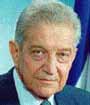
(1924 - 2005)
Ezer Weizman was an Israeli air force general, politician and the seventh President of the State of Israel.
Weizman (born June 15, 1924; died April 24, 2005) was born in Tel
Aviv in pre-State Israel and raised in Haifa.
He learned to fly at 16 and began his long military career as a fighter
pilot during World War II,
joining the Royal Air Force in 1942 at age 18. Returning to Mandatory
Palestine after the war, Weizman was one of a handful of pilots
who founded the “Air Service” of the Haganah.
He served as a fighter pilot during the War
of Independence, commanded a squadron, and later (1958-66) was commander
of the Israeli
Air Force, in which capacity he introduced the use of electronic
warfare systems in aircraft. During the Six-Day
War he was Chief of Operations of the General Staff, and later Deputy
Chief of Staff. He retired in 1969 with the rank of major-general, and
turned to politics.
An outspoken individual with strong political views
and a vivid personality, Ezer Weizman maintained a high and at times
highly-provocative public profile, even while in the army. In the two
and a half decades following his retirement from the military, Weizman
served in many key political posts. He ran the election campaign that
brought Likud leader Menachem Begin to power
in 1977, after nearly thirty years in opposition; served as Minister
of Defense; and was a member of the Israeli negotiating team to the
talks that culminated in the Camp
David Accords.
In 1980, Weizman, who had gradually moderated his views,
resigned from the government because of disagreements with Begin over
the pace of implementing the peace agreements. He briefly retired from
politics to pursue a business career. Returning to public life four
years later, he formed a small independent party and served as a government
minister for the next six years — first as Minister for Arab Affairs,
then as Minister of Science and Technology. In 1992 he retired from
active politics and a year later, he was elected as the seventh President of the State of Israel.
Almost without actual powers, the Presidency is an
institution that relies heavily on style. Ezer Weizman's strong personality
and unique manner, which pervaded every task he undertook— from
air force commander to government minister — also colored his Presidency.
Weizman's down-to-earth manner was quite different from the statesmanlike
image and “elevated status” that characterized most of his
predecessors. His unique character endowed the Presidency with an informality
and lack of reserve that reflects the warm, dynamic and unstructured
nature of Israel's society. Thus, the office has in many ways come to
mirror the typical Israeli — direct, familial and unceremonious,
candid and spontaneous.
While President Weizman conducted state visits to Great Britain, India, South Africa and Turkey,
meeting national and Jewish leaders in his travels, he focused more
on Israel itself and its citizens — Jews, Arabs and Druze — and on Israel's immediate neighbors.
In addition to planned visits to various communities
and participation in major public events, Weizman adopted a schedule
that included unplanned and spontaneous visits closely tied to unfolding
events, many of them tragic. Thus, during the July 1993 "Accountability"
campaign against Hizballah terrorism, the President demonstrated his solidarity with Israeli citizens
living on the northern border by visiting them while their towns were
still under shell-fire, staying the night with the inhabitants and even
sleeping in a bunker with IDF soldiers. President Weizman also visited the wounded in hospitals and
the families of the fallen and of terror victims in their homes. Weizman
applied the one real power of the Presidency — the right to grant
Presidential pardons — in his own way, by refusing to sign some
pardons recommended by the Ministry of Justice.
President Ezer Weizman renewed an institution established
by one of his predecessors — a monthly gathering of intellectuals
and academics entitled the “Bible and Jewish Sources Group,”
dedicated to examining and discussing core Jewish issues. This rather
exclusive and prestigious circle became a “traveling forum.”
Monthly deliberations were conducted in a different outlying location,
with former Supreme Court Justice Menachem Elon acting as moderator.
Weizman took a more active role in political developments
than did Presidents in the past — first behind-the-scenes, later
publicly — and his actions were a source of public controversy.
Political figures involved in the peace process met with Weizman, even
though this was not part of diplomatic protocol. Moreover, as President,
Weizman openly criticized the government's performance and attempted
to prevent derailing of the peace process. His unique brand of personal
diplomacy, his charm and his personal ties opened communication lines
between Israel and the The Palestinian
Authority and with Egypt.
Ezer Weizman was re-elected to a second term in May
1998, and resigned from the Presidency in July 2000 when allegations
of bribery surfaced related to his time as a lawmaker and cabinet minister.
Charges were never pressed because the statute of limitations had expired.
Weizman died April 24, 2005, at his home in Caesarea at the age of 80. A few months after his passing, Weizman was voted the 9th-greatest Israeli of all time in a poll conducted by an Israeli newspaper.
Sources: Israeli
Foreign Ministry; Haaretz (April 26, 2005); Wikipedia |