Frederic Brenner
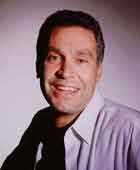
(1959 - )
An elderly Soviet officer,
medals littered across his chest and cascading
to his paunch; nine Italian men with deadpan
stares and motorcycle helmets clutched beneath
their arms; a group of Africans framed by
bare, stony earth and mountain; a somber
Chinese family of four, and black-coated
young men, side curls dangling from beneath
black hats, oblivious of the tall grass
and wild flowers surrounding them, arguing
points of Torah. What common thread runs
through these people’s
lives? It is this: they are all Jews, and
they are pieces of a puzzle assembled by
renowned photographer Frederic Brenner in
his new two-volume book called Diaspora:
Homelands in Exile, published by HarperCollins.
Consisting of 264 photographs
and commentaries by the world’s foremost
thinkers, the book is the most extensive
visual record of Jewish life ever created.
It is the result of a 25-year journey that
took Brenner to more than 40 countries on
five continents. “What I did,”
Brenner says, “is to deconstruct the
image of the Jew and to say there is not
one way of being a Jew, but as many ways
as there are of being a man or woman among
the nations.”
Brenner’s mission was more than an anthropological study of the
varied Jewish communities around the world; it was a personal search
for self. Born in Paris, Brenner
grew up in a totally assimilated Jewish family. He says, “I believe
one of the reasons I’ve been doing what I’ve been doing over
the years is to try to reclaim this part of my history that I didn’t
know. I think one does what he does because of the part of himself that
is the part of history that he ignores, not the part of history that
he knows.”
The part of his history that Brenner did know growing up in Paris was
that his mother’s family were Spanish
Jews who had found refuge in Algeria and had immigrated to France at the beginning of the 20th century. His
father’s family had left the Ukraine and Romania for France before
the Russian Revolution. Brenner says that his parents, who survived
the Holocaust, tried to distance
themselves from their Jewish heritage. “Most Jews tried to melt
within the French society after the war, either to assimilate or to
be as quiet as possible.”
Israel’s triumph in the Six-Day
War of 1967 provided a wakeup call after which Brenner’s parents
began to acknowledge their Jewishness. They sent him to a Jewish school,
which he describes as “a door opening.” But the door had only
widened a crack and Brenner wanted to fling it open and pass through
to explore what was on the other side. So at age 18, he joined a group
of friends and traveled to Israel.
His companions traveled around the country, but Brenner spent most of
his time in Jerusalem.
“I was fascinated by this ballet, this theater, taking place in
front of my eyes in Me’a She’arim,” he recalls. He had
no previous interest in photography but says, “I started to photograph
those people who had recreated in the heart of Jerusalem a shtetl like no other shtetl that exists today. I then spent about three years,
back and forth, between university and Israel to portray these people
who seemed to me the authentic Jews.”
Even though he was spending his spare time photographing the Jews of
Me’a She’arim, Brenner says, “I never wanted to become
a photographer.” Yet at age 22 he had his first solo exhibition
and won his first major awards: the Prix Niepce and the Prix du Salon
de la Photo.
“I know very little about my life,” he says. “I think
the mystery of life is a motor that makes me move, and maybe photography
has chosen me as much as I have chosen photography.”
It was a good choice. His work has been exhibited in galleries and museums
in Paris, New York, Tel
Aviv, Buenos Aires, Amsterdam and other major
cities. Among his published works are Israel with a text by A.B.
Yehoshua and Marranes with a contribution by Y.H. Yerushalmi.
A book he published in 1996, Jews/America/A Representation, includes
group portraits of some 40 famous and powerful people who shaped American
and western culture in the 20th century. Framed against the New York
skyline—literally framed in the elaborate gilded picture frames
in which you find old masters at a museum—are Itzhak Perlman, Betty
Friedan, Norman Mailer, Arthur Ochs Sulzberger, Ruth
Bader Ginsburg, Barbra
Streisand, Arthur Miller, Saul Bellow, Billy Wilder,
Carl Sagan and other Americans who Brenner selected as men and women
who have redefined their fields. “Of Philip Roth,” Brenner
says, “you can say there is before and after Philip Roth. Of Steven
Spielberg, you can say there’s before and after Steven Spielberg.”
Steven Spielberg is among the prominent Americans who have supported
Brenner’s projects. “I was lucky enough to meet people in
New York and on the West Coast who believed in my dreams and who gave
me the means for 25 years to achieve them. If it hadn’t been for
Jews in the U.S., I would never have been able to create these portraits
of my people.”
Brenner has produced these portraits the way a painter would. His subjects
are carefully posed: In the Vatican, Jewish vendors bearing their wares
of Christian souvenirs gaze into the camera flanked by the colonnade
of the Piazza San Pietro against the backdrop of the Basilica; in front
of and on the steps of a Miami synagogue,
we find a band of—are they Hell’s Angels? No, they are Jews
with cut-off tee shirts and tattoos, astride Harley-Davidsons; a gaggle
of New York psychoanalysts literally pushed to the wall by an enormous
analyst’s couch; four survivors from Salonika display their tattooed arms in the camera’s face—three vertical
lines and one horizontal, a vision that came to Brenner in a dream.
(Three men hold an arm out, its fist clenched; their expressions are
angry and unforgiving. The fourth uses his arm to cradle a face that
reveals a depth of sorrow beyond imagination with no trace of anger.)
The images that Brenner composes are disturbing, funny, moving and challenging.
But he sees these portraits as no more unnatural in composition than
our own choices of how we represent ourselves to other people.
“Whenever you speak of natural, it’s already cultural,”
he says. In addition, even a photojournalist who is capturing a subject
in the moment is making choices as to how we see that subject. The photographer
selects how and where to shoot and that assigns a particular meaning
to the end result. We think of this as natural, rather than composed,
but Brenner says, “The photographer often doesn’t realize
how much he’s affected by so many choices that have been deeply
internalized. I believe that each photojournalist should re-invent the
rules of photojournalism.”
Brenner’s sees life as theater. “It’s a big stage and
I’m just staging the life. I am only doing with people what they
do in their everyday life, only more so. It’s not by being objective
that you create a document, it’s by being subjective and accepting
and assuming. Photography is a long, on-going conversation—with
myself and with the people that I photograph. And I need the person
that I photograph to collaborate with me. I’m really a midwife
for the person that I photograph. And the person that I photograph is
a midwife for me. I know where I want to go, but I know that the place
where the person that I photograph will lead me is a much better place.”
The photographs should also lead the viewer to find his or her own place,
which is why Brenner shoots in black and white. He believes that less
is more. The lack of color leaves space to enable viewers to undertake
their own journeys.
The variety of cultural and social background, size, shape, features
and color of the Jews in his new book is amazing. It renders laughable
the concept that someone can “look Jewish.” And it challenges
anyone who thinks they have the answer to the divisive question, “Who
is a Jew?”
Brenner says, “This book shows such a large spectrum of expressions
and representations of Jews that I believe this book could enable people
to understand the extreme fluidity of identity. It could tell people
that maybe you can become the Jew that you want. All identities are
invented. Why cannot you become who you want to be as a Jew? When Jews
try to freeze a definition of themselves, they are already negating
the fluidity of their own identity.”
Jews, he reminds us, are descended from Abraham, an idol breaker, a
man who created a new identity, who metamorphosed from Abram to Abraham
when he followed the Biblical injunction: Lech lechah (Go forth). Leave
your land, your kindred, and the house of your father, and go to the
place that I will show you. “This is a permanent movement,”
Brenner says. “Life is only about movement. And I wanted to show
who these people are, like Abraham, who have re-invented themselves.
Non-Jews and Jews alike should understand that Jewish identity cannot
be frozen, cannot be petrified. This identity is about becoming. Jews
don’t exist, they become.
“I believe that what Jews have in common is their differences,”
Brenner continues. “I spent 25 years going around the world from India to Sarajevo, from Rome to New York, from Beijing
to Buenos Aires, and to Morocco and Ethiopia trying to understand
what makes a people. I really see these portraits as a puzzle and each
fragment is necessary and indispensable. Each place enabled me to express
a part of myself and a part of what the Jewish people are.”
The search began in Jerusalem. “Twenty-five years later I understand
that Me’a She’arim was, in fact, the matrix of my entire project.”
When he first encountered them, he believed that the Jews of Me’a
She’arim were “the beginning and the end of Judaism.”
But Brenner wanted to understand the diffusion of Jewish identity. Today,
he says, “I believe we all are woven of so many threads that in
each of us there are so many voices that speak. We just don’t have
the courage to listen.”
According to Brenner, the refusal to acknowledge and embrace our differences
leads to ideology and fundamentalism. “While this project is, of
course, about Jews,” he says, “it’s really a lesson of
pluralism. It’s really about asking, ‘Do you listen to all
these voices that speak within you, even when they are dissonant?’
And from that point of view, I believe that when I photographed Yemenite
Jews or Ethiopian Jews or Jews in Sarajevo, I was not photographing
somebody else. I was photographing a part of myself.”
Brenner’s book is a celebration of diversity, a study of a people
that is all-inclusive. That is one reason Brenner would like to see
it brought out in Israel, as well as in the U.S., France, Germany,
Holland and England, where
it is now in publication. Translating the book into Hebrew “would enable people to really reclaim the many fragments of
their history that they have been deprived of—that have been ignored.”
He lays the blame on the way Jewish history has been chronicled in the
20th century. “It has been written largely from a very white, western, Ashkenazi point of view,
to the extent that whole pages of our history have been entirely buried.”
He cites a history book used in Israeli schools. “Of its 264 pages,
only four are devoted to Oriental Jews and Sephardim. So in this
way, my book is really rehabilitating many of these groups who have
lived on the fringe of history, on the fringe of our memory.”
A comprehensive visual account of where and how Jews live, Brenner’s
book assigns no pre-eminence to any one community. Home for Brenner
is Paris where he lives with his wife, Myriam Tangi, a poet and painter,
and his two teenage daughters. But, he says, “I don’t believe
that the journey of my people within the French nation is more important
than the journey of my people among the German, Italian, Yugoslavian
or Yemenite nations. I believe that each of these dwellings has enabled
us to extract very different types of potentialities. And the very notion
of Klal Yisrael, the community of Israel, is made of all these many
fragments. It is a puzzle that implicitly supposes the interdependence
of these fragments.”
Not just Eretz Yisrael, but the
Diaspora as well is a calling for the Jewish people, says Brenner. “Again,
Lech lechah—Go forth. Leave your land, your kindred and the house
of your father, and go to the place that I will show you. But the place
is never named. It’s as if it belonged to each of us to name it.
And from this point of view, I never saw the Diaspora as a curse but
truly as a blessing, as a vocation.”
History, he believes, has unfolded in a way to enable the Jewish people
to accomplish this vocation. “I believe that what Jews have in
common is the experience of dispossession, dispersal, whether chosen
or forced.” This dispersion is not a passive experience. It is
an active encounter that benefits humanity. Spread out among the nations,
Jews have absorbed knowledge and culture from their hosts while enriching
them with their own values and traditions. Brenner says, “It appears
to me that the Diaspora is this incredible metaphor how we have been
fertilized and how we are fertilizing in return.”
After more than 5,000 years, the Jewish people are still a vibrant presence
in the Diaspora and in their homeland. “Who are we?” Brenner
asks. “Who are we, these people who are still alive, who are still
here after more than 5,000 years, still an enigma to the nations and
still an enigma to ourselves?”
Nations do not like enigmas, Brenner says, and he sees Purim as the
ultimate metaphor for the Jewish presence among the nations. While Purim
recounts persecution and the threat of extinction, it is, after all,
a story of survival and triumph. He believes his photographic odyssey
rebuts a culture of victimhood.
“I would say it took me 23 years to come back to Europe, to the
very place where I was born, and maybe because intuitively I knew that
there’s no way one can win with whatever touches death. It took
me all those years to deal with those subconscious injunctions passed
on to me from my grandfather to my father to me about the episode of
the Shoah in my own family.” Brenner believes his photographs offer
incontestable proof that, “We are not the children of the Shoah. We are a children of a much deeper tradition which doesn’t
surrender to Death. While the very large majority of Jews and non-Jews
alike in our generation know how Jews died, my book—this photographic
journey —is about how Jews live. And this is another injunction
in the Bible: “I have placed in front of you life and death, and
you will choose life.”
Sources: Article written by Myra Cohen, courtesy of Lifestyles |