Dennis Gabor
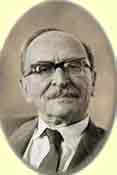
(1900 - 1979)
Dennis Gabor was born in Budapest, Hungary on June 5, 1900.
Gabor was educated at Budapest and Berlin.
He received his diploma at the Technische Hochschule Berlin in 1924,
and Dr.-Ing. in 1927. After graduation, Gabor joined the Siemens &
Halske AG. Having fled from Nazi
Germany in 1933,
Gabor was invited to England to work at the development department of the British Thomson-Houston
company in Rugby, Warwickshire.
In 1947, whilst working there he invented holography,
an achievement for which he later received the Nobel Prize in Physics
in 1971. Holography is the science of producing holograms, an advanced
form of photography that allows an image to be recorded in three dimensions.
Holography however did not become commercially available until the introduction
of the "laser" in 1960. Gabor also researched how human beings
communicate and hear; the result of his investigations was the theory
of granular synthesis, although Greek composer Iannis Xenakis claims,
that he was actually the first inventor of this synthesis technique
(Xenakis, Formalized Music, preface xiii).
In 1948, Gabor moved from Rugby to the Imperial College
in London and, in 1958, became professor of Applied Physics until his
retirement in 1967.
In addition to being awarded the Nobel
Prize, Gabor became a Fellow of the Royal Society of London in 1956,
and an Honorary Member of the Hungarian Academy of Sciences in 1964.
Gabor died in London on February 9, 1979.
Sources: Wikipedia.
Picture courtesy of: National
High Magnetic Field Laboratory |