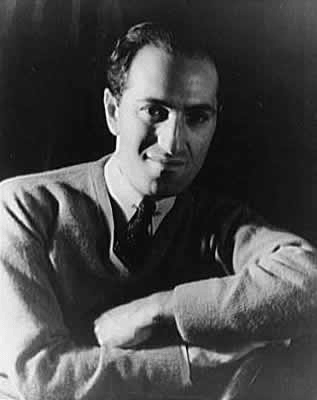
George Gershwin and his
older brother, Ira, elevated the Broadway musical to new and distinctive
heights. George Gershwin also composed popular music and jazz for classical
concert halls.
Gershwin was the son of Morris and Rosa, nee
Bruskin, Gershwin. He was born on September 26, 1898, in Brooklyn,
New York. When the Gershwins bought a piano for Ira, George monopolized it.
He took piano lessons and was introduced to classical music.
Gershwin wrote his first song in 1913. At the age of 15, he quit
school to become a song plugger. In 1919, he completed his first score
for the Broadway musical La, La Lucille. During the same year, he
teamed up with Irving Caesar to write Swanee. Al Jolson heard
Gershwin play Swanee at a party and put it into his Broadway show. It
became an overnight hit and rocketed Gershwin to a new status in the
musical world.
Gershwin worked with his brother to create the Broadway musical Lady be Good in 1924. In the same year, he composed the concerto Rhapsody in Blue for bandleader Paul Whiteman to use in a concert to
demonstrate the versatility of contemporary, popular music. Rhapsody in Blue was a hit that remained most associated with the Gershwin name.
George and Ira Gershwin wrote many successful Broadway musicals, including Oh, Kay! (1926), Funny Face (1927), Strike Up the
Band (1930), Girl Crazy, (1930), and Of Thee I Sing (1931).
The Gershwin brothers wrote successful individual songs that are
still popular today. Some of these hits are Embraceable You , I'll Build
a Stairway to Paradise , The Man I Love , Summertime, I Got Rhythm and A Foggy Day. When not writing for the stage, George and Ira
Gershwin were busy writing music for the movies. Some of their many
hits were Shall We Dance and Damsel in Distress (both in 1937).
George Gershwin was always thinking about his serious compositions. One of his successes was Concerto in F (1925). After traveling
through Europe, he wrote An American in Paris (1928). He was disappointed when his Second Rhapsody and Cuban Overture (both in 1932)
were not well received.
Gershwin's ambition was to compose a jazz opera about black
Americans. When he read DuBose Heyward's best-selling novel Porgy he knew that the story was the ideal vehicle to use to write his opera.
Gershwin felt that all modern jazz was built upon the rhythms and
melodic turns and twists that came directly from Africa. Porgy and
Bess opened in New York to mixed reviews on October 10, 1935. Sponsored by the State Department, the American National Theater and Academy performed the opera on tour in Europe and Africa during 1954 and 1955. After the tour, the opera was performed in the Eastern
Bloc countries and received rave reviews.
While performing his Concerto in F in concert with the Los Angeles Philharmonic in February 1937, Gershwin had a momentary mental lapse. This was the beginning of a series of headaches and feelings of dizziness. On July 11, 1937, he was operated on for a brain tumor
and died.
Gershwin, the son of Jewish immigrants, left America a legacy of
rich, melodic music.