George Gershwin
(1898 - 1937)
Early in life, George
Gershwin (1898-1937) frequented the Yiddish theaters on Second Avenue
in New York's Lower East Side and was much taken with the music of Joseph
Rumshisky. In 1915, Boris Thomashevsky, reigning star of the Yiddish
Theater, invited Gershwin and Sholem Secunda to collaborate on a Yiddish
operetta. Gershwin was willing, but Secunda refused to join with a young,
musically untrained, publishing-house pianist. Later in life, when he
was already a successful writer of popular songs, Gershwin signed a
contract with the Metropolitan Opera to write an opera based on Ansky's Dybbuk and was ready to go to Europe to study Jewish music,
but having learned that the rights to the play had already been given
to Ludovico Rocca, he withdrew
Gershwin's idiom was the American scene and its music.
Beginning with jazz and popular songs, he broadened his talents thematically
and musically, until they culminated in his greatest work, the opera
Porgy and Bess (1935). In the vast Gershwin Collection in the
Library, there is but one composition on a "Jewish theme," the sprightly
ditty, Mischa, Yascha, Toscha, Sascha, of which Gershwin biographer
Charles Schwartz tells:
a humorous takeoff on the names of four famous Russian violinists:
Mischa Elman, Jascha Heifetz, Toscha Seidel and Sascha Jacobsen. George
and Ira [Gershwin] had originally written this tune around 1921. Gershwin
frequently sang and played it at parties, particularly when any of
the violinists who inspired the title was present.
The virtuoso violinists of this song title are Elman, Heifetz, Seidel, and Jacobsen, Russian Jewish
violinists all, who made their way to America. The humorous lyrics of Mischa, Yascha, Toscha,
Sascha, include "Dear Old Fritz"-Kreisler, that is, who was widely thought to be Jewish. Lyricist
Ira Gershwin has the four proclaiming:
We're not high brows,
we're not low brows ...
we're He-brows ...
A signed photo of Kreisler accompanies the holograph manuscript of
this humorous song now in the Gershwin Collection.
George and Ira Gershwin, Mischa, Yascha, Toscha, Sascha. n.d. Music Division.
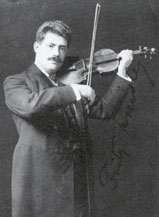 |
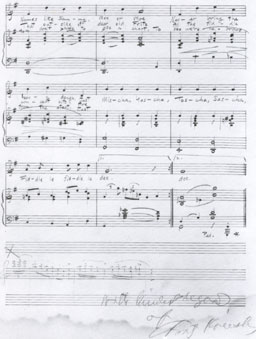
The lyrics add one more name to the four, "dear old
Fritz," meaning Fritz Kreisler, who must have been at a party where
it was sung. Among Gershwin's papers is a copy of part of the original
manuscript of the song and on the page where Kreisler is mentioned,
the violinist signed, "with kindest regards of Fritz Kreisler." Accompanying
it is a signed photograph of the virtuoso with his famed violin. One
refrain is:
We're not high-brows, we're not low brows,
Any one can see,
You don't have to use a chart,
To see we're He-brows from the start....
Mischa, Yascha, Toscha, Sascha.
The Gershwins refer, of course, to the unusual number
of Jews among the world's greatest violin virtuosos, especially the
Russian-born students of the great violin teacher, Leopold Auer, to
whom due credit is given in the song.
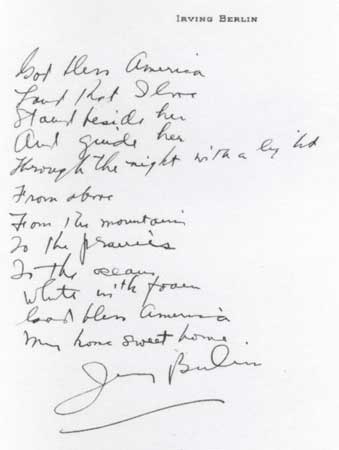
To express his gratitude to President Dwight D. Eisenhower for conferring upon him a special
gold medal, Irving Berlin sent a signed holograph copy of the words of the song that has become
a second national anthem, "God Bless America."
Irving Berlin, "God Bless America." n.d. Music Division.
 |
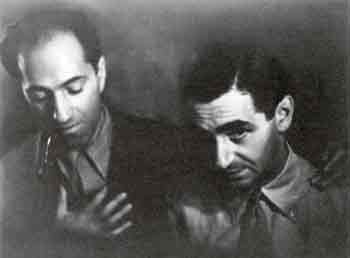
One of George Gershwin's early jobs was transcribing
the music of the songs Irving Berlin was composing, a craft that America's leading writer of popular songs
never mastered. In 1917, Abraham
Cahan already has his fictional immigrant millionaire cloak manufacturer
speak in envy (the obvious reference is to Irving Berlin) of the "Russian
Jew who holds the foremost place among songwriters and whose soulful
compositions are sung in almost every English-speaking house." Of the
1,500 songs Berlin wrote, perhaps the best known is "God Bless America."
When he received a special gold medal from President Eisenhower for
composing it, Berlin wrote the words on his personal stationery and
sent them to the Library of Congress.
God bless America
Land that I love
...
God bless America
My home sweet home.
Irving Berlin.
For America it has become a second national anthem.
One of George Gershwin's early jobs was to transcribe Irving Berlin's songs to the musical page.
The enormously prolific Berlin fashioned the words and music for some fifteen hundred songs,
but never acquired the skill of actually setting down the musical notes on paper.
George Gershwin and Irving Berlin. Music Division.
 |
Sources: Abraham J. Karp, From
the Ends of the Earth: Judaic Treasures of the Library of Congress,
(DC: Library of Congress, 1991).
|