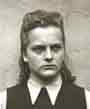
During World
War II Irma Grese was the most notorious of the female Nazi war
criminals. She was born on October 7, 1923, to a agricultural family
and left school in 1938 at the age of 15. She worked on a farm for six
months, then in a shop and later for two years in a hospital. Then she
was sent to work at the Ravensbrück Concentration Camp.
She became a camp guard at the age of 19, and, in March
1943, she was transferred to Auschwitz.
She rose to the rank of Senior SS-Supervisor in the autumn of 1943,
in charge of approximately 30,000 women prisoners, mainly Polish and
Hungarian Jews. This was the second highest rank that SS female concentration camp pesonnel
could attain.
After the war, survivors provided extensive details
of murders, tortures, cruelties and sexual excesses engaged in by Irma
Grese during her years at Auschwitz and Bergen-Belsen. They
testified to her acts of pure sadism, beatings and arbitrary shooting
of prisoners, savaging of prisoners by her trained and half starved
dogs, to her selecting prisoners for the gas
chambers.
She habitually wore heavy boots and carried a whip
and a pistol. She used both physical and emotional methods to torture
the camp's inmates and enjoyed shooting prisoners in cold blood. She
beat some of the women to death and whipped others mercilessly using
a plaited whip.
The skins of three inmates that she had had made into
lamp shades were found in her hut.
In January 1945, she returned to Ravensbrück Concentration Camp before being transferred to Bergen-Belsen in March.
After the Kommandant of Bergen-Belsen,
Josef Kramer, Irma Grese was the most notorious defendant in the Belsen
Trial, held between September 17 and November 17, 1945. Grese was
convicted and sentenced to be hanged. She was executed on December 13,
1945.