Heinz Guderian
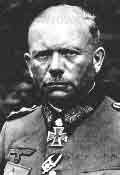
(1888 - 1954)
Heinz Guderian, the son of an army officer, was born
in Kulm, Germany, on 17th
June, 1888. He joined the German Army and was commissioned in the Jaegers
in 1908 where he became a communications specialist. He fought in the
First World War and afterwards was a member of the right-wing Freikorps
group.
In 1922, Guderian became Inspector of Motorized Troops.
He began to study the experience of tanks during the war and was greatly
influenced by the ideas of British military writers such as Basil Liddell Hart and John Fuller. As a result
of his studies he was employed as a teacher of tank tactics.
Guderian was appointed commander of a motorized battalion
in 1930. While in this post he developed one of companies as a tank
scout company, one as a tank company and one as an anti-tank company.
Guderian also developed a radio-communication system that enabled communication
between tank officers.
In 1934, Guderian was appointed chief of staff of
the Motorized Troops Command and, the following year, he took over the
2nd Panzer Division. The other two panzer divisions were commanded by
generals whereas Guderian was only a colonel.
In Feburary 1938, Guderian was promoted to lieutenant
general and the following month was involved in the occupation of Austria.
Later that year, Adolf Hitler appointed Guderian to the new post of Chief of Mobile Troops. However
Guderian had difficulty persuading his senior officers about the importance
of tank warfare in any future conflict. Franz
Halder, the Chief of General Staff told Guderian that the infantry
would always play the most important role in any future war.
Guderian led the attack on Poland in September 1939 and his rapid success created shockwaves throughout
the world. Despite this easy victory Guderian objected to the planned
Western Offensive. When Hitler ordered the plan to go ahead, Guderian,
who served under General Paul von Kliest, attacked at great speed and
crossing the crossed the Meuse near Sedan on May 14.
Kleist now ordered Guderian to halt until the arrival
of General Siegmund List and his 12th Army. Guderian disagreed with
Kleist's view that the panzers needed the support of the infantry. After
a heated argument with Kleist, who had the support of his superiors,
Gerd von Rundstedt and Heinrich von Brauchitsch, on May 17, 1940, Guderian
threatened to resign. Kleist responded by sacking Guderian.
Adolf Hitler was unwilling to lose this brilliant
commander and General Siegmund List was ordered to intervene and managed
to persuade Kleist that Guderian should return to duty. Guderian got
his way and Kleist's troops rushed ahead and reached the English Channel
at Abbeville on May 21, 1940.
Boulogne was taken on May 23, but later that day Hitler
called a halt arguing that the rapid advance was jeopardizing the whole
campaign. Kleist supported Hitler's decision but Guderian was furious.
He rightly argued that this stopped the German Army cutting off the
escape of the British Expeditionary Force (BEF) from Dunkirk.
Promoted to general for his achievements in France,
Guderian led the 2nd Panzer Group during Operation Barbarossa. Working
closely with Herman Hoth, Guderian's troops took Minsk and Smolensk.
In July 1941, he moved into the Ukraine where he captured Kiev before
moving on Moscow.
Guderian was shocked by the stout resistance of the
Red Army and, as the severe Russian winter set in, he made a limited
withdrawal to better defensive ground. Guderian then returned to Germany
where he argued with Adolf Hitler about the tactics being employed.
After further disagreements with General Fedor von Bock and General
Gunther von Kluge, Guderian was dismissed from office on December 25,
1941.
After the defeats at El Alamein and Stalingrad, Hitler
decided to recall Guderian and, on March 1, 1943, he became commander
of Germany's Armoured Troops. Guderian was unable to repeat earlier
successes and, in July 1943, lost one of the largest tank battles in
history at Kursk.
On July 21, 1944, Guderian replaced General Kurt Zeitzler
as commander of the General Staff. As a result of the July
Plot Guderian demanded the resignation of any officer who did not
fully support the ideals of the Nazi
Party. Over the next few months Guderian sat with Gerd
von Rundstedt and Wilhelm
Keitel on the Army Court of Honour that expelled hundreds of officers
suspected of being opposed to the policies of Adolf Hitler. This removed
them from court martial jurisdiction and turned them over to Roland
Freisler and his People's Court.
Although willing to carry out a purge of the German
Army, Guderian continued to argue with Adolf Hitler over strategy and
on March 28, 1945, he was dismissed from office.
Guderian was captured by the U.S. Army on May 10,
1945. Despite claims in the Soviet Union and Poland that Guderian was
a war criminal, he was released from captivity on June 17, 1948. Heinz
Guderian died on May 17, 1954.
Sources: Spartacus
Educational |