Gerd von Rundstedt
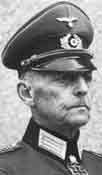
(1875 - 1953)
Gerd von Rundstedt, the son of a military officer,
was born in Aschersleben, Germany,
on December 12, 1875. He joined the German Army and served throughout
the First World War. By 1918 he had reached the rank of major and was
chief of staff of his division.
After the war, Rundstedt rose steadily in the small
100,000 man army and, in 1932, was appointed commander of the 3rd Infantry
Division. Later that year he threatened to resign when Franz
von Papen declared martial law and ordered his troops to eject members
of the Social Democratic Party from state government offices. However,
Rundstedt eventually agreed to carry out the task.
In February 1934, Rundstedt joined with General Wilhelm
Leeb to block the pro-Nazi Walther von Reichenau who General Werner
von Blomberg wanted to succeed Kurt Hammerstein-Equord as head of the
German Army. He also tried to protect General Werner von Fitsch when
he was ousted after false claims were made about his sexuality.
Rundstedt was unhappy with the growing power of Adolf
Hitler over the army and resigned from office on October 31, 1938.
Although 64 years old, Rundstedt was recalled to the army with the outbreak
of the Second World War and, in September 1939, led Army Group South
into Poland.
In 1940, Rundstedt was quick to see the merits of
the plan devised by Erich von Manstein to invade France.
With his support, the Manstein Plan was eventually used as part of the
Western Offensive. Rundstedt led seven panzer divisions, three motorized
divisions, and 35 infantry divisions during the invasion of France.
By May 14, 1940, the German tanks led by General
Heinz Guderian had crossed the Meuse and had opened up a a fifty-mile
gap in the Allied front. Rundstedt had doubts about the aggressive tactics
of Guderian and argued that his tanks should halt and wait until infantry
divisions could catch up. Rundsteadt did not fully understand Blitzkrieg
tactics and wanted a conventional assault on the British Expeditionary Force (BEF). Adolf Hitler agreed and this decision stopped
Guderian cutting off the escape of the British and French troops from
Dunkirk.
Rundstedt was promoted to field marshal on July 19,
1940 and took part in the planning of Operation Sealion. When the invasion
of Britain was called off Rundstedt took control of occupation forces
and was given responsibility to develop the coastal defences in Holland, Belgium and France.
In June 1941, Rundstedt took part in Operation Barbarossa
when as commander of Army Group South he led 52 infantry divisions and
five panzer divisions into the Soviet Union. Unlike those forces led
by General Wilhelm Leeb and General Fedor von Bock, Rundstedt made slow
progress during the first few weeks of the campaign.
In September 1941, Rundstedt took part in the capture
of Kiev where 665,000 Russian prisoners were taken. After this he moved
east to attack Kharkov and Rostov.
Rundstedt strongly opposed continuing the advance
into the Soviet Union during the winter. He advised Adolf Hitler to
call a halt but his views were rejected.
At the beginning of November 1941, Rundstedt had a
heart-attack. However, he refused to be hospilized and continued the
advance and reached Rostov on 21st November, but a Red Army counter-attack
forced the Germans back. Hitler was furious and blamed Rundstedt for
the defeat. When Rundstedt demanded he should be allowed to withdraw,
he was sacked and replaced by General Walther von Reichenau.
Adolf Hitler recalled Rundstedt to duty in March 1942
and was sent to France where he was given reponsibility of defending
the Atlantic coast. Known as the Atlantic Wall, Rundstedt organized
the building of permanent fortifications with huge naval guns along
1,700 miles of coastline.
After the Normandy landings, Rundstedt urged Hitler
to negotiate a peace settlement with the Allies. Hitler responded by
replacing Rundstedt with General Gunther von Kluge.
As a result of the July
Plot, Rundstedt agreed to join Heinz
Guderian and Wilhelm Keitel on the Army Court of Honour that expelled hundreds of officers suspected
of being opposed to the policies of Adolf Hitler. This removed them
from court martial jurisdiction and turned them over to Roland
Freisler and his People's Court.
Rundstedt was captured by the U.S. 36th Infantry Division
on May 1, 1945. While being interogated, he suffered another heart-attack.
He was taken to Britain where he was held in captivity. During this
period, he was interviewed by several military historians including
Basil Liddell Hart and Brian Horrocks .
Gerd von Rundstedt was released in July 1948, and
lived in Hanover until his death on February 24, 1953.
Sources: Spartacus
Educational |