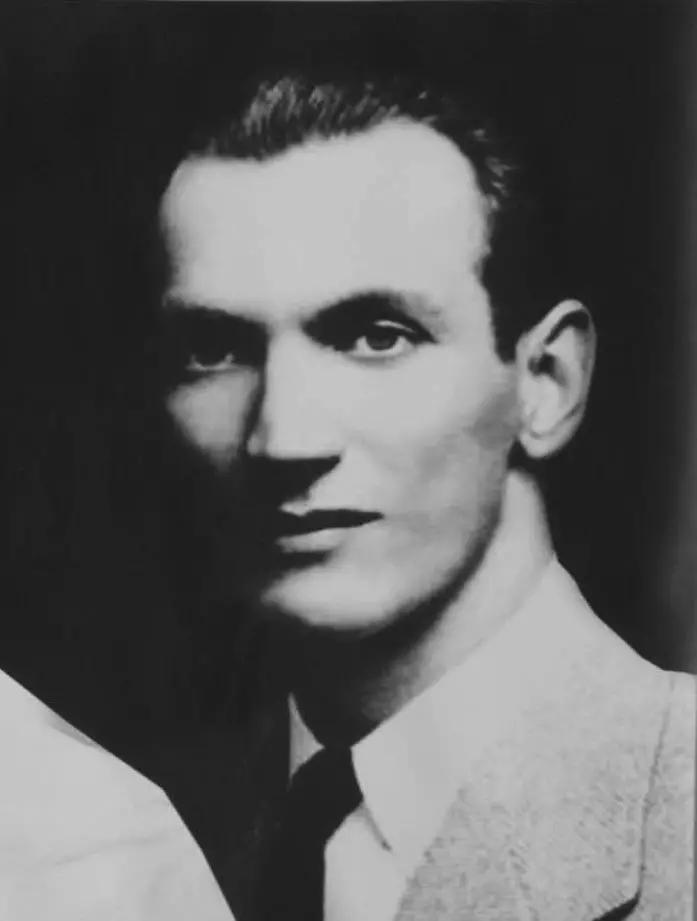
Jan Karski was a Polish World War II resistance movement fighter and later a university professor.
He was born April 24, 1914, in Lodz, Poland. He received a masters
degree in Law and Diplomatic Science at the University of Lwow in 1935
and then served in various diplomatic posts in Germany, Switzerland, and Great
Britain between 1936 and 1938.
At the outbreak of World
War II in 1939, he became a POW of the Red Army. Two months later
he escaped and returned to occupied Poland, joining the Underground
Polish Army. As a member of the Polish underground resistance movement
in World War II, Karski
repeatedly crossed enemy lines to act as a courier between his occupied
nation and the West. Prior to his last departure from Poland, he was
smuggled into the Warsaw
Ghetto by the Jewish underground in order to witness the horrendous
conditions and report to the outside world.
After touring the Warsaw Ghetto, he donned a disguise
to enter a Nazi concentration
camp in Eastern Poland. There he witnessed mass murder.
In November 1942, he delivered an impassioned plea
on behalf of Poland’s
Jews to top Allied officials in London. On July 28, 1943, in a lengthy
White House meeting, he told President
Franklin D. Roosevelt about the extermination of the Jews of Europe.
Jan Karski — a young, Roman Catholic Pole —
tried to stop the Holocaust.
His mission failed.
After World
War II, he came to the United States and, in 1952, he received his
Ph.D. from Georgetown University. Two years later, he became a U.S.
citizen. After receiving his doctorate, Karski taught at Georgetown
for 40 years, focusing on East European affairs, comparative government
and international affairs. He also went on numerous international lecture
tours, sponsored by the State Department and testified before Congress
on numerous occasions about Eastern Europe. He received honorary doctorates
from Georgetown University, Oregon State University, Baltimore Hebrew
College, Hebrew College of America, Warsaw University, Marie Curie-Sklodowska
University, and Lodz University. In 2002, a monument of Karski was unveiled
at Georgetown University.
Karski was made an honorary citzen of the State
of Israel and a tree was planted bearing his name at Yad
Vashem’s Valley of the Righteous
Among the Nations. In 2012, the Polish Senate posthumously honored
Karski as a World War II hero for working to reveal details of the Nazi
genocide in Poland. U.S. President Barack
Obama will posthumously honor Karski with the Presidential Medal
of Freedom, the nation's highest civilian honor, presented to individuals
who have made especially laudable contributions to the security or national
interests of the United States, to world peace, or to cultural or other
significant public or private endeavors.