Isaac Leeser
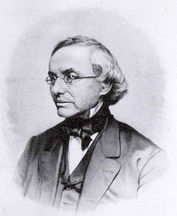
(1806 - 1868)
Born in Neunkirchen, Westphalia, Prussia, December
12, 1806, Isaac Leeser was orphaned at an early age. He received his
secular education at a gymnasium in Munster, and his religious
tutelage from Rabbis Benjamin Cohen and Abraham Sutro. At age
eighteen, Leeser joined his uncle Zalman Rehine in Richmond,
Virginia, where he began to prepare for a business career while
simultaneously assisting the local religious functionary, the
Reverend Isaac B. Seixas. An article Leeser published in defense of
Judaism brought him to public attention and also brought in 1829 an
invitation to occupy the pulpit of Philadelphia's congregation Mikveh
Israel. During the next forty years Isaac Leeser was the most
prolific American Jewish writer and the most creative Jewish communal
architect.
 Instruction in the Mosaic Religion,
Philadelphia, 1830. General Collection.
Instruction in the Mosaic Religion,
Philadelphia, 1830. General Collection. |
Leeser brought with him to Philadelphia his
translation of J. Johlson's Instruction in the Mosaic Religion.
He had it published there in 1830, appropriately dedicated to his
uncle Zalman Rehine. The book is a catechism published in Germany and
translated and adapted by Leeser for "the instruction of the
younger ... of Israelites of both sexes, who have previously acquired
some knowledge of the fundamental part ... of their religion."
Leeser undertook its publication because there was a great scarcity
of elementary textbooks for Jewish children. It is significant that this Instruction in
the Mosaic Religion, Leeser's first issued work, is a
textbook of religious instruction for the young, for though
Leeser attained distinction as an author, translator, editor, and
a national leader of the American Jewish community, he considered
himself, first and foremost, an educator.
In 1838 he issued The
Hebrew Reader and a year later, Catechism for Younger Children.
The Reader, initially prepared for a newly established Sunday
School in Philadelphia, was, in the words of Leeser, "used over
a large surface as a first book of instruction in Hebrew,"
attaining a seventh edition in 1873.
Of the Catechism Leeser wrote:
If any event in my life can afford me some
degree of satisfaction, it is the consciousness of having added one
contribution ... to satisfy the demand for information in the ways
of the law of God. And it will be to me a far greater gratification
than any public applause, could I be convinced that the thoughts
offered in this guide to the young Israelites has led a few as
sincere worshippers to the house of our God.
The Library has copies of both the Reader and the Catechism which Leeser himself had sent at the time of
publication to establish his copyright. The Catechism is
dedicated to "Miss
Rebecca Gratz, Superintendent of the Sunday-School for Religious
Instruction of Israelites in Philadelphia," whom Leeser credits
with the founding of the school. But it was he himself who was the
instigator of the school, for while still in Richmond he had,
together with the Reverend Isaac B. Seixas, founded such a school,
which met "with but partial success." As early as 1835,
Leeser urged the establishment of a Jewish all-day school; and, in
1846, the Hebrew Education Society of Philadelphia was founded,
chartered for "the establishment of a school or schools within
... Philadelphia, in which are to be taught the elementary branches
of education, together with the sciences, and modern and ancient
languages, always in combination with instruction in Hebrew language,
literature and religion."
 The Hebrew Reader, No. 1. The Spelling Book,
Philadelphia, 1838. General Collection.
The Hebrew Reader, No. 1. The Spelling Book,
Philadelphia, 1838. General Collection. |
Its charter also granted the right "to
establish ... a superior seminary of learning ... the faculty of
which ... shall have power to furnish to graduates and others the
usual degrees of Bachelor of Arts, Master of Arts and Doctor of Law
and Divinity." In 1867, Leeser was instrumental in establishing
the first rabbinical seminary in America, Maimonides College, which
survived its founder by only four years, having to close its doors in
1873.
While still in Richmond, Leeser began his literary
career with a defense of the Jews against an attack which first
appeared in the London Quarterly Review and was reprinted in a
New York newspaper. His works continued to involve him in polemics.
In 1834, he published The Jews and Mosaic Law, a defense of
the Revelation of the Pentateuch and of the Jews "for their
adherence to same." The book's twenty-six chapters show wide
reading in the contemporary religious literature. Leeser was aware
that just as he was reading works on religion written by Christians,
so too were many other young Jews. What was needed was a polemic
arguing for loyalty to the ancestral faith and adherence to its ways.
Leeser's Discourses, Argumentative and
Devotional on the Subject of the Jewish Religion (1837) were, as
the title page reports, "delivered at the Synagogue Mikveh
Israel, in Philadelphia, in the years 5590-5597 (1830-37). Its 590
pages are filled not only with sermons in the usual sense, but also
with scholarly essays on such themes as God, the Holidays, and
"The Messiah." An address on behalf of "The Female
Hebrew Benevolent Society" of Philadelphia emphasizes his
espousal of women's participation in Jewish communal enterprises. The
copyright copies of both books may be consulted in the Library, as
well as his liturgical and biblical publications. In 1845, he issued
an edition of the Pentateuch in five volumes, entitled The Law of
God, with Hebrew text, "edited and with former translations
diligently compared and revised by Isaac Leeser." Eight years
later, Leeser published a translation of the entire Bible, the first
translation of the entire Bible into English by a Jew. His
translation of the Sefardi prayer book into English was published in six volumes in 1837-38, and
a decade later, in 1848, appeared The Book of Daily Prayers for
Every Day in the Year According to the Custom of the German and
Polish Jews, which he edited and translated.
 Commemoration of the Life and Death of William Henry Harrison, Philadelphia, 1841. General Collection.
 |
Leeser founded and, for a quarter of a century
from 1843-68, edited the first Jewish periodical, The Occident.
(The Jew, which appeared in 1823-25, was merely a polemical
response to a missionary publication.) He organized the first Jewish
publication society and edited its publications. He inspired and
helped to found a foster home for Jewish children, a Jewish hospital,
and a union of charities. Nor can we ignore his contributions as an American clergyman, which may be glimpsed from two items in the Library's
collection: a pamphlet, Commemoration of the Life and Death of
William Henry Harrison, by Isaac Leeser, Philadelphia, 5601
(1841); and a letter from Leeser to President Lincoln, of August 21,
1862.
Leeser's funeral address is the first published
eulogy for a president by a Jewish cleric. One brief section gives an
idea of Leeser's democratic sentiments.
In the brief sketch we have just furnished of
the life and services of General Harrison, it will be perceived
that he passed through every stage of promotion, and that he rose
from a humble standard-bearer to the chief command of the army and
navy, and the presidency of the councils of his native land; and he
thus reached a station as high as human ambition can look for;
because the voluntary suffrage of a free people raising one of
their own fellow-citizens to the highest honour within their gift,
is a far more enviable distinction than a throne inherited by a
stripling from a royal ancestry, or acquired through violence by an
adventurous military chieftain.
As Secretary of the Board of Ministers of the
Hebrew Congregations of Philadelphia, Leeser wrote to Abraham
Lincoln: "Many Israelites are serving in the army of the United
States, and this city and vicinity being a locality where numerous
hospitals for the sick and wounded soldiers have been
established," he continues,
it is to be expected that not a few persons of
our persuasion will be brought hither in a condition to require
spiritual no less than bodily care. in fact two at least of our
persuasion have already died in the hospitals ... it has at our
last meeting been deemed highly expedient to have a Jewish chaplain
appointed by the President of the United States.
|
 |
In his capacity as Secretary of the Board of
Ministers of the Hebrew Congregations of Philadelphia, Isaac
Leeser wrote to President Lincoln on August 21, 1862 asking that
a Jewish chaplain be appointed to minister to the spiritual needs
of sick or wounded Jewish soldiers in military hospitals in
Philadelphia and its vicinity.
[Isaac Leeser to Abraham Lincoln, August 21, 1862., Manuscript
Division, Papers of Abraham Lincoln.] |
On the back of that letter is written:
Executive Mansion
Aug. 23, 1862
General:
The President directs me to refer the enclosed
communication to you with the request that you will favor him with
your opinion in regard to the legality and propriety of granting the
request of the Board of Hebrew Ministers.
- John Hay
The Surgeon General:
If possible the President would like this to be
done.
- JH 4 Sept. 62
The Surgeon General responds:
Respectfully returned to the President of the
United States.
The Surgeon General considers it both legal and
proper, that Chaplains of the Hebrew faith should be appointed in the
Army.
Sept. 5, 62
The following day John Hay sent Leeser the good
news, and on the president's behalf asked for the Board to
"designate the proper person for the purpose." The Board
chose the Reverend Jacob Frankel of Congregation Rodeph Sholom, who was
commissioned on September 12, the first rabbi to serve as a military chaplain in the United States.
Sources:Abraham J. Karp, From
the Ends of the Earth: Judaic Treasures of the Library of Congress,
(DC: Library of
Congress, 1991). Portrait of Isaac Leeser, published by I. Goldman
in 1868, the year of Leeser's death. Prints and Photographs Division.
|
