|
[By: Alden Oreck]
Jews first arrived in Brazil in the mid-15th century; today, the Jewish population is approximately 120,000 - the tenth largest Jewish community in the world. Although they make up around half of one percent of Brazil's population, the Jewish community is very active in several aspects of Brazilian
society. According Professor Anita Novinsky, a specialist on the Jews
at the University of Sao Paulo, "Brazil was made by the Jews."
- 1492 - 1655
- 1773 - 1916
- 1920's - 1970's
- Modern-Day Community
1492 - 1655
Jewish history in Brazil dates back to the time of
the voyages of Christopher
Columbus. Gaspar da Gama, a Jew by birth, but later kidnaped and
forcibly baptized, accompanied Portuguese admiral Pedro Alvares Cabral
when he landed in what is now Brazil in 1500, beginning a more than
500-year presence in the New World.
When the Inquisition in Portugal took hold in 1497,
Jews fled to places throughout the world, including Brazil. They arrived
in Brazil primarily as New Christians or Conversos (Jews converted to
Christianity), but many secretly practiced Judaism and began a colonization drive to settle on the land. Despite continued
persecution by the Brazilian Inquisition,
the New Christians successfully established sugar plantations and mills.
By 1624, approximately 50,000 Europeans lived in Brazil, with New Christians
making up a significant percentage. They were businessmen, importers,
exporters, teachers, writers poets, even priests. In that same year,
Dutch forces arrived in Brazil, taking over portions of northeast Brazil.
Dutch tolerance allowed for Jewish migration and the open practice of
religion. In 1636, Jews built the Kahal Zur synagogue in the Dutch capital of Recife.
In Dutch Brazil, Jews flourished in the sugar industry, tax farming
and slave trade. Jews often purchased slaves and resold them at great
profit. Those they kept often preferred to work for Jews because both Shabbat and Sunday were
rest days, whereas the Portugese only gave them Sunday off, and the
Dutch worked their slaves seven days a week.
In 1642, Rabbi Isaac Aboab da Fonseca, a well-known Amsterdam rabbi and scholar Moses Raphael d'Aguilar came to Brazil as spiritual leaders
to assist the congregations of Kahal Zur in Recife and Magen Abraham
in Mauricia. By 1645, the Dutch Jewish population peaked at 1,500, approximately
half of the European population there. Synagogue records show a well-organized
Jewish community with high participation, including a Talmud Torah (school),
a Tzedakah fund and
an overseeing executive committee.
Other Inquisition-fleeing Jews headed south to Sao Paulo. Little is
known what happened to them, some scholars suggest they assimilated
quickly, however, recent evidence has revealed Brazilian jungle tribes
who light candles on
Friday night and refrain from eating
pork.
In 1647, the Portuguese authorities arrested Isaac
de Castro for teaching Jewish rites and customs in Portuguese controlled
Brazil and sent him back to Portugal where the Inquisition sentenced him to death and burned him at the stake.
The Portuguese also started a nine-year war that successfully drove
the Dutch out of Brazil in 1654.
Portuguese anti-Jewish persecution
led to a mass immigration to places like Curacao and New York, where they laid foundations
for new Jewish communities, others returned
to Europe. Most who could not escape were
killed, but some became Crypto Jews, practicing Judaism in secret. They lived away from the authorities,
in the interior of Brazil, many becoming ranch
hands or cowboys. The persecutions, arrests,
confiscation of property and emigration of
the Jews greatly damaged the Brazilian economy
by bringing the manufacture and export of
sugar to a near standstill and seriously disrupting
trade between Portugal and Brazil. In 1655,
the Portuguese closed a major symbol of Brazilian
Jewry, the Kahal Zur synagogue. However, thanks
to the Safra banking family, the synagogue
re-opened in 2002 and now stands as the oldest
existing synagogue in the Americas, housing
a Jewish cultural center and hosting some
religious ceremonies.
1773 - 1916
In 1773, a Portuguese royal decree finally abolished
discrimination against Jews. They slowly filtered back into Brazil.
Almost 50 years later, in 1822, Brazil gained independence from Portugal,
and a stream of Moroccan Jews began arriving, and set up a synagogue in Belem (northern Brazil) called
Porta do Ceu (Gate of Heaven) in 1824 and later one in Manaus (on the
Amazon river). By World War I, Belem's Sephardi community of 800 people had its own charitable organizations and a social
club.
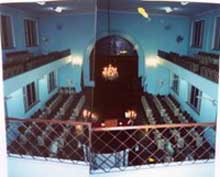 Manaus Synagogue
 |
In the last decade of the 19th century, European Jews
began discussing the idea of establishing agricultural settlements in
Brazil as an alternative to the unfavorable conditions in Europe. After
the 1891 expulsion of the Jews from Moscow, a close associate of Theodor
Herzl, Oswald Boxer went to Brazil and returned with a positive
report, but plans were abandoned because of Brazilian political strife.
The first agricultural settlement was finally established in 1902 by
the Jewish Colonization Association (JCA) in the Santa Maria area (southern
Brazil). Despite a 1903 pogrom in Bessarabia, only 37 Bessarabian families
were willing to settle in the experimental colony, which covered 13,388
acres. The 1904 farming season failed because of inexperience, insufficient
funds and poor planning. Although a cooperative headed by an experienced
teacher formed in 1907, the settlement continued to produce a fraction
of its capability. In 1926, the JCA reported that of the 122 families
that settled in the first colony, 17 remained, cultivating corn and
beans on only 326 acres. The unused land was then sold.
In 1909, the JCA bought another track of land covering
almost 94,000 acres in the Quatro Irmaos area, north of Santa Maria
and near a large-scale government development. Despite a more rigorous
selection process, the settlers once again failed. Administrative problems,
lack of agricultural facilities and the lure of city jobs doomed the
settlement. By November 1915, only 72 of the original 232 families remained
in the colony. World War I and a civil war, which was partially fought
on the colony's land drove out more settlers and by 1926, only 40 people
remained. In 1920, the JCA began selling some of the land to non-Jewish
settlers. In 1935, after a renewed settlement effort, 104 Jewish families
lived in Quaro Irmaos, only to be outnumbered five to one by non-Jewish
settlers.
The JCA led a third attempt at agricultural settlement in 1935 because
of deteriorating conditions in Germany.
However, as part of a strict immigration policy against Jews, the Brazilian
government refused to issue the settlers entry visas. The land was later
sold.
The settlers who abandoned the colonies set up rich
cultural communities in Brazilian cities. By World War I, approximately
7,000 Jews lived in Brazil. In Porto Alegre, capital of the southern
state of Rio Grande do Sol, the community opened a Jewish school in
1910 and established a Yiddish newspaper, Di Menshhayt ("Humanity") in 1915. Sao Paolo
was home to several philanthropic and cultural associations. In 1916,
the Jewish community of Rio de Janeiro formed an aid committee for World
War I victims.
1920's - 1970's
Almost 30,000 Western European Jews came to Brazil in the 1920s and,
by 1929, there were 27 Jewish schools. Despite a strict immigration
policy in the 1930s, more than 17,500 Jews entered Brazil. While immigration
enriched Brazilian Jewish culture, the wide array of Jewish customs
and beliefs, made it nearly impossible to unify them, despite attempts
by Rabbi Isaiah Raffalovitch of JCA.
Brazil began an assimilation effort in 1938 and closed
the Yiddish newspapers and
the Jewish organizations, both secular and religious. A wave of anti-Semitism followed, including several editions of the Protocols
of the Elders of Zion. Only after Brazil adopted a new, more democratic
constitution in 1945, did organized Jewish activities resume.
Brazil was the only independent South American country to send ground troops to fight for the allies during World War II. The Brazillian Navy and Air Force also participated, from mid-1942 until the war's conclusion. Their contribution to the fight against the Axis was primarilly Naval. The Brazillian Fluminense Football club raised money from their members and purchased a single-engine airplane to be given to the Brazilian Air Force to aid in the fight. The current President of the Fluminense Football club, said at a celebration at the club's headquarters in 2015, “I am very glad to see that the Jewish community, to which so many of our supporters belong, has decided to value the fact that Fluminense supported Brazil when it chose to fight on the Allies’ side against the Axis. This is part of our glorious past that must be remembered and honored.”
In 1947, Brazil voted for the partition
of Palestine and for the creation of a Jewish state at the United
Nations General Assembly. A Brazilian statesman, Oswaldo Aranha,
played a vital role in the adoption of the resolution. Brazil recognized Israel in February 1949 and opened
an embassy there three years later. In 1959, Brazil and Israel signed
the first of several agreements to cooperate in a variety of areas,
including culture, commerce, agriculture, science and industry.
In the late 1950s, another wave of Jewish immigration brought more
than 3,500 North African Jews to Brazil. By the 1960s, Brazilian Jewry
was thriving. In the 1966 parliamentary elections six Jews, representing
various parties, were elected to the federal legislature. In addition,
Jews served in state legislatures and municipal councils. In 1967, 33
Jewish schools were attended by more than 10,000 students. By 1969,
approximately 140,000 Jews lived in Brazil, mostly in the large cities:
Rio de Janeiro (50,000), Sao Paulo (55,000), Porto Alegre (12,000),
Belo Horizonte (3,000), Recife (1,600) and Belem (1,200).
Jewish communal life was uneventful throughout the
1970s, save some minor anti-Semitic activity by the right-wing Catholic organization Tradicao, Familia e
Propriedade (Tradition, Family and Property).
Modern-Day Community
Today, Brazil's rich cultural life includes several
Jewish publications as well as a weekly Jewish television program, Mosaico.
Author Moacyr Scliar has been published worldwide. Museums exhibit Jewish
history and art and efforts to preserve Brazil's Jewish history are
underway. The Center for Jewish Studies of the University of Sao Paulo,
the Federal and State Universities in Rio de Janeiro and the Marc Chagall
Institute in Porto Alegre sponsor lectures, conferences and academic
courses of Jewish interest. Jewish and Israeli film festivals are common
in Sao Paulo and Rio de Janeiro. Special commemorative and cultural
events are held in conjunction with Yom
Hashoah and Yom
Hatzmaut. Within Brazil's Jewish community are several Zionist organizations, youth groups, adult groups, and social clubs, including B'nai Brith, Hadassah
International, Pioneer Women, the World
Zionist Organization and the Jewish
Agency for Israel.
Like many other countries, Brazil's religious observance
encompass a wide spectrum, from liberal to orthodox with both strong Sephardi and Ashkenazi influences. Chabad-Lubavich has grown considerably in recent years with schools and synagogues in several major cities.
Politically, Jews have continued to play an important role. In 1994,
Jaime Lerner was elected head of Parana, a major industrial state, becoming
Brazil's first Jewish governor. In 1998, Dr. Eva Alterman Bay, a distinguished
professor, became the first Jewish woman to serve in Brazil's Senate.
Jews have also served in the Cabinet.
Professionally, Jews have made a tremendous impact on the Brazilian
economy. Jewish families own Brazil's two largest publishing and jewelry
companies, the sixth largest bank and are among the executives of several
other large corporations.
While Brazil's total population
exceeds 160 million people, the Jewish population
has stabilized at approximately 120,000. More
than 8,000 Brazilian Jews have moved
to Israel since 1948. There are more than
40 active synagogues,
several kosher supermarkets and a number of kosher restaurants.
The Confederacao Israelita do Brasil (CONIB),
founded in 1951, is the central body representing
the 12 federations (states) of Brazil, and
serves as an umbrella organization for more
than 200 associations involved in Zionist
activity, Jewish education, culture and charity.
Brazil's Jewish community has been on high alert since
the 1994 bombing of
the Jewish community headquarters in nearby Buenos Aires, Argentina,
but has suffered only isolated anti-Semitic attacks such as harassment, threats and vandalism. Intermarriage is
actually the greatest threat to Brazilian Jewry. Experts say the rate
is even higher than in the United States. Brazil's slumping economy
poses another challenge for the Jewish community.

Hebraica
|
Sao Paulo is home to 75,000 Jews, approximately half
of Brazil's Jewish population. Located on Rua Antonio Carlos 653 is
the Congragacio Israelita Paulista. This Ashkenazi synagogue is the largest on the continent with 2,000 family members
(600-700 regularly attend Friday night services). The primary Sephardic synagogues are Ohel Yaakov and Beit Yaakov. At Rua Hungria 1000 is the
28,000-member Jewish club called Hebracia. It resembles a self-contained
city, complete with swimming pools, movie theaters, ballroom, synagogue,
bank, restaurants, art gallery, library and more.
A tiny hasidic synagogue still functions in the old Jewish neighborhood called Bom
Retiro ("Good Retreat") is in northern Sao Paulo, but most
of the Jews have moved to other parts of the city. There are four orthodox schools and four secular Jewish schools. Approximately 3,000 students
attend the Educacio Hebraico Brasileiro Renscenca at Rua Prates 790.
Sao Paulo Jews are especially proud of their support of the Hospital
Israelita Albert Einstein, one of the best in all South America. The
Casa da Cultura Judaica, the Jewish cultural house is another popular
place that organizes debates, folk dancing and other activities.
In 2001, the synagogue in Recife, the first shul ever
built in the Americas, was reopened, 347 years after it was closed by
Portuguese colonial rule. After two years of excavation and restoration,
the synagogue will house a Jewish cultural center and host a few religious
ceremonies. The synagogue had not been used since the mid-17th century
when the Portuguese defeated the Dutch at Recife and expelled the estimated
1,200 Jews and banned Judaism.
The Jewish musuem in Rio de Janiero documents the history
of Jews in Brazil and gives insight into the culture of the city's Jewish
community. The area around Rua Alfandega is the center of Rio's old
Jewish neighborhood. The Congregation of Grande Templo Israelita is
located at Rue Tenente Possolo 8.
In August 2004, the mayor of Sao Paulo declared her
city a sister city with Tel
Aviv. Mayor Marta Suplicy said the new status would strengthen ties
between both Brazilians and Israelis. Suplicy, who recently married
a Jew, added that the new status would be a kickoff for urban, cultural,
scientific, tourist and economic programs.
Prime Minister and acting Foreign Minister Benjamin Netanyahu named former settlement leader and Knesset hopeful Dani Dayan as the new ambassador to Brazil in August 2015. Born in Argentina, Dayan has always had a connection to Latin and South America. A statement from Netanyahu's office pertaining to the appointment of Dayan, read that “Latin America is one of Israel's key destinations as part of the efforts to develop new markets that will contribute to increased economic growth in Israel.”
The Brazilian subsidiary of Israel's Elbit Systems Ltd, Ares Aeroespacial e Defesa S.A., signed a $100 million agreement to supply the Brazilian military with remote-controlled weapons stations in January 2017. The system, including 12.7/7.62 mm Remote Controlled Weapon Stations (“RCWS”), nicknamed “REMAX” will be delivered over a 5-year period.
The number of Brazilian Jews making aliyah to Israel more than doubled between 2011 and 2015. In 2015, 463 individuals immigrated to Israel from Brazil, compared with only 191 in 2011. This number represents a 41% increase from 2014's 308 immigrants. Retival Poleg, head of the Jewish Agency’s delegation to Brazil, stated in November 2016 that, “the Jewish community is very Zionist and very connected to Israel, and their decision to make aliya is a combination of different factors, including the economic situation, issues of personal safety, educational opportunities in Israel, and... the possibility of living among your own people.” Brazilian Jewish immigration to Israel only accelerated in 2016, with more than 700 individuals making aliyah.
Sources: Linde, Steve. “What is behind the significant rise in aliyah from Brazil to Israel?” Jerusalem Post (November 20, 2016);
“Record number of Brazilian Jews moving to Israel,” JTA (February 14, 2016);
JTA. “Jewish supporters honor Brazilian soccer team that aided fight against Nazis,” Jerusalem Post (December 14, 2015);
Moraes, Marcus. “Aliyah From Brazil Is Raising Into Record Numbers,” Haaretz (December 8, 2015);
Ravid, Barak. “Former Settler leader Dani Dayan tapped as Israel's Ambassador to Brazil,” Haaretz, (August 6, 2015);
Solomon, Shoshanna. “Israel’s Elbit gets Brazil contract for $100 million,” Times of Israel, (January 9, 2017);
Encyclopedia
Judaica;
Eban, Abba. Heritage:
Civilization and the Jews. NY: Summit Books, 1984;
Tigay, Alan M. (ed.). The
Jewish Traveler. Jason Aronson, Inc. 1994;
Beker, Dr. Avi. (ed.) Jewish
Communities of the World. Lerner Publication Co. 1998;
Jewish Daily
Forward;
Zaidner, Michael (ed.). Jewish
Travel Guide 2000. Vallentine Mitchell & Co. 2000;
Jewish Telegraphic Agency,
(August 17, 2004);
Reuters, (December 4, 2001);
Hebraica photo courtesy of Hebraica;
R
io photo © Mitchell Bard;
A
dditional photos: HaChayim
HaYehudim Jewish Photo Library (Jono
David Media);
Rio de Janeiro panoramic photo courtesy of Artyominc
|