|
[By: Rebecca Weiner]
Argentina is
the second largest nation in Latin America
and boasts the largest Jewish community in
the region, with more than 181,000 Jews (the seventh largest Jewish community in the world). From an open door policy of immigration
to the harboring of Nazi war
criminals, Argentina’s Jews have faced
periods of peaceful coexistence and periods
of intense anti-Semitism.
- Early History
- Post-World War II
- Present Day Argentina
- Jewish Community
- Buenos Aires
Early History
After the expulsion
from Spain in 1492, conversos (or secret Jews) settled in Argentina. Most of these
immigrants assimilated into the general population
and, by the mid 1800's, few Jews were left
in Argentina.
Argentina gained its independence
from Spain in 1810. Bernardino Rivadavia, Argentina’s
first president, gave support to policies that
promoted freedom of immigration and respect
for human rights, i.e., he officially abolished
the Inquisition.
In this atmosphere of tolerance, a second wave
of Jewish immigration began in the mid-19th
century with Jewish immigrants arriving from
western Europe, especially from France.
In 1860, the first Jewish wedding was
recorded in Buenos Aires. A couple of years
later, a minyan met
for the High Holiday services and, eventually,
the minyan became the Congregacion Israelita
de la Republica.
In the late 19th century,
a third wave of immigration fleeing poverty
and pogroms in Russia, and other Eastern Europe
countries, moved to Argentina because of its
open door policy of immigration. These Jews became known as "Rusos" and became
active in Argentinian society.
In 1889, 824 Russian Jews arrived in Argentina on the S.S. Weser and
became gauchos (Argentine cowboys). The gauchos
bought land and established a colony, which
they named Moiseville. Due to lack of funding,
the gauchos appealed to Baron
Maurice de Hirsch for funds and the Baron
subsequently founded the Jewish Colonization
Association. During its heyday, the Association
owned more than 600,000 hectares of land, populated
by more than 200,000 Jews. While many of these
cooperative ranches are now owned by non-Jews,
Jews continue to run some of the properties.
Between 1906 and 1912, Jewish
immigration increased at a rate of 13,000 immigrants
per year. Most of the immigrants were Ashkenazi Jews
from Europe, but a number of Sephardic Jews
from Morocco and
the Ottoman
Empire also settled in Argentina. By 1920,
more than 150,000 Jews were living in Argentina.
Anti-Semitic attacks
against Jews were infrequent in Argentina before
World War I. Following the Russian Revolution,
between 1918 and 1930, anti-revolutionary feelings
developed into full-blown anti-Semitism against
the Rusos. From January 7-13, 1919, a general
strike in Buenos Aires lead to a pogrom against
the Jews. Many were beaten and had their property
burned and looted.
Despite anti-Semitic actions
against the Jews and increasing xenophobia, Jews became involved in most sectors of Argentine
society. Still they were unable to be work
in the government or military and so many became
farmers, peddlers, artisans and shopkeepers.
Cultural and religious organizations flourished
and a Yiddish press and theater opened in Buenos
Aires, as well as a Jewish hospital and a number
of Zionist organizations.
Post-World War II
 Adolf Eichmann on trial in Israel after being captured in Argentina
 |
Juan Peron’s rise to
power in 1946 worried many Jews because of
he was a Nazi sympathizer with fascist leanings.
Peron halted Jewish immigration to Argentina,
introduced Catholic religious instruction in
public schools and allowed Argentina to become
a haven for fleeing Nazis. On the other hand,
Peron also expressed sympathy for Jewish rights
and established diplomatic relations with Israel in
1949. Since then, more than 45,000 Jews have immigrated
to Israel from Argentina.
Peron
was overthrown in 1955, which was followed
by another wave of anti-Semitism.
In 1960, Israeli agents abducted Adolf
Eichmann from a Buenos Aires suburb. The
Eichmann trial in Jerusalem, in April 1961,
aroused further anti-Jewish sentiment in Argentina.
Argentina was under military
rule between 1976 and 1983. During this period, Jews were increasingly targeted for kidnapping
and torture by the ruling junta; about 1,000
of the 9,000 known victims of state terrorism
were Jews. According to the Jerusalem
Post, the Israeli government had a special
agreement with the Argentine government to
allow Jews arrested for political crimes to
immigrate to Israel. Once the military’s
power waned in Argentina, anti-Semitic attacks
also declined.
Present-Day Argentina
In 1983, Raul Alfonsin was
democratically elected as president of Argentina.
Alfonsin enjoyed the support of the Jewish
population and placed many Jews in high positions.
Carlos Saul Menem was elected
president in 1989, his Arab origin and support
of Peron worried the Jews, however, he did
not follow in Peron’s footsteps. Menem
appointed many Jews to his government, visited
Israel a number of times and offered to help
mediate the Israeli-Arab peace
process. After a Jewish cemetery was desecrated
in Buenos Aires, Menem immediately expressed
his outrage to the Jewish community and, within
a week, apprehended those responsible.
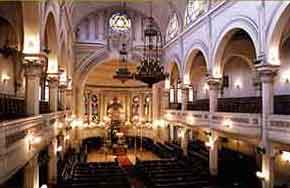 Gran
Templo de Paso, Buenos Aires
Gran
Templo de Paso, Buenos Aires |
President Menem also ordered
the release of files relating to Argentina’s
role in serving as a haven for Nazi
war criminals. A law against racism and anti-Semitism passed
in the Argentine parliament in 1988.
Despite Menem’s sympathetic
policies and a democratic regime, the Jews of Argentina were targets of two major terrorist attacks.
The Israeli Embassy was bombed in April 1992,
killing 32 people. In 1994, the Jewish community
headquarters (AMIA) in Buenos Aires was bombed,
killing 87 people and wounding more than 100
others. The community’s archives were
destroyed in the bombing and the event left
many emotionally scarred. Though Iran was
suspected of involvement, with the help of
Argentine police, the culprits have never been
found. In 2005, an Argentine prosecutor said
the AMIA bombing was carried out by a 21-year-old
Lebanese suicide
bomber who belonged to Hezbollah.
Jews are active in all sectors
of Argentine society and many are prominent
figures in the arts, film, music and journalism.
Some influential Argentine Jews include: writer
Jacobo Timmerman, owner of a local newspaper
who campaigned for human rights; Rene Epelbaum,
who founded a protest group for mothers of
political prisoners; pianist Daniel
Barenboim, and Cesar Milstein, the 1984 Nobel
Prize recipient in medicine.
Throughout Argentina’s
history, Jews have held a large stake in the
country’s fur, textile, chemical, electronics
and auto industries. Both Banco Mercantile
and Banco Comercial were founded by Jews. On
the other hand, Jews are still absent from
the high ranks of the military, foreign ministry
and judiciary.
Poverty in Argentina is on
the rise, affecting Argentina’s middle
class, which is losing its small and medium
sized businesses. Many Jewish business owners
have lost their shops and are unable to pay
membership or tuition fees to local Jewish
institutions and synagogues.
These communal institutions now face declining
membership and budgets to maintain their activities
and services. A much larger percent of the
bugets of these oranizations now has to go
to emergancy economic relief. In response to
the economic decline and lack of funds, the
Joint Distribution Committee and the Jewish
Agency are training new, young lay leaders
to rebuild the community and run the local
institutions.
The economic situation has
caused about 10,000 Jews to leave Argentina
in the last few years. About 6,000 emigrated
to Israel. Jewish community leaders are hoping
that the election of a new presdient will bring
economic stability and cease emigration .
Jewish Community
Argentina’s Jewish community
numbered more than 181,000 as of 2012. The vast majority live in Buenos Aires, with approximately 15-20,000 in Rosario, 5-9,000
in Cordoba and 20,000 in other small, rural
communities, including some areas in the Sante
Fe province. There are also signifcant numbers
of Jews in the cities of Concordia, La Plata,
and Mar del Plata. The majority of these Jews are Ashkenazi,
about 15 percent are Sephardic.
Nearly all the Jews speak Spanish — Ladino
and Yiddish are rarely spoken. The community
is not growing and many young Jews are immigrating
to other countries.
Argentina’s Jews have
numerous Jewish community organizations. The
DAIA (Delegacion de Asociaciones Israelitas
Argentinas) was founded in 1939 as the political
arm of the Jewish community. The DAIA protects
Jewish rights and represents the community
in the government. Another organization, the
AMIA, originally an Ashkenazic mutual-aid society
that provided health and human services to
Argentina’s Ashkenazi population, now
serves the country's entire Jewish community.
 ACILBA,
Buenos Aires
ACILBA,
Buenos Aires |
Most of Argentina’s synagogues are
traditional, lying somewhere between Conservative and Orthodox.
Buenos Aires has 50 Orthodox synagogues, 21
Conservative synagogues and a few Reform synagogues.
Most of the synagogues built before World War
II are still in use today.
The Conservative movement
became strong in Argentina in 1958 after Rabbi
Marshall Meyer took control over Communidad
Bet El, the country’s first Conservative
synagogue, located in Buenos Aires. His enthusiasm
attracted many young adults. Meyer became involved
politically, gathered information about political
prisoners and published the material in the
newspapers.
President Alfonsin appointed
Meyer to a government commission that investigated
the disappearances of Jews in the military
regime. In 1984, Marshall left the community
and moved to New York, where he currently serves
as the Rabbi for B’nei Jeshrun, another
vanguard synagogue in the Conservative movement.
Today, Communidad Bet El also
has a day school and attendance on a regular
Saturday morning reaches up to 800 worshipers.
Argentina boasts more than
70 Jewish educational institutions, including
kindergartens, day schools, elementary and
secondary schools. More than 60% of Jewish
Argentine youth attend one of these institutions.
In Buenos Aires alone, 17,000 Jewish children
study in the Jewish educational system
Communities in other cities
also have Jewish social clubs, Sociedad Hebraica
for Ashkenazi Jews and Casa Sephardi for Sephardic Jews. Maccabe Sport Federation is also active
in Argentina. Plays are performed in Yiddish,
Spanish and Hebrew in a number of Jewish theaters
across the country.
There are also 18 Jewish cemeteries
located in Argentina, of those seven are still
active. One can find Jewish cemeteries in Buenos
Aires, Cordoba, Parana, La Plata, Colinas del
Tiempo, Rosario and Sante Fe. La Tablada cemetery
in Buenos Aires has been vandalized in anti-Semitic
attacks in 1994. Bronze objects were stolen
from more than 150 graves.
While Argentina's Jewish population
has many community outlets, one quarter of
the population is living below the poverty
line. Even well-educated young people are finding
it next to impossible to find a job. There
are groups in Argentina trying to irradicate
this problem. Alianza Solidaria (started by
the JDC) is an organization trying to fight
poverty among Jews. The Tzedaka foundation
is another organization that devotes its efforts
solely to helping the impoverished Argentinian Jews.
Even those wealthier Jews who try to help the poor have been unable.
In 1998, Banco Patricios collapsed, taking
with it millions of Jewish dollars. The Banco
Mayo also failed to help the situation as it
too went bankrupt in 1999. Because of these
circumstances, many once wealthy Jewish organizations
are now unable to give funding to charity groups.
AMIA, a major benefactor for social programs,
is now trying to pay off a $26 million debt.
The DAIA elected an Orthodox Jew to head their organization for the first time in it's 80-year history in November 2015. The Delegation encompasses more than 120 Jewish organizations in Argentina, and is the political umbrella organization of the Argentine Jewish community. The newly elected President, Ariel Cohen Sabban, previously served as the treasurer of the DAIA.
Buenos Aires
Much of Buenos Aires Jewish
life centers around the Once district (pronounced
on-say). One of Once’s well known synagogues
is Yesod Hadat, founded in 1932 by Jews
from Aleppo, Syria. It is located on Lavalle
2449.
 Libertad
 |
Once also has a Jewish cultural
center, which hosts concerts, lectures and
a high school, located at Sarmiento 2233. Other
Jewish clubs include Hacoaj and C.A.S.A. Sefardita
have a range of sports and cultural activities.
Argentina’s oldest synagogue,
Congregacion Israelita de la Republica Argentina,
is known as "Libertad" because it
is located at Libertad 733 in Buenos Aires.
The Libertad was dedicated in 1932 and houses
a small Jewish museum, which a good collection
of photographs and Jewish ritual objects.
The Argentine branch of the
Jewish Theological Seminary, the Conservative
movement’s Rabbinical School, opened in
1962 in Buenos Aires and trains Conservative
Rabbis from all over Argentina and Latin America.
In 1992, the first woman was ordained by the
seminary. The seminary acts as a center for
interfaith dialogue, hosts a high school and
a graduate school and offers adult education
lessons and seminars for the community.
Buenos Aires has one of the
world’s four remaining Yiddish daily newspapers,
others are found in Paris, Tel Aviv and Birobidjan,
in Siberia.
Sources: Argentina. The
American Jewish Joint Distribution Committee, Inc.
Argentina. Jewish
Communities of the World.
Beker, Dr. Avi. (ed.) Jewish
Communities of the World. Lerner Publication
Co. 1998.
Rosenberg, M.J. “Israel’s
Mission is to Save Jews.” Jacob
Richman’s homepage, (March 23, 1984).
Tigay, Alan M. (ed.). The
Jewish Traveler. Jason Aronson, Inc.
1994.
Zaidner, Michael (ed.). Jewish
Travel Guide 2000. Vallentine
Mitchell & Co. 2000.
Photo Credits: Eichmann from US
Holocaust Memorial Museum
Libertad synagogue copyright George Wohlberg. |