Kraków, Poland
Kraków (also Cracow) is the second largest, and one of the oldest, cities in Poland. Situated on the Vistula River, the city dates back to the 7th century and has been one of the leading centers of Polish academic, cultural and artistic life. Jewish history in the city can be traced back to the 14th or 15th century.
- Early History
- 15th Century
- 16th Century
- 17th Century
- 18th Century
- 19th Century
- Inter-War Period
- The Holocaust
- Post-Holocaust Period
- Jewish Tourist Sites
Early
History
Jews
arrived in Cracow in the late 13th century among German
immigrants traveling on a commercial route to Prague. Kazimierz,
located on the outskirts of Cracow and founded in 1335 by King Casmir
the Great, became the main center for Jewish settlement. By the 14th century, Jews had established an organized community. Records reveal
a mikveh, bathhouse and cemetery by the 1350's. Jews owned homes and
building plots in their quarter and in neighboring quarters of the
city in 1312; however, Jewish ownership was resented and protests
began in 1369 against Jewish activities. A municipal council
requested in 1392 that Jews should only be allowed to sell their
homes to non-Jews.
15th Century
Disagreements continued between the Jews and the
other residents of Cracow during the 15th century. One
disagreement flared due to the construction of a university building
on a street in the overcrowded Jewish district. University students
frequently attacked the Jewish residents and forced Jewish bankers to
give low-interest loans to them. Blood
libels and mob attacks against Jews broke out in 1407 and 1423.
Another set of anti-Jewish riots followed the visit of a Franciscan
Preacher John of Capistrano in 1457. In 1469, Jews were forced to
vacate the street that housed the university building and move to
another area near one of the synagogues. In 1485, Jews signed an
agreement under duress, barring them from most branches of commerce.
More riots were set off after a fire spread from a Jewish street to
one inhabited by Christian residents in June 1494. Finally, in 1495,
Jews were expelled from Cracow to Kazimierz, by order of the King.
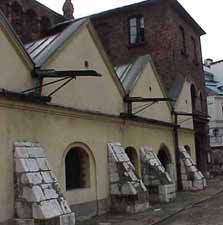
In 1407, construction began on the Alte Schul, the
oldest medieval synagogue preserved
in Poland. By 1487, a Jewish bathhouse, marketplace and cemetery were
in existence in Kazimierz. The Kazimierz Jewish community was run by
four elected elders who judged lawsuits between Jews.
Also in the 15th century, Jacob Pollack
settled in Kazimierz and founded the first yeshiva, and talmudic
learning began to spread throughout Poland.
16th Century
An influx of immigrants from Bohemia-Moravia, as
well as from Germany, Italy, Spain and Portugal came to Kazimierz in
the 16th century. Among those who came were wealthy men
and physicians who had special tax exemptions from the King of
Poland. These privileges were revoked into 1563, after complaints
from Jewish community leaders.
Overcrowding in Kazimierz became a problem because
of the influx of immigrants. In 1553, Jews were allowed to extended
the size of Kasimierz. In 1564, they were given the sole right to
acquire residence in the Jewish town. By the 1570's, the Jewish
population of Kazimierz numbered about 2,060.
One
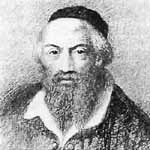
of the greatest rabbis of the 16th century Rabbi Moses
ben Isserles (1525-1572) lived and taught in Kazimierz. He is
known for his commentaries to the Shulkhan
Arukh, which expanded the religious code to Ashkenazic Jews,
as well as Sephardic Jews. Rabbi Isserles’ works were printed in
the Hebrew printing press, which had started in the 1530's and was
active until the 19th century.
17th Century
This period is marked by intense struggle between
Jewish traders and Christian merchants over Jewish commercial rights
in Christian sectors. An agreement was made in 1609, which allowed
Jews to trade freely in Kazimierz and in another local town. Limited
Jewish economic activity was permitted in Cracow proper and depended
on bribery; nevertheless, Jewish trade continued to develop in Cracow
and was recognized by de facto royal decisions.
Cultural life in Cracow-Kazimierz flourished in
this period. Seven main synagogues were functioning by 1644,
including the Alte Schul and the Rema Synagogue. A number of yeshivot
founded in the late 16th century continued to grow, making
Cracow a center of Jewish learning. Cracow-Kazimierz became one of
the principal communities in the Council of Lands.
The Council of Lands is the council of Jewish
communities of Poland. It was in charge of Jewish livelihood,
muncipal affairs, disputes, loans, fairs, commerce, interaction with
non-Jews, Torah study, appointment of Rabbis and tax collection. It
could impose punishments for infractions of their rulings, such as
imprisonment, expulsion, fines and a herem (ban).
Cracow’s population grew during the 1630's with
a large immigration from Jews fleeing from Germany during the Thirty
Years’ War. The Jewish community experienced hardships, however,
during the Swedish invasion and occupation from 1655-57. Jewish
property was harmed and Jews were accused of collaboration with the
Swedes.
In the late 17th century, Jews were
increasingly subject to attacks by students and to blood libels. A
plague in 1677 killed 1,000 Jews in Kazimierz and most of the Jewish
quarter was abandoned. The community reorganized in 1680 and reopened
its yeshivas, but was buffeted again two years later by renewed
anti-Jewish rioting.
18th Century
The 18th century was marked by the
struggle between the citizens of Cracow and the Jews of Kazimierz
over closing Cracow to Jewish trade and crafts. The anti-Jewish
restrictions were ineffectual and Jews became involved in many areas
of trade, including furs, wax, soap, salt and tobacco. Jews served as
gold and silversmiths and worked in the import-export industries.
Unfortunately, the majority of Kazimierz Jews remained impoverished,
despite the rise of a Jewish merchant class. Then, in 1761, the
Senate of Poland prohibited Jewish commerce in Cracow.
From 1772-1776, Kazimierz became part of Austria
and Cracow remained part of Poland. Austrian authorities permitted
the Jews to travel to Cracow, but the Cracow municipality tried to
stop them. In 1772, Kazimierz returned to Austria, however, Jewish
commerce in Cracow was still forbidden.
In late 1776, the king allowed the Kazimierz
municipality to increase Jewish commerce rights. During this period,
many wealthy Cracow Jews moved to Warsaw.
The period between 1768-72, known as the
Confederacy of the Bar, is marked by violence perpetrated against the
Jews by both the Russians and the confederates, whom both considered
the Jews to be the enemy. Jews were hung on branches of trees and
both sides demanded that Jews provide them with food, housing of
soldiers and help in espionage services.
In 1795, Cracow and its surrounding areas were
annexed by Austria and in 1799 all Jewish businesses were removed
from Cracow by order of the Austrian Authorities.
19th Century
Cracow changed hands again in 1809 and became part
of the Grand Duchy of Warsaw. The Cracow Republic was formed between
1815-1846. During this period, Jews were allowed to live in the
Jewish section of Kazimierz and "cultured" (assimilated)
Jews were permitted to live in the Christian sections.
By 1833, the Jewish population of Cracow numbered 10,820.
A Jewish elementary school was opened in 1830. In 1844, the first Reform
synagogue opened in Cracow. In 1846, the Cracow Republic ceased functioning
and Cracow became part of Austria once again.
Jews stayed in Kazimierz until 1868, when the Kazimierz
and Cracow communities merged. During the interim, Jews had some rights
to trade and work in Cracow. Jews had freedom of movement and only the
poor stayed in Kazimierz.
Cracow was emancipated in 1867-68 and Jews were
given permission to settle in Cracow proper. Jewish community
institutions were abolished and assimilationists and maskilim (Followers of the Jewish
enlightenment) became the new leaders of the Jewish Religious
Council. The first secular Hebrew public Library in Cracow opened in
1876.
Cracow had a diverse network of schools by the end
of the 19th Century, including traditional hederim (the Heder was small elementary school classroom, often located in
the house of the Rabbi), as well as elementary and secondary schools
taught in Polish and German.
Jews became part of the Polish-German cultural
life in Cracow. At the same time, Jewish nationalists became popular
and chapters of Zionist Organizations were established.
In 1900, Cracow had a Jewish population of 25,670.
Inter-War
Period
Anti-Semitism continued to grow since the late 19th century and pogroms
broke out. A self-defense group of Jewish youth organized and was
able to defend themselves against the riots.
The Jewish community continued to grow in the
period and reached 56,800, in 1931. Cracow became a center of Jewish
political and social life in Poland.
The
Holocaust
At
the start of World War II, there were 60,000 Jews living in Cracow,
one-fourth of the entire population. The German
occupation began on September 6, 1939. The Germans dismantled the
Jewish community organization and appointed a Judenrat to administer to Jewish affairs. An order was given in April 1940 for
Jews to evacuate Cracow within four months. In that period, 35,000 Jews
left the city and 15,000 were allowed to remain. Cracow became the capital
of Nazi-occupied Poland.
In
March 1941, a ghetto was built
and housed 20,000 Jews, including 6,000 Jews from neighboring
communities. Deportations began in June 1942; 5,000 Jews were sent to
the Belzec death camp. In
October 1942, 6,000 Jews were deported to Belzec.
Patients at the hospital, residents of the old age home and 300
children at the orphanage were killed in the aktion.
Another several hundred Jews were put to death in the ghetto itself.
 Oskar Schindler
 |
The Jewish Combat Organization was active in organizing
resistance in the ghetto. A Zionist resistance group, Akiva, and a leftist group, joined together to form
the ZOB. Their group ceased to function after the ghetto was liquidated
and the remaining Jews were sent to the Plaszow labor camp in March 1943.
In
the Zablocie district of Cracow, Oscar
Schindler had a factory, which he used to save 1,098 Jews from
Plaszow. His factory became a subcamp of the Nazi concentration
camp system, and he paid the German Reich for their labor. The film Schindler's List was filmed across the river from the location of the actual Cracow ghetto, in the town of Kazimierz, out of respect for the victims.
Post-Holocaust
Period
Only 2,000 Jews from Cracow
survived the war. Some Jews who lived in Russia
during the war returned to Cracow in 1945-46.
A Jewish community was not re-established
because of a fear of progroms. The last Jew
left Kazimierz in 1968. About 700 Jews remained
in Cracow after 1968. Today, approximately
1,000 Jews live in Cracow, but only about 200
identify themselves as members of the Jewish
community.
Despite the dwindling population,
interest in preserving Jewish history has
been rekindled. A new Jewish research institute
was established in Jugiellonian University
and a Jewish Cultural Center was set up in
Kazimierz. Every two years, Kazimierz hosts
a Jewish cultural festival that has music,
dance, film and theater.
In June 2005, the Rabbi Moses
Isserles Remuh Jewish Library, named for the famous
16th-century rabbi and scholar who lived
in Crakow, opened in
the city’s Jewish youth
club. The library will house approximately
1,100 books, among them 500 in Yiddish, 200
in Polish and 250 in English. Young people
will deliver books to elderly Jews.
In October 2005, the Shavei
Israel organization reported that it was dispatching
Rabbi Avraham Flaks to become the city’s
first full-time rabbi since the Holocaust.
The Jerusalem-based organization, which reaches
out to “lost Jews” and tries to
reconnect them with the Jewish community, will
try to rekindle Jewish life in the city.
Tourist
Sites
Kazimierz District
The streets of the old Jewish city still evoke a
sense of the past. Be sure to visit ul Szeroka, the old town square,
which was the center of Jewish life in Kazimierz.
Seven synagogues can be found in Kazimierz,
but only one is still in use.
1. Old Synagogue: ul Szeroka 24
The
synagogue was established in the 15th century and was
remodeled many times. It is the oldest synagogue left standing in
Poland. During World War II, the Nazis used the synagogue as a
warehouse and most of its artwork and Jewish relics were looted
during World War II. Afterward, the synagogue was remodeled and today
it houses the Museum of Jewish History, containing collections of
liturgical items, ancient Torah scrolls, textiles, dishes, utensils
and shofars, as well as photographs, documents and artwork showing
the history of the Jews of Cracow. In the plaza in front of the
synagogue, there is a monument to 30 Poles shot by the Nazis.
2. Remuh Synagogue & Old Cemetery: ul
Szeroka 40
This
synagogue was founded in 1553 by Israel
Isserles. He and his family are buried in the cemetery next to
the synagogue. The cemetery was in use between 1551-1800. Both the
synagogue and the cemetery were devastated by the Nazis during World
War II; however, the synagogue has been remodeled and is in use
today.
In
the 1950's the cemetery was excavated by archaeologists who found
hundreds of ancient tombstones dating back the 1550's. Theories have
arisen that these tombstones were actually hidden during the period
of the Swedish invasion in 1704. Today, 700 tombstones have been
re-erected, along with other tombstones donated from the remains of
cemeteries throughout Poland. A beautiful mosaic wall of tombstone
fragments was also built.
3. Bociana or Popper’s Synagogue - ul
Szeroka 16.
Built in 1620 by a wealthy merchant, this
synagogue is no longer used for ritual purposes. All of its interior
decorations were destroyed during the Holocaust. Today it hosts the
cultural center.
4. Tempel Synagogue (also known as Reformed
Synagogue): ul Miodowa 24
A wealthy community elder, Izaak Jakubowicz, built
this synagogue in 1683. It has been remodeled many times since and it
is currently undergoing restoration. During World War II, the Nazis
looted its interior and little remains.
5. High or (Tall) Synagogue - ul Jozefa 38
Originally built in 1553-56 as a prayer room on
the second floor above ground floor shops, it was destroyed during
the Holocaust. Today its is used for a monument restoration workshop.
6. Kupa Synagogue - ul Warszawera 8
This synagogue was built in the late 17th century. After WWII, it was turned into a matzah factory. Little
remains of the original interior beyond a few 20th century
frescoes.
7. Izaak Synagogue - ul Miodowa
The
synagogue was founded in 1644. The exterior stairway goes up to the
women's gallery. This Synagogue invites non-Jews to events, such as
movies, which it sponsors.
Other sites
* Bath house and mikva - ul Szeroka 6
This
building housed the community bathhouse and mikva during the 16th century. It was remodeled in the 19th century. The Jewish
practice of ritual baths kept them from getting epidemics. Today
there is a café located there.
* New Cemetery ul Miodowa 55.
The
cemetery was founded in 1800, after the closing of the old cemetery,
and it is still in use today. It was devastated by the Nazis, but
restored in 1957. One can find thousands of gravestones, dating back
to the 1840's. Engravings on the gravestones can be found in German
and Polish, revealing the assimilation of the time. The cemetery also
contains a Holocaust Memorial.
* The Ghetto
 Memorial at Plaszow
 |
The ghetto was built in March 1941, on the opposite side of the Vistula River
from Kazimierz. In Bohaterow Ghetta (Ghetto Heroes) Square, the Jews
were deported to Nazi death camps, mainly Belzec and Auschwitz-Birkenau. At No.
18, one can find the Museum of National Commemoration that was built
in 1983. It contains exhibits on the ghetto and the Nazi occupation.
Fragments of the ghetto walls are still visible.
* Plaszow
Close
to the former ghetto is the site of the Plaszow concentration camp. At this camp, Oscar
Schindler saved almost 1,100 Jews by putting them to work in his
factory. A monument was built in commemoration of the 10,000 who did
not survive. Nearby on ul Lipowa 4 is Schindler’s pot and pan
factory, which is in use today for making electronic parts. In the
courtyard of the factory, there is a monument.
There are two restaurants serving Jewish-style food, both named
Ariel. Café No. 17 has kosher food and evening concerts of Jewish
and gypsy music. Next door, Café No. 18, is the other Jewish-style
restaurant. Next door is the site of the former Poppers Synagogue.
Sources: Photos courtesy of Scrap
Book Pages.
|