|
[By: Jacqueline Shields]
The Jewish community of Suriname is one of the oldest
in the Americas, as the first Jews settled in the area around 1500. Today, the Jewish community of Suriname numbers around 200.
- Beginnings of a Community
- Colonial Period
- 20th Century
- Present-Day Community
Beginnings of a Community
The Jewish community of Suriname is one of the oldest
in the Americas. During the Inquisition in Portugal and Spain around 1500, many Jews fled to Holland and the Dutch colonies to escape torture and condemnation to the stake.
Those who were converted to the Catholic fate were called "Marranos."
The stadtholder of the King of Portugal gave those who wanted to depart some time to settle their business and
supplied them with 16 ships and safe-conduct to leave for Holland. The
most prominent amongst them were Rabbi
Izak Aboab and members of the Nassi, the Meza and the Pereira families.
Many of the Jews who went to Holland departed later
for the Dutch colonies because of the climate and problems with their
co-religionists in Amsterdam (See Wanderings by Chaim Potok).
Many took the opportunity offered by the Dutch government to immigrate
to Brazil free of charge or for
a small fee. For some time they found in Recife a new home, being merchants
or sugar cane growers. After 1643, in Recife, however, everything began
to change in trade and commerce; creditors started to seek repayment,
and many debtors went into hiding or departed.
This fact and the recapture of Dutch Brazil by the
Portuguese forced many Jews to leave Brazil for other Dutch colonies
in North America and the Guyanas. Jews apparently arrived from Brazil
(or Holland) and settled in Suriname as early as 1639, and there is
an extant ketubbah, marriage contract, signed by a rabbi in 1643.
A second group of Jewish settlers arrived from England in 1652 under the auspices of Lord Willoughby of Parham, who managed
to establish a permanent settlement. The next group of Jewish settlers
was led by Joseph Nunez de Fonseca, also known as David Nassi, and was
of primary importance to this oldest Jewish community in the Western
Hemisphere. Most of the group was composed of Jews who had fled the
Inquisition and had gone to live under the Dutch in Brazil. When they
were driven from Brazil after the Dutch were defeated by the Portuguese
in 1654, they went back either to Holland or to Cayenne, Essequibo,
and other places in the New World, some finally settling in Surinam
in 1666. Experienced traders and agriculturists, they set up many sugarcane
plantations, which were a valuable asset to the British colony.
The Colonial Period
In 1652, Lord Willoughby had already brought a group
of English settlers to Suriname, some of them probably Ashkenazi Jews. The first Jews in Suriname lived among the other Dutch and English
settlers in Thorarica, then the capital of Suriname. Remnants of a cemetery
and a synagogue were found there capital in the beginning of the 18th
century. When the Jewish population increased they moved to Cassipora,
some miles upstream. Here, they established a cemetery on a hill close
to the banks of the Suriname river. After some years they settled at
Jodensavanne, a mile from Cassipora, also along the Suriname river.
In the beginning, they were called "Congregation
of Cayenne." According to their archives, the "Portuguese
Jewish Congregation of Suriname" was founded in 1661/1662. When
Suriname was English territory, the Jews received important privileges
from the Crown on August 17, 1665. These were re-affirmed by the Dutch,
after Suriname was taken by Abraham Crijnssen in 1667.
From 1665 to 1667, the first synagogue was built on the land of Baruch da Costa and Selomoch (de) Solis at
Jodensavanne. The Kahal Kadosh (Holy Congregation) was called Beracha
Ve Salom (Blessing and Peace). The K.K.B.V.S. was a "filiacao"
of the Congregation of Amsterdam and followed the same rituals. The
"College of Senhores do Mahamad" consisted in 1785 of 4 Parnasim
and a gabbai. The ex-members of the Mahamad were called "Adjunctos".
They, and the College of the Mahamad, made-up the "Juncta,"
the governing board. The Mahamad acted also as their Court of Civil
Justice. In the "Ashkamoth" (rules of the Congregation) of
1748 it was written that the assembly of the Senhores do Mahamad "como
deputados" had the right of civil justice.
In light of their importance to the general community
Jewish settlers had previously been guaranteed (1665) full enjoyment
and free exercise of their religious rites and usages, a guarantee which
was reinforced in 1667 when it was decreed that all Jews who came to
Suriname for settlement purposes were to be considered British-born
subjects. When Suriname surrendered to the Dutch in 1667, some of the
colonists left, but not without opposition on the part of the Dutch
authorities. Under Dutch occupation, Spanish and Portuguese Jews came
from Amsterdam.
The Jewish community continued to prosper under the
Dutch, owning numerous slaves and plantations. Nevertheless, a number
of the settlers tried to leave in 1674 but were forcibly held back by
the Dutch. Two years later, the Jews were promised free exercise of
their religion, having been restricted by the Dutch after their occupation
of Suriname in 1667. By 1694, there were 92 Portuguese Jewish families
and some 12 German Jewish ones in the colony, totaling 570 persons who
had holdings of more than 40 plantations and 9,000 slaves. The economic
position of the community rose rapidly during the first half of the
17th century. Yet, the end of the 17th century and the beginning of
the 18th century brought many problems between the Suriname Jews and
the Dutch Government. Their privileges of 1665 and 1667, such as contract
marriages, opening their shops on Sunday, and administering justice,
were criticized. In 1767, hostilities culminated in considering creating
a ghetto for the Jews in Paramaribo. Jews owned 115 of 400 plantations
in 1730; however, their position declined, and by 1791 they owned only
46 of 600 plantations. Anti-Jewish feelings grew slowly in the colony,
which led to various efforts on the part of the Dutch to restrict the
religious freedom of the Jews beginning in 1667. Furthermore, differences
arose between the Portuguese and German Jewish communities, eventually resulting in a division of the community
and the formation of the Neve Shalom Ashkenazi synagogue. The synagogue
Neve Shalom (Oasis of Peace), built in 1719 (enlarged in 1780 to 200
seats for males and rebuilt from 1833 to 1835, having been destroyed
by a fire) in Paramaribo was sold to the Ashkenazim in 1735. In the
same year the Sephardim started
to build their own synagogue in Paramaribo called Sedek Ve Shalom (Justice
and Peace).
Suriname was attacked by the French under the command of Du Casse in 1689 and under the command of Cassard
in 1712, who looted the colony and also inflicted much harm to the Jewish
planters. Yet, the German community continued to grow throughout the
18th and 19th centuries, and by 1836 it was larger than the Portuguese
one. In 1825, all special privileges which had previously been granted
to the community were no longer necessary, since they enjoyed full and
equal rights as subjects of the crown. Dutch gradually replaced Portuguese
as the language of the community.
The economic decline of the community was largely connected
with the abolition of the slave trade in 1819 and the emancipation of
the slaves in 1863. As the export of sugarcane dropped off during the
19th century, the inhabitants made efforts to adapt the soil to other
uses; as their efforts failed, they moved largely to the coastal areas.
In 1861 the archives of the former Jewish court at Jodensavanne were
declared government property and put in the Suriname library, later
transferred to The Hague in 1916. The Jewish population was estimated
at 719 in 1835, dropping steadily to 607 in 1885.
20th Century
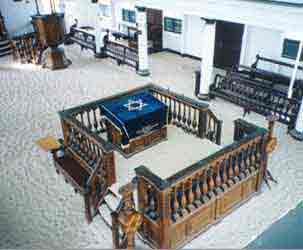
Bimah of the Neve Shalom Synagogue, Paramaribo
 |
As the Jewish population declined during the first
quarter of the 20th century, the economic situation of the colony forced
what was left of a thriving Jewish community to relocate itself mainly
in Paramaribo, the capital. During World War II, a few Jewish refugees
from the Netherlands and other parts of Europe settled temporarily in
Suriname. By 1970, there were only about 500 people left in the community,
which held alternating services at the synagogues of Congregations Neve
Shalom and Zedek ve-Shalom, the congregations of the Ashkenazi and Sephardi
communities respectively.
Present-Day Community
200 Jews live in Suriname with the Nederlands Portugees
Israelitische Gemeente overseeing the community's activities. The two
18th century synagogues in the capital, Paramaribo, have been restored.
Neve Shalom is considered to be Conservative,
and both synagogues hold weekly Shabbat services. The Ashkenazi synagogue, like the Curacao one, has a sandy floor, which is symbolic of the 40 years in the desert,
and was also supposed to have hidden the foot steps of the Conversos. Kosher food is available.
There is a community newspaper, Sim Shalom, that is printed in
Dutch.
Israel and Suriname
have enjoyed full diplomatic relations since the country attained independence
in 1975. Israel is represented by its ambassador in Caracas and by an
honorary consul in Paramaribo.
Sources: "Suriname." Encyclopaedia
Judaica
Beker, Avi. "Suriname." Jewish Communities of the World. Lerner Publications Company,
Minneapolis, 1998.
History
of Suriname
Zaidner, Michael. Jewish Travel Guide 2000. Vallentine Mitchell, Portland, OR, 2000.
Map: CIA-World
Fact Book
Photos of Jodensavanne and Neve Shalom courtesy Jodensavanne
Foundation |