|
[By: Ariel Scheib]
The Jewish community in Armenia can trace its roots back nearly 2,000 years to after the destruction of the First Jewish Temple in Jerusalem. Today, the Jewish population in Armenia is approximately less than 100 people.
- Community History
- Community Organizations
- Anti-Semitism
- Community Relations
- Relations with Israel
Community History
The Jewish community of Armenia dates back almost
2,000 years. Many historians date the arrival of the first Jewish settlement
in Armenia back to the destruction of the First
Temple. During the conquest of King Tigranes II the Great, Tigranes
brought with him 10,000 Jewish captives to Armenia when he retreated
from Palestine, because of the Roman attack on Armenia (69 B.C.E.).
By 360-370 C.E., there was a
massive increase in Jewish Hellenistic immigration into Armenia; many
Armenian towns became predominately Jewish. During this period, however,
the Persian Shapur II began deporting thousands of Jews to Iran.
Halakhic studies never prospered in Armenia, although there are a few references
to the region in Jewish Hellenistic sources. During Medieval times,
most of Armenian Jewry vanished as a distinct entity in the region,
although many historians believe they became a part of the Kurdish Jewry.
There is an ancient Jewish cemetery located in the region of Vayots
Dzor, in the city of Eghegis, south and west of Yerevan. There are more
than 40 tombstones dating back to the 13th century, 16 tombstones with Hebrew and Aramaic inscriptions.
Jews from Poland and Persia first began arriving in Armenia in the early 19th century.
Since 1840, Jewish settlers established both Ashkenazic and Sephardic communities
in Yerevan. Up to 1924, the Sephardic synagogue,
Shiek Mordechai, was a leading institution among the Jewish community.
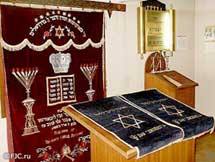 Ark in Yerevan Synagogue
 |
During and after World
War II, hundreds of displaced Jews moved to Soviet Armenia. The
Jewish population of Armenia grew to approximately 5,000 people. In
1959, the Jewish population peaked in Soviet Armenia at approximately
10,000 people. Another wave of Jewish immigrants arrived in the country
between 1965 and 1972, mainly intelligentsia, military, and engineers.
These Jews arrived from Russia and Ukraine, attracted to
the more liberal society. Today, the Jewish community has fewer than
1,000 citizens due to emigration and assimilation. Between 1992 and
1994, more than 6,000 Jews immigrated to Israel because of Armenia’s
political isolation and economic depression. In 1995, the Chabad House
was established in Yerevan. The Chabad House provides free meals, offers
classes in Hebrew and Jewish traditions, and cares for the community
elderly.
The rate of intermarriage among Jews and Christian
Armenians is very high. In an interview, Rabbi Berstein of the Yerevan
Chabad described the Jewish community as “‘too small’
to be of great interest to most Jewish organizations.” Almost
half of the Jewish population resides in Yerevan. Seven, Yerevan and
Vanadzor have active Jewish community centers.
At the start of 2002, Rimma Varzhapetian became the
president of the Jewish Community of Armenia. The only rabbi in Armenia is Rabbi Gershom Meir Berstein of the Chabad in Yerevan. In 2004, the Jewish community, through the assistance of
Chabad, began producing kosher food. Slowly, the Jewish community is rebuilding itself in Armenia.
Community Organizations
The American Jewish Joint Distribution Committee (JDC)
is very active in Armenia assisting the elderly, through the charity
Orot Hesed. The JDC works through the Yerevan synagogue to provide finances
for food supplies, fuel, and medicine. This program supports nearly
80 people.
The Jewish Community of Armenia (JCA) in Yerevan also sponsors
programs for Jews. In late 2002, the JCA published the community’s first newsletter.
The Jewish Agency for Israel (JAFI) maintains a Sunday
school, a Hesed senior center, several youth clubs and communal activities
in Armenia. The Religious Society of Armenia also supports a second
Sunday school and a summer camp, both located in Yerevan. Menorah, the
Armenia-Israel culture group, conducts many activities in the community.
Modern Hebrew has been taught at the state university since 1995.
 Yerevan Synagogue
 |
In 1992, the Jewish Religious Community of Armenia
was established in Yerevan. This Chabad organization maintains a rabbi,
the third Sunday school in Armenia and a Community Center for programs
and gatherings. It also supports a summer camp and charity programs.
There are weekly Shabbat services and holiday services
held at the Yerevan synagogue. Since 1997, the Jewish Religious Community
has published the newsletter, Koelet, to help keep the community informed.
There is also a small Jewish community in Sevan that
occasionally holds services led by the head rabbi of the Yerevan Synagogue.
Anti-Semitism
Historically, Jews and Armenian Christians have had
good relations. Both groups have ancient cultural and religious roots
in Armenia that have helped them through modern persecutions. Nonetheless,
Jews are considered aliens in Armenia and not full citizens.
Anti-Semitism does exist in Armenia, although it does not occur frequently. For instance,
in February 2002, Romen Yepiskoposyan published an anti-Semitic book.
Also the media and local officials initiated a boycott of the Holocaust
memorial.
Because of Armenia and Turkey’s have poor relationship
over time, much of the anti-Semitism in Armenia stems from the good
relationships between Turkey and Israel and the United States.
Community Relations
The Armenian Jewish community has good relations with
their government. Armenian Jewry may worship and practice Jewish traditions
freely due to the 1991 Armenian Law on Freedom of Conscience, amended
in 1997, of separation of church and state. In 1996, the state registration
agency required every communal organization to register with the state.
The Jewish Religious Community of Armenia is registered with the Committee
on Nationalities.
In 1999, the JCA planted trees in Yerevan in commemoration
of the Holocaust and the Armenian Genocide Memorial.
A state-sponsored channel broadcasts a weekly television
show highlighting Jewish and Israeli culture. The Armenian government
has also been cooperating with the Jewish community to retrieve Torah scrolls confiscated in the past and placed in state collections.
Relations with Israel
Israel and Armenia
have diplomatic relations; however, neither maintains an embassy in
the other country. Israel is represented in Armenia by the Israeli ambassador
in Tbilisi, Georgia. Yad Vashem,
the Holocaust Memorial in Israel, has paid tribute to ten Armenians as “Righteous
Among the Nations” for risking their lives during the Holocaust to rescue Jews. In 1988, Israel
Defense Forces were sent to Armenia after a devastating earthquake.
Over the past years, trade between Israel and Armenia has further increased
the two nations’ friendship.
Since 1989, 1,246 Jews have immigrated to Israel from
Armenia.
Sources: NCSJ
World
Jewish Congress
“Hebrew
University Expedition Studies Jewish Cemetery in Armenia”
“Armenia,” The Jewish Travelers'
Resource Guide. Feldheim
Publishers. 2001.
Encylopaedia
Judaica
The
Federation of Jewish Committees of the CIS
“Armenia’s
Jews Anxious for Calm”
IAJGS-
Cemetery Project
Picture of Yerevan Synagogue courtesy of: NCSJ
Other picture(s) courtesy of: Federation
of Jewish Communities of the CIS and Baltic States |