|
[By: Avi Hein]
Switzerland has had a settled Jewish community since the 13th century. Today, the Jewish population of Switzerland is approximately 17,500 people - the tenth largest Jewish community in Europe.
- Early History Through Middle Ages
- Expulsion & Emancipation
- Basel
- The Struggle for Shechitah
- Intellectual Elite
- The Holocaust
- Post-World War II
- Jewish Tourist Sites
- Jewish Cemeteries
Early
History through the Middle Ages
Switzerland has had a settled Jewish community since the 13th century.
In 1213, Basel was one of the largest Jewish communities in Europe and
the first recorded mention of Jews in Switzerland, The community was
made up of Jews mostly from Germany and France Jews settled
in Bern by 1259, St. Gall in 1268, Zurich in 1273, Schaffhausen, Diessenhofen,
and Luzerne in 1299. The Basel community flourished until 1348, during
the Black Death, when they were accused
of poisoning wells. The Jews underwent a diverse variety of tortures
and persecutions during this time. Six hundred Jews were burned at the
stake and the community was dissolved in 1349. The Jews of Basel were
burned on an island in the Rhine on Jan. 9, 1349. Their children were
spared from the burning but were forcibly baptized instead. The first
Swiss persecution of the Jews took place in Bern, where the Jewish community
was accused of having murdered a Christian boy named Rudolf (Ruff).
They were expelled from Bern but then allowed to return shortly after.
In the fourteenth century, Jews from Alsace, Ulm, Nuremberg, France,
and various southern German cities began to settle in Neuchâtel,
Biel, Vevay, Pruntrut, Solothurn, Winterthur, Zofingen, and various
places in Aargau and Thurgau. During this time, the Jews of Switzerland
were regarded as "Kammerknechte" (in English, Chamber farmhands)
of the Holy Roman Empire and were under their protection as long as
they paid an annual tribute. In some towns, they instead had acquired
the "Judenregal" (right of protecting the Jews and imposing
taxes on them). Beginning in the early fourteenth century, a number
of towns granted Jews citizenship. Citizenship, however, did not grant
the same rights as Swiss Christians, instead merely granting municipal
protection to the Jews and requiring them to pay certain sums in order
to be permitted to live in their cities. Foreign Jews had to pay certain
fees to the municipality to remain even for a few days.
Like most of Europe during the Middle
Ages, the Jews were almost exclusively confined to
money lending, advancing funds to all strata of society.
Of course, their actions were not without restriction.
The Jews, while being permitted to live in Switzerland
and engage in some form of job, were hated and ostracized.
Jews were required to wear the "Judenhut"
(or Jew's hat), with the occasional exemption of Jewish
physicians. As their principal occupation was money
lending, when the Christian inhabitants were in debt
to the moneylenders, the Jews were blamed and tortured
or expelled. Expulsions and persecutions occurred repeatedly.
Because of the prohibition against usury the Jews
could not be gone for long or else the economic functioning
of Swiss society would have ceased. Jews were also
required to live in certain neighborhoods and reside
on certain streets. Their infrastructure, such as slaughterhouses,
synagogues, mikvot, and cemeteries were located in
these neighborhoods. Jews had to pay high taxes for
these privileges, particularly for their cemeteries.
While most of the Jews were expelled in 1349 from Switzerland,
they had already returned to Zurich by 1352 and Basel
by 1361. Their return did not herald an end to persecutions
and maltreatment continued until the Jewish community
was again expelled. Accused of blood libel, all of
the Jews living at Schaffhausen were condemned to death
and thirty were burned alive on June 25, 1401. Four
weeks later, eighteen men and women were burned at
the stake in Winterthur. The Jews of Zurich, though,
were safeguarded. A church edict in 1434 requiring
attendance by Jews at proselytizing sermons effectively
ensured that there would not be another Jewish community
in Basel for four-hundred years. They were banished
from the city and canton of Bern in 1427, from Freiburg
in 1428, from Zurich in 1436, from Schaffhausen in
1472, from Rheinau in 1490, from Thurgau in 1494 and
from Basel in 1543. Despite these expulsions, a few
Jews found their way back into Switzerland during these
years. A few Jews were admitted in the sixteenth century
when Christian printers
in Basel began printing Hebrew texts. They needed Jews
to proofread these texts and therefore acquired hundreds
of residency permits for Jews.
A Jewish community in Geneva was
established by the end of the 18th century. According
to the Jewish Encyclopedia online, "The modern history
of the Geneva community begins with the year 1783,
when a number of Lorraine Jews settled in the suburb
Carouge, which belonged to the Duke of Savoy until
he ceded it to Geneva in 1816. Under French domination
several Jews settled in Geneva, enjoying complete freedom
until 1815, when French rule ceased. The law of Nov.
14, 1816, forbade their owning land in the canton.
Not until 1841 did they again receive civic equality.
In 1843 the first Jews were naturalized, and were granted
full religious liberty. For several decades the few
Jews who lived in Geneva worshiped in Carouge, where
the old synagogue still exists. In 1857 the law of
Nov. 14, 1816, was repealed, and all the Jews who lived
in Carouge were, without charge, enfranchised. The
Jews in Geneva, numbering about 200, thereupon proceeded
to build a temple on a piece of land given them by
the city. This temple was dedicated in 1859, and in
the same year Joseph Wertheimer, a pupil of the rabbinical
school of Metz, was chosen rabbi. The old cemetery
at Carouge has been extended by the community."
Expulsion and Emancipation
In 1622, at the diet of thirteen cantons, all Jews except for physicians
were expelled from all of Switzerland except two villages in the Aargau
canton. Aargau did not join the Swiss Confederation until 1803 hence
they were exempt from requiring the expulsions.
The drive to emancipation was a long and hard battle, though generally
resembling the patterns of the rest of Western Europe. Prior to emancipation
Jews were generally considered resident aliens and required special
permission to marry, and their business activities were heavily regulated.
They also did not receive the same type of financial assistance for
their schools that the rest of Swiss society received. In the Great
Council of Helvetia during 1798-1799 several of the liberal-minded men
advocated full civic equality for the Jews. Limited progress was made
toward emancipation. The ambassadors of France, England, and the United
States insisted that all citizens should be granted full settlement
rights, regardless of creed but full religious freedom was granted only
in 1874 with the passage of the confederal constitution. Switzerland
was one of the last Western European countries to grant Jews emancipation.
In fact, the only countries to provide emancipation later were Spain
and Portugal in 1918.
Basel
During the French Revolution, Basel temporarily allowed a number of
Jews in, officially forming a community in 1805. By 1864 the Basel Jewish
community had grown to 300 souls, however,between then and emancipation,
they were under severe civil and religious restrictions. Contemporary
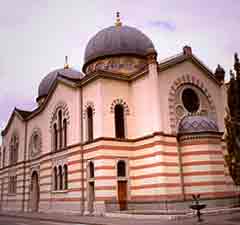
Basel Jews date their community from this time. In 1868 the single-domed
synagogue was built. After full civil rights were granted in 1874 the
Jewish community experienced significant growth.
Theodor Herzl on the podium
at the First
World Zionist Congress in Basel
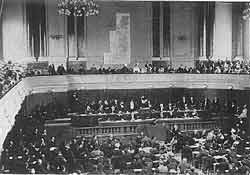 |
The First
Zionist Congress was held in Basel in 1897. It was originally supposed
to be held in Germany but was moved to Basel because of rabbinical protests in Germany.
In his diary Theodor
Herzl wrote, "To summarize the Basel Congress in one sentence
- which I shall be careful not to pronounce publicly - it is this: I
have founded the Jewish state in Basel." It was Herzl's wish to
center the Zionist movement in Basel, with a special congress building there, but his wish was never
realized. However, Basel was the host of nine
more congresses: including the second, attended by Chaim
Weizmann, the sixth - in which the Uganda
plan was proposed, the tenth - the first conducted in Hebrew, and
the twenty-second - the last held outside of Israel in 1946. At the
Congress in 1929, held in Switzerland, the Jewish
Agency was formed.
Many Jews from Alsace and Eastern
Europe immigrated to Switzerland in the nineteenth and twentieth centuries.
In 1903, a Jewish cemetery was opened in Basel. Between then and 1947,
several other synagogues were built. In 1947, the Great Synagogue (originally
built in 1868) was restored. In 1972, the Jewish community of Basel was
the first Jewish community in Switzerland to be recognized as a sanctioned
corporation. In 1996, the Basel Jewish community numbered 1655 people.
In April 2012, a packed house of rabbis, diplomats, government officials, and Jewish community members presided over an historic dedication of the first synagogue to open in Basel since 1929. The synagogue, called the Feldinger Chabad Jewish Center, was backed by philanthropist and international businessman Sami Rohr to honor the memory of Shlomo Zalman and Recha Feldinger, who at the height of World War II provided a loving home to the young refugee.
The
Struggle for Sh'chitah
Despite the constitution of 1874 granting full religious
equality, certain religious
requirements were still forbidden, particularly ritual
slaughter (shechitah).
In 1886, the Aargau Society for the Prevention
of Cruelty to Animals called for the government to prohibit ritual slaughter.
A year later, the Jews of Baden petitioned the government to allow kosher
slaughter according to Jewish
law (halakha). The Swiss government upheld the prohibition against
kosher slaughter, ruling that, while it may impinge on religious freedom,
it was indispensable to prevent cruelty to animals. The issue was brought
to referendum and, in August 1893, an article was inserted into the
Swiss confederal constitution declaring ritual slaughter illegal throughout
the whole of Switzerland. That ban continues to this day.
The Jewish
community of Switzerland has fought as late as 2002 and 2003 to reverse
the ban on kosher slaughter but have not been successful after over
a century in the face of constant protests by European animal rights
groups. In 2002, the Swiss government promised Swiss Jewish leaders
that they would not prevent the importation of more-expensive kosher
meat but would not allow cheaper domestic slaughter. This compromise
does not please the Jewish community. Alfred Donath, president of the
Jewish Federations, said the law forbidding kosher slaughter is discriminatory and a violation
of human rights and religious freedom. Samuel Debrot, president of the
Vaud section of the Society for the Protection of Animals, stated that Jews and Muslims should "either become vegetarians or leave
the country."
Another prominent opponent to ritual slaughter is
Erwin Kessler, president of Verein gegen Tierfabrik (Association against
Animal Factories) who was convicted of hate crimes against the Jews,
among others, and is known to affiliate with Holocaust deniers. He has
previously compared ritual slaughter to the Nazi treatment of Jews.
Intellectual
Elite
From emancipation onwards, Switzerland became a major haven for the
Russian Jewish intellectual circle. Imbibing Western ideals about freedom,
Switzerland helped shape the ideology of these Russian Jewish intellectuals. Chaim Weizmann wrote of his university days in 1898:
If Russian Jewry was the cradle of my Zionism,
the Western universities were my finishing schools. The first of these
schools was Berlin, with
its Russian-Jewish society; the second was Berne, the third Geneva,
both in Switzerland.
Around this time, prominent
Jews who would become leaders of the Russian
Revolution such as Georgi Valentinovich
Plekhanov, Marxist philosopher and leader
of the Russian Social Democratic movement,
and Leon Trotsky, were also in Switzerland. Albert
Einstein spent his youth in Switzerland
and received his doctorate from Federal
Polytechnic Academy in Zurich and was employed
by the Swiss patent office. Ze'ev
Jabotinsky also studied law in Switzerland.
The
Holocaust
Prior to and during the Second World War, Switzerland gave refuge to
about 23,000 Jewish refugees although the government decided that Switzerland
would serve only as a country of transit. These Jews were protected
during the Holocaust due to Swiss neutrality. The Jewish refugees, however,
did not receive the financial support from the government that non-Jewish
refugees received. Many more Jews were prevented from entering, effectively
shutting the border. The Swiss government persuaded Germany to stamp
"J" on the passport of Jews, making it easier to refuse Jewish
refugees. The end of the war had delivered many thousands of Jews into
the hands of the Nazis and their collaborators. In 1942, the Swiss police
issued a regulation that denied refugee status to "refugees only
on racial grounds, e.g., Jews." By the end of the war, less then
25,000 Jews were permitted to take refuge. Most of the refugees left
Switzerland at the end of the war. More then 30,000 Jews were turned
away according to a 25-volume study on Switzerland's role during World
War II completed in 2002.
In the past few years, Switzerland has had to owe up
to its behavior during the Holocaust.
In 1996, Swiss President Kastar Villiger formally apologized to world
Jewry for their 1938 accord with the Nazis and its wartime actions against
the Jews. At the same time, however, he downplayed economic cooperation
between Switzerland and Nazi Germany. It transpired that numerous documents
relating to Jewish property in Swiss banks disappeared during the 1940s
and 1950s and there was significant pressure in the 1990s and early-21st
century to rectify
and compensate Holocaust victims and their heirs who were denied
their assets in Swiss banks.
Post-World
War II
In 1956, after the Sinai
Campaign and Hungarian uprising, the Swiss Federation of Jewish
Communities looked after Jewish refugees from Egypt and Hungary. In 1968,
it also looked after Jews who fled to Switzerland from Czechoslovakia.
Switzerland has generally been seen of as supportive toward Israel,
while maintaining its noted neutrality. This support was strengthened
by an Arab terrorist
attack against an El
Al plane in Zurich in 1969 and an act
of sabotage on a Swissair plane bound for Israel in 1970. However,
like in the rest of Europe, anti-Semitism and anti-Israel sentiment
has increased since September 2000 according to the Stephen
Roth Institute for the Study of Contemporary Anti-Semitism and Racism.
According to the 1990 census, 17,577 Jews (0.26% of the total population)
reside in Switzerland. While the number of Swiss Jews has remained fairly
stable since the early twentieth century, the relative proportion has
declined owing partly to emigration, an aging population, and mixed
marriages. The largest communities are in Zurich, Basel, Geneva and
Vaud, however Jewish communities can be found in all of Switzerland's major cities. One-third of the total Jewish population is in Zurich. While the
population has decreased, the institutional strength of the Jewish community
has increased.
Basel Synagogue
 |
The Swiss Jewish population is well organized and united. There is
an umbrella organization of more than 23 different Jewish organizations and 17 Jewish communities
- The Swiss Federation
of Jewish Communities (SIG/FSCI) - that provides a united front
for Swiss Jewry. The Swiss Federation of Jewish Communities was founded
in 1904 to combat the prohibition against kosher slaughter. By the 1950s
and 1960s, the Federation was already working on the issue of dormant
accounts assets held by Jews in Swiss banks. The Federation has acted
as official representation of the Jewish community in the international
investigation of Holocaust assets and Swiss banks. The Federation
was also a founder of the World
Jewish Congress. The FSCI has a strong Orthodox representation but includes the entire spectrum of the Jewish community
in its membership with the exception of the ultra-Orthodox (out of choice)
and Reform communities (because the
other members have prevented them). Switzerland's two liberal communities have formed a platform which cooperates with the Federation of Communities on the issues of anti-Semitism and security. Switzerland's French-speaking Jewish population is represented by the CICAD (Coordination Intercommunautaire Contre l'Antisémitisme et la Diffamation), which has its headquarters in Geneva. CICAD focuses on education, organizing seminars and trips to Auschwitz for teachers, and distributing information and materials to schools. Both SIG and CICAD train high school students to talk to their peers about anti-Semitism and Israel. Both organizations also teamed up to establish Media Watch, an organization which monitors and analyzes Swiss media coverage of issues relating to the Jewish community and works to counter anti-Semitic statements and attempts to delegitimize the State of Israel. Media Watch also collaborates closely with AKdH (Aktion Kinder des Holocaust), which runs the biggest database in Switzerland on subjects of Jewish interest. AKdH also runs a program that seeks to rehabilitate neo-Nazi youngsters from the streets, called 'Internet Streetworking.'
The Jewish population is well represented
in the textile and clockwork industries as well as manufacturers and
wholesales. Switzerland does not have much Jewish representation in
Switzerland's largest industry -- chemicals. They also do not play a
significant role in public banking, but European banking magnate Edmond
Safra ran his banking industry from Switzerland for many years and Jews
own many private banks in Switzerland. Jews are also not well represented
in public service, but Switzerland's first woman president (January
1-1999 - January 1, 2000) Ruth Dreifuss was also Jewish. Many international
Jewish organizations, such as the World
Jewish Congress, have offices in Switzerland. Switzerland, particularly
in the large cities, has numerous Jewish institutions, youth groups,
thriving synagogues, kosher restaurants, Jewish bookstores, and other
signs of a flourishing Jewish life
Tourist
Sites
There are several very important tourist sites that
are a must see! Most important are the Three Kings Hotel in Basel and
the Stadtcasino. Theodor Herzl stayed at the Three Kings Hotel in August 1897, during the world's first
Zionist Congress. Besides Herzl,
the hotel has also been visited by Napoleon, Dickens, Voltaire, and
Metternich. The Congress itself was held at the Stadtcasino —
a concert hall. While not officially open to viewing, visitors manage
to find their way into the main stage area. To the right of the stage
there is a plaque that reads: "On Theodor Herzl's initiative and
under his guidance, the first Zionist organization was established leading to the foundation of the State
of Israel."
Basel also has Switzerland's only Jewish museum and
the Great Synagogue is a national landmark. The Jewish Museum at Kornhausgasse
8 includes an exhibit on Zionism with
mementos from the First Zionist Congress. It also includes various Jewish
memorabilia from the Jews of Switzerland. The synagogue, first built
in 1868, was expanded and renovated several times over the past century-and-a-half.
The Great Synagogue, at Leimenstrasse 24, houses two synagogues, a choir,
mikveh, and is beautifully designed. Next door to the synagogue is the
community center, library, and day school.
Behind the synagogue at Mostackerstrasse 17 stands
Victor Goldschmidt's Jewish bookshop. Another important attraction is
Israel Park, a grove of 40 trees, presented by Israeli president Chaim
Herzog, that were given to Basel by the JNF/KKL and the State of Israel on the occasion of the 40th anniversary of the
State.
There is a well that Zurich's Jews were accused of
having poisoned in the Middle Ages which was rediscovered during renovation
in 1979. It can be seen parallel to the window of the Guegi framing
shop at 15 Predigergasse. The ICZ Building is the center for Zurich's
non-haredi Jews which houses community services, meeting halls, and
a kosher restaurant. It is located at 33 Lavaterstrasse; 41-1-283-2222.
The Loewenstrasse Synagogue, dedicated in 1884, is the oldest synagogue
in Zurich. It is located at 10 Loewenstrasse, corner of Nueschelerstrasse;
41-1-201-1659. Other synagogues include the Freigutstrasse Synagogue
(37 Freigutstrasse; 41-1-201-4998), Agudas Achim Synagogue (8 Erikastrasse;
41-1-463-6798), Chabad (19 Witelikerstrasse; 41-1-386-8403) and several
smaller minyanim. The Holocaust Memorial Cemetary is an inscribed stone
near the funeral hall of the Upper Friesenberg Jewish cemetary on Friesenbergstrasse.
Jewish Cemeteries
BADEN/AG:
Jewish cemetery: In use since 1879, 353 graves
BASEL:
Jewish Museum at Kornhausgasse 8, Tel. 25-95-14 contains
fragments of Jewish tombstones from 1222. Source: Israelowitz, Oscar.
Guide to Jewish Europe. Brooklyn, NY: Israelowitz Publishing, 1995,
p. 321. [October 2000]
Wie die Israelitische Gemeinde in Basel zu einem eigenen
Friedhof Gekommen ist/ eine Berichterstattung von S. Bloch-Roos. Basel:
Basler Handelsdruckerei A. Galliker, 1902. 54 p. microfilm; 16 mm. At
the Leo Baeck Institute: ID # MfW W687
Ueber den judenfriedhof in Zwingen und Judenniederlassungen
im Fuerstbistum Basel/ von Nordmann, Achilles/Basel: 1906. [120]-151
p. illus. 24 cm. Detached from Basler Zeitschrift fuer Geschichte und
Altertumskunde, Bd. 6, Heft 1. At the Leo
Baeck Institute: ID # GT 3264 Z9 N6
BASEL/BS:
Jewish cemetery: In use since August 1903, capacity
4,800 graves, used 3700
BERN/BE:
Jewish cemetery: In use since 1871, capacity 2,000
graves, used 1753
BIEL:
CAROUGE/ GE:
Jewish cemetery: Located near Geneva (Switzerland)
on the other side of the "Arve" river. The older inscriptions
are from about 1779. The total number of stones is about 720. Entirely
and very well renovated in 1996 by the "Communaute Israelite de
Geneve". Because of the 1876 legal interdiction against the establishment
of new cemeteries in the 'canton de Genève', a new cemetery was
located in Etrembières (France). With its entry in Switzerland,
the village of Veyrier was created in 1920. The cemetery of Carouge
was used again in 1943-1944 during the German occupation of the Haute-Savoie.
Source: Jean-Daniel Greub-Hirsch [email protected]
LA CHAUX-DE-FONDS/ NE:
Jewish cemetery: The cemetery is located in "Les
Eplatures" between La Chaux-de-Fonds and Le Locle. There are hundreds
of stones. The oldest inscription is 5 December 1872 (Cecile Hirsch).
The Jewish community of La Chaux-de-Fonds principally comes originally
from the village of Hegenheim (Alsace, near Basle, Switzerland) and
from others villages of Alsace. The cemetery and its little chapel are
active. The same architect erected the very beautiful synagogue of La
Chaux-de-Fonds (located between the "rue de la Serre" and
the "rue du Parc") about 1900 and the synagogue destroyed
by the German troops in Strasbourg, France. The synagogue of La Chaux-de-Fonds
was recently entirely renovated. Source: Jean-Daniel Greub-Hirsch; e-mail: [email protected]
DAVOS/GR:
Jewish cemetery: Street address is Islen near Davos.
In use since 1931, capacity 945, used 180
ENDINGEN AND LENGNAU: {10686} also see Tiengen, Germany
The newer section of the cemetery
 |
Endingen-Lengnau -- Verein fuer Erhaltung der Synagogen
und des Friedhofs Endingen-Legnau [The Association for the Preservation
of the Synagogues and the Cemetery of -- ] published a complete register
of the burial sites, with name index and arranged by dates, supplemented
by a volume of narrative which includes, among other documents and photographs,
a facsimile of the first Jewish census of 1761: Der Judenfriedhof Endingen-Lengnau.
2 vols. 400 pp. Menes Verlag, Postfach 5070, CH 5405 Baden. Sfr. 100
(about $66). (If you join the Association for Sfr 30/year, you may buy
1 copy (2 vols). Postage is additional for non-Swiss delivery). The
in German books are excellent and list all the people buried there.
(Names are from the book listed below, which were sent to IAJGS.) As
the only place in Switzerland where Jews were allowed to settle from
the 17th to the 19th centuries, Endigen and Lengnau Jews had to bury
their dead on an island in the Rhine. Then, in 1750, they established
a cemetery halfway between the two villages where some 2,700 persons
have been buried to date.
The old Jewish cemetery
 |
"About one half mile from Lengnau, in the direction
of Endingen, is the old Jewish cemetery. It is recognized by a cluster
of trees, on the right side of the road, and is surrounded by a stone
wall. During the first years of settlement in Lengnau, the Jews were
forbidden to bury their dead in Switzerland. They had to travel north
to the Rhine River, and bury their dead on an island in the middle of
the river, known as Juden Insle, Jews' Island." Endingen-Lengnau
is close to the town of Baden in Switzerland. Source: Israelowitz, Oscar.
Guide to Jewish Europe. Brooklyn, NY: Israelowitz Publishing, 1995,
p. 322. [October 2000]
FRIBOURG/FR:
Jewish cemetery: In use since 1904; 150 graves, 105
used
GENEVE:
LA TOURDE PEILZ:
Jewish cemetery: Cemetery has been indexed - 900 gravesites:
source: Jean-Pierre Bernard, 8, rue du Bocage, 91400 Orsay, France did
the indexing. [email protected].
Write to him in French.
LAUSANNE-PRILLY/VD:
Jewish cemetery: address: Av. Du Chateau, In use since
June, 1892, capacity 2000, used 1800
LUGANO-NARANCO/TI:
Jewish cemetery: In use since 1918, capacity 540, used
466
LENGNAU: see ENDINGEN
LUZZERN/LU:
I: In use since May 1, 1887, capacity and used 366
II: In use since May 6, 1943, capacity 689, used 369
ST.GALLEN/SG:
I: II:
VEVEY/VD:
ZURICH/ZH: (ICZ)
Unt. Friesenberg (ICZ)
Oberer Friesenberg (IRG)
Steinkluppenweg, In use since 1899-1968, capacity & used: 200
Pfaffhausen-Wedstr., In use since Nov.26, 1939, no more information
AGUDAS(OR CHADASCH) used since: 1982, 270 graves, used 31
Sources: Antisemitism
Worldwide 2001-2002: Switzerland
"Basel," Tigay, Alan M. (ed.). The
Jewish Traveler.
Jason Aronson, Inc: 1994.
"Basel - Swiss City welcomes Jewish travelers." The
Washington Jewish Week
Blocker, Joel. "Europe:
Switzerland Examines its Immoral Holocaust Record." Radio Free
Europe.
Eban, Abba. Heritage:
Civilization and the Jews.
Summit Books: 1984
Elazar, Daniel, "The
Jewish Agency: Current Role and Current Crisis."
"First New Synagogue in 80 Years Inaugurated in Basel," E-Jewish Philanthropy (April 19, 2012).
Independent
Commission of Experts
International
Jewish Cemetery Project - Switzerland
Israelitische Gemeinde
Basel (IGB) (Jewish Community of Basel)
Jewish Agency for
Israel - Department for Jewish Zionist Education
Jewish
Communities of the World: World Jewish Congress
Jewish Encyclopedia, "Switzerland."
Jewish
Switzerland from WUJS
Judaism
in Switzerland
Rom, Fred. JTA. "Swiss
will keep kosher slaughter ban, but will guarantee import of meat."
Swiss
Federation of Jewish Communities
"Switzerland" Encyclopaedia Judaica, CD-ROM v. 1.0
Map
from CIA World Factbook 2002
The Stephen Roth Institute for the Study of Contemporary
Anti-Semitism and Racism, Annual Report 2005, Switzerland.
Cemetery photos courtesy of Swissworld.org |