
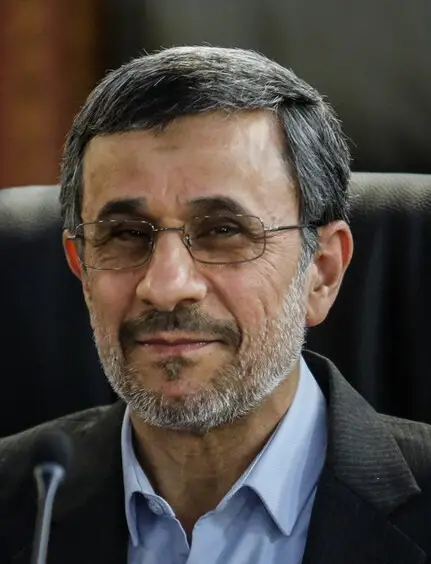
Mahmoud Ahmadinejad is an Iranian politician and diplomat who served as the sixth President of Iran from August 2005 to August 2013.
Ahmadinejad (born October 28, 1956) was born in Garmsar, near Tehran in central Iran. His father, Ahmad, was a grocer, barber and religious Shi'a Muslim who taught the Quran, while his mother, Khanom, held an honorific title given to those believed to be direct bloodline descendants of Muhammad.
In 1976, Ahmadinejad enrolled in the Iran University of Science and Technology (IUST) as an undergraduate student of civil engineering. He earned his Ph.D. in 1997 in transportation engineering and planning from IUST when he was the Mayor of Ardabil Province.
Confusion surrounds Ahmadinejad's role in the 1979 Islamic Revolution. Several of the American hostages from the U.S. embassy said they are certain Ahmadinejad was among those who captured them. Ahmadinejad, however, always maintained his distance from this incident and several known hostage-takers also denied he was with them.
After the Islamic Revolution, Ahmadinejad joined the Revolutionary Guards voluntarily and he is also reported to have served in covert operations during the Iran-Iraq War in the 1980's.
In 2003, the City Council of Tehran appointed Ahmadinejad as mayor of Iran's capital city. He stayed in that post until is election to the presidency in June 2005. That year, Ahmadinejad was one of the top ten finalists for the "World Mayor 2005" award, however his resignation to take the post of president made him ineligible for the award.
In June 2005, Ahmadinejad, a mostly unknown candidate who had never before run for political office, won 62% of the votes in a run-off against former President Ali Akbar Hashemi Rafsanjani and he was inaugurated into the post by Ayatollah Khamenei in August 2005. In 2009, with the explicit support of Khamenei, Ahmadinejad won reelection as president, beating his main competitor Mir-Hossein Moussavi with 62% of the vote.
Ahmadinejad is widely considered to be a religious, ultra-conservative Islamist, with a commitment to an agenda of economic populism and sociopolitical conservatism, bearing ample resemblance to the Taliban’s. However, unlike his predecesors Khatami and Rafsanjani, Ahmadinejad has no formal religious education and has always stressed his modest origins. Moreover, Ahmadinejad has praised the acts of suicide terrorists and staunchly defends his country's nuclear program. He has been condemned by Human Rights Watch and other NGO's for the worsening human rights conditions in Iran and has successfully cracked down on pro-democracy dissidents as well as a budding femanist movement.
In June 2013, Iranian academic and politican Hassan Rouhani won election as president to replace Ahmadinejad who was not allowed to run due to legislative term limits.
Ahmadinejad periodically signaled interest in returning to power, including expressing a desire to run again in presidential elections despite repeated tensions with Iran’s ruling establishment and past disqualifications by the Guardian Council. During the political turmoil and protests that swept Iran in 2025–2026, reports circulated that he had been detained by authorities, reflecting the regime’s broader crackdown on political figures and dissent amid nationwide unrest. At the same time, rumors of his death spread widely during the recent U.S.-Israeli strikes on Iran, with some outlets claiming he had been killed. Still, these reports were later contradicted by videos and statements indicating he was alive.
The New York Times reported in July 2026 that Israel had spent years cultivating former Iranian President Mahmoud Ahmadinejad as an intelligence asset and potential replacement for Iran’s leadership, despite his history of Holocaust denial, anti-Israel rhetoric and nuclear expansion. Israeli operatives had allegedly met him abroad, including during conferences in Budapest arranged as cover, provided money for travel and housing, and discussed a plan under which he would recognize Israel and join the Abraham Accords after taking power. The effort culminated after the war began in February 2026, when Mossad operatives reportedly extracted Ahmadinejad from his Tehran compound following an Israeli strike and moved him to a safe house. The plan collapsed after he became disillusioned and left under unclear circumstances. Ahmadinejad later resurfaced briefly at Ayatollah Ali Khamenei’s funeral and was reportedly placed under house arrest by the Revolutionary Guards. His office rejected the report, dismissing the newspaper’s allegations as “Hollywood-style claims” and accusing it of publishing fabricated stories. It said Ahmadinejad remained active and continued his daily work.
Ahmadinejad is married, and has one daughter and two sons.
Sources: BICOM; BBC Online; The New Republic; Biography Channel; Official Website of the President of the Islamic Republic; Azer News; New York Times; @IranIntl_En.
Photo: Mehr News Agency, CC BY 4.0, via Wikimedia Commons.