Erich Hoepner
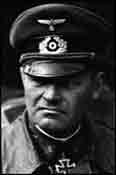
(1886 - 1944)
Erich Hoepner was born in Frankfurt, Germany on September 14, 1886. He joined the German Army and after the First
World War he was a member of the Freikorps.
Hoepner remained in the army and, by 1938,
had reached the rank of Major General and was head of 1st Light Division
and took part in the invasion of Czechoslovakia and Poland.
He placed his tanks at the disposal of the conspirators for the intended 1938 coup attempt
against Hitler.
In March 1939,
Hoepner succeeded Heinz
Guderian as head of the 16th Army Corps and, the following year,
led his troops in France and chased Allied troops to Dunkirk.
Hoepner also took part in Operation
Barbarossa where he commanded the
4th Panzer Army. Hoepner’s enthusiasm
for the war against Russia reflected
his belief in Hitler’s fight
against Jews and Bolsheviks. In an order he issued on May 2, 1941, Hoepner wrote:
“The war against Russia is an important part of the
German people’s battle
for existence. It is the old fight of Germans
versus Slavs, the defense of
European culture against the Muscovite-asiatic
flood; and the repulse of
Jewish Bolshevism.
This war must have as its goal the destruction
of today’s Russia and for
this reason it must be conducted with unheard-of
harshness. Every clash
must, in its conception and execution, be guided
by the iron will to
completely and mercilessly annihilate the enemy.
In particular, there is to
be no mercy for the carriers of the current Russian-Bolshevik
system.”
His troops
attacked Leningrad before being transferred
to the AG Centre and fought under Gunther von Kluge on
the advance to Moscow. By December 5, 1941,
Hoepner was only 20 miles north of the
capital. However, following a counter-attack
by the Red Army, Hoepner decided to withdraw
his troops to save them from annihilation. Adolf
Hitler was furious when he heard
the news and dishonorably discharged
Hoepner in 1942 for
withdrawing German forces from Moscow
on his own initiative. After protests
from senior figures in the German Army,
Hoepner was allowed to retire and was
able to retain his pension rights.
In 1944, Hoepner joined the plot to overthrow
Adolf Hitler. He was on hand in the Bendlerstrasse
to help Stauffenberg launch his coup on July
20, 1944. He was appointed acting
Commander-in-Chief of the Home Army after General
Fromm refused to launch Operation Valkyrie. Arrested
that night, Hoepner declined to commit
suicide and chose to face the People's
Court. He was later found guilty of treason
and hanged at Ploetzwnsee Prison on August
8, 1944.
Sources: Joric
Center; Email from Dr. Geoffrey P. Megargee,
Applied Research Scholar,
Center for Advanced Holocaust Studies,
United States Holocaust Memorial Museum, Spartacus
Educational [Spartacus photo] |