Guenther von Kluge
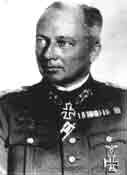
(1882-1944)
Scholars agree that the failure of the anti-Hitler
conspirators to enlist the active support of a single field marshal
with an army at his disposal severely impaired their goal to overthrow
the Nazi regime. Senior
officers like Guderian, Rundstedt, Manstein, Halder, and Brauchitsch,
might have tipped the scales in the conspirators' favor, but they refused.
Kluge, on the other hand, appeared to hold out more promise.
After his schooling at the Military Academy, Kluge
served on the General Staff from 1910 to 1918. During the inter-war
period, he rose quickly through the ranks to colonel in 1930, major-general
in 1933 and lieutenant-general
the following year. After 1936,
Kluge was given command of an army corps. His interest in mobile warfare
soon won Hitler's esteem
and assured Kluge's continued ascendance.
Kluge disliked Hitler's gangsterlike Nazi entourage
and was appalled at the persecution of the Jews. He was among those many
officers of the General Staff who feared Hitler's warmongering would lead Germany to disaster. But
like others, Kluge soon succumbed to Hitler's spell as the Teflon fuehrer
won one spectacular victory after another. When it came to Poland,
Kluge had for years bitterly resented the Versailles Treaty's compensation
of West Prussia to Poland and believed Germany was entitled to reclaim
its eastern territories.
In the September 1939 campaign against Poland, Kluge
proved to be an outstanding strategist on the battlefield, racing ahead
with his army to reach the Vistula before Britain and France had even declared
war. In this first of adventures he exhibited "a flair for innovation"
and won Hitler's admiration. (Lamb, 396). Yet Kluge noted with horror
the slaughter of Jews which was being perpertrated by Reinhard
Heydrich's security forces that followed on the heels of the Wehrmacht.
Having heard in early October the shocking news that
Hitler intended to wage war against the West at the earliest opportunity,
Kluge pondered whether to join the conspirators in their second bid for
a coup attempt. But he quickly rejected their appeal on account of Hitler's
immense popularity at that stage with the German people and troops.
The October 1939 coup attempt was aborted by Army Chief of Staff General Franz Halder who believed
Hitler was on to something when the latter threatened to "destroy
the spirit of Zossen" (the headquarters of the General Staff).
During the campaign against France and the Low Countries,
Kluge again distinguished himself in the field of battle for his bold
and innovative use of the panzer divisions. He developed a close
professional and personal relationship with General Erwin
Rommel who served under him and contributed immensely to his victories.
On July 19, 1940,
Hitler awarded Kluge the field marshal's baton and selected him to help in the invasion of Russia.
He was assigned to Army Group Center commanded by Field Marshal Feodor
von Bock.
Like so many other senior officers in his theater
of operations, Kluge failed to dissuade Hitler from diverting the bulk
of Army Group Center's panzer forces northward and southward towards
Leningrad and the eastern Ukraine. Like Bock,
he was shocked that Hitler expected Army Group Center to conquer Moscow
with a seriously depleted panzer force. As half-frozen exhausted German
infantry forces ground to a halt before Moscow, Hitler angrily rejected
Kluge's pleas to authorize a limited retreat to allow the Wehrmacht
to recuperate. Hitler's lack of compassion for the troops and his inability
to understand that Moscow could not be taken under such conditions, caused
Kluge to develop serious doubts about Hitler's sanity.
In June 1942,
Kluge's commanding officer, Bock,
was temporarily stricken with illness. Hitler therefore appointed Kluge
to suucceed him as Commander-in-Chief of Army Group Center. At Army
Group Center headquarters in Smolensk, Kluge developed a close friendship
with his Chief of Staff Colonel Henning
von Tresckow - an officer of outstanding professional ability who
by that time had become the leader of the conspiracy and had recruited
many officers into the plot.
Tresckow wasted no time convincing his senior ranking officer that they were dealing
with a maddened tyrant who had committed unspeakable evils against humanity
and who's war would lead to the total destruction of Germany. The aristocratic
circle of young officers on Tresckow's staff, outraged by the brutality
of Hitler's war of genocide in Russia, had been won over long before.
The Army Group Center conspirators persuaded Kluge that Germany's only
hope of survival was Hitler's physical elimination. Tresckow even arranged
for Germany's most influential anti-nazi politician Dr.
Carl Goerdeler to be secretly flown to Smolensk to help enlist Kluge.
But Kluge had a serious character flaw vis a vis the conspirators -
the inability to stick to his guns.
Kluge agreed to Tresckow's plan to lure Hitler into
visiting Army Group Center headquarters in Smolensk where the conspirators
planned to kill him. But when he discovered that the scenario involved shooting
the fuehrer as he lunched with the officers, Kluge forbid it claiming
that it would be shameful for German officers to dispose of Hitler in
this manner. By contrast, when Tresckow approached his young fellow
anti-nazi staff officers with the same suggestion, thirty-five of them
immediately volunteered to form the shooting party. But because Kluge
had vetoed the measure, the Army Group Center conspirators missed the
best chance they had of killing Hitler when he visited their headquarters
on March 13, 1943. It was not the last time Kluge would fail the plotters.
On June 29, 1944,
Hitler fired Field Marshal Gerd
von Rundstedt as Commander-in-Chief West and appointed Kluge in
his place. Kluge now had under his command all the German armies in
France and was therefore in a position to give the conspirators the pivotal
support they needed to start a coup. But ever the waiverer, and ever susceptible
to Hitler's hypnotic influence, after spending a few days at Hitler's
Berchtesgaden retreat, he returned to France convinced that the fuehrer
alone could save Germany and that Rommel and Rundstedt were overly
pessimistic.
As soon as Kluge arrived
at Rommel's
headquarters at La Roche-Guyon, an angry
row erupted with Rommel demanding that Kluge visit the western front
himself. Upon his return, Kluge was again
won back into the conspirator's camp and
on July 12 agreed with Rommel that
the war was lost and that Hitler must sue
for peace or be overthrown. On July 16,
military governor for Paris and co-conspirator
General Karl Heinrich von Stuelpnagel informed Rommel and Kluge that Colonel Claus
von Stauffenberg, who had just been
elevated into Hitler's inner circle, would
assassinate Hitler within days and a Beck-Goerdeler
government would be formed to negotiate
peace. Kluge in his typical manner promised
to help only if they succeeded in killing
Hitler. Rommel, however, promised to cooperate
regardless of whether his commanding officer,
Kluge, went along with the plot.
Tragically for the conspirators, Rommel was seriously wounded the next day, leaving them to depend on Kluge for
support. On July 19, Kluge visited Stuelpnagel in Paris and was told that
the asssassination and coup would take place the next day. Kluge promised to honor Rommel's commitment. According to General
Blumentritt, another conspirator close to Stuelpnagel, when Kluge heard
the news of the explosion at Rastenberg, he stated: "If the Fuhrer
is dead, we ought to get in touch with the other side at once."
(Lamb, 407).
Despite the failure of the July
20th coup in Berlin, Stuelpnagel
did his part and had the entire Gestapo and SS contingent in Paris
arrested by Wehrmacht units. When Kluge learnt of Hitler's survival,
it was futile to expect any support from his quarter. But Stuelpnagel
and his aide Colonel Caesar von Hofacker (also Stauffenberg's cousin)
were not prepared to give up, and they drove to Kluge's headquarters.
Hofacker implored Kluge that he had all the armies in France at his disposal and could lead a mass uprising. At the very least he could
surrender all German forces under his command to the Allies and thereby
save thousands of German lives, and help the Anglo-Saxon powers reach
Berlin before the Russians get there. But the Commander-in-Chief remained
silent. When Stuelpnagel persisted, Kluge threatened him with arrest.
As the Normandy front unraveled, Kluge desperately
tried to convince Hitler to withdraw the western armies back to the
Rhine and hold the line there, but Hitler refused to yield an inch of
territory. On August 15, as British and American armies cut deep into the forces of Army Group West, Kluge decided after
all to contemplate surrender and left his headquarters all day. But
at fuehrer headquarters, an American radio transmission was intercepted
asking for Kluge's whereabouts.
Hitler immediately suspected Kluge of attempting to
negotiate an armistice and called it the worst day of his life. Dr. Udo
Esche, Kluge's son-in-law (who provided the cyanide capsule with which
the field marshal later commited suicide) told Allied interrogators
that Kluge had contemplated surrender and "went to the front line
but was unable to get in touch with the Allied commanders."
George Pfann, secretary to General Patton, later revealed
that Patton had also vanished the same day and that the American general
had tried to make contact with a German emissary who had not appeared
at the appointed place. Montgomery's Chief of Intelligence also confirmed
that Kluge was reported missing and that he warned his general that
they might receive a message from Kluge at any moment. (ibid.).
When asked by fuehrer headquarters about his being
out of touch for an entire day, Kluge replied that his radio car had
been damaged by enemy fire. A suspicious and livid Hitler rebuffed Kluge's
story and sacked him immediately, replacing him with a fanatical Nazi
- Field Marshal Walter Model. Kluge then decided to return to Germany.
While driving through Valmy he committed suicide, certain that he had
somehow been implicated in the July 20th plot.
Sources: Joric Center |