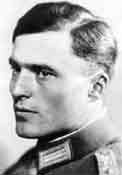
Claus von Stauffenberg was
born in Jettingen, Germany on November 15,
1907. In his youth, he belonged to Stefan
George's circle and remained a disciple of
the great poet for the rest of his life.
He would quote George's The Anti-Christ when
recruiting friends and trusted colleagues
into the conspiracy.
A bright student, at nineteen
he became an officer cadet. He attended the
War Academy in Berlin and joined the General
Staff in 1938 as a quartermaster officer
in General Erich Hoepner's 1st Light
Division, which was renamed 6th Panzer Division
in November 1939.
Stauffenberg served combat positions in
all of Hitler's major
campaigns from the Sudetenland to Poland, France and Tunisia. During Operation Barbarossa,
Stauffenberg became appalled by the atrocities
committed by the Schutzstaffel
(SS), SD and “Security Police” units,
particularly the mass murder of the Jews
in Russia. He was equally appalled by
the atrocities committed by the German Army
against Soviet prisoners-of-war and by the
treatment of the civil population in Russia at the hands of the German occupation administration
and forces. Stauffenberg cited these
matters to Major Joachim Kuhn in August 1942.
From the end of May 1940 to the end of January
1943, Stauffenberg served in the Army High
Command/General Staff Headquarters.
In early 1943, Stauffenberg served with
the 10th Panzer Division in Field Marshal Erwin
Rommel's Afrika Korps. On April 7, 1943,
he was seriously wounded at Sebkhet en Noual,
south of Mezzouna in the North African desert,
when Allied fighters strafed his vehicle.
He lost his left eye, right hand, and last
two fingers of his left hand after surgery.
Stauffenberg had decided
earlier in 1942 that he must try to help overthrow Hitler. He had attempted throughout the summer
of 1942 to persuade senior commanders to
move against Hitler, and he had declared
in September 1942 that he himself was prepared
to kill Hitler. In 1943, he only agreed to
join in conspiracy with the civilian side
of the German Resistance, including Wilhelm
Canaris, Carl
Goerdeler, Julius
Leber, Ulrich
Hassell, Hans
Oster, Henning
von Tresckow, Fabian
von Schlabrendorff , Peter Graf
Yorck von Wartenburg, Ludwig
Beck, and Erwin
von Witzleben in what became known as
the July
Plot.
According to the plan, after Hitler, Hermann
Goering and Heinrich
Himmler were assassinated, Ludwig
Beck, Erwin
von Witzleben and Friedrich
Fromm would take control of the German
Army and seize key government buildings,
telephone and signal centres, and radio stations.
Stauffenberg was to become State Secretary
of the War Ministry in the post-coup government.
In June 1944, Stauffenberg
was promoted to Colonel and appointed Chief
of Staff to Home Army Commander General Friedrich
Fromm. This gave him direct access to
Hitler's briefing sessions.
On July 11, Stauffenberg
brought a bomb concealed in a briefcase with
him to a briefing at Hitler's Berghof residence.
He planned to assassinate Hitler that day,
but circumstances beyond his control prevented
him from doing so.
Four days later, Stauffenberg
flew to the Fuehrer's "Wolf's Lair" headquarters
with aide and co-conspirator Captain Friedrich Karl Klausing with intent to leave a bomb in a briefing meeting with Hitler.
However, Stauffenberg reported the absence of Himmler and Luftwaffe Air Marshal Hermann
Goering from the briefing session and was subseuqently ordered by senior conspirators in Berlin to abort the assassination attempt. Nevertheless, he
secretly agreed with close friend and
co-conspirator Colonel Albrecht von Mertz to try to
kill Hitler anyway, but when he returned
to the briefing room, he discovered the session
had ended after only five minutes.
On July 20, Stauffenberg
flew to the Wolf's Lair again, this time with aide and
co-conspirator Lt.
Werner von Haeften. Stauffenberg, who
had never met Hitler before, carried the
bomb in a briefcase and placed it on the
floor of the briefing room while he left to make a phone call.
Shortly thereafter the bomb exploded.
Four men died from the attack - one outright while three others succumbed to their wounds later - but Hitler survived the blast with only a badly injured right arm. Stauffenberg returned to Berlin with Haeften and arrived at Army High
Command Headquarters at 4:30 P.M. to launch
the planned coup. The plot unraveled, however,
for several reasons: co-conspirator General
Friedrich Olbricht neglected to set the
coup in motion during the first two hours after
the assassination attempt; the conspirators failed
to seize any radio stations or retain authority
over reserve army troops in Berlin; and, most notably, Hitler survived the
attack.
In an attempt to protect
himself, Fromm organized
the execution of Stauffenberg along with
three other conspirators - Olbricht, von Haeften, and von Mertz - in the courtyard of
the War Ministry.
On July 21, 1944, at 12:30
A.M., Stauffenberg was executed by firing
squad. It was later reported that Stauffenberg
died shouting, "Long live free Germany."