Erwin von Witzleben
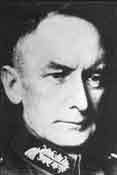
(1881 - 1944)
Erwin von Witzleben was born in Breslau, Germany on December 4, 1881. He joined the German Army in March 1901 as a second lieutenant in the 7th Grenadier Regiment.
On the outbreak of the First World War Witzleben he
was appointed Adjutant of the 19th Reserve Brigade. He served on the
Western Front where he won the Iron Cross. In April 1917, Witzleben
assumed command of a battalion in the 6th Infantry. The following year
he became General Staff Officer to the 108th Infantry Division.
Witzleben remained in the army and in January 1921
was given command of the 8th Machine Gun Company. He was on the General
Staff of the Wehrkries IV (1922-25), 12th Cavalry Regiment (1925-26)
and Infantry Command III (1926-28). W became Chief of Staff of Wehrkries
IV (1929-31) and commander of the 8th Infantry Regiment (1931-33).
In 1934 Witzleben was promoted to major general and
appointed commander of Wehrkries III, replacing General Werner von Fitsch,
who was named Commander in Chief of the Army.
An opponent of Adolf
Hitler and his government in Nazi Germany, Witzleben joined with Erich von Manstein, Wilhelm Leeb and Gerd von Rundstedt to
demand a military inquiry into the death of Kurt von Schleicher following
the Night of the Long Knives.
However, the Defence Minister, Werner von Blomberg, refused to allow
it to take place.
Witzleben was furious when his friend, General Werner
von Fitsch, was dismissed as Commander in Chief of the Army on a trumped
up charge of homosexuality. He was now a staunch anti-Nazi who began
considering the possibility of a military coup against Hitler. The Gestapo became aware of his criticisms of Hitler and in 1938 he was forced to take early retirement. Witzleben plotted
with anti-Nazis such as Ludwig
Beck, Franz Halder, Wilhelm Canaris, Hans
Oster, Wolf von Helldorf, Kurt Hammerstein-Equord and Erich Hoepner
and they considered the possibility of a military coup.
On the outbreak of the Second World War, Witzleben
was recalled to the German Army. In the invasion of France Witzleben commanded the 1st Army. His troops broke through the Maginot
Line in June 1940 and then occupied Alsace-Lorraine. As a result of
this action, Witzleben was promoted to the rank of field marshal.
Witzleben remained in France and after the failure
of the Operation Barbarossa he once again began plotting against Adolf
Hitler. The Gestapo was
informed that he was once again being critical of the government and,
in 1942, Witzleben was called back to Germany and retired.
Witzleben spent the next two years at his country
estate. He kept in touch with anti-Nazis and, in 1944, became involved
in the July Plot. After Claus von Stauffenberg planted the bomb, the conspirators thought that Hitler had been killed,
and Witzleben was installed as Commander in Chief of the Armed Forces
and Erich Hoepner as Commander of the Home Army.
On July 21, 1944, Witzleben was arrested and during
his trial he was humiliated by being forced to appear in court without
his belt and false teeth. Erwin von Witzleben was found guilty of treason
and on August 8, 1944, was executed by being hung by piano wire from
a meat hook.
Sources: Spartacus
Educational |