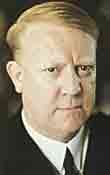
Vidkun Abraham Lauritz Jonssøn
Quisling was a Norwegian politician and
officer, commonly known as one of World
War II's most infamous traitors. He held
the office of Minister President of Norway
from February 1, 1942, to the end of World
War II, while the elected social democratic
cabinet of Johan Nygaardsvold was exiled
in London. Quisling was tried for high treason
and executed by firing squad after the war.
The term "quisling" has
become a synonym in many European languages,
including English, for traitor.
Vidkun Quisling
had a mixed and relatively successful background,
having achieved the rank of major in the
Norwegian army (some years before he had
become the country's best ever war academy
cadet upon graduation), and worked with
Fridtjof Nansen in the Soviet Union during
the famine in the 1920s, as well as having
served as defense minister in the agrarian
government 1931-1933. He was the son of the
Lutheran minister and well-known genealogist
Jon Lauritz Quisling, and both of his parents
belonged to some of the oldest and most
distinguished families of Telemark.
On May 17, 1933,
the Norwegian Constitution Day, Quisling
and state attorney Johan Bernhard Hjort formed
Nasjonal Samling (NS) ("National
Unity"), the Norwegian national-socialist
party. Nasjonal Samling had an anti-democratic,
Führerprinzip-based political structure,
and Quisling was to be the party's Führer,
much like Adolf
Hitler was for the NSDAP in Germany.
The party went on to have modest successes.
In the election of 1933, four months after
the party was formed, it garnered 27850
votes, following support from the Norwegian
Farmer's Aid Association, with which Quisling
had connections from his time as a member
of the Agrarian government. However, as the
party line changed from a religiously rooted
one to a more pro-German and anti-Semitic hardline
policy from 1935 onwards,
the support from the Church waned and, in
the 1936 elections,
the party got about.50,000 votes. The party
became increasingly extremist, and party
membership dwindled to an estimated 2,000
members after the German invasion.
When Germany invaded Norway
on April 9, 1940,
Quisling became the first person in history
to announce a coup during a news broadcast,
declaring an ad-hoc government during the
confusion of the invasion, hoping that the
Germans would support it. The background
for this action was the flight northwards
of the King and the government. Quisling
had visited Adolf
Hitler in Germany the year before, and
was liked by Hitler, so Quisling's belief
that the Germans would back his government
was not entirely unfounded. However, Quisling
had little popular support, and the Quisling
government lasted only five days, after which
Josef Terboven was installed as Reichskommissar
(Commissioner), the highest authority in
Norway, reporting directly to Hitler. The
relationship between Quisling and Terboven
was tense, although Terboven, presumably
seeing an advantage in having a Norwegian
in a position of power to reduce resentment
in the population, named Quisling to the
post of “Minister President” (as opposed to Prime Minister) in 1942, a
position the self-appointed
"Führer" assumed in 1943,
on February 1.
Vidkun Quisling stayed in
power until he was arrested May 9, 1945,
in a mansion on Bygdøy in Oslo that
he called Gimle after the place in Norse
mythology where the survivors of Ragnarok
were to live.
Quisling, along with two
other Nasjonal Samling leaders, Albert Viljam
Hagelin and Ragnar Skancke, were convicted
and executed by firing squad. In later days,
these sentences have been controversial,
since the capital punishment was reintroduced
to the Norwegian legal system during the
end of the war, by the exile government,
to handle the postwar trials.
Maria Vasilijevna, Quisling's Russian wife, lived in Oslo until her
death in 1980. They had no children.