Pope Benedict XVI
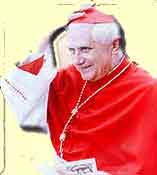
(1927 - )
Joseph Alois Ratzinger was elected as Pope of the Roman Catholic Church on April 19, 2005 and formally installed as Pope Benedict XVI during the Mass of Papal Installation on April 24 of that year. In February 2013, Pope Benedict announced that he would resign from the papacy, citing his advanced age and declining health as reasons for the first such resignation in six centuries. In March 2013, Pope Benedict was succeeded by Jorge Mario Bergoglio (Pope Francis).
- Early Life
- Communio and Later Works
- Ratzinger, the Jews and Israel
- Election as Pope
- Controversy
- Acts As Pope
- Visit to German Synagogue
Early
Life
Joseph Ratzinger was born in Marktl am Inn, in Bavaria, Germany, the son of a police
officer who was anti-Nazi. In 1937,
Ratzinger's father retired and setled in the town of Traunstein. When
Ratzinger turned 14 in 1941,
as required by law he joined the Hitler
Youth. According to his biographer John Allen he was not an enthusiastic
member. He requested to be taken off the rolls and reportedly refused
to attend a single meeting.
In 1943,
at the age of 16, Ratzinger was, along with the rest of his class, drafted
into the Flak or anti-aircraft corps, responsible for the guarding of
a BMW plant outside Munich. He was then sent for basic infantry training
and was posted to Hungary,
where he worked setting up anti-tank defences until deserting in April 1944.
In 1945,
Ratzinger was briefly held in an Allied POW camp, where he attended
de-Nazification classes. By June, he was released, and he and his brother
(Georg) entered a Catholic seminary. On June 29, 1951, they were ordained
by Cardinal Faulhaber of Munich. Ratzinger's dissertation (1953) was
on Saint Augustine, his Habilitationsschrift (second dissertation) on
Saint Bonaventure. Ratzinger's supporters say his experiences under
the Nazi regime convinced him that the Church had to stand up for truth
and freedom.
Ratzinger was a professor at the University of Bonn
from 1959 until 1963, when he moved to the University of Münster.
In 1966, he took a chair in dogmatic theology at the University of Tübingen,
where he was a colleague of Hans Küng but was confirmed in his
traditionalist views by the liberal atmosphere of Tübingen and
the Marxist leanings of the student movement of the 1960s. In 1969,
he returned to Bavaria, to the University of Regensburg, eventually
rising to become its dean and vice-president.
At the Second Vatican Council (1962–1965), Ratzinger
served as a peritus or chief theological expert alongside Justinae Janisch,
to Josef Cardinal Frings of Cologne, Germany.
Communio
and Later Works
In 1972, Ratzinger founded the theological journal Communio with Hans Urs von Balthasar, Henri de Lubac and others. Communio,
now published in seventeen editions (German, English, Spanish and many
others), has become one of the most important journals of Catholic thought.
In March 1977, Ratzinger was named archbishop of Munich
and Freising, and in the consistory that June was named a Cardinal by
Pope Paul VI. At the time of the 2005 Conclave, he was one of only 14
remaining cardinals appointed by Paul VI, and one of only three of those
under the age of 80, and so eligible to participate in that Conclave.
On November 25, 1981, Pope
John Paul II named Ratzinger prefect of the Congregation for the
Doctrine of the Faith, formerly known as the Holy Office of the Inquisition,
which was renamed in 1908 by Pope Pius X. He resigned the Munich archdiocese
in early 1982, became cardinal-bishop of Velletri-Segni in 1993, vice-dean
of the College of Cardinals in 1998, and was elected Dean in 2002, ,
becoming titular bishop of Ostia.
In office, Ratzinger usually took traditional views
on topics such as birth control and inter-religious dialogue. He was
closer to John Paul II than any other cardinal, and Ratzinger and John
Paul were called “intellectual bedfellows.” Many see him
as being a “scientist” who prefers intellectual discussions.
He was already one of the most influential men in the Vatican before
he became Pope and presided over the funeral of John Paul II and the
Conclave in 2005 that elected him. During the most recent sede vacante,
he was the highest-ranking official in the Catholic Church.
Piers Paul Read wrote or Ratzinger in The Spectactor on March 5, 2005:
There can be little doubt that his courageous promotion
of orthodox Catholic teaching has earned him the respect of his fellow
cardinals throughout the world. He is patently holy, highly intelligent
and sees clearly what is at stake. Indeed, for those who blame the
decline of Catholic practice in the developed world precisely on the
propensity of many European bishops to hide their heads in the sand,
a pope who confronts it may be just what is required. Ratzinger is
no longer young — he is 78 years old: but Angelo Roncalli was
the same age when he became Pope as John XXIII. He turned the Church
upside-down by calling the Second Vatican Council and was perhaps
the best-loved pontiff of modern times.
“We are moving toward a dictatorship of relativism
which does not recognize anything as definitive and has as its highest
value one's own ego and one's own desires,” Ratzinger declared
at a pre-conclave Mass in St. Peter's Basilica.
Election
as Pope
This is the 16th Pope to choose the name Benedict;
the last such named Pope (Benedict XV) served as Pope from 1914 to 1922
and was the Pope during the years of World War I. He is the eighth German
pope. The last German pope, Adrian VI, was elected in 1522 and died
in 1523. He is also the oldest cardinal to become pope since Clement
XII in 1730, who like Ratzinger was elected at age 78.
Benedict speaks ten languages (among them German, Italian,
English, and ecclesiastical Latin). He is an accomplished pianist with
a preference for Beethoven.
In April, 2005, he was identified as one of the 100
most influential people in the world by Time Magazine. On April
19, 2005, he was elected as the successor to Pope
John Paul II on the second day of the papal conclave.
On his first appearance at the balcony of Saint Peter's
Basillica after becoming Pope, he had notably forgotten to take his
black sweater off before putting on his Papal robes, leaving it clearly
showing on his arms. At the balcony, his first words to the crowd of
thousands were:
Dear brothers and sisters, after the Great Pope John
Paul II, the cardinals have elected me, a simple, humble worker in
the Lord's vineyard. I am comforted by the fact that the Lord knows
how to work and act even with insufficient instruments. And above
all, I entrust myself to your prayers. With the joy of the risen Lord
and confidence in His constant help, we will go forward. The Lord
will help us and Mary, His most holy mother, will be alongside us.
Thank you.
Controversy
Ratzinger has a long record of controversial remarks
on Islam, Buddhism, politics,
and social issues such as homosexuality, and for some Catholics who
had hoped for a more moderate choice, the election of Cardinal Ratzinger
caused immediate consternation.[1]
As head of the Congregation for the Doctrine of the
Faith, Ratzinger waged a campaign against liberation theology, which
had gained ground among priests in Latin America and elsewhere as a
means of involving the Church in social activism and human rights issues.
He has described homosexuality as a “tendency”
towards an “intrinsic moral evil.”
Ratzinger also has spoken out on other issues related
to politics. For example, during the 2004 U.S. presidential election
campaign, he called for pro-choice politicians to be denied Communion.
He has also argued that Turkey should not be admitted into the European
Union.
Acts As Pope
On April 20, 2005, Benedict listed top priorities of
his pontificate in a message read in Latin to cardinals gathered in
the Sistine Chapel for the first Mass celebrated by the 265th leader
of the Roman Catholic Church. He said his “primary task”
would be to work without fail to reunify all Christians and that sentiment
alone was not enough. “Concrete acts that enter souls and move
consciences are needed,” he said. The Pope also declared his willingness
to continue “an open and sincere dialogue” with other religions
and would do everything in his power to improve the ecumenical cause.
In a Vatican sermon marking his installation as new
pontiff, Pope Benedict XVI extolled Jews for sharing a “spiritual
heritage” with Christianity. Benedict offered greetings to “my
brothers and sisters of the Jewish people, to whom we are joined by
a great shared spiritual heritage, one rooted in God´s irrevocable
promises.” Rome´s chief rabbi, Riccardo di Segni, received
a personal invitation to the Sunday Mass in which the Pope said “I
confide in the help of the Almighty to continue the dialogue and strengthen
the collaboration with the sons and daughters of the Jewish people.”
The rabbi did not attend the event due to Passover.
Pope Benedict held his first
audience for 25 Jewish leaders from Israel,
the United States, Europe and Latin America
on June 9, 2005. “The history of relations
between our two communities has been complex
and often painful,” the pope said, “but
I am convinced that the spiritual patrimony
treasured by Christians and Jews is itself
the source of the wisdom and inspiration
capable of guiding us toward a future of
hope in accordance with the divine plan.”
He praised a landmark document of the 1962-1965
Second Vatican Council, recalling that it
urged greater understanding and esteem between Christians and Jews and that it “deplored
all manifestations of hatred, persecution
and anti-Semitism.”
He added: “At the very beginning of
my pontificate, I wish to assure you that
the Church remains firmly committed, in her
catechesis and in every aspect of her life,
to implementing this decisive teaching."
The Pope also told his visitors the painful
past could not be forgotten. “Remembrance
of the past remains for both communities
a moral imperative and a source of purification
in our efforts to pray and work for reconciliation,
justice, respect for human dignity and for
that peace which is ultimately a gift from
the Lord himself.” Benedict called
for “continued reflection on the profound
historical, moral and theological questions
presented by the experience of the Shoah.”
Another early sign of sensitivity
toward Jews was the Pope's decision to at
least temporarily block the beatification
of Leon Dehon (1843-1925), a French priest
who founded the Priests of the Sacred Heart
order. The Pope acted after a historian found
several controversial texts in which Dehon
made disparaging remarks about Jews, such
as suggesting Jews were “thirsty for
gold” and that “lust for money
is a racial instinct in them.” He also
called the Talmud “a manual for the
bandit, the corrupter, the social destroyer,” and
recommended that Jews wear special markings,
live in ghettos and be prevented from owning
land or participating in certain professions.
Pope Benedict appointed a commission to investigate
the priest's writings.
In February 2008, Pope Benedict XVI made the decision to reformulate the Catholic Church’s traditional Good Friday prayers. The Latin prayers for Good Friday ask Catholics to “pray also for the Jews that the Lord our God may take the veil from their hearts and that they also make acknowledge Our Lord Jesus Christ,” and ask God not to “refuse your mercy even to the Jews; hear the prayers which we offer for the blindness of that people so that they may acknowledge the light of your truth, which is Christ, and be delivered from their darkness." The new text will drop all references to the “darkness” and “blindness” of the Jews.
The Pope had issed a “Motu Propio” edict permitting the use of this version of the prayer from the 1962 Latin Tridentine missal in July 2007. But after protests from leaders in the Jewish community, the Pope drafted a new version to be used in time for the Holy Week celebrations in March 2008.
Visit
to German Synagogue
On August 19, 2005, Pope
Benedict visited the synagogue on
Roonstrasse in Cologne, Germany in
what was viewed as a reflection of his interest
to maintain the warm relations with world
Jewry fostered by his predecessor who had
been the first Pope to visit a synagogue. “It
has been my deep desire, during my first
visit to Germany since my election...to meet
the Jewish community of Cologne and the representatives
of Judaism in
Germany,” the
Pope said. The Pope reflected on the Holocaust and anti-Semitism,
saying, “In the darkest period of German
and European history, an insane racist ideology,
born of neo-paganism, gave rise to the attempt,
planned and systematically carried out by
the regime, to exterminate European Jewry...This
year marks the 60th anniversary of the liberation of the Nazi concentration
camps, in which
millions of Jews — men, women and children — were
put to death in the gas
chambers and ovens.”
Israel's two chief rabbis
met with Pope Benedict XVI on September
15, 2005, to celebrate the 40th anniversary
of a landmark Vatican
document on relations
with Jews, and sought his support in fighting anti-Semitism and terrorism. Israel's
Ashkenazic Chief Rabbi Yona
Metzger and
Sephardic Chief Rabbi Shlomo
Amar called
on the pope at his summer residence in
Castel Gandolfo, in the hills south of
Rome.
On October 27, 2005, Pope Benedict celebrated
the 40th anniversary of the Second
Vatican Council’s “Nostra
Aetate” document, which absolved
Jews of collective guilt in the death of
Jesus. “This anniversary gives us abundant
reason to express gratitude to almighty God,” Benedict
told Jewish and Catholic leaders marking
the event in Rome. “In laying the foundations
for a renewed relationship between the Jewish
people and the church, Nostra Aetate stressed
the need to overcome past prejudices, misunderstandings,
indifference and the language of contempt
and hostility,” he said. “I have
expressed my own firm determination to walk
in the footsteps traced by my beloved predecessor
Pope John Paul II. The Jewish-Christian dialogue
must continue to enrich and deepen the bonds
of friendship which have developed.”
“We cannot but denounce and fight
hatred and incomprehension, injustice and
violence that continue to sow concern into
the souls of men and women of good faith,” Benedict
said January 16, 2006, during his first meeting
with Rome’s chief rabbi, Riccardo Di
Segni. “How
can one not be hurt and worried by the renewed
displays of anti-Semitism that sometimes
appear?” He added, “The people
of Israel have been freed on numerous occasions
from the hands of their enemies and the hand
of the Almighty has supported and guided
them during centuries of anti-Semitism (and)
in the dramatic time of the Shoah,” he
said.
In May 2008, Pope Benedict
congratulated Israel on its birthday and
described Israel's 60th Independence
Day as a sign of God's beneficence toward the
Jews. “The Holy See is united with
you,” he reportedly told Motti
Levy, the new Israeli ambassador to the Vatican,
“and thanks God for the full realization
of the Jewish people's aspirations to live
in its homeland, the land of its forefathers.”
Ratzinger,
the Jews and Israel
Ratzinger's membership in
the Hitler
Youth has raised eyebrows in the Jewish
community, but he explained that membership
was compulsory in his 1997 book Salt of
the Earth:
“At first we weren't,” he
says, speaking of himself and his older brother. “But
when the compulsory Hitler Youth was introduced
in 1941, my brother was obliged to join.
I was still too young, but later as a seminarian
I was registered in the Hitler Youth. As
soon as I was out of the seminary, I never
went back. And that was difficult because
the tuition reduction, which I really needed,
was tied to proof of attendance at the Hitler
Youth.”
Ratzinger wrote that he
was helped by a mathematics professor. “He
himself was a Nazi, but an honest man, and
said to me, ‘Just go once to get the
document so we have it...’
When he saw that I simply didn't want to,
he said, ‘I understand, I'll take care
of it’ and so I was able to stay free
of it.”
Rabbi David Rosen, the international
director of interreligious affairs for the
American Jewish Committee, said the choice
of Ratzinger as Pope would bring continuity
to Catholic-Jewish relations. “He has
a deep commitment to this issue. And his
own national background makes him sensitive
to the dangers of anti-Semitism and
the importance of Jewish-Catholic reconciliation,” Rosen
said
Rabbi Israel Singer, chairman
of the World Jewish Congress, called Ratzinger
the architect of the “ideological policy
to recognize, to have full relations
with Israel.”
Cardinal Ratzinger played
a key role on a number of issues related
to Judaism and
the Holocaust during
the pontificate of John
Paul II involved. For example, he personally
prepared Memory
and Reconciliation, the 1999 document
outlining the church's historical
“errors” in its treatment of
Jews.
Ratzinger also authorized
the 2002 publication, “The Jewish People
and the Holy Scriptures,” prepared
by the Pontifical Biblical Commission. That
210-page report was seemingly buried upon
publication, but contained several important
expressions of Church doctrine. For example,
it said “the Jewish messianic wait
is not in vain”
and that Jews and Christians share their
wait for the Messiah,
although Jews are waiting for the first coming
and Christians for the second. The report
also expressed regret that certain passages
in the Christian Bible condemning individual
Jews were used to justify anti-Semitism.
It also stressed the importance of the Torah for
Christians.
“He has shown this
sensitivity countless times, in meetings
with Jewish leadership and in important statements
condemning anti-Semitism and
expressing profound sorrow for the Holocaust,” said
Abraham H. Foxman, Anti-Defamation League
National Director. “We remember with
great appreciation his Christmas reflections
on December 29, 2000, when he memorably expressed
remorse for the anti-Jewish attitudes that
persisted through history, leading to ‘deplorable
acts of violence’ and the Holocaust.
In that Christmas “meditation,” which
appeared on the front page of the Vatican
newspaper L'Osservatore Romano, Ratzinger
said:
Even if the most recent,
loathsome experience of the Shoah (Holocaust)
was perpetrated in the name of an anti-Christian
ideology, which tried to strike the Christian
faith at its Abrahamic roots in the people
of Israel, it cannot be denied that a certain
insufficient resistance to this atrocity
on the part of Christians can be explained
by an inherited anti-Judaism present in
the hearts of not a few Christians.
According to the Religious
News Service, “Ratzinger's warm tone
and repeated emphasis on Christianity's roots
in Judaism appeared
aimed at easing severe strains caused by
the controversial document on salvation that
his congregation issued in September 2000.
The ‘Declaration Dominus Iesus’ asserted
the primacy of Catholicism and said followers
of other religions are in a ‘gravely
deficient situation’ regarding salvation.”
“The entire story
of salvation,” Ratzinger said in his
meditation, “had Israel as its initial
protagonist. For this reason, the voices
of Moses and the prophets have resonated
in the liturgy of the church from the beginning
until today; Israel's Book of Psalms is also
the church's great book of prayer.”
Ratzinger has also written
about dialogue with Jews:
The average observer would
probably regard the following statement
as obvious: the Hebrew Bible, the “Old
Testament,”
unites Jews and Christians, whereas faith
in Jesus Christ as the Son of God and Redeemer
divides them. It is not difficult to see,
however, that this kind of division between
what unites and what divides is superficial.
For the primal fact is that through Christ
Israel's Bible came to the non-Jews and
became their Bible...For through the encounter
with Jesus of Nazareth the God of Israel
became the God of the Gentiles. Through
him, in fact, the promise that the nations
would pray to the God of Israel as the
one God, that the “mountain of the
Lord”
would be exalted above all other mountains,
has been fulfilled. Even if Israel cannot
join Christians in seeing Jesus as the
Son of God, it is not altogether impossible
for Israel to recognize him as the servant
of God who brings the light of his God
to the nations. The converse is also true:
even if Christians wish that Israel might
one day recognize Christ as the Son of
God and that the fissure that still divides
them might thereby be closed, they ought
to acknowledge the decree of God, who has
obviously entrusted Israel with a distinctive
mission in the “time of the Gentiles.”
....I think we could say
that two things are essential to Israel's
faith. The first is the Torah, commitment
to God's will, and thus the establishment
of his dominion, his kingdom, in this world.
The second is the prospect of hope, the
expectation of the Messiah
— the expectation, indeed, the certainty,
that God himself will enter into this history
and create justice, which we can only approximate
very imperfectly.... For Christians, Christ
is the present Sinai, the living Torah
that lays its obligations on us, that bindingly
commands us, but that in so doing draws
us into the broad space of love and its
inexhaustible possibilities. In this way,
Christ guarantees hope in the God who does
not let history sink into a meaningless
past, but rather sustains it and brings
it to its goal. It likewise follows from
this that the figure of Christ simultaneously
unites and divides Israel and the Church:
it is not in our power to overcome this
division, but it keeps us together on the
way to what is coming and for this reason
must not become an enmity.
He also made remarks, however,
that raised some concerns among Jews. In
2001, for example, Ratzinger said the Church
is waiting for the moment when Jews will “say
yes to Christ.” When asked if Jews
should acknowledge Jesus as
the Messiah,
Ratzinger said, “We believe that. The
fact remains, however, that our Christian
conviction is that Christ is also the Messiah
of Israel.”
Ratzinger said this “does
not mean that we have to force Christ upon
them but that we should try to share in the
patience of God. We also have to try to live
our life together in Christ in such a way
that it no longer stands in opposition to
them or would be unacceptable to them but
so that it facilitates their own approach
to it....They are not excluded from salvation,
but they serve salvation in a particular
way, and thereby they stand within the patience
of God, in which we, too, place our trust.”
In January 2009, Italy’s
rabbis announced they were pulling out of
the Italian Catholic Church’s annual
celebration of Judaism because of Pope Benedict
XVI’s decision to restore a prayer
in Easter Week services of the old Latin
Mass that calls for the conversion of Jews.
The chief rabbi of Venice, Elia Enrico Richetti,
said, “If we add to this the recent
positions taken by the pope about dialogue,
said to be useless because the superiority
of the Christian faith is proven anyway,
then it’s evident that we're heading
toward the cancellation of the last 50 years
of church history.”
According to the Jerusalem
Post, “In 2007, Benedict relaxed
restrictions on celebrating the old Latin
Mass, also known as the Tridentine rite,
which was celebrated before the liberalizing
reforms of the Second Vatican Council in
the 1960s paved the way for the New Mass
used widely today in local languages. In
doing so, Benedict restored to prominence
a prayer for the conversion of Jews that
is recited during Good Friday services
of Easter Week. Jewish groups had long
criticized the prayer, and they expressed
dismay that the pope's decree would allow
it to be celebrated more broadly. In a
bid to stem the criticism, the Vatican
issued a new prayer last year. But Jewish
groups said the changes were equally disappointing
since the language still suggested that
they needed to convert to Christianity
to find salvation.”
Pope Benedict XVI insisted
on January 28, 2009, that he felt “full
and indisputable solidarity” with Jews
after his decision to revoke the excommunication
of a bishop who says no Jews were gassed during
the Holocaust provoked
an outcry among Jews and prompted the Chief
Rabbinate of Israel to sever ties with the
Vatican. The Vatican said removing the excommunication
did not imply an endorsement of Bishop Richard
Williamson’s denial that
6 million Jews were murdered during World
War II. Bowing to criticism, the
Vatican on February 4 demanded that Williamson
“absolutely and unequivocally distance
himself from his remarks,” but Williamson’s
subsequent apology was deemed insufficient
for readmission into the Catholic Church
as a clergyman.
In a meeting with Jewish
leaders aimed at quelling the controversy
over Williamson, the Pope said the Catholic
Church was “profoundly and irrevocably
committed to reject all anti-Semitism.” He
added, “The hatred and contempt for
men, women and children that was manifested
in the Shoah was a crime against God and
against humanity....It is beyond question
that any denial or minimization of this terrible
crime is intolerable and altogether unacceptable.”
In his annual New Year's message in 2010,
the Pope said: “Once
again I call for a universal recognition
of the right of the State of Israel to exist
and to enjoy peace and security within internationally
recognized borders," he
said. "Likewise,
the right of the Palestinian people to a
sovereign and independent homeland, to live
in dignity and to enjoy freedom of movement,
ought to be recognized.” He
also called for “protection
of the identity and sacred character of Jerusalem,
and of its cultural and religious heritage,
which is of universal value.” Later,
the Vatican issued a statement
saying that the latest meeting of representatives
of Israel and the Vatican had been “useful” in moving toward an agreement on unresolved
financial issues clouding relations between
the two states.
On January 17, 2010, the
Pope paid his first visit to the main synagogue of Rome, Longotevere
Cenci. The president of Rome's Jewish
community, Riccardo Pacifici, criticized Pope
Pius XII for his silence during the Holocaust in
remarks before the Pope spoke. Afterward,
Pope Benedict said the Vatican had worked
quietly to save Jews.
In March 2011, when excerpts of his latest book, the second volume of Jesus of Nazareth, were released, the Pope received praise from Jewish organizations for his repudiation of the claim that the Jewish people were responsible for the death of Jesus. Though the Vatican already rejected the claim in general terms in 1965 with the Nostra Aetate document, Benedict employs a thorough scholarly analysis of Catholic teaching to clearly draw the conclusion based on scripture.
Sources: Wikipedia; BBC
News (April 19, 2005); New York Times (February 11, 2013); Jerusalem Post
(April 19 & 20,
& August 21, 2005, February 3,
2008, January
14 & 27, February
12, 27,
2009; January
17, 2010); The
Jewish Week (January 25, 2002); Catholic
Reflections & Reports; Religion
News Service (December 29, 2000); Haaretz,
(April 22, 2005, June 9, 2005); Washington Post,
(June 16, 2005); AP,
(September
15, 2005); JTA, (October 28, 2005;
January 17, 2006; May 14, 2008; January
12, 2010, March 3, 2011); Photo:
Domus Ecclesiae |