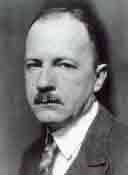
Attorney and estate owner Ewald von Kleist-Schmenzin
supported the German National People's Party and advocated a monarchistic
and Christian ideal of conservatism. In the final phase of the Weimar
Republic, he resolutely opposed National
Socialism and refused to fly the swastika flag over his castle. He was arrested in May and June of 1933 and released a short time later.
Ewald von Kleist-Schmenzin traveled to London in the
summer of 1938 as a secret emissary of Ludwig
Beck and Admiral Canaris to inform the British government of the existence of a German opposition
to Hitler. Through his
contacts to Winston Churchill and Robert Vansittart, he tried to shift
Great Britain away from its policy of appeasement. Only the British
government's credible determination to back Czechoslovakia with military
force, Kleist-Schmenzin insisted, would provide the German anti-war
faction the support it needed among the generals to move against Hitler.
Winston Churchill is receptive and agreed to write a strongly-worded
letter to Hitler. The
letter reached its destination but had no effect, as Churchill was not
yet prime minister.
Kleist-Schmenzin met Carl
Goerdeler in 1942 and 1943 and agreed
to support new attempts at a coup d'etat. Later, he joined the inner
circle of the conspiracy and backs Colonel
von Stauffenberg's plan to assassinate Hitler. He also encouraged
his son Lt. Ewald Heinrich von Kleist to volunteer for a suicide assassination
attempt organized by Stauffenberg and set for January 1944.
Circumstances beyond their control caused the attempt to be canceled.
Kleist-Schmenzin is appointed by Stauffenberg to be
the political representative in the Stettin military district for the
coup, but he was arrested on July 21, 1944, after the coup failed. He was sentenced to death by the People's Court on February
23, 1944, and hanged April 9, 1945,
in Plotzensee prison.
The criminal investigation involving his son, Ewald-Heinrich,
who on July 20, 1944, was present in the Bendler Block with the conspirators
as aide-de-camp under orders from Fritz-Dietlof
Graf von der Schulenburg, was dropped on December 12, 1944. He was
subsequently transferred to the front and survived the war.