Simcha Nornberg
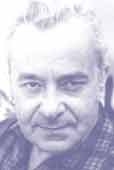
(1918-2000)
Simcha Nornberg was a Jewish Polish-born artists.
He was born
on July 18, 1918, in Nowe Brzesko, a small
Jewish town near Crakow,
to Hadassa and Nathan, into a poor religious
family. He received a traditional education
in Heder and Talmud Torah.
Nornberg graduated in 1937
from HaGymnasia HaIvrit in Crakow,
where he started painting. He also began
his study of law at the Jagiellonian University,
playing a leading role in Zionist movements.
At the beginning of WWII,
he moved to the eastern part of Poland,
which was controlled by the Soviet Union,
and organized the Zionist youth in Lvov.
In 1940, Nornberg was declared an “enemy
of the people” and sentenced to prison
with hard labor in Soviet camps, where he
refused to work on Yom
Kippur. His paintings, done for the wife
of the prison-camp commander, saved his life.
Most of his family had remained in the German-controlled
part of Poland and
perished in the Holocaust.
His older sister, Genia Weinstein, was saved
by Oscar
Schindler and lives today in New Heaven.
 |
| Self Portrait (1993) |
In 1945, Nornberg wrote,
acted and directed a play that was staged
at the local theater in Ursk in the Ural
mountains. A young Jewish woman, named Bella
Gelassen, who acted the role of his wife
in the play, became his real life wife before
the end of the year.
Nornberg returned to Poland in
1946, where he engaged in Zionist politics
and educational activity. He founded the
first Hebrew school in Katowitz and was active
in aiding Jewish survivors to
immigrate to Eretz
Israel. He took up painting again, depicting
mainly scenery of the small Jewish towns
and villages that had been destroyed during
the war. His Zionist activities endangered
his life and he was forced to flee Poland.
After a short stay in Paris, he and his family
immigrated to Israel in
1948.
During the years 1949-1952,
Nornberg was active in Israeli politics and
public life and became a member of the World
Jewish Congress leadership between 1952-1955.
He edited the Hebrew monthlies BaDerech and Mabat.
In 1955, Nornberg set up
a private law firm in Tel
Aviv. The year 1972 marked a turning
point in his life when he abondoned law and
dedicated himself fully to art.
The images that Nornberg
carried within him for so long gushed forth
in his desire to compensate himself for “lost
time.” The contrasts that characterize
his entire oeuvre are manifested in a real
rift between two worlds: the world of his
childhood and youth cut short so cruelly
by World
War II, and the “new world,” a
modern world of cultural and political rebirth
in Israel. Nornberg's work affirms life,
but cannot ignore an entire world turned
topsy-turvy by the war. The passing time
honed and intensified the artist's need to
give testimony, to battle forgetfulness,
to leave footprints behind and revive the
ashes of the past world whose music continued
to be heard in his soul many years after
it fell silent.
Nornberg passed away on
January 8, 2000. He and his wife Bella, who
passed away later that year, are burried
at the Old Cemetery on Trumpeldor Street
in Tel Aviv.
A permanent exhibition of
Nornberg's work is exhibited in the art gallery
named after he and his wife at Bar-Ilan
University in Israel and at the Teatr
NN Museum in Lublin, Poland. A documentary
television film: “My Shtetl - The place
Where I Was Born” was made about Nornberg's
paintings by Nathan Gross, one of Israel's
pioneering filmakers.
Sources: Simcha
Nornberg - Malen um zu leben, Aachen: Shaker,
1997. Ksiega ascemy i radosci zycia / Simcha Nornberg
; ze wstepem Jana P. Hudzika - The book of
asceticism and joy of life / Simcha Nornberg
; with an introduction by Jan P. Hudzik,
Lublin 1999. |


