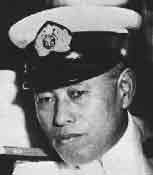
Isoroku Yamamoto was the outstanding Japanese naval
commander of World War II.
Born Isoroku Sadayoshi in the village of Kushigun Sonshomura
on Hokkaido. He enrolled at the Naval Academy at Etajima, Hiroshima
in 1896, graduating in 1904. In 1905 during the war with Russia he saw
action as an ensign on the cruiser Nisshin in at the Battle of Tsushima
against the Russian Baltic Fleet and was slightly injured. After the
war he went with various ships all over the Pacific.
In 1913 he went to the Naval Staff College at Tsukiji,
a sign that he was being groomed for the high command. Upon graduation
in 1916, he was appointed to the staff of the Second Battle Squadron
and was adopted by the Yamamoto family. From 1919-1921 he studied at
Harvard University. Promoted to Commander apon his return to Japan he
taught at the staff college before being sent to the new air-training
centre at Kasumigaura in 1924 to direct it and to learn to fly. From
1926 to 1928, he was naval attache to the Japanese embassy in Washington.
He was then appointed to the Naval Affairs bureau and made Rear Admiral,
he attended the London Naval Conference in 1930. Back to Japan he joined
the Naval Aviation bureau and from 1933 headed the bureau and directed the entire navy air program.
In December 1936,
Yamamoto was made vice minister of the Japanese navy, from which position
he argued passionately for more naval air power and opposed the construction
of new battleships. He also opposed the invasion of Manchuria and the
army hopes for an alliance with Germany.
When Japanese planes attacked a US gunboat on the Yangtze River in December 1937 he apologised personally to the American Ambassador. He became the target
for right-wing assassination attempts, the entire Naval ministry had
to be placed under constant guard. However on August 30, 1939 Yamamoto was promoted to full Admiral and appointed commander-in-chief
of the entire fleet.
Yamamoto did not soften his logical anti-conflict
stance, when the Japan signed the Tripartite Pact with Germany and Italy
in September 1940,
Yamamoto warned Premier Konoe Fumimaro not to consider war with the
United States: "If I am told to fight... I shall run wild for the
first six months... but I have utterly no confidence for the second
or third year." He also accurately envisaged the "island-hopping"
and air dominance tactics such a war would have. His foresight also
led him to believe that a pre-emptive strike against US Navy forces
would be vital if war did occur.
Following the invasion of Indochina and the freezing
of Japanese assets by the US in July 1941,
Yamamoto won the argument over tactics and when in December war was
declared the entire First Fleet air arm under Admiral Nagumo Chuichi
was directed against the American fleet at Pearl Harbor, attacking on
December 7. With around 350 planes launched from six carriers, eighteen
American warships were sunk or disabled. Nagumo's failure to order a
second search-and-strike against the American carriers and Yamamoto's
disinclination to press him turned a tactical victory into a strategic
defeat.
In the movies Tora! Tora! Tora! and Pearl Harbor,
Yamamoto's character says, after the attack on Pearl Harbor, "I
fear all we have done is to awaken a sleeping giant and fill him with
a terrible resolve." Considerable doubt exists, though, whether
he actually ever said (or wrote) anything like that; it was probably
invented for the movies.
Yamamato directed operations for the Battle of Java
Sea on February 27-28, 1942.
Without airpower playing a significant role and fought almost entirely
by cruisers the Japanese defeated a combined force of Dutch, British,
and American ships, thereby enabling Japan to seize Java.
Yamamoto then decided on an ambitious plan to defeat
the American Pacific Fleet in a decisive battle. He chose the atoll
of Midway Island as a strategic target that if the Japanese occupied
it would draw out the American carriers. Yamamoto intended to drawn
the Americans into a ambush to destroy the carriers. Yamamoto believed
that if Japan did not soon win a decisive battle, defeat was simply
a matter of time.
Yamamoto had at his disposal a massive fleet of some
250 ships, including eight carriers. Yamamoto's strategy was a very
complex series of feints and diversionary attacks to trap the Americans.
Unfortunately for the Japanese the Americans were well aware of the
plan. Decoded intercepts of communications meant that by the end of
May, the United States knew the date and place of the operation, as
well as the composition of the Japanese forces. Compounding this there
was poor communication on the Japanese side and the commanders were
inadequately prepared.
The Battle of Midway, from June 4 to 6, 1942, was
another aircraft only clash and a disaster for the Japanese, losing
four carriers to the American loss of one and 3,500 men to only around
300 American dead.
Yamamoto never recovered from the defeat at Midway
although he remained in command. He directed the Solomons campaign and
realising the strategic importance of Battle of Guadalcanal, he initiated
the efforts to remove the American troops who had landed on August 7,
1942. Yamamoto's forces suffered huge losses before he conceded that
he could not could not dislodge the Americans. On January 4, 1943,
he ordered the evacuation of the island. The actual evacuation was a
tactical masterwork.
To boost morale following Guadalcanal, Yamamoto decided
to make a inspection tour throughout the South Pacific. In April 1943,
U.S. intelligence intercepted and decrypted reports of the tour. Eighteen
American P-38 aircraft flew from Henderson Field, Guadalcanal to ambush
Yamamoto in the air. On April 18, his transport aircraft was shot down
near Kahili in Bougainville.