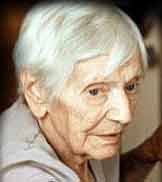
Emilie Pelzl was born on October 22, 1907, in the city of Alt Moletein,
a village in the German-populated border region of what was then The
Republic of Czechoslovakia. Emilie later recalled the local pastor,
an old family friend, who instructed young Emilie to end her friendship
with a young Jew, Rita Reif. Emilie defied the pastor and retained her
friendship with Rita, until Rita was murdered by the Nazis in front
of her father's store in 1942.
Emilie Pelzl first saw the tall, handsome and outgoing Oscar
Schindler when he came to the door of her father's farmhouse in
Alt Moletein. It was 1928 and Oscar was selling electric motors. After
a courtship of six weeks, they were married on March 6, 1928, in an
inn on the outskirts of Zwittau, Oscar's hometown. Emilie's father had
given Oscar a dowry of 100.000 Czech crowns, a considerable sum in those
days, and he soon bought a luxury car and squandered the rest on outings.
In her A Memoir Where Light And Shadow Meet, Emilie recalls how
she struggled trying to understand him:
In spite of his flaws, Oscar had a big heart and was always ready
to help whoever was in need. He was affable, kind, extremely generous
and charitable, but at the same time, not mature at all. He constantly
lied and deceived me, and later returned feeling sorry, like a boy
caught in mischief, asking to be forgiven one more time - and then
we would start all over again.
In the thirties, now without employment, Oscar
Schindler joined the Nazi party, as did many others at that time. He had seen the possibilities
which the war brought in its wake, and he followed on the heels of the SS when the Germans invaded
Poland.
He left Emilie in Zwittau and moved to Crakow, where he took over a
Jewish family`s apartment. Bribes in the shape of money and illegal
black market goods flowed copiously from Schindler and gave him control
of a Jewish-owned enameled-goods factory, Deutsch Emailwaren Fabrik,
close to the Jewish ghetto.
Schindler principally employed Jewish workers. At this time, they were
the cheapest labour.
But slowly as the brutality of the Nazis accelerated with murder, violence
and terror, the seeds of their plan for the total extermination of the
Jews dawned on Schindler in all its horror - he came to see the Jews
not only as cheap labour, but also as mothers, fathers, and children,
exposed to ruthless slaughter.
Schindler promised the Jews who worked for him that they would never
starve, that he would protect them as best he could. And he did, building
his own workers barracks on the factory grounds to help alleviate the
sufferings of life in the nearby Plaszow labor camp. He gave safe haven
to as many Jewish workers as possible, insisting to the occupying Nazis
that they were "essential workers", a status that kept them
away from harassment and killings.
At Schindler`s factory, nobody was hit, nobody murdered, nobody sent
to death camps. But conditions at the factory were far from comfortable.
Freezing, lice-ridden inmates still suffered typhus and dysentery.
Until the liberation of spring, 1945, the Schindler's used all means
at their disposal to ensure the safety of the Schindler-Jews. They spent
every pfennig they had, and Emilie's jewels were sold, to buy food,
clothes, and medicine. They set up a secret sanatorium in the factory
with medical equipment purchased on the black market. Here Emilie looked
after the sick. Those who did not survive were given a fitting Jewish
burial in a hidden graveyard - established and paid for by the Schindlers.
Later accounts have revealed that the Schindlers spent something like
4 million German marks keeping their Jews out of the death camps - an
enormous sum of money for those times.
The factory continued to produce shells for the German Wehrmacht for
7 months. In all that time not one usable shell was produced; none passed
the military quality tests.
One night in the last weeks of the war, Emilie, acting alone while
Oscar was in Crakow, was confronted by Nazis transporting 250 Jews in
four wagons from Golechau to a death camp. She succeeded in persuading
the Gestapo to send these
Jews to the factory camp "with regard to the continuing war industry
production". In her A Memoir she recalls:
We found the railroad car bolts frozen solid .. the spectacle I saw
was a nightmare almost beyond imagination. It was impossible to distinguish
the men from the women: they were all so emaciated - weighing under
seventy pounds most of them, they looked like skeletons. Their eyes
were shining like glowing coals in the dark ..
Of the 250 in the wagons, thirteen were dead. Throughout that night
and for many nights following, Emilie worked tirelessly to rehabilitate
these Jews. One large room in the factory was emptied for the purpose.
Three more men died, but with care, the others gradually rallied.
Today, surviving Schindler-Jews remember how Emilie worked indefatigably
to secure food and somehow managed to provide the sick with extra nourishment
and apples. A Jewish boy, Lew Feigenbaum, broke his eyeglasses and stopped
Emilie in the factory and told her: "I broke my glasses and can't
see .." When the Schindler-Jews were transferred to Brunnlitz,
Emilie arranged for a prescription for the eyeglasses to be picked up
in Crakow and delivered to her in Brunnlitz.
Feiwel (today Franciso) Wichter, 75, was No. 371 on Schindler's List,
the only one of the Schindler Jews living in Argentina:
As long as I live, I will always have a sincere and eternal gratitude
for dear Emilie. I think she triumphed over danger because of her
courage, intelligence and determination to do the right and humane
thing. She had immense energy and she was like a mother.
Another survivor, Maurice Markheim, No.142 on the list, later recalled:
She got a whole truck of bread from somewhere on the black market.
They called me to unload it. She was talking to the SS and because
of the way she turned around and talked, I could slip a loaf under
my shirt. I saw she did this on purpose. A loaf of bread at that point
was gold .. There is an old expression: Behind the man, there is the
woman, and I believe she was the great human being.
In May, 1945, it was all over. The Russians moved into Brunnlitz. The
previous evening, Schindler gathered everyone together in the factory,
where he and Emilie took a deeply emotional leave of them. The Schindlers
- and the 1300 Schindler-Jews - had survived.
Oscar Schindler`s life
after the war was a long series of failures. He tried without success
to be a film producer and was deprived of his nationality immediately
after the war. Threats from former Nazis meant that he felt insecure
in post-war Germany, and he applied for an entry permit to the United
States. He was refused as he had been a member of the Nazi party.
After this he fled to Buenos Aires in Argentina with Emilie, his mistress, and a dozen Schindler Jews. The
Schindlers settled down in 1949 as farmers, first raising
chickens and then nutrias. They were supported financially
by the Jewish organization, Joint, and other thankful Jews.
But Oscar Schindler met with no success, and in 1957 he became
bankrupt and travelled back alone to Germany, where he remained
estranged from his wife for 17 years before he died in poverty
in 1974, at the age of 66. He never saw Emilie again.
Emilie stayed in Argentina, where she scraped by on a small
pension from Israel and a $650 a month pension from Germany.
Her only relative, a niece, lived in Bavaria, Germany.
In May, 1994, Emilie Schindler received The
Righteous Amongst the Nations Award. In 1995, Argentina decorated
her with the Order of May, the highest honor given to foreigners who
are not heads of state. In 1998, the Argentine government decided to
give her a pension of $1,000 a month until her financial situation improved.
She was named an Illustrious Citizen by Argentina.
In July, 2001, during a visit to Berlin, Germany, a frail Emilie handed
over documents related to her husband to a museum. Emilie Schindler
died Friday night October 5, 2001, in a Berlin hospital.
As to Oscar Schindler the author Erika Rosenberg had no doubt: 'Emilie
still loved Oscar Schindler', though Emilie was bitter and disillusioned:
'He gave his Jews everything - and me, nothing.' But she was capable
of expressing both her love and bitterness towards him in one sentence,
calling him a drunk and womanisor, but also saying: 'If he'd stayed,
I'd have looked after him.'
In A Memoir Emilie tells about her inner thoughts, when she
visited his tomb, over thirty-seven years after he left:
"At last we meet again .. I have received no answer, my dear,
I do not know why you abandoned me .. But what not even your death
or my old age can change is that we are still married, this is how
we are before God. I have forgiven you everything, everything .. "