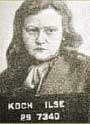
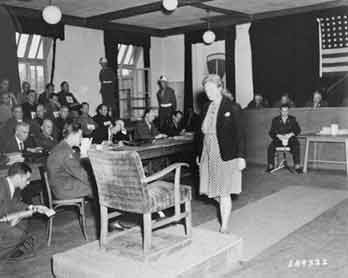
Ilse Koch was born in Dresden, Germany in 1906. A secretary by profession, Koch joined the Nazi
party in 1932.
Four years later, she married Karl
Otto Koch (1897-1945), head of the Sachsenhausen concentration camp, who in 1937 was assigned
to build a new concentration camp in Buchenwald.
Ilsa went with him and became a SS-Aufseherin (overseer) at the camp.
While Karl Otto was known for his personal greed in
the camps he worked in, Ilse was known as the “Bitch of Buchenwald”
for her bestial cruelty and sadistic behavior. She was especially fond
of riding her horse through the camp, whipping any prisoner who attracted
her attention. Her hobby was collecting lampshades, book covers, and
gloves made from the skins of specially murdered concentration camp
inmates, and shrunken human skulls.
Ilse Koch would specially select prisoners with distinctive
tattoos on her rides around the camp. These prisoners would be killed
and their skin tanned and stored for later use by the SS guards.
Her taste for collecting lampshades made from the tattooed
skins was described by a witness at The
Nuremberg Trials after the war:
"The finished products (i.e. tattooed skin detached
from corpses) were turned over to Koch's wife, who had them fashioned
into lampshades and other ornamental household articles .."
In the book Sidelights on the Koch Affair by
Stefan Heymann, the author pointed out that the fact that the Kochs
had lamps made of human skin did not distinguish them from the other
SS officers. They had the same artworks made for their family homes:
"It is more interesting that Frau Koch had a
lady's handbag made out of the same material. She was just as proud
of it as a South Sea island woman would have been about her cannibal
trophies .. "
In 1942,
the Kochs received a punative transfer to Majdanek.
In August 1943, Karl Koch was arrested by the Gestapo at the request of SS judge
Josias Prince of Waldeck-Pyrmont. Karl Otto was charged with the unauthorized
murder of three prisoners, while Ilse was accused of the embezzlement
of more than 700,000RM. Though Ilse was acquitted, Karl Otto was convicted
and shot in April 1945.
At the end of the war, Koch was arrested and charged
with "participating in a common criminal plan for encouraging,
aiding, abetting and participating in the atrocities at Buchenwald."
In 1947, an American military tribunal found Koch found guilty and sentenced
her to life-imprisonment.
After serving only two years, General Lucius D. Clay,
the military governor of the American zone in Germany, pardoned her.
As a result of the international condemnation this decision received,
Koch was re-arrested in 1949 and tried before a West German court for
instigation to murder in 135 cases. She was sentenced to life-imprisonment
on January 15, 1951.
She committed suicide in a Bavarian prison on September
1, 1967.