Eugene Wigner
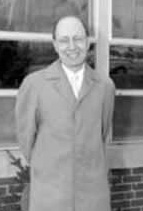
(1902 - 1995)
Eugene Wigner was born on November 17, 1902, in Budapest, Hungary. In 1921, he entered
the Technische Hochschule Berlin, later obtaining the Dr. Ing. Degree.
In 1930, Princeton University recruited Wigner and
Von Neumann. When Adolf
Hitler came to power in Germany in 1933, Wigner
and von Neumann found safe haven in Princeton, New Jersey, though they
still spent half the year in Europe, traveling, studying and teaching.
In 1936, Wigner
moved to the University of Wisconsin. On January 8, 1937,
Wigner became a naturalized citizen of the United States. From 1938
until his retirement in 1971, Wigner was the Thomas D. Jones Professor
of Mathematical Physics at Princeton University.
In 1939 and 1940, Dr. Wigner played a major role in
agitating for a Manhattan Project, to build an atomic bomb. From 1942-1945,
he worked on the Manhattan Project at the University of Chicago. Wigner
was sorry to see atomic bombs dropped on Hiroshima and Nagasaki; nevertheless,
he remained a defender of the U.S. military. Dr. Wigner always thought
of his work on the atomic bomb as essentially defensive, and he would
later become a major figure in the field of civil defense.
From 1946-1947, Wigner was appointed Director of Research
and Development at Clinton Laboratories. From 1952-1957, he was a member
of the General Advisory Committee to the U.S. Atomic Energy Commission.
He laid the foundation for the theory of symmetries
in quantum mechanics. In the late 1930s, he extended his research into
atomic nuclei. He developed an important general theory of nuclear reactions.
In 1963, Wigner received the Nobel
Prize in Physics, along with Maria Goeppert-Mayer and J. Hans D.
Jensen, for their contribution to the theory of the atomic nucleus and
its particles. In addition to receiving the Nobel Prize, he was also
been awarded the U.S. Medal for Merit (1946), Atoms for Peace Award
(1960), the National Medal of Science (1969), and the Max Planck Medal
of the German Physical Society. He was also a member of the American
Physical Society and American Nuclear Society.
Wigner died on January 1, 1995, in Princeton.
Sources: Nobel
Prize; Wikipedia |