|
[By: Joanna Sloame]
Latvia,
a former Soviet Union republic, is divided
into four regions, each with
its own slightly different demographics based
on its proximity to Europe or Russia. Today, the Jewish population of Latvia is approximately 6,200 people.
- Courland
- Latgalia
- Republic of Latvia
- World War II & Holocaust
- Holocaust Legacy
- Modern Latvia
- Jewish Sites & Contacts
Courland
The origins of Latvian Jews lie in Livonia
and Courland, which are located on the coast
of the Baltic Sea. Both were not included
in the Pale
of Settlement, so only those
Jews who could prove they had lived in the
region before it came under Russia were permitted
to live there. Therefore, the gradual annexation
of the country by the Russian Empire weakened
the Jewish presence. However Germnaized or
Russianized the Jews became, their position
was always uncertain in relation to the national
movement in Latvia, which saw them as foreigners.
Boasting the
oldest Jewish community in Latvia, Courland
was made up of two separate realms, Piltene
(Pilten) and Courland. In the 12th century,
the Livonian Knights took control of the
region from local tribes and forbade Jews
to settle in the kingdom. Piltene, due to
its valuable ports on the Baltic Sea, was
a separate entity owned by the head of the
Church of Courland and exchanged hands numerous
times.
The first Jews arrived in Piltene in around
1571, after the Bishop of Courland sold the
land to the King of Denmark, who then gave
it to his brother, Duke Magnuss von Holstein.
Under the duchy, Piltene became a sort of
island within the province of Courland, leading
to numerous military conflicts with Poland,
until it was purchased by Poland in 1585.
Beginning in 1561, Jews were allowed to
live in Piltene but not the rest of Courland.
Piltene Jews created thriving communities
and were prominent traders and businessmen.
In 1708, the first synagogue was built in
Aizpute (Hasenpoth).
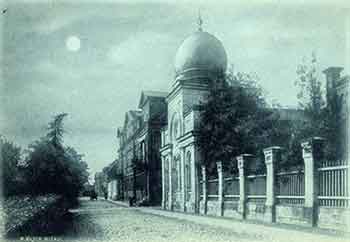
Jelgava Synagogue
 |
Courland Jews identified
with German Jewish culture and the majority
spoke German, not Yiddish,
until World
War II. A dialect of
German called “Courland Yiddish” also
developed. The haskala movement
was popular, but Courland Jewry did not assimilate
to the same degree that Western European
Jewry did. Courland Jewish culture differs
significantly from that of the rest of Latvia,
due to the province’s proximity to Germany,
though it was slightly influenced by the
neighboring Lithuanian Jewish
community.
The community’s position declined,
however, after the Duke of Courland and Piltene
made an alliance. In 1717, every Jew was
forced to pay an annual tax of two talers,
a toll that was doubled in 1719. From 1727
to 1738, the government ordered the expulsion
of the Jews, though the decree was never
carried out to its entirety.
Outside of Piltene, the
Courland Jewish population steadily increased
during the 17th century. During this time,
however, Jews were labeled as foreigners
and faced anti-Jewish persecution, especially
at the hands of competing merchants and craftsmen.
Despite local hostilities, the duchy treated
the Jews well until 1713, when the community
was expelled from the province. Those who
remained were forced to pay one taler a day
for themselves and for those who refused
to pay. In 1719, the Jews made a deal with
the duchy that allowed them to live there
for the price of 400 talers. This policy
stayed in place until 1760, when the duchy
ruthlessly forced the Jews out of the province.
Piltene and Courland became part of Russia
in 1795. At the time, there were 4,581 Jewish
males in Courland. By 1799, the Russian Emperor
Paul gave the Jews of Courland full Russian
citizenship, but forced them to pay double
taxes. Due to their new status, Jews were
able to partake in government and integrate
into German society.
Courland was not included
in the Pale
of Settlement created by the
Russians in 1804. In the mid-19th century,
despite heavy restrictions on citizenship,
Jews from the Pale managed to move to Courland
to escape suffering. By 1850, the Jewish
population had risen to 51,072, and on the
eve of World War I, had skyrocketed to 68,000.
During the war, the Jews were blamed for
Russian military defeats on the claim that
they had committed treason. This led to the
expulsion of the Jews from western Courland
in May 1915, and approximately 40,000 Jews
were forced to leave the province. When Courland
was incorporated into the independent Republic
of Latvia in 1918, some refugees and exiles
returned. Despite this influx, in 1925, there
were only 22,548 Jews in the province.
Latgalia
The Jews of Latgalia, the
southwestern part of Latvia, developed along
the same lines as the Jews of Lithuanian-Byelorussian
region and the Polish kingdoms. Poland took
over Latgalia in 1561, maintaining control
until 1772. Jews began to arrive in Latgalia
in the early 17 th century after severe pogroms
in Poland from 1605 to 1639, and in the Ukraine and Byelorussia from
1648 to 1653. These refugees were Yiddish-speaking Orthodox Jews.
Toward the end of the Polish rule, in 1766,
some 2,996 Jews lived in Latgalia.
Latgalia came under Russian control after
the First Partition of Poland in 1772. At
the time, 5,000 Jews lived there, but by
1784, the number had been reduced to 3,700.
Latgalia was divided in 1802, when the Vitebsk
region became part of the Pale
of Settlement.
Jews were forced to leave rural areas and
resettle in cities or small towns (shtetlach),
where they faced double taxation.
The traditional Yiddish Jewish community,
along with the rest of Latgalia, was very
poor, owing to its location in the interior
of Latvia, on the Russian border. Despite
this, there was a significant amount of Jewish
activity, and, by 1847, the population had
grown to 11,000. The community followed Eastern
European Orthodoxy tradition and were not
as influenced by hashkala as the rest
of the country was.
The Republic of Latvia
In November 1918, Latvia gained its independence
from Russia. During this time, the majority
of the Jews of Latvia worked in commerce.
Approximately 29 percent of the community
was involved in industry and about 7 percent
in liberal professions. The government of
Latvia was void of Jews and, between the
wars, the economic situation of the Jews
nose-dived. A series of government policies
left the Jews in a precarious position, forcing
many into small trade, peddling, and bartering.
The government assumed control of the grain
trade, taking away the Jews’ main source
of employment, favored Latvian enterprises
over Jewish ones, levied heavy taxes on the
community, and made it difficult for Jews
to obtain credit.
Latvian Jewish culture was a mixture of
Russian, Western European, and Lithuanian
elements. The community was influenced by
both the more secular East Prussian Jewish
community, and the more traditional and religious
Russian community due to its location. There
were many social and spiritual differences
between Latvian Jews of different backgrounds
depending on their proximity to Prussia or
Russia.
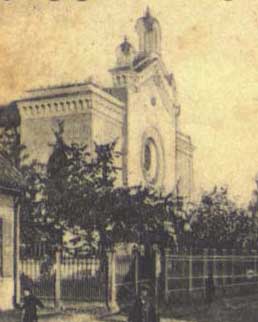
Kuldiga Synagogue
 |
A broad network of Hebrew, Yiddish, Russian
and German schools for Jewish children was
established during this same period, accommodating
the numerous languages spoken by the Jewish
population. The Jews maintained a sense of
autonomy, establishing their own schools,
universities, theaters, cultural clubs, and
newspapers.
Prior to World War I, 190,000
Jews lived in Latvia. During the war, many
Jews were exiled to the Russian interior
and others fled the country. By 1920, the
Jewish population had declined to 79,644.
After a peace treaty was signed between the
Soviet Union and the Latvian Republic on
August 11, 1920, Jewish refugees began to
return to the Latvia and, by 1925, 95,479
Jews lived in the republic, the largest number
since independence.
Wide scale emigration on the part of the
young Jewish adults and a scale back on family
size led to a sharp decline in the Latvian
Jewish population. Between 1925 and 1935,
6,000 Jews left Latvia, the majority of whom
made aliyah. This left 43,672 Jews
in Riga, 11,106 in Daugavpils, and 7,379
in Libau.
Though initially a democratic state, the
growing popularity of fascism in Western
Europe soon took hold. On May 15, 1934, Prime
Minister Karlis Ulmanis staged a coup,
taking control of the government and deporting
opposition leaders to concentration camps.
The new totalitarian state under the dictatorship
of Ulmanis was influenced by Nazi Germany.
With the Fascist coup came a severe
decline in the situation of Latvian Jews.
All Jewish political organizations were forbidden,
secular Yiddish schools were closed, and
Hebrew schools’ curriculums were screened.
When World
War II broke out in 1939, the
Soviet Union forced Latvia to sign a treaty
allowing the Soviet army to use the country
for the war effort. This led to the annexation
of Latvia in June 1940, annihilating the
few freedoms the Jewish population had left.
World War II & The Holocaust
Almost immediately after the war began,
in July 1941, Germany overran Latvia. The
country was placed in the new Reich Kommissariat “Ostland” and
came under the control of Commissioner General
Otto Heinrich Drexler. At the end of July,
the military administration was replaced
with a civil government, whose first order
of business was to enact a series of anti-Jewish
laws.
Directly before the arrival of the Germans,
the Soviets deported a huge group of Latvians,
including thousands of Jews, to Siberia and
Central Asian Soviet republics due to their
oppositional political views. When the Nazis arrived in Latvia, a significant number of
Jews were also able to escape to Central
Asia, but Germany still got a hold of some
75,000 remaining Latvian Jews.
The Jews were not only persecuted
by the Nazis, but by significant numbers
of Latvian activists who belong to anti-Semitic organization
such as Aizsargi paramilitary and
the Einsatzgruppen,
or “action
commandos.” These groups systematically
aided in the annihilation of the Jews of
Latvia. In Riga,
the Einsatzgruppe started
a pogrom against
the Jews, destroying all the city’s
synagogues and murdering 400 Jews. By the
end of 1941, the Einsatzgruppe had
facilitated the mass execution of 35,238
Jews in Riga, Mitau, Liepaja, Valmiera, and
Daugavpils. Afterward, only 2,500 Jews were
left in the Riga ghetto, and 950 in the Daugavpils
ghetto.
The genocide in Latvia had three main stages.
The first was from July to October, 1941,
when the Germans killed around 34,000 Jews.
In July, 300 Jews hiding in a basement in
the Riga Choral Synagogue were burned alive
by Nazi forces. In 1994, a Holocaust memorial
was erected near the destroyed synagogue
to commemorate their deaths.
At the end of 1941 and the beginning of
1942, Latvia received 15,000 Jewish deportees
from Germany, Austria, Czechoslovakia, and
other annexed countries. These “Reich
Jews” were mainly sent to Riga, where
they were deported to execution sites in
the Rumbuli and Bikernieks forests. Barrack
and concentration
camps, such as Salaspils
and Kaiserwald, where Jews faced forced labor
and extermination, were located around Riga. Kaiserwald, created in the summer of 1943,
held Jewish survivors of the Riga, Daugavpils, Vilna and Liepaja ghettos. When the Germans
were forced to retreat in the summer of 1944,
the surviving prisoners were sent to the Stutthof concentration camp near Danzig.
The second phase was from
November to December 1941, when the Nazis
liquidated the Latvian ghettos. In Daugavpils,
more than 11,000 Jews were murdered. It was
during this second stage that the Rumbula
Forest massacre took place. The Nazis, with
the help of the Latvian police, took 25,000
Jews from the Riga ghetto to the forests
around the city, where they systematically
executed them. In 2002, a memorial opened
in Rumbula, following the 2001 dedication
of an immense monument in the Bikernieki
forest to the 30,000 Jews murdered there.
The final stage took place
from January to July 1942, when nearly all
of the deportees in Latvia from other countries
were murdered in and around the city of Riga.
After the war, 33,000 Jewish refugees and
exiles scattered around the Soviet Union
returned to Latvia. Only 1,000 Latvian Jews
survived the concentration camps, most of
whom remained in the displaced
persons camps
in Germany, Austria, and Italy, refusing
repatriation. Eventually, many made aliyah.
In Latvia itself, several hundred Jews miraculously
survived the Holocaust by hiding or intermarrying.
Overall, the Nazis and their collaborators
killed 95 percent of the 100,000 Jews in
the country before the outbreak of the war.
About 2,000 Jews died fighting
German and pro-Nazi forces in Latvia, and Yad
Vashem has recognized 93 non-Jewish Latvians
as “Righteous
Among Nations” for risking their
lives to save Jews during the Holocaust.
Because of the devastating effects of the
German occupation, only half of the present-day
Jewish community has roots in Latvia, and
only 60 percent hold Latvian citizenship.
Holocaust Legacy
After the
war, the Soviet government investigated crimes
committed by German and Latvian fascists
during the German occupation. Those investigated
included the Reich commissioner for Ostland,
the commissioner general for Latvia, the
chief of police for Ostland, the chief of
the Gestapo,
and the chief of the Riga concentration camp.
On January 26, 1946, a number of suspected
Nazi war criminals were tried by the Riga
military district war tribunal. Seven Nazis,
including Friedrich Jeckeln, the chief of
police for Ostland, were convicted
and hung in Riga on February 3, 1946. Despite investigations,
only a very small percentage of Germans and
Latvians involved in the decimation of the
Jews of Latvia were brought to justice.
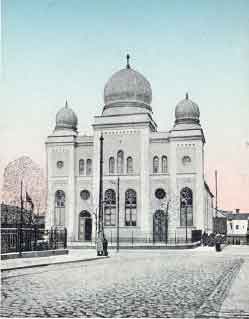
Liepaja Synagogue
 |
Since Latvia regained its independence in
1991, July 4th has been designated as the
official Holocaust Memorial Day in Latvia.
President Ulmanis and the Saeima have formally
apologized for Latvia’s role in the
Holocaust, but the Simon Wiesenthal Center
has condemned the lack of war crimes prosecutions
in Latvia, and in July 2002 launched “Operation:
Last Chance,” calling on Baltic citizens
to identify suspected Nazi collaborators
for monetary rewards. The initiative provoked
controversy, as many Latvians continue to
regard World War II as a war against the
Soviet Union in which the Germans were their
liberators.
The Latvian government
investigated Konrad Kalejs and Karlis Ozols,
both of whom were accused of collaboration
with the Nazis while serving in the SS-affiliated
Arajs Commando, but both suspects died in 2001.
Neither was extradited to Latvia, but Latvia
has pledged to continue the investigations.
The Latvian History Commission
researches crimes against humanity committed
in Latvia between 1940 and 1956 under the
alternating Soviet and Nazi regimes, and
developed a curriculum for teachers and materials
for high schools. Study of the Holocaust
is compulsory in secondary schools. The Commission
held a conference on Holocaust research in
2001, in conjunction with the University
of Latvia’s Center for Judaic
Studies.
Several recent cultural
projects and exhibitions in Latvia have addressed
Holocaust themes. In May 2000, the exhibition “Anne Frank – A
History for Today” opened at Riga’s Museum
of War. In April 2001, the exhibit opened at the
Jewish Community Center, with President Vaira Vike-Freiberga
in attendance. The president also spoke at the July
4, 2001 Holocaust Memorial Day, the 60th anniversary
of the Holocaust of Latvian Jews.
In addition to co-sponsoring
the Holocaust studies conference, the Center
for Judaic Studies helped mount a traveling
exhibit of Latvian Jewish history called “History, Tragedy, Revival,” sponsored
by the Latvian Foreign Ministry. In 2001, a Latvian
Jewish businessman funded the publication of 5,000
copies of Elie Wiesel’s Night in
Latvian for distribution to Latvian schools.
Modern Latvia
Latvia once again came under Soviet control
after the Germans were defeated. The country
remained part of the Soviet Union until its
collapse in the late 1980s. Very little is
known about the Jewish community of Latvia
under the Soviets. The Jewish population
maintained a steady decline throughout the
late 1970s and 1980s. In 1979, the community
numbered 28,300 but, by 1989, had dropped
to 22,900, 18,800 of whom lived in Riga.
This decline was mostly due to the high rate
of intermarriage, immigration, and aliyah.
In 1989, 1,588 Jews left the country. In
1990, 3,388 Latvian Jews made aliyah.
The vast majority of Latvia’s Jews
live in Riga. Rabbi Natan Berkhan, Chief
Rabbi of Riga and Latvia, runs the Central
Synagogue, Riga’s only synagogue.
 The Riga Synagogue
 |
Latvia is home to about 20 Jewish organizations,
most of which are concentrated in Riga. The
Riga Jewish community is unified under the
Council of Jewish Organizations. The Council
of Latvian Jewish Communities and Congregations
also represents them nationally. The Jewish
community of Riga has its own monthly newspaper, Gersharim (bridges),
and a matzah bakery. Latvia also boasts the
only Jewish hospital in the former Soviet
Union.
The Riga Jewish Community Center was established
in 2000 with the support of the American
Joint Distribution Committee. The JCC provides
educational and cultural programs for children,
youth, and families, including a cinema,
musical clubs, and a sports program. The
JCC also runs a meals-on-wheels program for
the elderly, funded by the JDC. The Federation
of Jewish Communities of the CIS runs a daily
soup kitchen in Riga and prepares 300 food
packages for the homebound each month.
The two Jewish day schools in Riga-the Dubnov
School, which is a secular day school, and
Chabad’s Jewish Private School-teach
close to 500 students combined. The Dubnov
School, foundede in 1989 as the first Jewish
school in the Soviet Union, operates in conjunction
with the Israeli Ministry of Culture.
Several Jewish youth programs operate in
Latvia. In addition to Chabad’s Jewihs
Private School, the FJC also operates summer
camps. The Union of Jewish Youth of Latvia
was founded in 1994 to promote Jewish education,
address anti-Semitism, and develop community
youth leadership. Latvia’s Shalom Club,
sponsored by the Israeli Foreign Ministry’s
Center for International Cooperation (MASHAV)
and the Israeli Embassy, conducts community
education programs and charity projects.
A Center for Judaic Studies was established
in 1998 at the University of Latvia.
The Latvian government has a positive relationship
with the Jewish community and provides it
financial and material support. The government
has provided the buildings for the Jewish
day school and JCC as well as teacher salaries.
The book Distinguished Jews of Latvia was
released in September 2003, and was distributed
to Latvia’s major libraries and schools
throughout Riga.
Latvia and Israel established
diplomatic relations on January 6, 1992,
after Latvia became an independent republic.
In October of that same year, Israel opened
an embassy in Riga. On February 5, 1995,
the Latvian embassy in Tel
Aviv opened. The
two countries have become trade partners
and work together to promote Holocaust awareness,
research, and remembrance.
Sites and
Contacts
The Riga Synagogue
Lachplesha str. 141
Riga, Latvia LV1003
Tel.: (371) 720-53-13 |
Chabad Lubavitch Community
of Latvia
Lachplesha str. 141
Riga, Latvia LV1003
Tel.: (371) 720-40-22
http://www.chabadcenters.com/riga |
Jewish Community of Daugavpils
29 Seknu St.
Daugavpils, Latvia |
Embassy of Israel
Elizabetes Street 2 LV1322 |
Jewish Community of Liepaya
21 Kungu St.
Liepaya, Latvia |
Jewish Community of Ludza
13-81 Blaunany St.
Ludza, Latvia |
Jewish Community of Rezekne
14-54 Valdemara St.
Rezekne, Latvia |
Jewish Community of Yelagva
1-54 Palshdzibas St.
Yelagva, Latvia |
Sources: Ministry
of Foreign Affairs of Latvia
The
Federation of Jewish Communities of the
CIS
Jewish
Encyclopedia
Rumbula
Yad Vashem
Postcards from Judaica
Philatelic Resources
Photo of Bikernieki Memorial courtesy of www.Rumbula.org |