Background & Overview
(June 6, 1944)
The plans to invade Nazi-occupied Europe through the beachheads of France sat in front of General Eisenhower. On the evening of June 5, 1944, the wind was blowing at 15
to 20 knots and six-foot waves were roiling the ships, but the Royal
Air Force (RAF) predicted the skies would be clear the next
day. Conferring with his colleagues, Eisenhower got conflicting
advice - Generals Bradley and Montgomery
wanted to go ahead; the Air Force and Navy generals preferred
to wait.
After a few moments of deliberation, Eisenhower said three
words that would change history: “Okay, let’s go.”
- Attacking France
- Omaha Beach
- Gold Beach
- Sword Beach
- Hitler's Mistakes
Attacking France
On the morning of June 6, 1944, Eisenhower released the following order, alerting the Allied armies of the green light for war:
“Soldiers, sailors, and airmen of
the Allied Expeditionary Force! You are about to embark upon the
Great Crusade, toward which we have striven these many months. The
eyes of the world are upon you. The hopes and prayers of liberty-loving
people everywhere march with you.”
With General Eisenhower's go-ahead, the BBC broadcast a coded message that instructed
members of the French resistance to cut railway lines throughout the
country. Nearly all of those targeted were successfully severed.
The attack began with more than 1,000 RAF bombers
attacking coastal targets. This attack was followed by 18,000 paratroopers
being dropped inland to capture key bridges and roads and cut German
communications. The British Sixth Airborne Division suffered few casualties
and succeeded in capturing bridges at the Orne River and the Caen Canal.
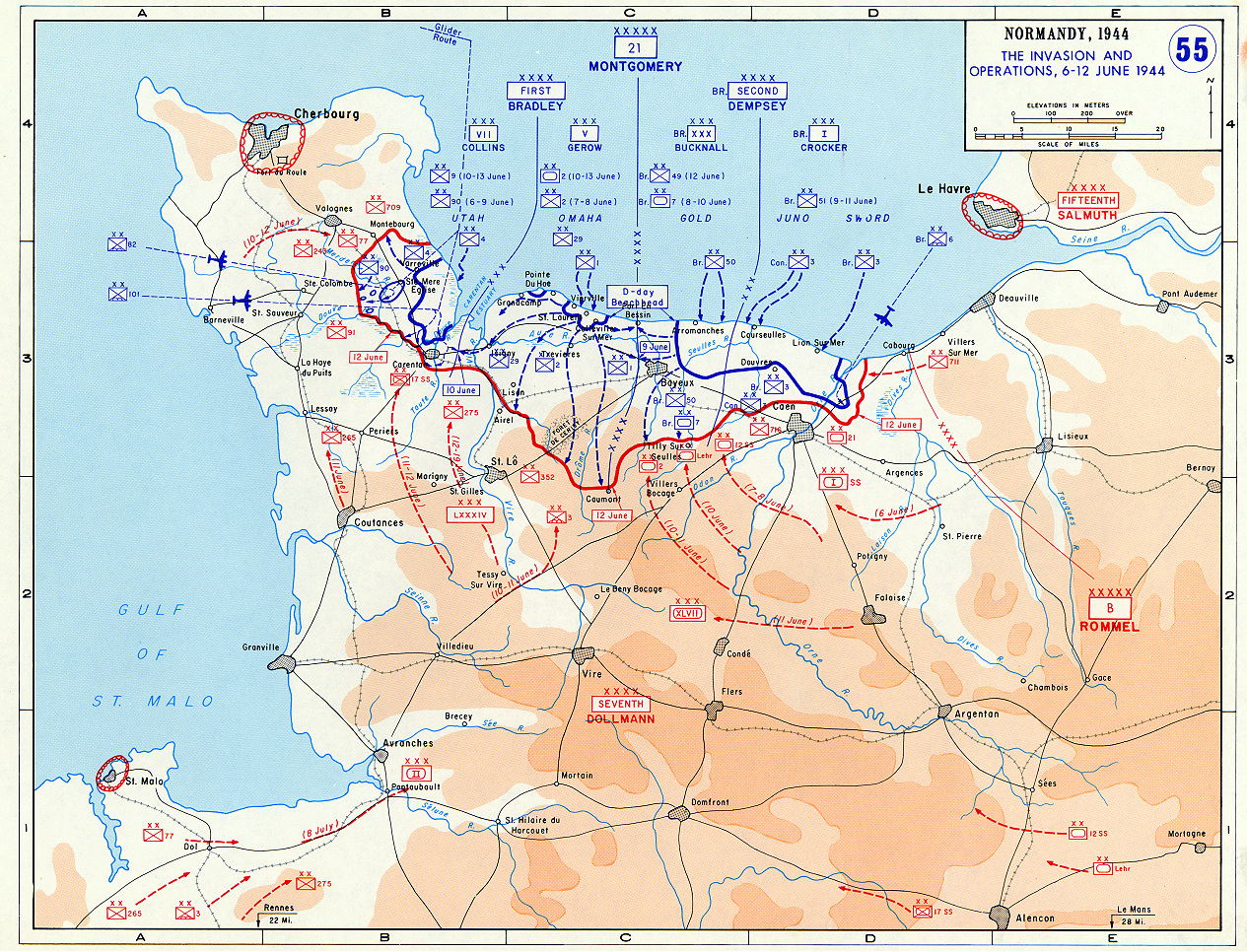 Allied Invasion of Normandy (Click to Enlarge)
 |
The Americans had a harder time. Their 101st and 82nd
Airborne Divisions missed their drop zone and were scattered. Many men
drowned when they landed in the water. The dispersion of the Americans
helped confuse the Germans, but it also meant that troops who survived
the jump (and many didn’t) were isolated and easier to kill or
capture. But in the end, they played a major role in the securing of
Normandy by opening the way inland for the infantry, destroying much
of the German artillery aimed at the beaches, and blocking avenues for
potential counterattacks. Dying was not a danger for the dummy paratroopers
— literally dolls dressed up like soldiers — that were also
dropped away from Normandy to deceive the Germans as to the location
of the attack.
Minesweepers cleared lanes in the English Channel for
the transports. The beaches were 60 to 100 miles away when the armada
of nearly 7,000 ships left from ports such as Portsmouth, Southampton,
Chichester, and Falmouth. Soon that 100 miles would be covered with
59 convoys that included 4,000 landing craft, 7 battleships, 23 cruisers,
and 104 destroyers.
German torpedo boats out of the port at Le Havre were
the first to encounter the Allied forces, but they were quickly driven
off. Having spotted the invasion fleet, German coastal batteries began
firing at the approaching ships. At the same time, Allied warships began
bombarding the beaches, destroying bunkers, setting off land mines,
and destroying obstacles in the path of the landing parties.
To prepare for the landing of troops, the air force
and navy bombarded German positions, and continued their attacks throughout
the day. Meanwhile, paratroopers blocked any potential counterattackers
and knocked out the artillery batteries that covered the beach.
The first troops hit the beaches about 6:30 A.M.,
with 23,000 men rushing onto Utah Beach. Though certainly scared to
enter combat, which most were facing for the first time, the soldiers
were so terribly seasick from the rough crossing that they were actually
anxious to get off the boats.
“We want this war over with. The quickest
way to get it over with is to go get the bastards who started it.
The quicker they get whipped, the quicker we can go home. The shortest
way home is through Berlin and Tokyo. And when we get to Berlin,
I am personally going to shoot that paper-hanging son-of-a-bitch
Hitler.”
— General Patton, Speech to the Third
Army (June 5) |
Almost nothing went according to plan. Few of the landing
craft arrived at the time they were supposed to, and none placed their
troops at the designated target. The landing craft were buffeted by
wind and waves and had to evade a network of thousands of mines, which
sank several of the ships that were assigned to guide those that followed.
General Theodore Roosevelt, Jr., the son of the former
president, was one of the first ashore. He had lobbied to lead his troops
in to boost their morale, but had a tough time persuading his superiors
to let him go. Besides his rank and lineage, Roosevelt had a heart condition
and walked with a cane, but he would not be deterred from the mission.
Looking every part the Hollywood commander— Roosevelt did not bother
with a helmet, he wore a wool-knit hat instead— he ignored the shooting
around him and calmly walked across the beach to huddle with commanders.
Since the invasion force had landed in the wrong place, they had to
decide whether to stick to the original plan and have the remaining
troops try to land in the target area or improvise and head inland from
where they were. Roosevelt is said to have made the decision, “We’ll
start the war from right here.”
Most of the German defenders (many of whom were not
German, but soldiers forced into the army from occupied countries) either
surrendered or withdrew inland. The American forces quickly secured
the area and, within a few hours, supplies and additional troops were
also coming ashore. Soon the biggest problem for the Americans at Utah
was managing the traffic jam of men and material.
Omaha Beach
Rommel knew that if an attack came at Normandy, at least part of the invasion
force would try to land on the sandy beach the Allies designated as
Omaha. This beach was the largest landing area (six miles) and the most
vulnerable: 100-foot nearly perpendicular cliffs overlooked the beach.
To prepare for a possible attack, the Germans had mined the waters offshore,
littered the beach with obstacles, and placed heavy guns on the cliffs
overlooking what amounted to a shooting gallery below. And, in fact,
when the defenders saw the first landing parties, they thought they
were crazy.
 American soldiers landing at Omaha Beach
 |
The Allies were confident that the air and naval bombardment
would soften up the defense, that the German soldiers would be from
a low-quality division, and that the 40,000 troops assigned to take
the beach would overwhelm the defenders. Instead, the defensive force
the Americans confronted, an elite German infantry division, was far
stronger and better trained than expected. Heavy clouds protected the
German defenders from Allied bombers, who dropped their payloads in
fields beyond the beachfront, and the poor visibility also prevented
offshore guns from initially offering much support.
With the exception of one unit, the wind and tide
caused the landing craft to miss their objectives. Instead of distributing
troops across the beach, they landed in bunches that became easier targets
for the German gunners. Many soldiers were killed before they could
fire a shot in the war. More than two-dozen of the special amphibious
Sherman tanks made for the invasion immediately sank upon debarking
the transports, taking their crews to the bottom. These were just a
fraction of the hundreds of vehicles of all types that never reached
the beach or were destroyed soon after they got there. Instead of 2,400
tons of supplies being brought ashore, only 100 tons made it.
In writing, much of the fighting can only be described
in a sterile fashion that doesn’t capture the horror of combat.
Omaha Beach was as hellish as any battle of the war. The first landing
parties, seasick from the rough crossing, were literally ripped apart
by mines, artillery, and machine-gun crossfire.
Many soldiers drowned in deep water before their craft
were close enough to the beach. Others struggled even in shallower water,
fighting the tide and the burden of carrying packs and guns, wearing
heavy boots and steel helmets, and then adding the additional weight
of their drenched uniforms. Helpless in the water, still more men were
killed before they could stagger ashore. The noise was deafening, and
the cries of the wounded sickening. The beach offered no cover, the
only place to go was forward, and the chances of making it across in
the early stages were practically zero. Waves of landing craft continued
to drift ashore, many exploded by shells or mines, and the numbers of
Allied soldiers and casualties piled up. The veterans of the landing
on Omaha would later reminisce that it was a miracle they managed to
get on the beach, let alone survive on it or advance beyond it.
Given the enormous naval armada offshore and the Allied
dominance of the air, it is reasonable to ask why the German forces
couldn’t have been decimated by strafing planes, bombers, and
shells from the navy’s big guns. Those assets did not play as
large a role as they might have for several reasons. Perhaps the most
important is that once the soldiers were on the beach, neither the air
force nor the navy had the accuracy to hit only the enemy targets, and
it was feared that too many friendlies could be hit by accident. The
navy provided invaluable support, but it was limited because so many
radios were lost or disabled in the landing that troops on the beach
could not communicate with the ships and direct their fire. The air
force ensured the Germans couldn’t put planes in the air to harass
or otherwise threaten the invasion, but Allied planes couldn’t
support the fight on the beach; their main contribution would be in
destroying targets inland that would help the advancing troops after
they got past the beaches.
The landing stalled and the order was given to cease
landing. General Bradley thought the landing had been a disaster and
the troops might have to withdraw. All organization fell apart as soldiers,
boats, and bodies jammed the single narrow channel engineers were able
to clear among the German mines and obstacles. Trapped behind a low
shelf halfway across the beach, under withering German fire from above,
isolated groups and individuals with no choice but to get off the beach
gradually fought their way forward and eventually took key points at
each end of the beach. It took several hours, and heavy navy bombardment,
to secure the beachhead, as well as a courageous effort by Army Rangers,
men of C Company, and the 116th regiment to scale the surrounding cliffs
with rope ladders to take out the guns guarding the coast.
Gold Beach
The British troops landed at 7:20 on Gold Beach, where
their experience was completely different from that of the Americans
at Utah and Omaha. Unlike those landed sites, the British had little
actual beach to cross. Once they surmounted the seawall and an antitank
ditch, they were into villages with pave streets. Beyond the villages
were mostly large wheat fields. They also faced almost no enemy fire
and had an orderly landing that went largely according to plan. A total
of 25,000 troops stormed Gold at a cost of 400 casualties. By the end
of the day, the British had advanced five miles beyond the coast.
A Canadian force was assigned the task of taking Juno
beach. This all-volunteer force was well-trained and highly motivated
because of a desire to avenge a disastrous defeat during the attempted
assault on the port of Dieppe in August 1942.
As in the case at the other landing sites, the Canadians
expected the defense to have been significantly degraded by air force
bombing, but despite the heaviest bombardment of the war during the
hours preceding the invasion, not a single fortification on Juno was
destroyed. Still, the 2,400 Canadians who came ashore overwhelmed the
400 German defenders, who were not front-line troops, but mostly Poles
and Russians who had been forced to serve a regime they did not believe
in.
Sword Beach
While much of the preinvasion actions designed to knock
out German defenses and make the beach landings easier did not go according
to plan, the airborne plan to take out the German guns covering Sword
beach did succeed. Not all the guns were taken out, and the invasion
force did face formidable mine fields, antitank ditches, and other fortifications,
but the paratroops did succeed in significantly degrading the enemy
defenses. This allowed 29,000 British soldiers to storm the beach at
a cost of 630 casualties. As in the case of the other beaches, the troops
overcame the initial defense and then began to move inland, but failed
to get as far as the D Day planners had hoped.
By 10:15 A.M., Rommel had learned that the Allies
had landed and rushed back to France. Hitler had ordered him to drive the invaders back into the sea, but still had
not given him the military resources he needed to do so. One of the
strongest panzer divisions, equipped with new, state-of-the-art Tiger
tanks, was sent to reinforce the defenders at Normandy, but its trip
from Toulouse was repeatedly delayed through the sabotage efforts of
British agents and French partisans, who turned what should have been
a 3-day race to the front into a 17-day crawl.
Another panzer division tried to split the British
and Canadian forces by shooting through the gap between Sword and Juno.
Had it succeeded in reaching the sea, it might have caused serious trouble,
but the British were able to neutralize the German force before it could
do any serious damage.
In the terrifying first hours making their way under
fire from the stormy sea to shore, across a front of more than 50 miles,
the Allies suffered surprisingly few casualties. On that first day,
roughly 175,000 soldiers had come ashore and approximately 2,500 had
been killed. The Americans had suffered the fewest casualties (dead
or wounded) on Utah Beach, approximately 300, but also the most, 2,400
(our of 40,000 who went ashore), on Omaha. In the first two days, the
number of men and vehicles the Allies got across the Channel was well
below what was planned; still, Eisenhower was happy the deception had
worked, and the Germans were unable to stop them on the beaches.
Once the initial assault succeeded, the Allies had
an opportunity to press their advantage and exploit the Germans’
confusion, but they did not advance as far as expected. In fact, the
deepest penetration, by the Canadians at Juno, was only about six miles.
Besides German opposition, one of the principal reasons the penetration
was not greater was that soldiers felt so satisfied with what they’d
just accomplished — and thankful that they had survived.
Hitler's Mistakes
The Germans had made numerous fatal miscalculations.
The most important was their conviction that the invasion would be elsewhere,
so they were caught by surprise at Normandy. At the end of D Day, most
of their forces were still arrayed in preparation for an invasion at
Pas-de-Calais.
General Jodl believed it would take the Allies as long as a week to put three divisions
into France, but the Americans had accomplished this on Utah beach alone
in a single day. Communication was poor, so the Germans were confused
throughout the attack as to exactly what was happening where and Rommel,
the architect of the defense plan, was in a car driving through France
and incommunicado during several crucial hours.
As in the case of the Eastern Front, the German high
command was also hamstrung by Hitler’s distrust of his generals
and their fear of acting without his approval. This proved disastrous
on D Day when Rundstedt ordered two panzer divisions to Normandy, but
first requested Jodl’s approval. Jodl told Rundstedt Hitler was sleeping. No
one had the courage to wake Hitler for approval and since he slept in
that day, the tanks were not moved into position.
The Germans also made the mistake of trusting their
own version of the Maginot Line, the Atlantic Wall, to stop the Allied
invasion rather than the deployment of their best troops. They had indeed
erected a formidable defense of trenches, mines, barbed wire, and other
obstacles, but it took the Allies less than a day to breach it, and
then the “wall” was useless.
Rather than assign their crack troops to protect the
wall, the Germans had also decided to hold them in reserve or had them
deployed elsewhere. Instead, they relied on poorly trained conscripts
and POWs from territories they’d conquered who had little or no
motivation to fight for Hitler, and were no match for the Allied troops
who were superbly trained and believed they were fighting to keep the
world free.
Monitoring German military messages after the invasion,
the British picked up the crucial piece of information that the Luftwaffe
was dangerously short of aircraft fuel. Knowing this, war planners made
Germany’s synthetic oil factories their top priority for air strikes
as soon as Overlord could spare
the planes.
Within a week, American and British forces linked
up, clearing the beachheads. With this done, the Seventh Corps, under
Major General J. Lawton Collins, moved on Cherbourg and took the city
on June 27. This port was meant to receive men and supplies, but it
took several weeks for the damage to be sufficiently repaired. The delay
was a factor in stalling the later offensive, but once the port was
fully operational, it was the entry point for more than half of all
American supplies sent to France.
The victory at Cherbourg was important for demoralizing
the Germans, particularly after Hitler had ordered the port held at all costs. Afterward, Rommel and von Rundstedt went
to see Hitler, to ask again for more troops and equipment, and to find
out how he intended to win the war. Hitler’s reaction was to deny
the requests, sack von Rundstedt, and replace him with Field Marshal Gunther Hans von Kluge.
Sources: Bard, Mitchell G. The
Complete Idiot's Guide to World War II. 2nd Edition. NY: Alpha
Books, 2004. |