Background & Overview
(June 5 - 10, 1967)
Israel consistently expressed a desire to
negotiate with its neighbors. In an address to the UN
General Assembly on October 10, 1960, Foreign Minister Golda
Meir challenged Arab leaders to meet with Prime Minister David
Ben-Gurion to negotiate a peace settlement. Nasser answered on
October 15, saying that Israel was trying to deceive world opinion,
and reiterating that his country would never recognize the Jewish
State.(1)
The Arabs were equally adamant in their refusal to
negotiate a separate settlement for the refugees. As Nasser told the
United Arab Republic National Assembly March 26, 1964:
Israel and the imperialism around us, which
confront us, are two separate things. There have been attempts to
separate them, in order to break up the problems and present them
in an imaginary light as if the problem of Israel is the problem of
the refugees, by the solution of which the problem of Palestine
will also be solved and no residue of the problem will remain. The
danger of Israel lies in the very existence of Israel as it is in
the present and in what she represents.(2)
The Palestinian Army
In 1963, the Arab
League decided to introduce
a new weapon in its war against Israel — the Palestine
Liberation Organization (PLO). The
PLO formally came into being during a 1964
meeting of the first Palestinian Congress.
Shortly thereafter, the group began
to splinter into various factions. Ultimately,
the largest faction, Fatah,
would come to dominate the organization, and
its leader, Yasser
Arafat,
would become the PLO chairman and most visible
symbol. All the groups adhered to a set of
principles laid out in the Palestine
National Charter, which called for Israel's destruction.
The PLO’s belligerent rhetoric was matched
by deeds. Terrorist attacks by the group grew
more frequent. In 1965, 35 raids were conducted
against Israel. In 1966, the number increased
to 41. In just the first four months of 1967,
37 attacks were launched. The targets were
always civilians.(3)
Most of the attacks involved
Palestinian guerillas infiltrating Israel from Jordan,
the Gaza
Strip,
and Lebanon.
The orders and logistical support for the attacks
were coming, however, from Cairo and Damascus.
Egyptian President Nasser’s main objective
was to harass the Israelis, but a secondary
one was to undermine King
Hussein’s regime
in Jordan.
King Hussein viewed the PLO as both a direct
and indirect threat to his power. Hussein feared
that the PLO might try to depose him with Nasser’s
help or that the PLO’s attacks on Israel
would provoke retaliatory strikes by Israeli
forces that could weaken his authority. By
the beginning of 1967, Hussein had closed the
PLO’s offices in Jerusalem, arrested
many of the group’s members, and withdrew
recognition of the organization. Nasser and
his friends in the region unleashed a torrent
of criticism on Hussein for betraying the Arab
cause. Hussein would soon have the chance to
redeem himself.
Terror from the Heights
The breakup of the U.A.R.
and the resulting political instability only
made Syria more
hostile toward Israel. Another major cause
of conflict was Syria’s resistance to
Israel’s creation of a National Water
Carrier to take water from the Jordan River
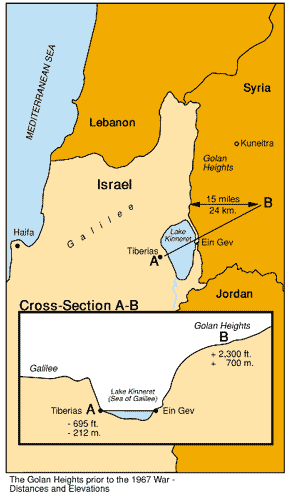
to supply the country. The Syrian army used
the Golan
Heights, which tower 3,000 feet above
the Galilee, to shell Israeli farms and villages.
Syria’s attacks grew more frequent in
1965 and 1966, forcing children living on kibbutzim in
the Huleh
Valley to sleep in bomb shelters.
Israel repeatedly protested the Syrian bombardments
to the UN Mixed
Armistice Commission, which was charged with
policing the cease-fire, but the UN did nothing
to stop Syria’s aggression — even
a mild Security
Council resolution expressing “regret” for
such incidents was vetoed by the Soviet Union.
Meanwhile, Israel was condemned by the United
Nations when it retaliated.
 |
While the Syrian military bombardment and
terrorist attacks intensified, Nasser’s
rhetoric became increasingly bellicose. In
1965, he announced, “We shall not enter
Palestine with its soil covered in sand; we
shall enter it with its soil saturated in blood.”(4)
Again, a few months later, Nasser expressed
the Arabs’ aspiration: “[el] the
full restoration of the rights of the Palestinian
people. In other words, we aim at the destruction
of the state of Israel. The immediate aim:
perfection of Arab military might. The national
aim: the eradication of Israel.”(5)
Syria’s attacks on Israeli kibbutzim from
the Golan
Heights finally provoked
a retaliatory strike on April 7, 1967. During
the attack, Israeli planes shot down six Syrian
fighter planes — MiGs supplied by the
Soviet Union. Shortly thereafter, the Soviets
— who had been providing military and economic
assistance to both Syria and Egypt — gave
Damascus false information alleging a massive
Israeli military buildup in preparation for
an attack. Despite Israeli denials, Syria decided
to invoke its defense treaty with Egypt and
asked Nasser to come to its aid.
Countdown to War
On May 15, Israel's Independence
Day, Egyptian troops began moving into
the Sinai and massing near the Israeli border.
By May 18, Syrian troops were prepared for
battle along the Golan
Heights.
Nasser ordered the UN
Emergency Force (UNEF), stationed in
the Sinai since 1956 as a buffer between
Israeli and Egyptian forces after Israel’s
withdrawal following the Sinai
Campaign,
to withdraw on May 16. Without bringing the
matter to the attention of the General
Assembly (as his predecessor
had promised), Secretary-General U Thant complied
with the demand. After the withdrawal of the
UNEF, the Voice of the Arabs radio station
proclaimed on May 18, 1967:
As of today, there no longer
exists an international emergency force to
protect Israel. We shall exercise patience
no more. We shall not complain any more to
the UN about Israel. The sole method we shall
apply against Israel is total war, which
will result in the extermination of Zionist
existence.(6)
An enthusiastic echo was heard
May 20 from Syrian Defense Minister Hafez Assad:
Our forces are now entirely
ready not only to repulse the aggression,
but to initiate the act of liberation itself,
and to explode the Zionist presence in the
Arab homeland. The Syrian army, with its
finger on the trigger, is united....I, as
a military man, believe that the time has
come to enter into a battle of annihilation.(7)
The Blockade
On May 22, Egypt closed the Straits of Tiran to
all Israeli shipping and all ships bound for Eilat. This blockade cut
off Israel's only supply route with Asia and stopped the flow of oil from its main supplier, Iran.
In 1956, the United States gave Israel assurances
that it recognized the Jewish State's right of access to the Straits
of Tiran. In 1957, at the UN, 17 maritime powers declared that Israel
had a right to transit the Strait. Moreover, the blockade violated
the Convention on the Territorial Sea and Contiguous Zone, which was
adopted by the UN Conference on the Law of the Sea on April 27, 1958.(8)
President Johnson expressed
the belief that the blockade was illegal and
unsuccessfully tried to organize an international
flotilla to test it. At the same time, he advised
the Israelis not to take any military action.
After the war, he acknowledged the closure
of the Strait of Tiran was the casus belli (June 19,
1967):
If a single act of folly was more responsible
for this explosion than any other it was the arbitrary and
dangerous announced decision that the Strait of Tiran would be
closed. The right of innocent maritime passage must be preserved
for all nations.(9)
Escalation
Nasser was aware of the pressure
he was exerting to force Israel’s hand,
and challenged Israel to fight almost daily. The day after the blockade was set
up, he said defiantly: "The Jews threaten to make war. I reply:
Welcome! We are ready for war."(10)
Nasser challenged Israel to fight almost daily.
"Our basic objective will be the destruction of Israel. The Arab
people want to fight," he said on May 27.(11) The following day, he added: "We will not accept
any...coexistence with Israel...Today the issue is not the
establishment of peace between the Arab states and Israel....The war
with Israel is in effect since 1948."(12)
King Hussein of Jordan signed a defense pact with Egypt on May 30. Nasser then
announced:
The armies of Egypt, Jordan, Syria and Lebanon
are poised on the borders of Israel...to face the challenge, while
standing behind us are the armies of Iraq, Algeria, Kuwait, Sudan
and the whole Arab nation. This act will astound the world. Today
they will know that the Arabs are arranged for battle, the critical
hour has arrived. We have reached the stage of serious action and
not declarations.(13)
President Abdur Rahman Aref of Iraq joined in the
war of words: "The existence of Israel is an error which must be
rectified. This is our opportunity to wipe out the ignominy which has
been with us since 1948. Our goal is clear -- to wipe Israel off the
map."(14) On June 4, Iraq joined
the military alliance with Egypt, Jordan and Syria.
The Arab rhetoric was matched
by the mobilization of Arab forces. Approximately
465,000 troops, more than 2,800 tanks, and
800 aircraft ringed Israel.(15)
By this time, Israeli forces had been on alert
for three weeks. The country could not remain
fully mobilized indefinitely, nor could it
allow its sea lane through the Gulf of Aqaba
to be interdicted. Israel decided to preempt
the expected Arab attack. To do this successfully,
Israel needed the element of surprise. Had
it waited for an Arab invasion, Israel would
have been at a potentially catastrophic disadvantage.
On June 5, Prime Minister Eshkol gave the order
to attack Egypt.
The U.S. Position
The United States tried to prevent the war through
negotiations, but it was not able to persuade Nasser or the other
Arab states to cease their belligerent statements and actions. Still,
right before the war, Johnson warned: "Israel will not be alone
unless it decides to go alone."(16) Then, when the war began, the State Department announced: "Our
position is neutral in thought, word and deed."(17)
Moreover, while the Arabs were falsely accusing
the United States of airlifting supplies to Israel, Johnson imposed
an arms embargo on the region (France, Israel's other main arms
supplier also embargoed arms to Israel).
By contrast, the Soviets were supplying massive
amounts of arms to the Arabs. Simultaneously, the armies of Kuwait, Algeria, Saudi Arabia and Iraq were contributing troops and arms to
the Egyptian, Syrian and Jordanian fronts.(18)
On June 5, 1967, Israel was
indeed alone, but its military commanders had
conceived a brilliant war strategy. The entire Israeli
Air Force, with the exception of just
12 fighters assigned to defend Israeli air
space, took off at 7:14 a.m. with the intent
of bombing Egyptian airfields while the Egyptian
pilots were eating breakfast. In less than
2 hours, roughly 300 Egyptian aircraft were
destroyed. A few hours later, Israeli fighters
attacked the Jordanian and Syrian air forces,
as well as one airfield in Iraq. By the end
of the first day, nearly the entire Egyptian
and Jordanian air forces, and half the Syrians’,
had been destroyed on the ground.
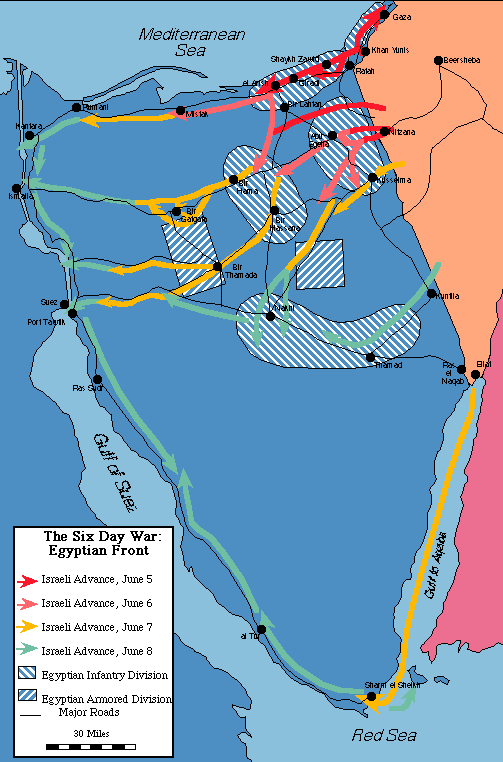
The battle then moved to the ground, and some
of history’s greatest tank battles were
fought between Egyptian and Israeli armor in
the blast-furnace conditions of the Sinai desert.
Jerusalem Is Attacked
Prime Minister Levi
Eshkol sent a message to King
Hussein on June 5 saying Israel would not
attack Jordan unless
he initiated hostilities. When Jordanian radar
picked up a cluster of planes flying from Egypt
to Israel, and the Egyptians convinced Hussein
the planes were theirs, he ordered the shelling
of West Jerusalem. It turned out that the planes
were Israel’s and were returning from
destroying the Egyptian air force on the ground.
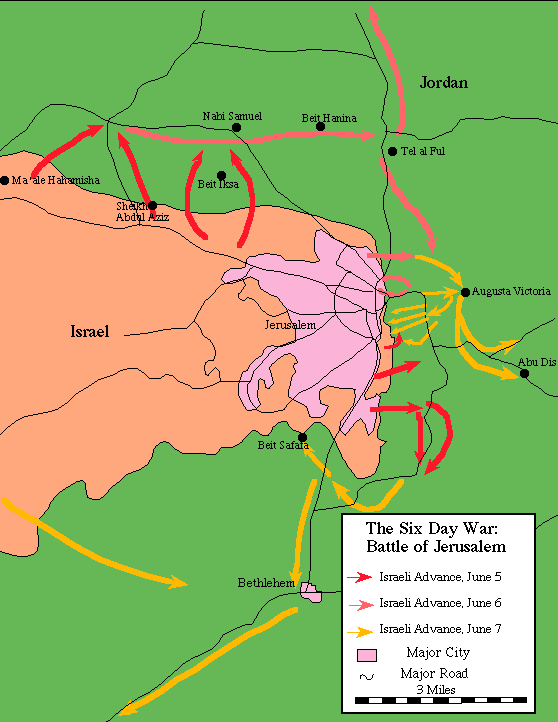
It took only three days for
Israeli forces to defeat the Jordanian legion.
On the morning of June 7, the order was given
to recapture the Old
City. Israeli paratroopers
stormed the city and secured it. Defense Minister Moshe
Dayan arrived with Chief of Staff Yitzhak
Rabin to formally mark the Jews’ return to
their historic capital and their holiest site.
At the Western
Wall, the IDF’s chaplain, Rabbi
Shlomo Goren, blew a shofar to
celebrate the event.
A Second Exodus
After Jordan launched
its attack on June 5, approximately 325,000
Palestinians living in the West
Bank fled
to other parts of Jordan, primarily to avoid
being caught in the cross-fire of a war.(19)
A Palestinian refugee who
was an administrator in a UNRWA camp in Jericho
said Arab politicians had spread rumors in
the camp. "They said all the young people
would be killed. People heard on the radio
that this is not the end, only the beginning,
so they think maybe it will be a long war and
they want to be in Jordan."(20)
Some Palestinians who left preferred to live in an
Arab state rather than under Israeli military rule. Members of
various PLO factions
fled to avoid capture by the Israelis. Nils-Göran
Gussing, the person appointed by the UN Secretary-General
to investigate the situation, found that many
Arabs also feared they would no longer be able
to receive money from family members working
abroad.(21)
Israeli forces ordered a handful
of Palestinians to move for "strategic
and security reasons." In some
cases, they were allowed to return in a few days,
in others; Israel offered to help them resettle
elsewhere.(22) The
net result, however, was that a new refugee
population had been created and the old refugee
problem was made worse.
The Stunning Victory
While most IDF units
were fighting the Egyptians and Jordanians,
a small, heroic group of soldiers were left
to defend the northern border against the Syrians.
It was not until the Jordanians and Egyptians
were subdued that reinforcements could be sent
to the Golan
Heights, where Syrian gunners commanding
the strategic high ground made it exceedingly
difficult and costly for Israeli forces to
penetrate. Finally, on June 9, after two
days of heavy air bombardment, Israeli
forces succeeded in breaking through the Syrian
lines.
 |
After just six days of fighting,
Israeli forces were in a position to march
on Cairo, Damascus, and Amman. By this time,
the principal objectives of capturing the Sinai
and the Golan Heights had been accomplished,
and Israeli political leaders had no desire
to fight in the Arab capitals. Furthermore,
the Soviet Union had become increasingly alarmed
by the Israeli advances and was threatening
to intervene. At this point, U.S. Secretary
of State Dean Rusk advised the Israelis “in
the strongest possible terms” to accept
a cease-fire. On June 10, Israel did just that.
The victory came at a very
high cost. In storming the Golan
Heights,
Israel suffered 115 dead-roughly the number of
Americans killed during Operation Desert Storm.
Altogether, Israel lost twice as many men — 777
dead and 2,586 wounded-in proportion to her total
population as the U.S. lost in eight years of
fighting in Vietnam.(23) Also, despite the incredible success of the air
campaign, the Israeli
Air Force lost 46 of its 200 fighters.(24) The
death toll on the Arab side was 15,000 Egyptians,
2,500 Syrians, and 800 Jordanians.
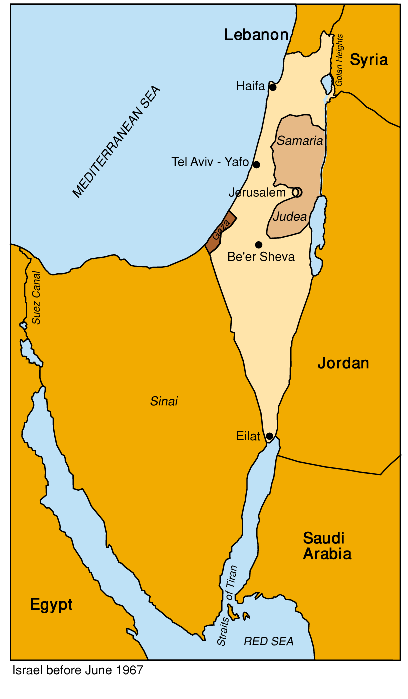
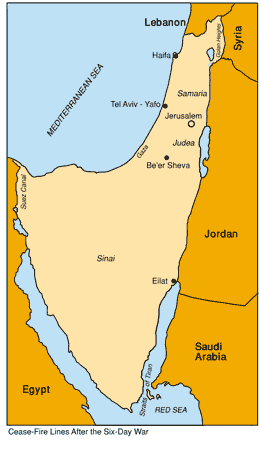
By the end of the war, Israel had conquered enough
territory to more than triple the size of the area it controlled,
from 8,000 to 26,000 square miles. The victory enabled Israel to
unify Jerusalem. Israeli
forces had also captured the Sinai, Golan
Heights, Gaza Strip and West
Bank.
Israel now ruled more than three-quarters of a
million Palestinians — most of whom were hostile to the government.
Nevertheless, more than 9,000 Palestinian families were reunited in
1967. Ultimately, more than 60,000 Palestinians were allowed to
return.(25)
In November 1967, the United
Nations Security Council adopted Resolution
242, which established a formula for Arab-Israeli
peace whereby Israel would withdraw from territories
occupied in the war in exchange for peace with its neighbors.
This resolution has served as the basis for peace negotiations
from that time on.
Israel's leaders fully expected to
negotiate a peace agreement with their neighbors that
would involve some territorial compromise. Therefore,
instead of annexing the West
Bank, a military administration was created. No
occupation is pleasant for the inhabitants, but the
Israeli authorities did try to minimize the impact on
the population. Don Peretz, a frequent writer on the
situation of Arabs in Israel and a sharp critic of the
Israeli government, visited the West Bank shortly after
the Israeli troops had taken over. He found they were
trying to restore normal life and prevent any incidents
that might encourage the Arabs to leave their homes.(26)
Except for the requirement that school texts in
the territories be purged of anti-Israel and anti-Semitic language,
the authorities tried not to interfere with the inhabitants. They did
provide economic assistance; for example, Palestinians in the Gaza
Strip were moved from camps to new homes. This stimulated protests
from Egypt, which had done nothing for the refugees when it
controlled the area.
Arabs were given freedom of movement. They were
allowed to travel to and from Jordan. In 1972, elections were held in
the West Bank. Women and
non-landowners, unable to participate under Jordanian rule, were now
permitted to vote.
East Jerusalem Arabs were given the option of
retaining Jordanian citizenship or acquiring Israeli citizenship.
They were recognized as residents of united Jerusalem and given the right to vote and run for the city council. Also,
Islamic holy places were put in the care of a Muslim Council. Despite
the Temple Mount's significance in Jewish history, Jews were barred
from conducting prayers there.
Sources: Mitchell G. Bard,The
Complete Idiot's Guide to Middle East Conflict. 4th
Edition. NY: Alpha Books, 2008
(1)Encyclopedia
Americana Annual 1961, (NY: Americana Corporation, 1961), p. 387.
(2)Yehoshafat
Harkabi, Arab
Attitudes To Israel, (Jerusalem: Keter Publishing House,
1972), p. 27.
(3)Howard Sachar, A
History of Israel: From the Rise of Zionism to Our Time,
(NY: Alfred A. Knopf, 1979), p. 616.
(4)Samuel Katz, Battleground-Fact
and Fantasy in Palestine, (NY: Bantam Books, 1985), pp.
10-11, 185.
(5)Netanel Lorch, One
Long War, (Jerusalem: Keter, 1976), p. 110.
(6) Isi Leibler, The
Case For Israel, (Australia: The Globe Press, 1972), p. 60.
(7)Ibid.
(8)United Nations
Conference on the Law of the Sea, (Geneva: UN Publications 1958),
pp. 132-134.
(9)Yehuda Lukacs, Documents
on the Israeli-Palestinian Conflict 1967-1983, (NY: Cambridge
University Press, 1984), pp. 17-18; Abba Eban, Abba
Eban, (NY: Random House, 1977), p. 358
(10)Eban, p. 330.
(11)Leibler, p. 60.
(12)Leibler, p. 18.
(13)Leibler, p. 60.
(14)Leibler, p. 18.
(15)Chaim Herzog, The
Arab-Israeli Wars, (NY: Random House, 1982), p. 149.
(16)Lyndon B.
Johnson, The
Vantage Point: Perspectives of the Presidency 1963-1969,
(NY: Holt, Rinehart and Winston, 1971), p. 293.
(17)AP, (June 5,
1967).
(18)Sachar, p. 629.
(19)Encyclopedia
American Annual 1968, p. 366.
(20)George Gruen,
"The Refugees of Arab-Israeli Conflict," (NY: American
Jewish Committee, March 1969), p. 5.
(21)Gruen, p. 5.
(22)Gruen, p. 4.
(23)Katz, p. 3.
(24)Jerusalem
Post, (4/23/99).
(25)Encyclopedia
American Annual 1968, p. 366.
(26)Don Peretz,
"Israel's New Dilemma," Middle East Journal, (Winter
1968), pp. 45-46.
|