The Waffen-SS
Early history; LSSAH, SS-VT
After humble beginnings as a protection
unit for the NSDAP leadership, the Waffen-SS eventually grew into a huge
force of thirty-eight combat divisions comprising over
950,000 men. In the Nuremberg
Trials, the Waffen-SS was condemned as part of a
criminal organisation, and therefore Waffen-SS veterans
were denied many of the rights afforded other German
combat veterans. However the Nuremberg
Trials exempted conscripts from that comdemnation.
The original cadre of the Waffen-SS
came from the Freikorps and the Reichswehr along with
various right-wing paramilitary formations. Formed at
the instigation of Heinrich Himmler, the Leibstandarte SS Adolf
Hitler was the first formation of what was
to become the Waffen-SS. When the SA was rendered powerless
in the Night
of the Long Knives, many ex-SA men requested transfer
to the SS, swelling its ranks and resulting in the formation
of several new units including the SS-Verfügungstruppe
(to become the SS Division Das Reich) and the SS-Totenkopfverbände
(to become the SS Division Totenkopf and also the concentration
camp guard unit). Waffen-SS men were equipped with camouflage
smocks and helmet covers, a new innovation which made
them easily identifiable and provided them with an edge
in combat. While they received the latest in uniforms,
the majority of the Waffen-SS men received second rate
weapons and equipment, many formations receiving Czech
and Austrian weapons and equipment. This policy continued
throughout the war. Contrary to popular belief, the
Waffen-SS did not receive the best equipment, and in
fact many units were equipped with outdated or captured
weapons, vehicles and tanks, with the majority of the
best equipment going to the Heer's elite divisions (Panzergrenadier-Division
Großdeutschland and Panzer-Lehr-Division) and
the Luftwaffe's Hermann
Göring Division.
Concept and Training
SS combat training consisted primarily
of several months of intensive basic training with three
objectives; physical fitness, small-arms proficiency
and political indoctrination. The training was so intensive
that one in three potentials failed to pass the course.
After this basic training, the recruits would be sent
to either to specialist schools where they received
further training in their chosen combat arm. As the
war progressed and replacements were required more frequently,
particularly after the expansion of the Waffen-SS following
the success of the SS-Panzerkorps at Kharkov, the intensity
of the training was relaxed somewhat.
For officers, the focus was on leadership
and combat command, usually at the SS-Junkerschüle
at Bad Tölz. The process tended to produce outstanding
soldiers and officers, and many of the basic tenents
of Waffen-SS training are still used by many armed forces
today. A strong emphasis was placed on creating a bond
between the officers and men, and officer candidates
were made to pass through basic training alongside the
enlisted candidates. This created a mutual trust and
respect between the officers and men, and meant that
the relationship between these groups was very relaxed,
unlike the Heer (German Army), where strict discipline
and a policy of seperation between the officers and
enlisted men existed.
While it is difficult now
to understand why anyone would volunteer
for the Waffen-SS, during the war the organisation
was presented as a multinational force protecting
Europe from the evils of Communism. In addition,
training emphasised unit cohesion and mutual
respect between officers and men, rather
than strict discipline. In the Waffen-SS,
it was not a requirement to salute officers
and a more casual salute was adopted (the
right arm raised vertically from the elbow
- a relaxed version of the Heil salute.
This salute is portrayed in many war films).
Added to this, the practice of addressing
a superior as Herr ("Sir") was
also forbidden, with everyone up to Himmler
being addressed simply by their rank.
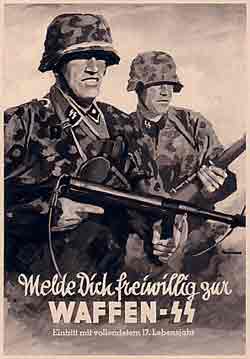 Waffen-SS
Recruitment Poster
Waffen-SS
Recruitment Poster |
Trial by Fire
As the outbreak of war neared, Himmler
ordered the formation of several combat formations from
the SS-Standartes (units of regimental size). The resulting
three formations (the LSSAH, SS-VT and SS-TV) took place
in the Invasion of Poland as well as Fall Gelb. During the campaign in the West,
both the Totenkopf and LSSAH were implicated in atrocities.
The overall performance of the Waffen-SS had been mediocre
during these campaigns.
The poor initial performance of the
Waffen-SS units was mainly due to the emphasis on political
indoctrination rather than proper military training
before the war. This was largely due to the shortage
of experienced NCOs, who preferred to stay with the
regular army. Despite this, the experience gained from
the Polish, French and Balkan campaigns and the peculiarly
egalitarian form of training soon turned Waffen-SS units
into elite formations.
On several occasions, the Waffen-SS
was criticised by Heer commanders for their reckless
disregard for casualties while taking or holding objectives.
However, the Waffen-SS divisions eventually proved themselves
to a skeptical Heer as capable soldiers, although there
were exceptions such as Kampfgruppe Nord's rout from
the the town of Salla during its first engagement in
Karelia.
The Waffen-SS truly proved their worth
during the Third Battle of Kharkov, where the II.SS-Panzerkorps
under SS-Brigadeführer Paul Hausser recaptured
the city and blunted the Soviet offensive, saving the
forces of Erich von Manstein's Army Group South from
being cut off and destroyed.
In Mid 1943, the II.SS-Panzerkorps
took part in Operation Citadel and the LSSAH, Das Reich
and Totenkopf (all now Panzergrenadier divisions) took
part in the immense armour battles near Prokhorovka
on the southern flank of the Kursk salient.
As the fronts began to crumble, the
Waffen-SS divisions began increasingly to be used in
a "fire-brigade" role. Held back behind the
line,the divisions would be committed to counter enemy
breakthroughs. As the success of the divisions increased,
so too did the difficulty of the missions assigned them.
In the closing months of the war, Waffen-SS formations
were assigned impossible missions by Hitler, who saw
them as not only exceptionally effective in combat,
but also politically reliable. The Konrad operations
to relieve Budapest and the Frühlingserwachen operation
to recapture the Hungarian oilfields were doomed to
defeat from the beginning. After the failure of Frühlingserwachen,
Hitler proclaimed that the Waffen-SS had let him down,
and ordered the removal of all honorary cufftitles.
The commander of VI.SS-Panzer-Armee, SS-Oberstgruppenführer
'Sepp' Dietrich, completely disgusted by the order,
did not pass it on to his troops.
Classic SS Divisions
As the Waffen-SS Order of Battle expanded,
several divisions were seen as being elite. These divisions
were characterised by extremely high unit morale and
combat ability, as well as commitment to the Crusade
against Bolshevism and the defense of the Fatherland.
These divisions are referred to as
the classic Waffen-SS divisions, and they include the
LSSAH, Das Reich, Totenkopf, the multi-national Wiking,
the Hohenstaufen and Frundsberg, and the Hitlerjugend.
While several other formations (e.g. the Nordland and
Nord divisions) could also be considered elite, they
are generally not referred to as classic SS Divisions.
In spite of heavy casualties, many
of the Waffen-SS units retained their reputations as
crack formations until the end of the War, though the
quality of formations raised late in the war was often
execrable, and some of the Freiwillige troops were prone
to mutiny.
Foreign Volunteers and Conscripts
Himmler, wishing to expand the Waffen-SS,
advocated the idea of SS controlled foreign legions.
The Reichsführer, with his penchant for medieval
lore, envisioned a united european 'crusade', fighting
to save old Europe from the 'Godless bolshevik hordes'.
While volunteers from regions which and been declared
Aryan were approved almost instantly, Himmler eagerly
pressed for the creation of more and more foreign units.
In late 1940, the creation of a multinational SS division, the Wiking, was authorised. Command of
the division was given to SS-Brigadeführer Felix
Steiner. Steiner immersed himself in the organisation
of the volunteer division, soon becoming a strong advocate
for an increased number of foreign units. The Wiking
was committed to combat several days after the launch
of Operation Barbarossa, proving itself an impressive
fighting unit.
Soon, Danish, Flemish, Norwegian and
Dutch freiwilligen (volunteer) formations were committed
to combat, gradually proving their worth. As the success
of his experiment became apparent, the Reichsführer
began to look for recruits from further afeild, planning
the formation of legions from ethnic groups viewed as
inferior to the Nordic races of Northern Europe.
Hitler however, was hesitant to allow
foreign volunteers to be formed into formations based
on their ethnicity, preferring that they be absorbed
into multi-national divisions. Hitler feared that unless
the foreign recruits were committed to the idea of a
united Germania, then their reasons for fighting were
suspect, and could damage the German cause.
Himmler was allowed to create his new
formations, but they were to be commanded by German
officers and NCOs. Beginning in 1942-43, several new
formations were formed from Latvians, Estonians, Ukrainians
and even Bosnians. The Reichsführer had sidestepped
the race laws by ordering that Waffen-SS units formed
with men from non-Aryan backgrounds were to be designated
division der SS (or Division of the SS) rather than SS Division. The wearing of the SS runes on the collar
was forbidden, with several of these formations wearing
a national insignia instead.
All non-germanic officers and men in
these units had their rank prefix changed from SS to
Waffen (e.g. a Latvian Hauptscharführer would be
referred to as a Waffen-Hauptscharführer rather
than SS-Hauptscharführer). An example of a division
der SS is the Estonian 20.Waffen-Grenadier-Division
der SS (estnische Nr.1). The combat ability of the divisions
der SS varied greatly, with the Latvian, French and
Estonian formations perfoming exceptionally and the
Croatian and Albanian units perfoming poorly.
While many adventurers and idealists
joined the SS as part of the fight against communism,
many of the later recruits joined or were conscripted
for different reasons. For example, Dutchmen who joined
the 34.SS-Freiwilligen-Grenadier-Division Landstorm
Nederland were granted exemption from forced labour
and provided with food, pay and accomodation. Recruits
who joined for such reasons rarely proved good soldiers,
and several units composed of such volunteers were involved
in atrocities.
Towards the end of 1943, it became
apparent that numbers of volunteer recruits were inadequate
to meet the needs of the German military, so conscription
was introduced. The Estonian 20.Waffen-Grenadier-Division
der SS (estnische Nr.1) is an example of such a conscript
formation, which proved to be outstanding soldiers with
an unblemished record.
Not satisfied with the growing number
of volunteer formations, Himmler sought to gain control
of all volunteer forces serving alongside Germany. This
put the SS at odds with the Heer, as several volunteer
units had been placed under Heer control (e.g. all Spanish
volunteers of the Spanish Blue Division fell under Heer
control). Despite this, Himmler constantly campaigned
to have all foreign volunteers fall under the SS banner.
In several cases, like the ROA and the 5.SS-Freiwilligen-Sturmbrigade
Wallonien he was successful, and by the last year of
the war, most foreign volunteers units did fall under SS command.
While several volunteer units performed
poorly in combat, the majority acquitted themselves
well. French and Spanish SS volunteers, along with remnants
of the 11.SS-Freiwilligen-Panzergrenadier-Division Nordland
formed the final defence of the Reichstag in 1945.
After the surrender, many volunteers
were tried and imprisoned by their countries. In several
cases, volunteers were executed. Those volunteers from
the Baltic States and Ukraine could at best look forward
to years spent in the gulags. To avoid this, many ex-volunteers
from these regions joined underground resistance groups
(see Forest Brothers) which were engaged fighting the
Soviets until the 1950s.
 Waffen-SS
soldiers of the Kaminski Brigade during the
Warsaw Ghetto Uprising.
Waffen-SS
soldiers of the Kaminski Brigade during the
Warsaw Ghetto Uprising. |
Many other Waffen-SS volunteers, including
many Wiking veterans, avoided punishment by joining
the French Foreign Legion, and many ex-SS men fought
and died at the Battle of Dien Bien Phu in 1954. Wallon
volunteer leader Leon Degrelle escaped to Spain, where,
despite being sentenced to death in absentia by the
Belgian authorities, he lived in comfortable exile until
his death in 1994. John Amery, the leader of the Britisches
Freikorps, was tried and convicted of treason by
the British government. He was executed in December
1945.
War Crimes and Atrocities
Several formations within the Waffen-SS
were proven to have committed numerous war
crimes, most
notoriously at Oradour-sur-Glane, Marzabotto and in
the Malmedy massacre. Some additional allegations have
never been substantiated as many were intended to link
the Waffen-SS to crimes committed by the Allgemeine-SS
(political SS).
Perhaps the most infamous of all SS formations were the Dirlewanger and Kaminski Brigades
(later to become the 36.Waffen-Grenadier-Division der
SS and 29.Waffen-Grenadier-Division der SS (russische
Nr.1) respectively. These formations, composed mostly
of ex-Einsatzgruppen, released criminals and Russian
Prisoners of War and commanded by the fanatical Nazis
Oskar Dirlewanger and Bronislaw Kaminski, were engaged
in numerous atrocities throughout their existence. After
their actions in putting down the Warsaw Uprising, Heer
complaints resulted in these units being dissolved and
several members (including Kaminski) being tried and
executed for their role in several incidents.
Similarly, the Waffen-Sturm-Brigade
RONA has a "combat" record riddled with atrocities
as well as abysmal conduct when faced with front line
service.
While divisions like the Nordland and
Nord have virtually spotless records, most Waffen-SS
divisions were involved in at least some questionable
actions. The debate over the culpability of the organisation
is the center of much revisionist thinking.
Regardless of the record
of individual combat units within the Waffen-SS,
the entire organisation was declared a criminal
organization by the International Military
Tribunal during the Nuremberg
Trials, except
conscripts, who were exempted from that
judgement due to being forcibly mobilised.
The actions of Himmler and the Nazi heirarchy
in attaching the SS combat divisions to
the same overall command of as the Allgemeine
SS, Concentration
Camps and Einsatzgruppen meant that such a decision was inevitable.
Sources: Wikipedia:
. Picture courtesy of: Polish
Ministry of Foreign Affairs Picture of Waffen Recruit
Poster: Wikipedia
|