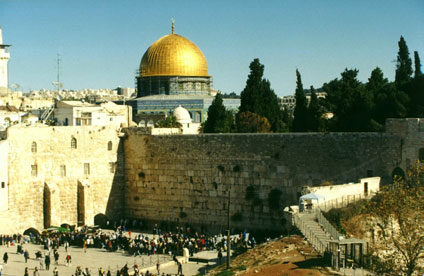
When Rome destroyed
the Second Temple in
70 C.E., only one outer wall remained standing.
The Romans probably would have destroyed
that wall as well, but it must have seemed
too insignificant to them; it was not even
part of the Temple itself, just an outer
wall surrounding the Temple
Mount. For the
Jews, however, this remnant of what was the
most sacred building in the Jewish world
quickly became the holiest spot in Jewish
life. Throughout the centuries Jews from
throughout the world made the difficult pilgrimage
to Palestine,
and immediately headed for the Kotel ha-Ma'aravi (the Western
Wall) to thank God. The prayers offered
at the Kotel were so heartfelt that
gentiles began calling the site the
“Wailing Wall.” This undignified name
never won a wide following among traditional Jews;
the term “Wailing Wall” is not used
in Hebrew.
The Western
Wall was subjected
to far worse than semantic indignities. During
the more than one thousand years Jerusalem was
under Muslim rule, the Arabs often used the
Wall as a garbage dump, so as to humiliate
the Jews who visited it.
For nineteen years, from
1948 to 1967, the Kotel was under
Jordanian rule. Although the Jordanians had
signed an armistice agreement in
1949 guaranteeing Jews the right to visit
the Wall, not one Israeli Jew was ever permitted
to do so. One of the first to reach the Kotel in
the 1967 Six-Day War was
Israeli Defense Minister Moshe
Dayan, who helped revive a traditional
Jewish custom by inserting a written petition
into its cracks. It was later revealed that
Dayan's prayer was that a lasting peace
"descend upon the House of Israel."
The custom of inserting
written prayers into the Kotel's cracks
is so widespread that some American-Jewish
newspapers carry advertisements for services
that insert such prayers on behalf of sick
Jews. The mystical qualities associated with
the Kotel are underscored in a popular
Israeli song, a refrain of which runs: “There
are people with hearts of stone, and stones
with hearts of people.” A rabbi in
Jerusalem once told me that the Hebrew expression
“The walls have ears” was originally
said about the Western Wall.
Unfortunately, even a symbol
as unifying as the Kotel can become
a source of controversy in Jewish life. Ultra-Orthodox
Jews have long opposed organized women's
prayer services at the Wall; prayer services
they maintain, may only be conducted by males.
On occasion they have violently dispersed
such services, throwing chairs and other
“missiles” at the praying women. Under
intense public pressure however, the right of women
to pray collectively at the Kotel is gradually
being won.
In addition to the large
crowds that come to pray at the Kotel on
Friday evenings, it is also a common gathering
place on all Jewish holidays, particularly
on the fast of Tisha
Be-Av, which commemorates the destruction
of both Temples. Today the Wall is a national
symbol, and the opening or closing ceremonies
of many Jewish events, including secular
ones, are conducted there.
On January 31, 2016, the Israeli government approved the creation of an “egalitarian” prayer space where non-Orthodox Jewish men and women can pray together at the Western Wall. This decision was met with praise from Jewish leaders across the globe, and opposition from Orthodox and ultra-Orthodox Israeli citizens and members of the government. Israeli Prime Minister Benjamin Netanyahu stated that the creation of this space was a “fair and creative solution,” to rising tensions at the site.
The advocacy group Women of the Wall called the decision a victory, with the government recognizing that, according to the organization's chairwoman, “that there is more than one way to be Jewish.” The new prayer space will be designated South of the mens and women's prayer sections of the wall, in an area known as Robinson's Arch. The first Reform, mixed-gender prayer service to ever take place at the Western Wall was held at this new space on February 25, 2016.