Walter von Reichenau
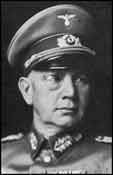
(1884 - 1942)
Walter von Reichenau, the son of a Prussian general,
was born in Germany on August 16t, 1884. He joined the German Army when
he was eighteen and, in 1904, became an officer in the 1st Guards Field
Artillery Regiment.
In May 1914, he entered the War Academy in Berlin where
he underwent General Staff training. On the outbreak of the First World
War he was sent to the Western Front. During the conflict he won the
Iron Cross and, by 1918, had reached the rank of captain.
After the war, Reichenau was a General Staff officer
with the Wehrkries VI (1920-22) before serving as commander of the 8th
Machine Gun Company. He was promoted to major in 1923 and joined the
Wehrkries III in Berlin. This
was followed by a period as commander of the 5th Signal Battalion at
Stuttgart (1927-29) and Chief of Staff to the Inspector of Signals at
the Reichswehr Ministry (1929-31).
In February 1931, Reichenau was named Chief of Staff
of Wehrkries I in East Prussia, where he served under General Werner
von Blomberg. Reichenau's uncle, Friedrich von Reichenau, was an
ardent supporter of the Nazi
Party and, in 1932, he introduced his nephew to Adolf
Hitler. Reichenau was immediately converted and soon afterwards
he arranged for Blomberg to meet Hitler.
When Hitler gained power in January 1933, Werner
von Blomberg became Minister of War and Reichenau was appointed
head of the Ministerial Office of the Reichswehr Ministry. Reichenau
now became chief liaison officer between the German Army and the Nazi
Party. Reichenau and Blomberg worked together to force Kurt Hammerstein-Equord,
a committed anit-Nazi, to retire as Commander-in-Chief of the Army. Blomberg persuaded Adolf
Hitler to appoint Reichenau to the post but after a group of senior
army officers complained, President Paul von Hindenburg vetoed the selection
and General Werner von Fritsch was chosen instead.
In 1933, Werner
von Blomberg and Reichenau became increasingly concerned about the
growing power of the Sturm Abteilung (SA). Its leader, Ernst
Roehm, was given a seat on the National Defence Council and began
to demand more say over military matters. On October 2, 1933, Roehm
sent a letter to Reichenau that said: "I regard the Reichswehr
now only as a training school for the German people. The conduct of
war, and therefore of mobilization as well, in the future is the task
of the SA.
Senior officers in the German Army were angry about
the growth in power of the SA and Reichenau began to fear the possibility
of a military coup against Hitler. If this happened Reichenau's career
would be over. He therefore conspired with Hermann
Goering and Heinrich Himmler against Roehm and the SA. Himmler asked Reinhard
Heydrich to assemble a dossier on Roehm. Heydrich, who also feared
him, manufactured evidence that suggested that Roehm had been paid 12
million marks by the French to overthrow Hitler.
Hitler liked Roehm and initially refused to believe
the dossier provided by Heydrich. Roehm had been one of his first supporters
and, without his ability to obtain army funds in the early days of the
movement, it is unlikely that the Nazis would have ever become established.
The SA under Roehm's leadership had also played a vital role in destroying
the opposition during the elections of 1932 and 1933.
However, Adolf Hitler had his own reasons for wanting
Roehm removed. Industrialists, who had provided the funds for the Nazi
victory, were unhappy with Roehm's socialistic views on the economy
and his claims that the real revolution had still to take place. Many
people in the party also disapproved of the fact that Roehm and many
other leaders of the SA were homosexuals.
On June 29, 1934. Hitler, accompanied by the Schutz
Staffeinel (SS), arrived at Wiesse, where he personally arrested Ernst Roehm. During the
next 24 hours, 200 other senior SA officers were arrested on the way
to Wiesse. Many were shot as soon as they were captured but Hitler decided
to pardon Roehm because of his past services to the movement. However,
after much pressure from Hermann
Goering and Heinrich Himmler,
Hitler agreed that Roehm should die. At first Hitler insisted that Roehm
should be allowed to commit suicide but, when he refused, he was killed
by two SS men.
The purge of the SA was kept secret until it was announced
by Hitler on July 13. It was during this speech that Hitler gave the
purge its name: Night of the
Long Knives (a phrase from a popular Nazi song). Hitler claimed
that 61 had been executed while 13 had been shot resisting arrest, and
three had committed suicide. Others have argued that as many as 400
people were killed during the purge. In his speech Hitler explained
why he had not relied on the courts to deal with the conspirators: "In
this hour I was responsible for the fate of the German people, and thereby
I become the supreme judge of the German people. I gave the order to
shoot the ringleaders in this treason."
In August 1935, Reichenau was promoted to lieutenant
general and was appointed commander of Wehrkries VII in Munich. The
following year he was appointed general of artillery and, in 1938, Adolf
Hitler wanted to appoint him as Commander-in-Chief of the Army. Leading
figures in the German Army complained and Gerd
von Rundstedt, Franz Halder and Ludwig Beck all refused
to serve under him. Hitler was forced to change his mind and, on February
4, 1938, General Heinrich
von Brauchitsch was appointed instead. Reichenau now replaced Brauchitsch
as Commander-in-Chief of Army Corps 4.
In September 1939, Reichenau commanded the 10th Army
for the invasion of Poland.
The following year he led the 6th Army during the Western Offensive
in Belgium and France.
On July 19, 1940, Hitler promoted him to field marshal.
Reichenau, a strong opponent of an invasion of the
Soviet Union, also took part in Operation
Barbarossa during the summer of 1941. Leading the 6th Army his troops
managed to capture Kiev, Belgorod, Kharkov and Kursk. Reichenau encouraged
his soldiers to commit atrocities against the Jews in the territory
under his control. On one occasion he told his men: "We have to
exact a harsh but just retribution on the Jewish subhumans."
In September 1941, Reichenau wrote to Adolf Hitler
suggested that they should start recruiting Ukrainians and White Russians
to fight against the Red Army. Hitler rejected the idea and told Reichenau
to stop interfering in political strategy. Later that month Reichenau
wrote to Hitler again on this subject warning of the dangers of large-scale
partisan warfare in the Soviet Union.
In November 1941, Hitler decided to replace Field Marshal Heinrich von Brauchitsch as Commander-in-Chief of the Army. Reichenau's name was suggested but
Hitler rejected the idea saying that he was "too political".
The campaign in the Soviet Union came to a halt during
the winter of 1941. Field Marshal R, commander of Army Group South,
asked permission to retreat to the Mius River. When Hitler rejected
the idea, Rundstedt resigned. On November 30, Hitler replaced Rundstedt with Gerd von Rundstedt.
The following day Reichenau ordered a withdrawal to the Mius River and
then sent a note telling Hitler what he had done.
In an attempt to keep fit, Reichenau used to go on
a daily cross-country run. On January 12, 1942, he ran several miles
in temperatures well below minus 20 degrees Fahrenheit. When he returned,
he complained of feeling unwell and, later that day, he had a severe
heart attack. After being unconscious for five days, it was decided
to fly him back to Germany. Walter von Reichenau died on January 17,
1942, when the plane carrying him to Leipzig crash-landed.
Sources: Spartacus |