|
Myths & Facts OnlinePartitionBy Mitchell G. Bard“The
United Nations unjustly partitioned
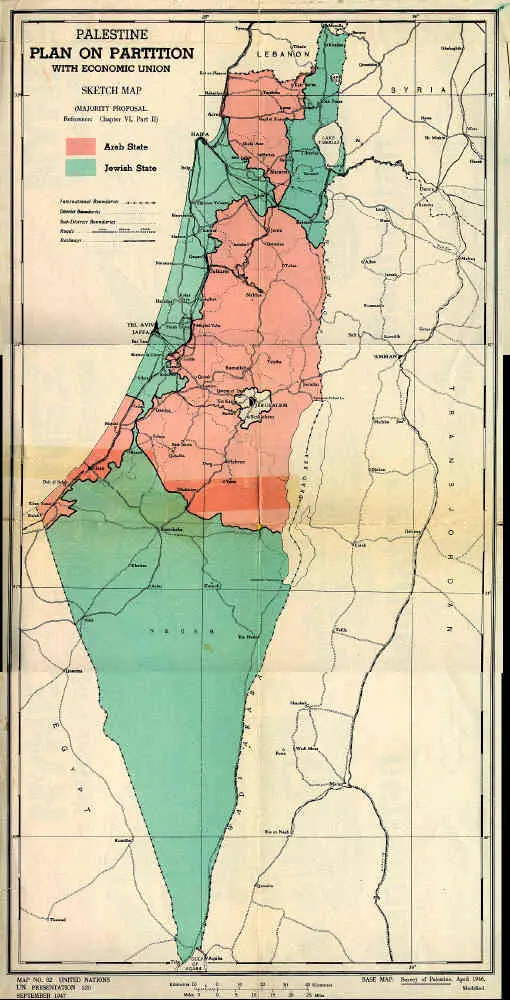
Palestine.” “The United Nations unjustly partitioned Palestine.” FACT As World War II ended, the magnitude of the Holocaust became known. This accelerated demands for a resolution to the question of Palestine so the survivors of Hitler’s Final Solution might find sanctuary in a homeland of their own. The British tried to work out an agreement acceptable to both Arabs and Jews, but their insistence on the former’s approval guaranteed failure because the Arabs would not make any concessions. The British subsequently turned the issue over to the UN in February 1947. The UN established a Special Commission on Palestine (UNSCOP) to devise a solution. Delegates from 11 nations* went to the area and found what had long been apparent: The conflicting national aspirations of Jews and Arabs could not be reconciled. The contrasting attitudes of the two groups “could not fail to give the impression that the Jews were imbued with the sense of right and were prepared to plead their case before any unbiased tribunal, while the Arabs felt unsure of the justice of their cause, or were afraid to bow to the judgment of the nations.”1 When they returned, the delegates of seven nations — Canada, Czechoslovakia, Guatemala, The Netherlands, Peru, Sweden and Uruguay — recommended the establishment of two separate states, Jewish and Arab, to be joined by economic union, with Jerusalem an internationalized enclave. Three nations — India, Iran and Yugoslavia — recommended a unitary state with Arab and Jewish provinces. Australia abstained. The Jews of Palestine were not satisfied with the small territory allotted to them by the Commission, nor were they happy that Jerusalem was severed from the Jewish State; nevertheless, they welcomed the compromise. The Arabs rejected UNSCOP’s recommendations. The ad hoc committee of the UN General Assembly rejected the Arab demand for a unitary Arab state. The majority recommendation for partition was subsequently adopted 33-13 with 10 abstentions on November 29, 1947.2
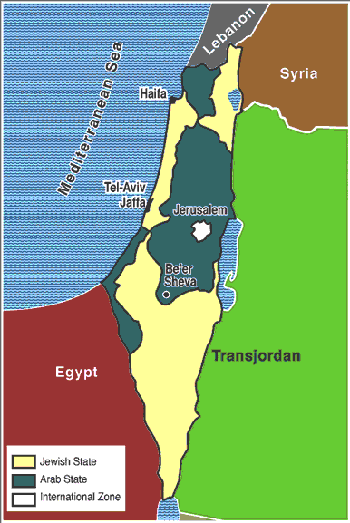
“The partition plan gave the Jews most of the land, and all of the cultivable area.” FACTThe partition plan took on a checkerboard appearance largely because Jewish towns and villages were spread throughout Palestine. This did not complicate the plan as much as the fact that the high living standards in Jewish cities and towns had attracted large Arab populations, which insured that any partition would result in a Jewish state that included a substantial Arab population. Recognizing the need to allow for additional Jewish settlement, the majority proposal allotted the Jews land in the northern part of the country, the Galilee, and the large, arid Negev desert in the south. The remainder was to form the Arab state.
These boundaries were based solely on demographics. The borders of the Jewish State were arranged with no consideration of security; hence, the new state’s frontiers were virtually indefensible. Overall, the Jewish State was to be comprised of roughly 5,500 square miles, and the population was to be 538,000 Jews and 397,000 Arabs. Approximately 92,000 Arabs lived in Tiberias, Safed, Haifa and Bet Shean, and another 40,000 were Bedouins, most of whom were living in the desert. The remainder of the Arab population was spread throughout the Jewish state. The Arab State was to be 4,500 square miles with a population of 804,000 Arabs and 10,000 Jews.4 Critics claim the UN gave the Jews fertile land while the Arabs were allotted hilly, arid land. To the contrary, approximately 60 percent of the Jewish state was to be the desert in the Negev while the Arabs occupied most of the agricultural land.5 Further complicating the situation was the UN majority’s insistence that Jerusalem remain apart from both states and be administered as an international zone. This arrangement left more than 100,000 Jews in Jerusalem isolated from their country and circumscribed by the Arab state. According to British statistics, more than 70 percent of the land in what would become Israel was not owned by Arab farmers, it belonged to the mandatory government. Those lands reverted to Israeli control after the departure of the British. Nearly 9 percent of the land was owned by Jews and about 3 percent by Arabs who became citizens of Israel. That means only about 18 percent belonged to Arabs who left the country before and after the Arab invasion of Israel.6 “Israel usurped all of Palestine in 1948.” FACTNearly 80 percent of what was the historic land of Palestine and the Jewish National Home, as defined by the League of Nations, was severed by the British in 1921 and allocated to what became Transjordan. Jewish settlement there was barred. The UN partitioned the remaining 20-odd percent of Palestine into two states. With Jordan’s annexation of the West Bank in 1950, and Egypt’s control of Gaza, Arabs controlled more than 80 percent of the territory of the Mandate, while the Jewish State held a bare 17.5 percent.7 “The Palestinian Arabs were never offered a state and therefore have been denied the right to self-determination.” FACT
In 1939, the British White Paper called for the establishment of an Arab state in Palestine within 10 years, and for limiting Jewish immigration to no more than 75,000 over the following five years. Afterward, no one would be allowed in without the consent of the Arab population. Though the Arabs had been granted a concession on Jewish immigration, and been offered independence — the goal of Arab nationalists — they repudiated the White Paper. With partition, the Palestinians were given a state and the opportunity for self-determination. This too was rejected. “The majority of the population in Palestine was Arab; therefore, a unitary Arab state should have been created.” FACT
The Jews never had a chance of reaching a majority in the country given the restrictive immigration policy of the British. By contrast, Palestine’s Arab population, which had been declining prior to the Mandate in 1922, grew exponentially because Arabs from all the surrounding countries were free to come — and thousands did — to take advantage of the rapid economic development and improved health conditions stimulated by Zionist settlement. The decision to partition Palestine was not determined solely by demographics; it was based on the conclusion that the territorial claims of Jews and Arabs were irreconcilable, and that the most logical compromise was the creation of two states. Ironically, that same year, 1947, the Arab members of the United Nations supported the partition of the Indian sub-continent and the creation of the new, predominantly Muslim state of Pakistan. “The Arabs were prepared to compromise to avoid bloodshed.” FACTAs the partition vote approached, it became clear little hope existed for a political solution to a problem that transcended politics: the Arabs’ unwillingness to accept a Jewish state in Palestine and the refusal of the Zionists to settle for anything less. The implacability of the Arabs was evident when Jewish Agency representatives David Horowitz and Abba Eban made a last-ditch effort to reach a compromise in a meeting with Arab League Secretary Azzam Pasha on September 16, 1947. Pasha told them bluntly:
Notes1Aharon
Cohen, Israel
and the Arab World, (Boston: Beacon Press,
1976), pp. 369-370. Voting against partition: Afghanistan, Cuba, Egypt, Greece, India, Iran, Iraq, Lebanon, Pakistan, Saudi Arabia, Syria, Turkey, Yemen. Abstained: Argentina, Chile, China, Columbia, El Salvador, Ethiopia, Honduras, Mexico, UK, Yugoslavia. Yearbook of the United Nations, 1947-48, (NY: United Nations, 1949), pp. 246-47. 3London
Times, (December 1, 1947). *Australia, Canada, Czechoslovakia, Guatemala, India, Iran, the Netherlands, Peru, Sweden, Uruguay and Yugoslavia. See also: Partition Previous To order the paperback edition, click HERE.
|
 |