Charleston, South Carolina
Charleston is the oldest and second-largest city in the state of South Carolina. By the 19th century, Charleston was home to the largest and wealthiest Jewish community in North America.
- Community History
- Kahal Kadosh Beth Elohim Synagogue
- Coming Street Cemetery
Community History
Jews began to settle in Charleston in 1695, 25 years after the English founded Carolina. Governor John Archdale, in a descriptive report on the colony, mentioned having a Spanish-speaking Jew as an interpreter in his dealing with captive Florida Indians. The early Jews were mostly Sephardim who came to Charleston from England by way of the Caribbean islands for the commercial opportunities available in a growing Atlantic seaport, and the religious freedom and personal rights offered and tolerated by the colony's Lord Proprietors. They helped build the city's colonial prosperity largely as shopkeepers, traders, and merchants. Among them was Moses
*Lindo
, who helped develop the important indigo trade and was made "Surveyor and Inspector-General of Indigo" for the provinces.
Charleston Jewish community life began in 1749 when Jews were numerous enough to organize a formal congregation called Kahal Kadosh Beth Elohim (Holy Congregation House of God). Influenced by Sephardi congregation Bevis Marks in London, Beth Elohim adopted its strict Sephardi ritual and governance. Its founding fathers were Joseph To-bias, president; Michael Lazarus, secretary; Moses Cohen, rabbi; and Isaac Da Costa, ḥazzan. The congregation, in 1764, purchased Isaac Da Costa's family burial ground, established in 1754, as a congregational graveyard, now known as the Coming Street Cemetery, the South's oldest surviving Jewish cemetery. The congregation was incorporated in 1791 and, in 1794, dedicated a new synagogue with a capacity of 500 people. The Hebrew Benevolent Society, founded in 1784, and the Hebrew Orphan Society, chartered in 1802, handled charitable activities. (Both are still active.) During the first decades of the 1800s, Charleston, with more than 700 Jews, had "the largest, most cultured, and wealthiest Jewish community in America," but it began a long decline in importance soon thereafter.
The Jews of Charleston became acculturated and were well received by the general community, which to them became "this happy land." They viewed themselves and were recognized as "a portion of the people." During the American Revolution, more than a score of Charleston Jews served in the patriot forces, several as officers. Francis
*Salvador
, a delegate to the revolutionary Provincial Congresses, which established independence from Great Britain in South Carolina (1775–1776), was the first Jew to hold elective public office in the New World. Killed and scalped by Tory-led Indians on August 1, 1776, he was the first Jew to die for American independence. In 1790, Beth Elohim wrote congratulations to George Washington on becoming the first president of the United States; Washington replied, "May the same temporal and eternal blessings which you implore for me, rest upon your Congregation."
Charleston Jews fought in every other war in which the United States was involved. In the Civil War, even though ambivalent about secession, they joined their South Carolina neighbors in the Confederate cause. The war left Charleston and its Jews decimated and impoverished. Noticeable recovery did not occur until mid-20th century.
Jews were well integrated in the Charleston community. Jews were active Masons; Isaac Da Costa was a member of the first Masonic lodge in South Carolina and four others were among the 11 founders of the Supreme Council of Scottish Rite Masonry (1802). Isaac Harby and Jacob N. Cardozo were newspaper editors; Penina Moise was a regular contributor of poems to Charleston newspapers; Joshua Lazarus headed the utility company, which introduced gas lighting to the city; Mordecai Cohen, a peddler, became at one time the second richest man in South Carolina and was noted for his philanthropies.
In 1854, the Ashkenazi congregation Berith Shalome was formed, one of the oldest in continuous existence in the United States; it merged in 1954 with Congregation Beth Israel
(1911) to form present-day Brith Sholom Beth Israel. These congregations benefited from an influx of East European immigrants (1881–1920).
After World War II, industrial growth and port development, along with expansion of military facilities, brought a new prosperity to Charleston, in which its Jewish citizens shared. Accompanying this was the growth of educational and medical institutions and tourism. Demographically, the Jewish population of metropolitan Charleston grew from about 2,000 in 1948, in a general population of about 175,000, to about 5,500 in 2004, in a general population of about 570,000. This resulted from the influx of Jews from other parts of the United States attracted by economic opportunities, mild climate, and a good quality of life. Jewish population, once contained entirely in peninsular Charleston, now spread over annexed suburbs and newly developed municipalities around the city. Jews were prominent in the area's business, professional, and cultural life, but retail trade gave way to the professions – doctors, lawyers, educators, and many other occupations. Jews were active in civic clubs and charitable organizations and were often elected to public office.
There were three congregations with a combined membership of about 1,450 family units. Emanu-El Synagogue (1947), Conservative, and K.K. Beth Elohim, Reform, were the largest, each with about 550 units. Brith Shalom Beth Israel conducted a Hebrew day school, Addlestone Academy. There were six Jewish cemeteries, three of them still active, maintained by the congregations. The Charleston Jewish Federation, established as the United Jewish Appeal in 1949, raised money for local, national, and overseas causes, dealt with community relations, and published a monthly periodical. There was a Jewish Community Center and active local chapters of most national Jewish organizations. The College of Charleston's Yaschik-Arnold Jewish Studies Program provided Jewish educational opportunities to the community, and the college's Marlene and Nathan Addlestone Library housed the Jewish Heritage Collection, preserving records of the Charleston Jewish community and its people.
Kahal Kadosh Beth Elohim Synagogue
Kahal Kadosh Beth Elohim Synagogue, a National
Historic Landmark, in Charleston, SC,
is the country's second oldest synagogue and
the oldest in continuous use. The American Reform
Judaism movement originated at this site
in 1824. The congregation of Kahal Kadosh
Beth Elohim — meaning Holy Congregation
House of God — was established in colonial
Charleston in 1749, and is now the nation's
fourth oldest Jewish community. The building
reflects the history of Jewish worship in
Charleston, as well as the high degree of
religious tolerance within the Carolina colony.
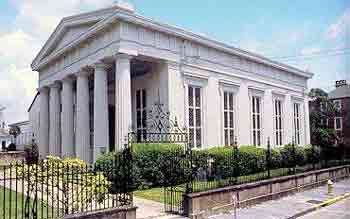
|
The Beth Elohim congregation
began as an Orthodox community,
founded primarily by Sephardic immigrants
(of Spanish and Portuguese ancestry). By
the end of the 18th century, the Beth Elohim
congregation had become the largest Jewish
community in the nation, with a membership
of 500. This synagogue was built in 1840,
on the site of the congregation's first
synagogue destroyed in the Charleston fire of 1838.
The building is an excellent example of the
Greek Revival style, as its form, portico
and rich ornamentation are adapted from classic
Greek temples. Designed by New York architect
Cyrus L. Warner, the temple was built by
congregation member, David Lopez.
By 1841, the majority of the congregation was
embracing Reform Judaism, and the first service
held in the new temple reflected this ideology.
The Reform Movement, an attempt to modernize
synagogue worship and a reevaluation of Jewish
theology, had its roots in Hamburg, Germany,
in the 1810s, and quickly spread throughout
central Europe and to the United States.
Worship reform included choral singing, organ
music, and the use of German instead of Hebrew for prayers and
sermons. In 1824, 47 members of Beth Elohim
petitioned the trustees to abridge the Hebrew
rituals and conduct prayers and sermons in
English. The denial of these requests resulted
in a temporary split of the congregation,
but, by 1833, a united Beth Elohim had nearly
200 members supporting the Reform Movement.
After the burning of the first synagogue
and the election of a new rabbi, the inaugural
service of this synagogue held in 1841 contained
modernized ritual and Beth Elohim formally
became the first American Reform congregation.
Today, the Synagogue still serves the Reform
Judaism community. A small museum contains
artifacts pertinent to the history of the
congregation, such as a letter written to
the congregation by George Washington.
Coming Street Cemetery
The Coming Street Cemetery,
established in Charleston, SC in 1762, is
the oldest Jewish burial ground in the South.
Privately owned by Kahal
Kadosh Beth Elohim Synagogue, the cemetery contains some 600
marble and brownstone grave markers. Most
of the markers date to the last half of the
18th century or the first half of the 19th
century, and include box tombs, table-top
tombs, obelisks, and columns. Many are significant
examples of gravestone art, signed by locally
prominent sculptors and stonecutters.
 Stones of the
Coming Street Cemetery Stones of the
Coming Street Cemetery
NPS photograph
|
Significant artistic markers
denote the graves of prominent Charlestonians
such as Joshua Lazarus (1791-1861), former
president of the Beth Elohim Synagogue
and the Charleston Gas Light Company. Lazarus's
marker features a fluted column on a pedestal,
surmounted by an urn. Marx E. Cohen, Jr.
(1839-1865) was a Confederate soldier killed
near the end of the Civil War, and his
obelisk marker features a cannon below
the State and Confederate flags in bas-relief.
An elaborately detailed box tomb, described
as a "stone
canopy," memorializes Catherine Lopez (1814-1843),
wife of David Lopez, builder of the Beth
Elohim Synagogue. Lopez is buried in a family
plot of land adjacent to the main cemetery
that was later incorporated. At the time
of her death, she was not permitted burial
in the main cemetery because she had not
converted to Judaism.
A stuccoed brick wall
surrounds the Cemetery, portions of which
are original. An important feature of the
site, this brick wall has been a major
factor in preserving the intact cemetery
over the past two centuries. There are
also remains of a wall that once divided
the cemetery, reflecting a time in the
mid-19th century when the Beth Elohim congregation
was divided over a doctrinal dispute. By
1887, Beth Elohim established a new cemetery,
and burials in the Coming Street Cemetery
are now restricted to the few vacancies
in the adjacent family plots. The appearance
of the cemetery, or graveyard as it was
called historically, has been little altered.
Over time, some damage has occurred to
individual gravestones from pollution,
climate, severe weather and vandalism.
Sources: Encyclopaedia
Judaica. © 2008 The Gale Group.
All Rights Reserved; National
Park Service; National
Park Service |