
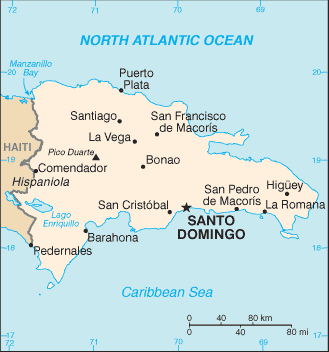
The Dominican Republic is a nation on the island of Hispaniola and part of the Greater Antilles archipelago in the Caribbean region. Today, there are approximately 100 Jews living in the Dominican Republic.
Jewish history in the small Caribbean nation became in earnest during the years preceding World War II.
In March 1938, President Franklin Roosevelt convened a 32-nation conference at Evian-les-Bains, France, to discuss the resettlement of German and Austrian Jewish refugees to other lands. The assembled nations endorsed the idea of resettlement but agreed that no nation would “be expected or asked to receive a greater number of emigrants than is permitted by existing legislation.” Given the immigration restrictions and anti-Semitic moods of the Depression era, this meant that, in effect, no nation – even the United States – was expected to take more than a few thousand refugees.
Only the Dominican Republic expressed a willingness to accept a significant number - between 50,000 and 100,000 Jews - an offer that the American Jewish Joint Distribution Committee jumped at.
The Dominican government, led by dictator Rafael Trujillo, welcomed the Jews on the condition that they become agricultural workers rather than “commission agents.” The Joint Distribution Committee created a special organization, the Dominican Republic Settlement Association (DORSA) and funded it to purchase 26,000 acres in the Dominican town of Sosua, which had previously been developed as a banana plantation but then abandoned by the United Fruit Company.
On January 30, 1940. DORSA officials signed a contract with the Trujillo regime. Historian Nicholas Ross, writing in the journal of the American Jewish Historical Society, quotes the contract:
The Republic ... hereby guarantees to the settlers and their descendants full opportunity to continue their lives and occupations free from molestation, discrimination, or persecution, with full freedom of religion ... civil, legal, and economic rights, as well as other rights inherent to human beings.
Despite this encouraging start, the Sosua experiment struggled. Submarine warfare in the Atlantic and the need to use Allied ships for troops and supplies made it possible to relocate only 50 or so refugees in the first year. Some of the refugees wished to begin life again as Dominican farmers, but an equal number saw Sosua only as a place to wait until they could get a visa to enter the United States. It soon became clear that it would cost about $3,000 to settle a family on a tract of Sosua land and equip it for farming and the colony appeared headed for disintegration.
James N. Rosenberg, head of DORSA, refused to let the experiment die. Nicholas Ross quotes Rosenberg: “Half the world lives now under the shadow of war, persecution, horror and death. ... Now an open door of hope beckons. ... We must carry this endeavor to accomplishment. … We dare not falter.”
DORSA imported experts from kibbutzim in Palestine to teach the settlers communal agriculture. They helped design and build a communal meat processing plant and butter and cheese factory and recommended raising lemongrass for its oil, which is commercially used in perfume. A trickle of refugee settlers continued to the town even though the American entry into the war made it even harder to cross the Atlantic.
In October 1941, the Nazis cut off Jewish emigration from the territories they occupied in Europe. Sosua’s Jewish population peaked at about 500. By this point, DORSA had invested about $1 million in the project.
By 1944, Sosua’s fortunes turned, DORSA abandoned communal agriculture and gave the settlers private plots. The colonists focused on raising cattle and butter and cheese production. Eventually, they learned to prosper. While some left for the U.S. or Israel, others stayed.
Today, fewer than 25 Jewish families remain in Sosua. Their dairy business supplies most of the butter and cheese consumed in the Dominican Republic. Until 1980, the town was still entirely Jewish; however, since the opening of the international Puerto Plata airport four miles west of Sosua, the village has turned into a major beach resort.
The town still maintains a functioning synagogue hat holds services every other Shabbat and on the High Holidays. The community also has a museum dedicated to preserving the history and story of the town’s original Jewish settlers. The final caption on its exhibit reads: “Sosua, a community born of pain and nurtured in love must, in the final analysis, represent the ultimate triumph of life.”
In August 2026, Dominican President Luis Abinader announced that his government would formally adopt the International Holocaust Remembrance Alliance’s working definition of anti-Semitism, making the country the seventh in Latin America to endorse the framework. Speaking at the Combat anti-Semitism Movement’s regional forum in Santo Domingo, Abinader said anti-Semitism threatens democratic coexistence and emphasized that combating it is compatible with freedom of expression. He also pledged 50 million pesos for a new complex for the Jewish Museum of Sosúa. U.S. anti-Semitism envoy Yehuda Kaploun praised the decision and urged other Latin American countries to follow suit.
Relations with Israel
The Dominican Republic has maintained one of Israel’s longest-standing relationships in the Caribbean. It voted for the 1947 UN partition plan, formally recognized Israel in December 1948, and established full diplomatic relations the following year. The Dominican Republic opened an embassy in Jerusalem in 1964 but moved it to Tel Aviv in 1980. In 2020, President Luis Abinader’s government said it was considering returning the embassy to Jerusalem, though the proposed move was not carried out. Israel maintains an embassy in Santo Domingo.
The relationship has focused heavily on technical and economic cooperation. Israel has provided expertise in agriculture, irrigation, rural development, public health, education, entrepreneurship, and technology. The countries signed a technical cooperation agreement involving Israel’s MASHAV development agency in 1979, followed by agreements promoting cultural, educational, scientific, and commercial exchanges. A broader cooperation agreement covering education, agriculture, entrepreneurship, and technology was signed in 2021, while Israel’s Mekorot and the Dominican Republic’s water authority, INAPA, reached a water management agreement in 2023.
Israeli investment has extended into Dominican agriculture, tourism, infrastructure, medical technology, and water systems. In 2024, the Israeli medical-device company Elcam announced plans for a Dominican production center involving an investment of approximately $80 million. Political relations remained friendly after the October 7, 2023, Hamas attack, which Abinader strongly condemned while calling for diplomacy and peace. In April 2025, Dominican Ambassador Olivio Fermín presented his credentials to Israeli President Isaac Herzog and reaffirmed his government’s desire to deepen bilateral cooperation.
Sources: American Jewish Historical Society.
Jerusalem Post (January 6, 1995).
“Diplomatic Relations”, Embassy of the Dominican Republic in Israel.
“Agreements and Treaties”, Embassy of the Dominican Republic in Israel. “Bilateral Relations,” Israel Ministry of Foreign Affairs, (July 15, 2024).
“Israel Hails News Dominican Republic May Move Embassy to Jerusalem,” Reuters, (October 31, 2020).
“Guerra de Israel y Hamás en Gaza,” RTVE, (October 9, 2023).
“Dominican Ambassador Presents Credentials to the President of Israel,” Embassy of the Dominican Republic in Israel, (April 22, 2025).
Erez Linn, “'Human dignity is indivisible': Dominican Republic to adopt IHRA definition,” Israel Hayom, (August 25, 2026).
Photo: CIA Factbook.