
From the beginning of the peace process in the 1990s, negotiations with Lebanon were overshadowed by Syria’s control over Lebanon’s policies and decision-making. Over a dozen rounds of bilateral talks were held between Israel and Lebanon in the framework of the Washington talks. These negotiations stalled in February 1994, and the two side did not resume talks until 2026 in the wake of the U.S.-Israeli war with Iran.
Israel has clarified to the Lebanese that it makes no claims to Lebanese land or resources and that its primary concern is for security on its northern border. Israel has suggested a settlement based on the following principles:
- The Lebanese army will be deployed north of the security zone and, for six months, will prevent any terror activities against the security zone and Israel. Israel will be prepared to sign a peace agreement with Lebanon three months following that initial period.
- Before any change in its redeployment on the Lebanese front, Israel must be convinced that the military organs of all terrorist groups currently operating out of Lebanon will be irreversibly disbanded.
- The government of Israel must receive practical and valid guarantees that no harm will be inflicted upon Lebanese citizens and Southern Lebanese Army personnel currently residing in the security zone and that they will be absorbed in the governmental and societal fabric of Lebanon.
In April 1996, following months of provocations by Iranian-backed Hezbollah terrorists based in Lebanon, Israel initiated “Operation Grapes of Wrath” directed against these terrorist elements.
On April 26, 1996, through U.S. mediation, a document of understanding was achieved in consultation with Syria, Lebanon, and Israel. In addition to establishing what it is hoped will be a lasting end to hostilities, the document recognizes that a comprehensive peace can be achieved only based on negotiations:
“It is recognized that the understanding to bring the current crisis between Lebanon and Israel to an end cannot substitute for a permanent solution. The United States understands the importance of achieving comprehensive peace in the region.
Toward this end, the United States proposes the resumption of negotiations between Syria and Israel and between Lebanon and Israel at a time to be agreed upon to reach a comprehensive peace.”
The United States understands that these negotiations should be conducted in a climate of stability and tranquility.”
On April 1, 1998, the Israeli government adopted a decision “accepting UN Security Council Resolution 425, so that the IDF will leave Lebanon with appropriate security arrangements, and so that the Lebanese government can restore its effective control over Southern Lebanon and assume responsibility for guaranteeing that its territory will not be used as a base for terrorist activity against Israel.” In addition, the government “calls on the Lebanese government to begin negotiations, based on UN Security Council Resolution 425 to restore its effective control over territories currently under IDF control, and to prevent terrorist activities from its territory against Israel’s northern border.”
The government guidelines established by Prime Minister Barak in July 1999 reiterate: “The Government will act toward bringing the IDF out of Lebanon while guaranteeing the welfare and security of residents of the north and aspiring to conclude a peace treaty with Lebanon.”
On March 5, 2000, the Israeli government passed a resolution to deploy the IDF forces on the border with Lebanon by July 2000, preferably in the framework of an agreement. After a 22-year military presence, Israel unilaterally withdrew from southern Lebanon in May 2000. The move ended its occupation, but Lebanon’s border demarcation remained unresolved, particularly regarding the Shebaa Farms area, which both Israel and Lebanon claimed.
In the summer of 2006, the Israeli military clashed with Hezbollah after the militant group captured two Israeli soldiers. The war led to widespread destruction in Lebanon and marked a significant deterioration in relations. The conflict ended with a UN-brokered ceasefire, and UN Resolution 1701 called for a cessation of hostilities, the reinforcement of UNIFIL, the disarmament of Hezbollah, and the expansion of the Lebanese army in southern Lebanon. Despite the resolution, Hezbollah regained its capabilities, UNIFIL and the Lebanese military proved ineffective, and tensions remained high.
In the years following the Second Lebanon War, the two countries began indirect negotiations over their maritime border, particularly concerning potential oil and gas reserves in the Mediterranean Sea. However, negotiations faltered, and no agreement was reached. Tensions later resurfaced over the demarcation of Israel’s maritime borders, mainly regarding an area with potential gas reserves. In 2020, after years of unofficial discussions, the United States mediated indirect talks between Lebanon and Israel to resolve this issue. In October 2020, with U.S. and UN mediation, Lebanon and Israel agreed to a framework for negotiations over their maritime border. The talks focused on resolving disputed waters in the Mediterranean and clearing the way for potential exploration of gas reserves. Finally, in October 2022, Israel and Lebanon announced a consensus on an agreement to establish a permanent maritime boundary between the two countries.
In October 2023, another escalation of Israel and Hezbollah occurred in the backdrop of the October 7, 2023, Hamas attacks. Following repeated Hezbollah provocations, which began the following day, Israel confronted Hezbollah and destroyed much of the organization’s military capabilities. Following these events, representatives from Israel, Lebanon, the U.S., and France met in Naqoura in March 2025 to begin negotiations to resolve disputes and prevent renewed conflict. Led by U.S. Deputy Middle East Envoy Morgan Ortagus, the talks were framed as “military to military” to avoid accusations of Lebanese normalization with Israel. As a goodwill gesture, Israel agreed to release five Lebanese detainees. Lebanese President Aoun has signaled a shift away from Iranian influence, aligning more with Saudi Arabia and the Arab consensus. During his first foreign visit as President to the kingdom, he had said, “When one occupies Beirut, destroys Damascus, threatens Amman, makes Baghdad suffer or takes Sanaa... it is impossible for anyone to claim that this serves Palestine.” He continued, still without naming Iran, “Lebanon has suffered a lot, but it has learned from its sufferings.”
Moving forward, three U.S.-led working groups will address border disputes, prisoner issues, and Israeli outposts in Lebanon, aiming for a long-term agreement beyond past ceasefires.
In December 2025, Israel and Lebanon held their first direct, publicly acknowledged talks since 1993, meeting in Naqoura under U.S. auspices to discuss economic cooperation aimed at stabilizing southern Lebanon and de-escalating border tensions. The dialogue followed weeks of heightened friction, including Israel’s assassination of Hezbollah commander Haytham Ali Tabatabai, and came amid U.S. concerns that Hezbollah’s rearmament could trigger renewed war. Washington pushed both sides to attend despite Israeli frustration over Lebanon’s failure to curb Hezbollah and Lebanese anger at Israeli strikes. The initial meeting focused on confidence-building measures and small joint economic projects, with a longer-term U.S. vision of creating a Hezbollah-free “Trump economic zone” along the border. All sides agreed to continue the talks and reaffirmed that disarming Hezbollah remains the overarching objective.
In March 2026, Prime Minister Benjamin Netanyahu reportedly tapped former strategic affairs minister Ron Dermer to oversee the Lebanon file during the ongoing war and lead discussions with the United States as well as any potential negotiations related to the conflict, amid reports that Lebanon’s president has pushed for talks and even signaled privately that normalization with Israel could be considered. However, Israel has so far rejected direct negotiations. Separately, France has reportedly drafted a diplomatic proposal aimed at ending the war that would require the Lebanese government to take the unprecedented step of recognizing Israel, a plan currently being reviewed by Israel and the United States and intended to increase pressure to disarm Hezbollah while potentially opening the door to a broader peace arrangement.
Later that month, Lebanese Foreign Minister Youssef Raggi announced the expulsion of Iran’s ambassador-designate, Mohammad Reza Shibani, declaring him persona non grata and ordering him to leave by March 29, 2026. Israeli Foreign Minister Gideon Sa’ar welcomed the move, calling it justified and necessary in response to Iran’s role in undermining Lebanon’s sovereignty, its indirect control through Hezbollah, and its involvement in dragging Lebanon into conflict, while urging further action against Hezbollah.
In April 2026, during the U.S.-Iran ceasefire, Prime Minister Benjamin Netanyahu announced that, following repeated Lebanese requests, he instructed the cabinet to begin direct negotiations with Lebanon as soon as possible, focusing on disarming Hezbollah and establishing peaceful relations between the two countries. Talks were expected to begin the following week, with the first meeting at the U.S. State Department in Washington, led by U.S. Ambassador to Lebanon Michelle Issa and involving Israeli Ambassador to Washington Yechiel Leiter and Lebanese Ambassador to Washington Nada Mouawad.
In a statement, Netanyahu stressed that diplomacy would not come at the expense of military pressure, declaring, “There is no ceasefire in Lebanon… we will not stop until we restore your security,” while praising northern residents for standing firm. He framed the talks as a result of Israel’s recent gains, saying, “Our great achievements… have brought about a historic shift,” and outlined their purpose “to achieve two goals: First, the disarming of Hezbollah. Second, a historic, sustainable peace agreement,” adding that “Israel is stronger than ever; Iran is weaker than ever” and reaffirming his vision of “peace through strength.”
During what was described as an “initial phone call,” Israeli Ambassador to the United States Yechiel Leiter said he spoke with the Lebanese ambassador and the U.S. ambassador to Beirut, Michel Issa, with the discussion “moderated by the State Department official, Mike Needham.” Leiter characterized the exchange as “a great conversation” and stated that participants agreed that if “we just put Hezbollah on the side and just Israel and Lebanon negotiate peace,” it could be possible to reach “a complete peace agreement” within “two months, three months.”
Israeli Ambassador Yechiel Leiter and Lebanese Ambassador Nada Moawad held the first direct talks between Israel and Lebanon since 1993 on April 14, 2026, under U.S. mediation and amid tensions with Hezbollah. Secretary of State Marco Rubio said “the Lebanese people are victims of Iranian aggression,” stressing “this is a process, not an event,” and describing the meeting as a “historic gathering” to outline a framework for lasting peace. Lebanese President Joseph Aoun expressed hope the talks would mark “the beginning of the end” of Lebanon’s suffering. At the same time, Israel said the dialogue aimed to disarm Hezbollah and advance peace, but would not include a ceasefire with the group as long as attacks continued.
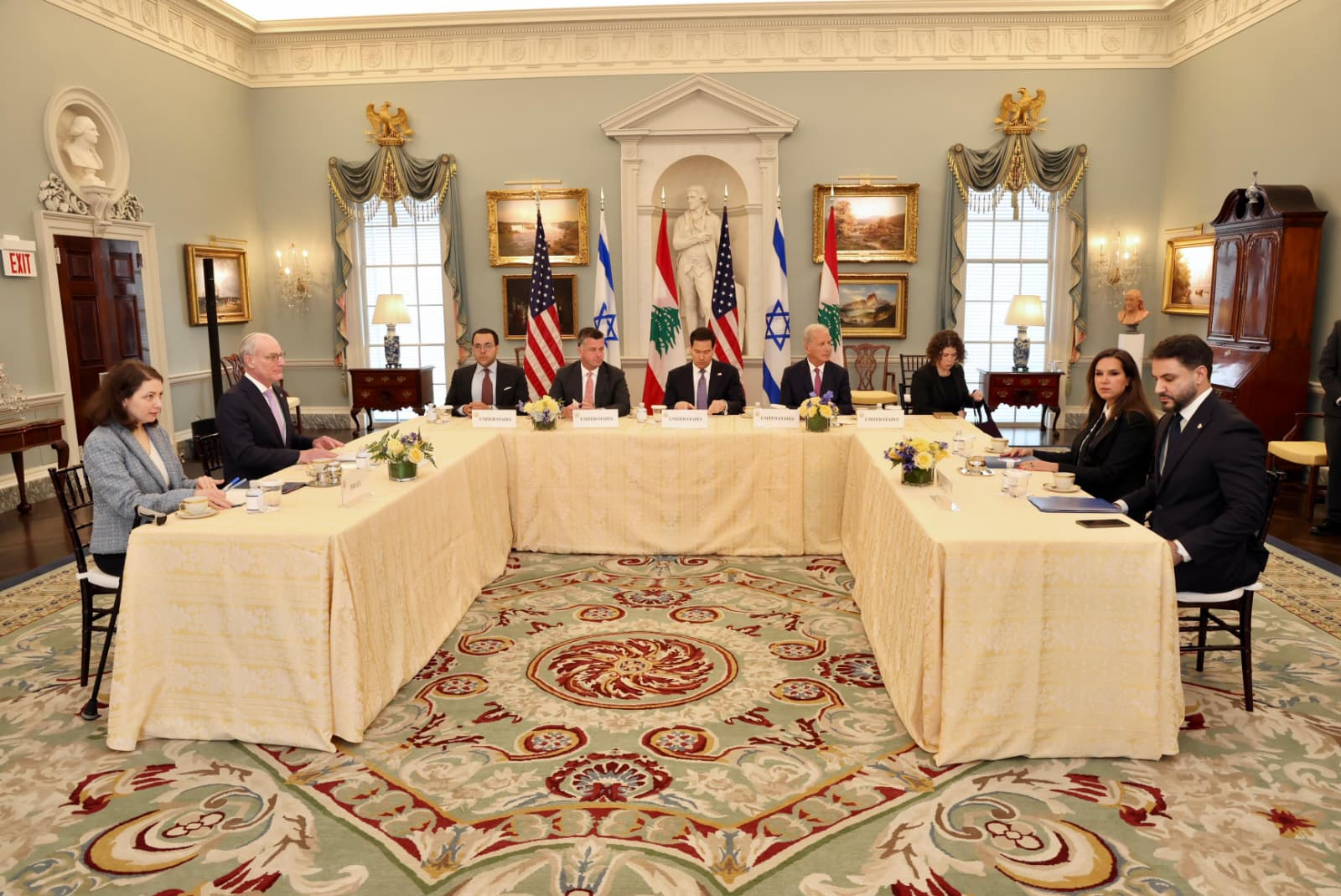
Israeli, Lebanese, and American officials gather at the State Department for the
first direct negotiations since 1993 (April 14, 2026). Photo: Shmulik Almany
On April 16, 2026, President Donald Trump announced a “historic” planned call between Israeli Prime Minister Benjamin Netanyahu and Lebanese President Joseph Aoun, which would have marked the first direct contact between the two leaders in 34 years. Still, the effort quickly stalled as Aoun rejected a U.S. request to participate. According to reports, Aoun informed Secretary of State Marco Rubio of his refusal, and officials indicated no such call is expected in the near future, even as Washington continues pushing for engagement amid ongoing Hezbollah attacks and broader ceasefire efforts.
On the same day, following the signing of a 10-day ceasefire agreement between Israel and Lebanon, President Donald Trump said he would invite Lebanese President Joseph Aoun and Prime Minister Benjamin Netanyahu to the White House for what he described as the first meaningful talks between the two countries since 1983. He added that he has tasked Vice President JD Vance, Secretary of State Marco Rubio, and Joint Chiefs Chairman Dan Caine with working toward a lasting peace, expressing confidence that both sides are interested in reaching a swift resolution.
Lebanon’s diplomatic engagement with Israel remained limited and conditional, with officials emphasizing that any direct political meeting between Prime Minister Netanyahu and President Aoun depended on first stabilizing a ceasefire, an Israeli withdrawal from southern Lebanon, and the deployment of the Lebanese army. While Beirut rejected a trilateral meeting with the United States and Israel at that stage, indirect engagement continued through U.S.-mediated contacts, including preparatory talks in Washington between the Lebanese and Israeli Ambassadors.
In the second meeting between U.S., Israeli, and Lebanese representatives on April 23, 2026, which took place at the White House, Donald Trump announced a three-week extension of the Israel-Lebanon ceasefire. He framed the extension as an opportunity to advance diplomacy, expressing optimism that a peace agreement could be reached within the year. Trump added that he expects to host Benjamin Netanyahu and Joseph Aoun in the near future, emphasizing continued U.S. efforts to bring the sides together while affirming that Israel retains the right to defend itself “carefully” and “surgically” if hostilities resume. Trump also stated he will work to nullify the Lebanese law criminalizing any contact with Israelis.
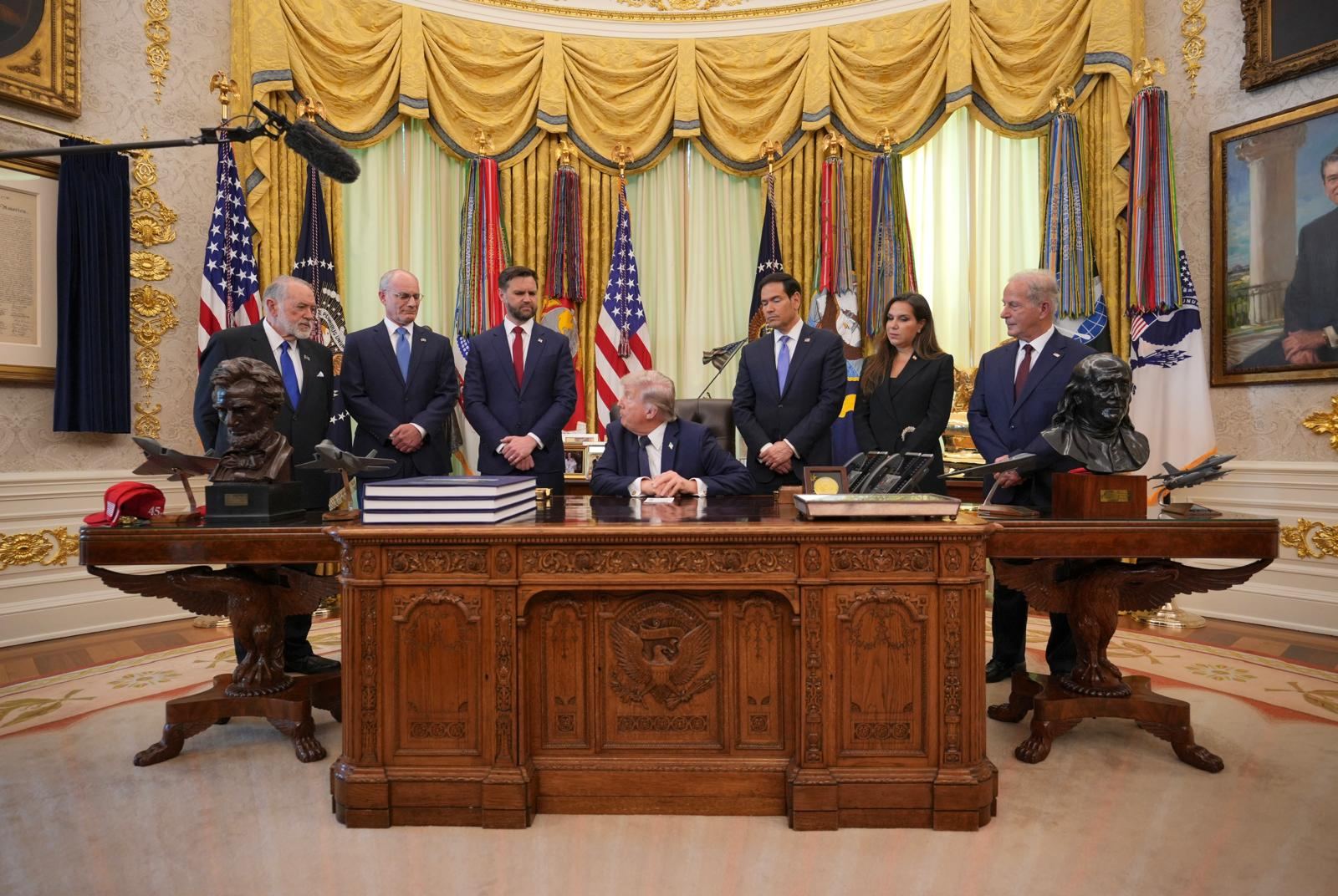
Israeli, Lebanese, and American officials gather at the Oval Office after the
second meeting between the sides (April 23, 2026). Photo: John Humbucker
Joseph Aoun said on April 27 that Lebanon’s decision to pursue direct talks with Israel under U.S. mediation was aimed at ending the long-standing state of war and reaching an armistice-style agreement. Speaking at the presidential palace after Naim Qassem rejected negotiations and reaffirmed that Hezbollah would not disarm, Aoun forcefully defended his approach and rebuked critics.
“My goal is to reach an end to the state of war with Israel, along the lines of an armistice agreement,” Aoun said. “Was the armistice agreement an act of humiliation? I will not accept reaching a humiliating agreement.” He rejected accusations of betrayal, adding, “What we are doing is not betrayal. Betrayal is committed by those who drag their country into war to serve external interests.” In a pointed swipe at Hezbollah, he continued, “Some criticize us for deciding to go to negotiations on the grounds that there is no national consensus. I ask: when you chose war, did you have national consensus first?”
“Hezbollah's strategy is clear: provoke, attack, and then blame Israel in order to kill the negotiations and make the Lebanese government look bad. We cannot feasibly expect Israel to just take the hits. This is not the Biden administration,” a U.S. official told Axios.
The paradox, Firas Maksad, managing director for Middle East and North Africa at Eurasia Group, explained to Axios is that, “It’s difficult to say ‘no’ to President Trump and risk his wrath, but it is also increasingly difficult to sustain direct negotiations with Israel, let alone meeting Netanyahu at the White House, when the destruction of villages and loss of Lebanese lives continues.”
On May 14-15, 2026, the United States hosted the third round of direct Israel-Lebanon talks in Washington, describing them as “highly productive.” Washington said the parties agreed to extend the April 16 cessation of hostilities by 45 days, reconvene the political track on June 2-3, and launch a new security track at the Pentagon on May 29. Israel described the talks as “frank and constructive,” emphasizing that any progress must prioritize the security of Israeli civilians and soldiers. Lebanon framed the outcome as “meaningful diplomatic progress,” stressing sovereignty, the return of displaced civilians, reconstruction, the release of detainees, the recovery of remains, and a U.S.-supported verification mechanism. Israel and Lebanon are expected to finalize a Statement of Intent at the June 2-3 meeting.
On May 29, Under Secretary of War Elbridge Colby hosted Israeli and Lebanese military delegations at the Pentagon for the security track supporting the ongoing peace talks between the two countries. According to Colby, the sides held “productive military-to-military discussions” that fed into the State Department-led political track. He added that the Department of War values its partnerships with both the IDF and Lebanese Armed Forces, supports Lebanon’s sovereignty and territorial integrity “free of armed non-state actors,” and expects the parties to reconvene soon to continue the security track.
The United States convened the fourth high-level trilateral meeting between Israeli and Lebanese representatives on June 2-3, 2026, resulting in an agreement to implement a ceasefire contingent on a complete cessation of Hezbollah fire and the evacuation of all Hezbollah operatives from the South Litani Sector. Under U.S. guidance, Israel and Lebanon agreed to swiftly advance “pilot zones” in which the Lebanese Armed Forces would assume exclusive control, excluding all non-state armed actors.
The measures formed part of a broader security framework aimed at safeguarding the sovereignty, security, and territorial integrity of both countries. The parties rejected efforts by any state or non-state actor to hold Lebanon’s future hostage, condemned Iran’s regional attacks and destabilizing proxy activities, and affirmed that any cessation of hostilities must be reached directly between the Israeli and Lebanese governments, brokered by the United States.
Israeli Ambassador to the United States Yechiel Leiter described the development as “relatively unprecedented,” saying Israel and Lebanon had been brought together by the understanding that “we’re not the enemy, Hezbollah is,” and that the two governments, backed by Washington, were working to “rid the country of this Iranian proxy” that threatens Israel’s security and Lebanon’s freedom.
Leiter said more than 2,000 Hezbollah fighters would be expected to leave southern Lebanon, with safe passage guaranteed if they departed, while special Lebanese army units would gradually take control of the pilot zones to prevent a return to the cycle in which Israel withdraws and Hezbollah re-entrenches.
The parties agreed to reconvene the political and security tracks during the week of June 22 to reach a comprehensive peace and security agreement.
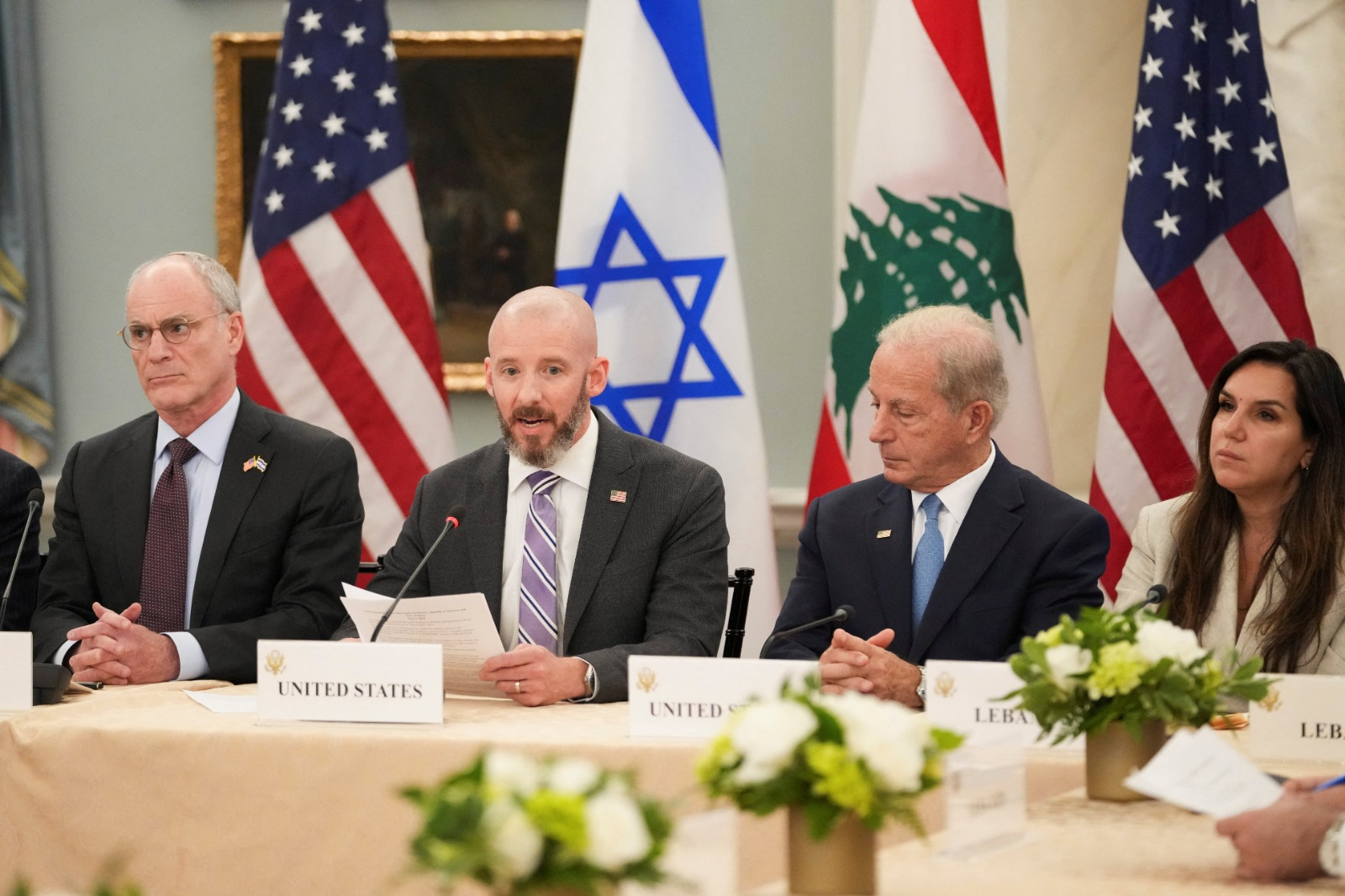
Israeli and Lebanese ambassadors sit side by side
with American mediators, June 3, 2026.
Meanwhile, Hezbollah and Iranian leaders continued to reject ceasefire proposals that fell short of their demand for a complete Israeli withdrawal and acceptance of their terms. This position appeared designed not only to shape the outcome in Lebanon but also to delay negotiations on broader disputes between Iran and the United States.
On June 10, Netanyahu posted a message to the Lebanese people: “Israel is not at war with Lebanon. We're at war with Hezbollah, that has taken your country hostage, that does Iran's bidding, that uses your territory to launch terrorist attacks against Israel. Once Hezbollah is dismantled, the possibilities are endless.”
Israeli and Lebanese officials held another round of U.S.-mediated talks in Washington on June 23-26, focused on security arrangements in southern Lebanon and a possible limited Israeli withdrawal. According to Israeli media reports, Israel is prepared to relinquish a small portion of territory captured in recent operations as part of a U.S.-backed pilot program under which the Lebanese Armed Forces would assume control of vacated areas and prevent Hezbollah from reestablishing a presence. At the same time, Prime Minister Netanyahu reportedly conveyed to Washington that he could not accept dictates regarding a broader withdrawal.
The talks took place amid growing Israeli concern that the parallel U.S.-Iran negotiations would affect the Lebanon track. Vice President Vance indicated that Hezbollah would effectively be represented in discussions through Iran, a framework Israeli officials rejected. Israeli Ambassador Yechiel Leiter argued that the objective should have been removing Iranian influence from Lebanon, disarming Hezbollah, and strengthening Lebanese sovereignty, rather than creating a “deconfliction” arrangement with Hezbollah. Israeli officials also warned that sanctions relief and other benefits flowing to Iran could ultimately enable Hezbollah to rebuild its military capabilities.
Tensions also persisted over restrictions on IDF operations. While Israeli officials maintained that troops retained freedom of action within the border security zone, critics, including former Prime Minister Naftali Bennett, argued that Hezbollah fighters had been reestablishing positions, repairing infrastructure, and monitoring Israeli forces while Israeli soldiers faced strict limitations on opening fire.
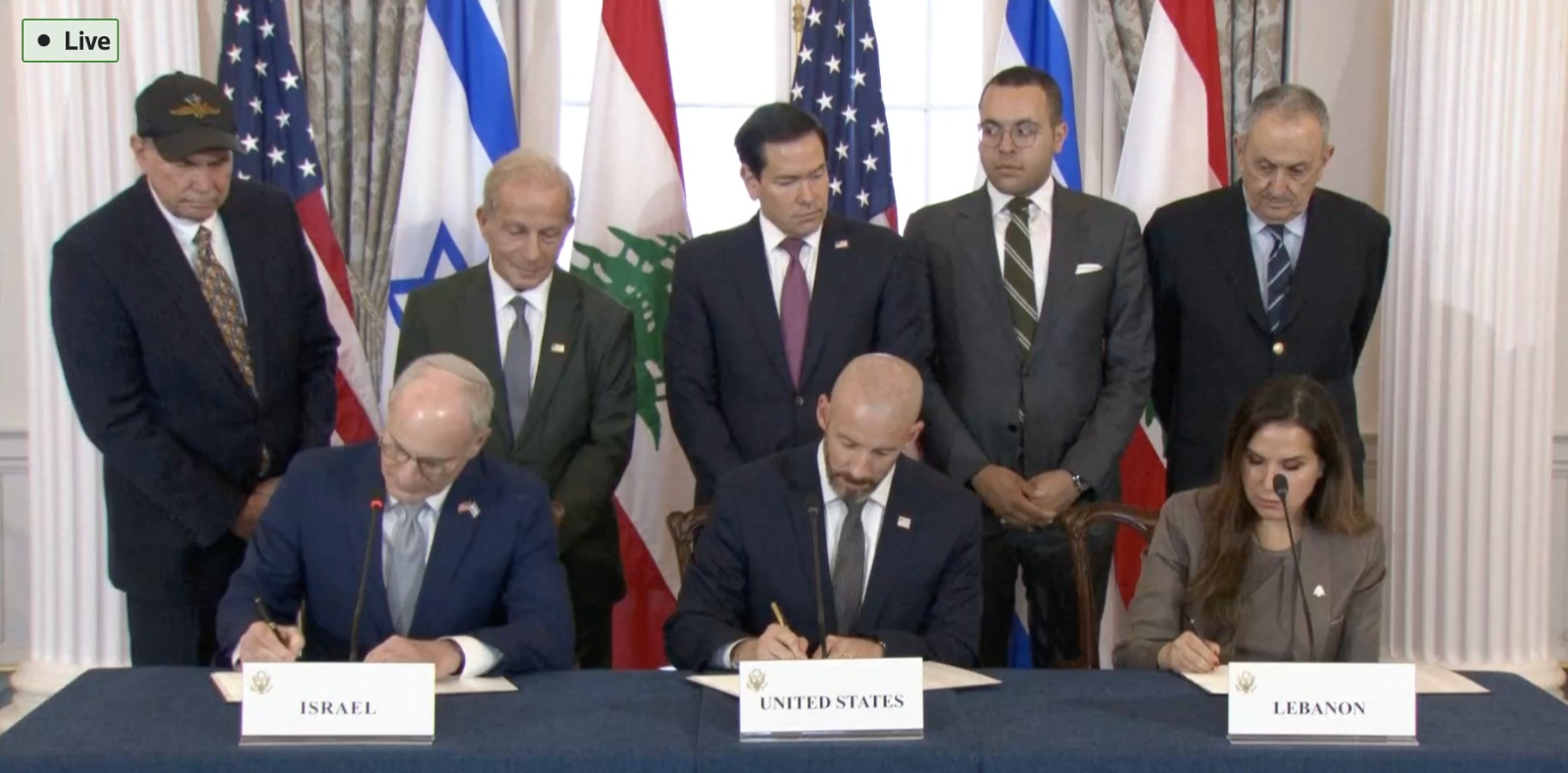 Israeli, Lebanese, and American representatives sign the framework agreement, June 26, 2026.
Following the fifth round of U.S.-facilitated negotiations between Israel and Lebanon, the countries signed a framework agreement in Washington on June 26, 2026. Secretary of State Marco Rubio said it was only a first step and that “there is still a lot of work” ahead. The deal includes a pilot in which the IDF would withdraw from limited areas, to be taken over by the Lebanese army under close U.S. supervision, training, and support. At the same time, Israel remains in the southern security zone and on the “yellow line” for now. Prime Minister Benjamin Netanyahu called the agreement “a major achievement” and “a major blow to Iran,” stressing that Israel would stay in the security zone until Hezbollah is disarmed and no longer poses a threat. The security annex of the deal, classified at Lebanon’s request, states that there will be no automatic IDF withdrawals and that any redeployments will be based on conditions on the ground. Israeli officials framed the deal as a way to strengthen the Lebanese state and reduce Iranian and Hezbollah influence. At the same time, Lebanese Ambassador Nada Hamadeh Moawad called it a first step toward restoring Lebanon’s sovereignty and enabling residents to return.
According to Israel Hayom, Aoun consulted with several Gulf leaders, including United Arab Emirates President Sheikh Mohammed bin Zayed and Saudi Crown Prince Mohammed bin Salman, and received their approval to reach an agreement with Israel. The paper also reported that Aoun received U.S. guarantees for his personal safety and the lives of other senior officials in his government who support the agreement with Israel and oppose Hezbollah, including Prime Minister Nawaf Salam and Foreign Minister Youssef Raggi.
In July 2026, U.S.-brokered talks between Israel and Lebanon concluded in Rome after two days of discussions described by both sides as positive, but without a timeline for Israel’s promised withdrawal from two pilot zones in southern Lebanon. The sides agreed on guidelines for the pilot-zone process, which would test the Lebanese Armed Forces’ ability to establish sovereignty, disarm Hezbollah and remove illegal weapons under third-party verification; Israel said UNIFIL and UNTSO would not participate. Further expansion would depend on the initial program’s success, while negotiations continued over removing weapons from private property without violating Lebanese law. The parties were expected to proceed to expanded technical talks aimed at implementing the trilateral framework and reaching a comprehensive agreement.
Pilot-zone operations began in the southern Lebanese villages of Froun, Srifa and Zawtar al-Gharbiya, following Israeli-Lebanese talks in Rome. The Lebanese Armed Forces gradually assumed security responsibility in the areas, which are intended to facilitate verified Lebanese Army deployments and phased Israeli withdrawals. However, the initial locations lie outside the IDF security zone and therefore required no immediate withdrawal. Washington expects Beirut to disarm Hezbollah and dismantle its infrastructure, while Israel insists that further redeployments depend on effective verification.
In August 2026, the seventh round of Israel-Lebanon talks in Rome concluded after discussions on three parallel tracks: legal, political, and military. The legal talks addressed Lebanese prisoners held by Israel, with the atmosphere being reported as positive and Lebanese civilians being handled separately from captured Hezbollah operatives. The political track focused on proposed pilot zones where the Lebanese Armed Forces would assume control from the IDF. At the same time, the military discussions sought to establish shared definitions of military operations.
The following month, Israel agreed to release five Lebanese civilians detained in areas of southern Lebanon under IDF control as part of ongoing negotiations with Beirut. The Israeli Prime Minister’s Office said investigations determined that the detainees were not members of terrorist organizations and had not engaged in terrorism. The decision followed what Israel described as significant efforts by both countries, including operations on the ground, to locate and repatriate the remains of leaders of Lebanon’s Jewish community who were abducted and murdered by terrorist organizations in the mid-1980s.
Later that month, Lebanese President Joseph Aoun said Lebanon sought a security agreement with Israel after an Israeli troop withdrawal, primarily to end the state of hostility and deploy the Lebanese army along the border, describing the accord as a possible prelude to an eventual peace agreement. Aoun said negotiations were Lebanon’s only viable alternative to another costly war. He reaffirmed that Hezbollah’s disarmament was “neither negotiable nor open to discussion,” but stressed that the government intended to achieve it peacefully and avoid confrontation or civil war.
Sources: Israeli Foreign Ministry.
Barak Ravid, “Israel and Lebanon agree to land border negotiations after U.S. push,” Axios, (March 11, 2025).
Barak Ravid, “U.S. brokers first direct Israel-Lebanon talks in decades,” Axios, (December 3, 2025).
“Netanyahu reportedly taps Dermer to handle Lebanon file as Beirut seeks direct talks,” Times of Israel, (March 14, 2026).
Barak Ravid, “Scoop: French plan to end Lebanon war includes recognition of Israel,” Axios, (March 14, 2026).
@YoussefRaggi, (March 24, 2026).
@gidonsaar, (March 24, 2026).
@BarakRavid, (April 9, 2026).
“Statement by Prime Minister Netanyahu,” Israel Prime Minister’s Office, (April 9, 2026).
“Israeli ambassador says U.S. and Israel have been in "lockstep from the beginning" of Iran war,” CBS, (April 12, 2026).
Dudi Kogan, Or Shaked, “Under Hezbollah Threat: Historic Israel–Lebanon Negotiations Open | Watch,” Israel Hayom, (April 14, 2026). [Hebrew]
Itamar Eichner, Lior Ben-Ari, “Lebanon's president refuses to speak with Netanyahu,” Ynet, (April 16, 2026).
@realDonaldTrump, (April 16, 2026).
@skleiman5791, (April 21, 2026).
Dudi Kogan, Or Shaked, “Against the backdrop of rocket fire toward northern Israel: Trump extends ceasefire by three weeks,” Israel Hayom, (April 23, 2026). [Hebrew]
Jamie Prentis, “Lebanon seeks armistice in talks with Israel, affirms Aoun,” The National, (April 27, 2026).
Barak Ravid, “Trump tells Netanyahu only 'surgical' Lebanon strikes as ceasefire falters,” Axios, (April 29, 2026).
@statedeptspox, (May 15, 2026).
@yechielleiter, (May 15, 2026).
@HibaNasr, (May 15, 2026).
@HibaNasr, (May 19, 2026).
@USWPColby, (May 29, 2026).
Emanuel Fabian and Stav Levaton, “Israel and Lebanon hold talks in DC, as IDF eases safety restrictions in northern Israel,” Times of Israel. (June 2, 2026).
Or Shaked, “‘The fire will stop’: Israel and Lebanon announce implementation of ceasefire | Full details,” Israel Hayom, (June 3, 2026). [Hebrew]
Emanuel Fabian, “Israel and Lebanon agree to renew truce, create ‘pilot’ zones where Hezbollah is banned,” Times of Israel, (June 4, 2026).
Benjamin Netanyahu, “Prime Minister Benjamin Netanyahu’s message to the Lebanese people,” @IsraeliPM, (June 10, 2026).
Or Shaked, Danny Zaken, Shachar Kleinman, “Historic image in Washington: Israel and Lebanon signed the agreement,” Israel Hayom, (June 26, 2026). [Hebrew]
Liza Rozovsky, Jonathan Lis, Yaniv Kubovich, and Ben Samuels, “Israel, Lebanon Sign U.S.-brokered Framework Agreement; Netanyahu: IDF to Remain in Southern Lebanon,” Haaretz, (June 26, 2026).
Grace Gilson, “Lebanon, Israel sign ‘framework agreement’ to end hostilities,” JTA, (June 26, 2026).
Jacob Magid, “Touting Lebanon deal, PM says it allows Israel to maintain buffer zone and bars Lebanese from returning to it,” Times of Israel, (June 26, 2026).
“Israel and Lebanon agree on a historic pathway to peace,” BICOM, (June 29, 2026).
Amit Segal, “The Right Recognition for the Wrong Reasons,” It’s Noon in Israel, (June 29, 2026).
Jacob Magid, “‘Eventual IDF redeployment from Lebanon’: Full text of Israel-Lebanon deal security annex,” Times of Israel, (June 30, 2026).
Jacob Magid, “Lebanon talks in Rome wrap up without specific timeline on implementation of pledged IDF withdrawals,” Times of Israel, (July 15, 2026).
“Lebanese Army deploys into first pilot zone in Southern Lebanon,” BICOM, (July 20, 2026).
Tomas Pigott. “Launch of First Pilot Zones in Lebanon,” U.S. Department of State, (July 20, 2026).
“Lebanese Army deploys into first pilot zone in Southern Lebanon,” BICOM, (July 20, 2026).
Lazar Berman, “Israel-Lebanon talks in Rome end,” Times of Israel, (August 6, 2026).
Nava Freiberg, “PM’s office confirms Israel freeing 5 Lebanese civilian detainees as Beirut aids search for Jewish remains,” Times of Israel, (September 3, 2026).
“Lebanon wants Israel security deal as prelude to peace: president to AFP,” AFP, (September 16, 2026).