Deportation of Jewish Fighters to Africa
(February 1944)
by Prof. Yehuda Lapidot
Deportation of the 251
On Thursday, October 19, 1944, at 4:30 am, a large
British military force surrounded the Latrun internment camp. At 6 am,
a list of 239 internees was read out. They were handcuffed, searched,
and taken out of the camp without being permitted to take anything with
them. Loaded onto trucks which formed a convoy, they were escorted by
armored cars to the Wilhelma airfield. There they were joined by 12
inmates from Acre prison, who had arrived an hour earlier.
The 251 detainees were divided into 12 groups, and each group boarded
an aircraft, accompanied by armed guards. When it became clear to the
prisoners that they were being deported, they burst into a mighty rendering
of Hatikva. The 12 planes
flew to Asmara, capital of Eritrea; the following day the internees were
taken from the airfield to their first place of exile in Africa - Sambel
camp, two kilometers north of Asmara.
The Mandatory government continued to exile persons suspected of terrorist affiliation. In all,
439 people were deported by the end of the Mandate.
The Yishuv reacted with restraint
to news of the deportation. The Jewish Agency Executive kept silent and
the Vaad Le'umi responded with
quiet protest. The Hebrew press did not take up arms, and Davar (the Histadrut newspaper)
wrote that if the underground was unwilling to abandon its separate path
"it should not wonder at the fact that the Yishuv is reacting in this
way." It will be recalled that in May 1944, about six months before the
deportation, the Jewish Agency had resumed its collaboration with the
Mandatory government and was once again informing on underground fighters
and foiling Irgun and Lehi operations. Eight days after the deportation of the 251 fighters, the
Yishuv was shocked by the assassination of Lord Moyne in Cairo, and cooperation
with the British police, the so-called Season,
was now overt and extensive.
Sambel Camp, Eritrea
Sambel camp in Erritrea had served in the past as a recreation center
for Italian fascist youth and the living conditions were no worse than
in Latrun. But, despite the good conditions and comfortable climate,
the internees suffered in the first few months from lack of clothing
and everyday necessities, from the absence of books and religious articles.
Two months after their arrival at Sambel, food rations were cut drastically.
The move apparently stemmed from the general wartime shortage of food,
but this fact did not appease the prisoners, who launched a partial
hunger strike. Several weeks later, the rations were restored to their
former size.
On January 21, 1945, three months after their arrival in Eritrea, the
internees made their first escape attempt. The weak spot was the sports
ground outside the camp, which was open to the internees all day, but
locked in the evening and unguarded all night. The rain had created a
trench in one corner of the sport ground, which was the inmates excavated
further. On the day of the escape, Benyamin
Zeroni, Haggai Lev and Shimon Sheiba hid in the trench and covered
themselves with soil. When the sports ground had been locked and darkness
fell, they emerged from their "tomb," climbed the fence and headed for
Asmara. They spent the first night in a field near the town and the next
day boarded a bus and asked the driver to let them off at the synagogue (there was a Jewish community in Asmara, consisting of fifty families
of Yemenite origin). There they met Haim Gamliel, who gave them money,
and hid them in his house. The aim of the three fugitives was to reach
Ethiopia. Near the border, a local patrol checked the identity of the
passengers; the three came under suspicion, and were handed over to the
British, who returned them to the camp and imposed a month's solitary
confinement on them.
Three days after the escape the internees were evacuated from Sambel
and taken to Massawa port. There they were put aboard an Italian vessel
and, under intolerably crowded conditions, transferred to Carthage in
the Sudan.
Carthage Camp, Sudan
The internment camp at carthage was located in the heart of the desert
and endured a harsh climate. Water was in short supply - drinking water
was transported in scant quantities by car from dozens of kilometers
away. The piped water was salty, and its consumption restricted. Khartoum,
the nearest town with a military hospital, was 600 kilometers away.
Carthage was much tougher than Sambel in terms of accommodation, sanitation
and climate.
In addition to the problem of poor nutrition, a controversy raged on the
issue of kosher food. At the beginning of November 1944, the authorities
cancelled the supply of kosher meat which they had been purchasing from
the Jewish community in Asmara, and offered instead canned non-kosher
meat from British army rations. The internees launched a protest against
this change, which offended both the religious and secular alike. Echoes
of the protest reached Palestine, and the chief rabbinate, with the aid
of the Jewish Agency, appealed to the High Commissioner to send a rabbi
and a ritual slaughterer (shohet) to the camp. On March 15, Rabbi Yaakov
Shraibom and the shohet, Rabbi Rosenberg, reached the camp. They were
housed outside the fence and were permitted to come and go at will. Their
free movement was exploited by the interneess to get information from,
and establish contact with, the outside world, which was vital to their
escape plans.
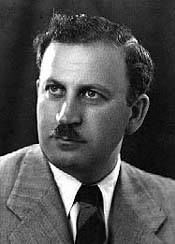
Yaakov Meridor
|
On September 26, 1945, three Irgun members (Yaakov Yundof, Yaakov
Meridor and Shimon Sheiba) left the camp concealed in a tanker which
had brought in water. The driver, who had been bribed, brought them to
a spot close to the railroad station, and left them there. They spent
the night in a field, and the next day boarded a train for Port Sudan,
where they planned to rent a boat to take them to Aqaba. They posed as
Polish intelligence officers working for the British, and were equipped
with wooden revolvers (which looked just like the real thing) and forged
documents. Their comrades in the camp covered their escape and hindered
the search after their absence was discovered. As was customary in internment
camps, all the inmates were counted every evening. The count was not conducted
simultaneously in all the huts, but consecutively. The interval between
the counts enabled three inmates to slip out of a hut which had already
been inspected, and to be counted again in other huts. They moved from
hut to hut through windows whose bars had been sawn through in such a
way that they could be lifted out and replaced without detection.
The escapees reached Port Sudan as planned, and spent three days searching
for a vessel which would transport them to Aqaba (the Irgun General Headquarters
had sent them a considerable sum of money). However, they aroused the
suspicion of the hotel owner where they were staying, and were forced
to leave. They contacted a Jewish merchant, but he was unwilling to risk
helping them. They had no alternative but to travel to Khartoum by train.
At one of the stations, British officers boarded the train and recognized
them. On September 26, six days after their escape, they were handed back
to the authorities.
Back to the Sambel Camp
The internees spent nine months in the Sudan; on October 9, 1945, they
were evacuated from Carthage and, after a four-day journey by train
and truck, found themselves back at Sambel. Two months later, 35 new
internees joined them and were housed in a special camp several hundred
meters from the veterans. On January 17, 1946, a dispute broke out between
one of the internees, Eliyahu Ezra, and a Sudanese sentinel, resulting
in Ezra being shot and wounded. The injured man was carried to the gate
for transfer to the first aid station outside the camp. When the guards
refused to let them out, the internees began banging on the gate, and
fire was opened on them from all sides. Eliyahu Ezra and Shaul Haglili
were killed, and 12 others were injured. Only then was the gate opened.
The medical officer and several medical orderlies hastened to the aid
of the injured, who were then taken to a military hospital. Ezra and
Haglili were buried in the cemetery of the Jewish community in Asmara.
The incident caused great agitation among the prisoners, who demanded
that an external committee of enquiry be set up to investigate the events.
The Yishuv, which was united at that time within the framework of the
United Resistance, was in uproar. In contrast to previous occasions, the
Hebrew press was unanimous in its demand for an investigation into the
murder, and the return of the internees to Eretz Israel. The Irgun, as
well as Lehi, refrained from initiating reprisals in order to avoid undermining
the solidarity of the United Resistance.
A month after the return to Sambel, on November 10, 1945, four internees
(Yaakov Gurevitz, Benyamin Zeroni, Eliyahu Lankin and Rahamim Mizrahi)
escaped at night via the unguarded sports ground. Their objective was
to seek out escape routes for a larger group, which would break out by
digging a tunnel.
Two months after their escape, on January 13, 1946, Gurevitz and Zeroni
set out by bus for Ethiopia. They were disguised as veiled Arab women,
and were accompanied by a Jew who lived in Asmara and posed as an Arab
travelling with his two wives. At one of the Ethiopian border towns, the
three entered a hotel to rest, but aroused the suspicion of the bellboy,
who summoned the police. The three men were arrested and interrogation
revealed their true identity. The British asked the Ethiopian authorities
to extradite them, but encountered objections. After seven months of negotiations,
they were finally handed over and sent back to Sambel.
Eliyahu Lankin, who set out in
mid-June (about six months after the escape) from Asmara to Addis Ababa,
was more fortunate. After five adventurous months he reached Djibouti
by plane and on January 7, 1947, sailed aboard a French boat to Marseille
and from there travelled to Paris. Lankin was the first escapee to succeed
in reaching his destination.
Rahamim Mizrahi remained in Asmara, where he tried to create suitable
conditions for the absorption of the large group scheduled to escape via
the tunnel.
The Escape of the 54
The inmates spent five months digging two tunnels: the first 32 meters
and the second 70 meters long. Both had a diameter of 45 cm, sufficient
for a man to crawl through. The work was carried out in three shifts,
and two-thirds of the internees took part. The problem of disposing
of the sand was solved by packing it in cloth bags and scattering it
during the exercise walk in the sports ground. The excavation created
numerous technical problems, such as introducing an electrical wire
for illumination, supports for the roof to prevent a cave-in, ventilation
etc. However, the main problem was how to conceal the work in the tunnel
from the camp guards, who conducted routine checks of the huts.
The internees managed to overcome all these obstacles and on Saturday
night, June 29, 1946, they were ready for action. That evening, 54 inmates
escaped from the camp in two groups: 30 through the large tunnel, and
24 through the smaller one. The two groups emerged from the tunnels equipped
with maps, and knapsacks packed with food and first aid kits. The larger
group was disguised in British army uniform - sewn by the inmates, who
scrupulously copied every detail, from insignia to rank. The "soldiers"
took over an Italian bus which was returning soldiers to the camp, and
drove off towards the Ethiopian border. An engine problem forced them
to continue their journey on foot, and the following day they were discovered
by armed villagers and handed over to the authorities. The second group,
in civilian clothing, succeeded in reaching a pre-designated hiding place
in Asmara. For three months they sought further escape routes, but all
their attempts to leave Asmara were unsuccessful. Finally, on September
24, their hiding place was surrounded by British security forces, and
the last escapees were returned to the internment camp.
The prisoners made further escape attempts, but all ended in failure.
As a result of these attempts, which greatly embarrassed the camp command
and army headquarters in Eritrea, the British government decided to transfer
the prisoners to Kenya.
Gilgil Internment Camp, Kenya
On March 2, 1947, all the internees were evacuated from Sambel, loaded
onto trucks and transferred under heavy guard to Massawa port. There
they boarded a ship and sailed to Mombasa, Kenya, under conditions of
intolerable heat and overcrowding. From the port they were taken on
a twenty-hour train journey in freight cars to the internment camp at
Gilgil.
 The internment camp at Gilgil
 |
Gilgil camp had been used in the past as a jail for soldiers serving sentences
for criminal offences and the living conditions and sanitation were very
poor. There were no windows in the dormitories, apart from a tiny barred
aperture under the roof, and the sewage conduits were open and crisscrossed
the camp. The climate was harsh and mosquitoes swarmed everywhere. The
internees refused to accept the situation and some two weeks after arriving,
they rebelled. They tore openings in the walls and covered the sewage
conduits with stones which they had removed from the walls. The camp commander
subsequently improved conditions and the camp became tolerable.
The British authorities hoped, vainly, that the remote location of the
camp would preclude escape attempts. Shortly after their move to Gilgil,
however, the prisoners began to excavate a tunnel and made various further
attempts.
The last successful escape took place on March 29, 1948. During the evening,
six inmates (Yaakov Meridor, Nathan Germant, Reuven Franco
and Yaakov Hillel of the Irgun, and Shlomo Ben Shlomo
and David Yanai of Lehi) crawled
through an eighty-meter tunnel and emerged on the other side of the camp
fence. They proceeded towards their meeting place with "Wilson" (one of
the two emissaries who had come specially from South Africa to help them),
who was waiting for them in a rented car. They crossed the border to Uganda
with passports brought from South Africa and, after a short rest, approached
the Belgian consul for visas to Belgian Congo. From there they flew to
Brussels, arriving two days later.
Lengthy imprisonment anywhere, but especially in a remote location, can
cause physical and emotional illness. In order to preclude these, the
internees began, from the very first days of exile, to organize social
and cultural activities. A library was set up, which in Gilgil contained
some three thousand volumes. A daily newspaper and a philosophical and
literary journal were produced. Various courses were held, and lectures
given on literature, the natural sciences and contemporary affairs. Many
of the internees took correspondence courses at secondary and university
levels, most of them at British institutions, and studied economics, law,
accountancy and even architecture and engineering. In addition to their
academic pursuits, the detainees played sport and exercised.
In one of his letters, Aryeh
Ben-Eliezer (a member of the Irgun General Headquarters before his
arrest) described the cultural and social activities in the camp, but
concluded as follows:
From the diverse activities mentioned in my letter, you could gain the impression that we are living in a paradise. Nonetheless, I pray to the Lord above to take pity on me and send me Eve, so that I can sin and be banished from Eden.
On the morning of July 12, 1948, the drama of African exile ended,
when the British ship Ocean Vigour, with 262 exiles aboard, reached
Israeli territorial waters. An Israeli Navy vessel came out of Tel Aviv
port to greet them, and the captain, Mila Brenner, hailed them:
"This is the captain speaking.
Welcome home!
We have been sent to greet the exiles who are returning home.
From now on, you are free citizens of the State of Israel".
Sources: The Irgun Site |