History & Overview
Biblical to Contemporary History
In Biblical times, the Golan Heights was referred to as
"Bashan;" the word "Golan" apparently derives from the
biblical city of "Golan in Bashan," (Deuteronomy 4:43, Joshua
21:27). The area was assigned to the tribe of Manasseh (Joshua 13:29-31).
In early First Temple times (953-586 BCE), the area was contested between
the northern Jewish kingdom of Israel and the Aramean kingdom based on
Damascus. King Ahab of Israel (reigned c. 874-852 BCE) defeated Ben-Hadad I
of Damascus near the site of Kibbutz Afik in the southern Golan (I Kings
20:26-30), and the prophet Elisha prophesied that King Jehoash of Israel
(reigned c. 801-785 BCE) would defeat Ben-Hadad III of Damascus, also near
Kibbutz Afik (11 Kings 13:17). In the late 6th and 5th centuries BCE, the
region was settled by returning Jewish exiles from Babylonia (modern Iraq).
In the mid 2nd century BCE, Judah Maccabee and his brothers came to the aid
of the local Jewish communities when the latter came under attack from
their non-Jewish neighbors (I Maccabees 5). Judah Maccabee's grandnephew,
the Hasmonean King Alexander Jannai (reigned 103-76 BCE) later added the
Heights to his kingdom. The Greeks referred to the area as "Gaulanitis",
a term also adopted by the Romans, which led to the current application of
the word "Golan" for the entire area. Gamla became the Golan's
chief city and was the area's last Jewish stronghold to resist the Romans
during the Great Revolt, falling in the year 67 (see Josephus, The Jewish
War, Chap. 13, Penguin edition). Despite the failure of the revolt, Jewish
communities on the Heights continued, and even flourished; the remains of
no less than 25 synagogues from the period between the revolt and the
Islamic conquest in 636 have been excavated. (Several Byzantine monasteries
from this period have also been excavated on the Heights.) The decisive
battle in which the Arabs under Caliph Omar, crushed the Byzantines and
established Islamic control over what is now Israel, Jordan, Lebanon and
Syria, was fought in the Yarmouk Valley, on the southern edge of the
Heights, in August 636. Organized Jewish settlement on the Golan came to an
end at this time.
In the 15th and 16th centuries, Druze began to settle in the
northern Golan and on the slopes of Mt. Hermon. During the brief period of
Egyptian rule (1831-1840) and in the ensuing decades, Sudanese, Algerians,
Turkomans and Samarian Arabs settled on the Heights. The Turks brought in
Circassians in the 1880's to fight against Bedouin brigands.
The Jewish presence on the Golan was renewed in 1886,
when the B'nei Yehuda society of Safed purchased a plot of land four
kilometers north of the present-day religious moshav of Keshet, but the
community -- named Ramataniya -- failed one year later. In 1887, the
society purchased lands between the modern-day B'nei Yehuda and Kibbutz Ein
Gev. This community survived until 1920, when two of its last members were
murdered in the anti-Jewish riots which erupted in the spring of that year.
In 1891, Baron Rothschild purchased approximately 18,000 acres of land
about 15 km. east of
Ramat Hamagshimim, in what is now Syria. First Aliyah (1881-1903)
immigrants established five small communities on this land, but were forced
to leave by the Turks in 1898. The lands were farmed until 1947 by the
Palestine Colonization Association and the Israel Colonization Association,
when they were seized by the Syrian army. Most of the Golan Heights were
included within Mandatory Palestine when the Mandate was formally granted in 1922, but Britain ceded the area
to France in the Franco-British Agreement of 7 March 1923. The Heights
became part of Syria upon the termination of the French mandate in 1944.
History from Israel's Independence
From the western Golan,
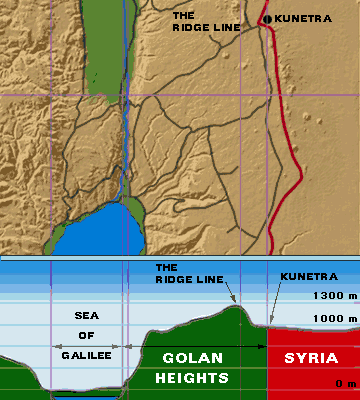
it is only about 60 miles -- without major terrain obstacles -- to Haifa and Acre, Israel's industrial heartland.
The Golan -- rising from 400 to 1700 feet in the western section bordering
on pre1967 Israel -- overlooks the Huleh
Valley, Israel's richest agricultural area. In the hands of a
friendly neighbor, the escarpment has little military importance.
If controlled by a hostile country, however, the Golan has the potential
to again become a strategic nightmare for Israel.
From 1948-67, when Syria controlled the Golan Heights, it used the area as a military stronghold
from which its troops randomly sniped at Israeli civilians in the
Huleh Valley below, forcing children living on kibbutzim to sleep
in bomb shelters. In addition, many roads in northern Israel could
be crossed only after probing by mine-detection vehicles. In late
1966, a youth was blown to pieces by a mine while playing football
near the Lebanon border. In some cases, attacks were carried out by Yasir Arafat's Fatah,
which Syria allowed
to operate from its territory.
Israel's options for countering the Syrian attacks
were constrained by the geography of the Heights. "Counterbattery
fires were limited by the lack of observation from the Huleh Valley;
air attacks were degraded by well-dug-in Syrian positions with strong
overhead cover, and a ground attack against the positions...would
require major forces with the attendant risks of heavy casualties
and severe political repercussions," U.S. Army Col. (Ret.) Irving
Heymont observed.
Israel repeatedly, and unsuccessfully, protested
the Syrian bombardments to the UN Mixed Armistice Commission, which
was charged with policing the cease-fire. For example, Israel went
to the UN in October
1966 to demand a halt to the Fatah attacks. The response from
Damascus was defiant. "It is not our duty to stop them, but to
encourage and strengthen them," the Syrian ambassador responded.
Nothing was done to stop Syria's aggression. A mild Security
Council resolution expressing "regret" for such incidents
was vetoed by the Soviet Union. Meanwhile, Israel was condemned by
the UN when it retaliated. "As far as the Security
Council was officially concerned," historian Netanel Lorch
wrote, "there was an open season for killing Israelis on their
own territory."
After the Six-Day
War began, the Syrian air force attempted to bomb oil refineries
in Haifa. While Israel was fighting in the Sinai and West Bank, Syrian
artillery bombarded Israeli forces in the eastern Galilee, and armored
units fired on villages in the Huleh Valley below the Golan Heights.
On
June 9, 1967, Israel moved against Syrian forces on the Golan. By
late afternoon, June 10, Israel was in complete control of the plateau.
Israel's seizure of the strategic heights occurred only after 19 years
of provocation from Syria, and after unsuccessful efforts to get the
international community to act against the aggressors.
Six years later, in a surprise attack
on Yom Kippur, the Syrians overran the Golan Heights before being
repulsed by Israeli counterattacks. After the war, Syria signed a disengagement agreement that left the Golan
in Israel's hands. [See map]
On December 14, 1981, the Knesset voted to annex the Golan Heights. The statute extended Israeli civilian law and administration to the residents
of the Golan, replacing the military authority that had ruled the
area since 1967.
Since 1974, Syria has adhered to the cease-fire on the Golan, largely because of the
presence of Israeli troops within artillery range of Damascus. But
during this time, Syria has provided a haven and supported numerous terrorist
groups that attack Israel from Lebanon and other countries. These
include the Democratic Front for the Liberation of Palestine (DFLP);
the Popular Front for the Liberation of Palestine (PFLP), Hezbollah
and the Popular Front for the Liberation of PalestineGeneral Command
(PFLPGC). In addition, Syria still deploys hundreds of thousands of troops-as much as 75 percent
of its army-on the Israeli front near the Heights.
As the peace process faltered in 1996-97, Syria began to renew threats of war with Israel and to make threatening
troop movements. Some Israeli analysts have warned of the possibility
of a lightning strike by Syrian forces aimed at retaking the Golan.
The Israeli Defense
Forces have countered the Syrian moves; however, and -- to this
point -- preserved the peace.
Speaking at the first ever Cabinet meeting to be held in the territory, Netanyahu stated on April 17, 2016, that Israel will never give up the Golan Heights. “It’s time that the international community finally recognize that the Golan will remain forever under Israel's sovereignty,” said Netanyahu to a crowd of supporters gathered around the Israeli officials.
The Golan Heights Today
Druze sector
There are approximately 17,000 Druze inhabitants on the
Golan Heights today. In contrast to 1948-1967, when civilian infrastructure
and services were almost completely neglected by successive Syrian
governments, Israel has invested substantial sums in either installing or
upgrading electric and water systems, in agricultural improvements and job
training, and in building health clinics, where none had existed
previously. The inhabitants also enjoy the benefits of Israel's welfare and
social security programs. Israel has built or refurbished schools and
classrooms, extended compulsory education from seven years to ten, and made
secondary education available to girls for the first time. The Golan's
Druze residents enjoy complete freedom of worship; the Israeli authorities
have made financial contributions and tax and customs rebates to the local
religious establishments.
Jewish sector
Today, there are approximately 14,000 Jewish residents
in 33 communities (27 kibbutzim and moshavim, 5 communal settlements and
the town of Katzrin) on the Golan Heights and the slopes of Mt. Hermon. (Katzrin
has its own mayor and local council; the other 32 communities form the
Golan Heights Regional Council.)
Economy
The economy of the Golan Heights is based on both
agriculture and industry, including tourism. 8,100 hectares of land are
under cultivation, producing a wide variety of crops, including wine
grapes. A further 46,575 hectares are dedicated to natural pasturage,
supporting 15,000 head of cattle and 5,000 sheep, for both meat and dairy
production. The Golan's dairy cattle produce approximately 60 million
liters of milk per year. The are approximately 30 industrial enterprises on
the Golan, mostly based in the Katzrin Industrial Zone.
There is a substantial tourist infrastructure on the
Golan, including the Mt. Hermon ski slopes, archaeological sites, hotels,
restaurants, bed-and-breakfast/guest room facilities in many communities,
and three Society for the Protection of Nature Field schools. There are
also facilities for jeep and bicycle tours, as well as horseback riding.
Israel has established 13 nature reserves -totaling 24,908 hectares -- on
the Heights. The Golan Archaeological Museum is located in Katzrin.
Prospects for Peace
For Israel, relinquishing the Golan to a hostile Syria could jeopardize
its early-warning system against surprise attack. Israel has built
radars on Mt. Hermon, the highest point in the region. If Israel withdrew
from the Golan and had to relocate these facilities to the lowlands
of the Galilee, they would lose much of their strategic effectiveness.
One possible compromise might be a partial Israeli
withdrawal, along the lines of its 1974 disengagement agreement with Syria. Another
would be a complete withdrawal, with the Golan becoming a demilitarized
zone.
After losing the 1999 election, Benjamin
Netanyahu confirmed reports that he had engaged in secret
talks with Syrian President Hafez Assad to withdraw from the Golan
and maintain a strategic early-warning station on Mount Hermon. Publicly,
Assad continued to insist on a total withdrawal with no compromises
and indicated no willingness to go beyond agreeing to a far more limited
"nonbelligerency" deal with Israel than the full peace
treaty Israel has demanded.
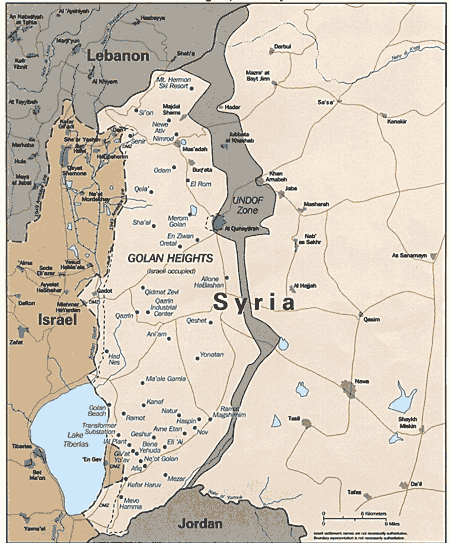 Israeli
Settlements in the Golan Heights (February 1992)
Israeli
Settlements in the Golan Heights (February 1992) |
The election of Ehud
Barak stimulated new movement in the peace process, with intensive
negotiations held in the United States in January 2000 between Barak and Syrian Foreign Minister Farouk al-Sharaa. These talks raised
new hope for the conclusion of a peace treaty, but the discussions
did not bear fruit. President Assad died in June 2000 and no further
talks have been held as Assad's son and successor, Bashar has moved
to consolidate his power. Rhetorically, Bashar has not indicated any
shift in Syria's position on the Golan.
Press reports suggest Israel has expressed a willingness
to withdraw from a significant part of the Golan Heights if it can
get from Syria security guarantees and normal relations.
In an interview with the Israeli Defense Ministry’s
monthly Bitachon, Deputy Defense Minister Ephraim Sneh said
the topographical concerns associated with withdrawing from the Golan
Heights could be offset by demilitarization. "Our red line needs
to be a defensible border," Sneh said, "a border where the
chief of General Staff can come to the government or the Knesset Foreign
Affairs and Defense Committee and say: ‘From this line I can defend
the State of Israel with minimum losses.’" Sneh added, "the
deeper the demilitarization and the better the early warning, the
more we will allow ourselves to be flexible topographically."
Sneh also emphasized that Israel could not compromise on water sources.
Besides military security, a key to peace with Syria,
Sneh said, would be the normalization of relations between the two
countries. "When an Israeli thinks of normalization he wants
to get up in the morning and take his wife and kids on a shopping
trip to Damascus and come home," Sneh said. "The Syrians
see normalization as an exchange of ambassadors and flight links –
maximum. We need to demand that it be a peace warmer than with Egypt,
closer to the type of peace we have with Jordan."
In the meantime, substantial opposition exists within
Israel to withdrawing from the Golan Heights. The expectation of many
is that public opinion will shift if and when the Syrians sign an
agreement and take measures, such as reigning in Hezbollah attacks
on Israel from southern Lebanon, that demonstrate a genuine interest
in peace. And public opinion will determine whether a treaty is concluded
because Barak has said
any agreement must be approved in a national referendum (a law to this effect was passed under Netanyahu).
Absent dramatic changes in Syria's government and
its attitude toward Israel; however, the Jewish State's security will
depend on its retention of military control over the Golan Heights.
Sources: Israeli Government Press Office; Maps courtesy of The
Jewish Connection and Maps
of the Middle East. |