- Background
- History and Roots
- Syrian Civil War
- The Caliphate
- Foreign Fighters
- Use of Media
- International Response & Analysis
Background
The Islamic State (IS), also known as the Islamic State of Iraq and Syria (ISIS) or the Islamic State of Iraq and the Levant (ISIL) is a brutal Sunni Muslim terror organization that gained traction and came to prominence in 2012-2014 during and after Syria's civil war. ISIS had close ties with Al-Qaeda until early 2014 and have made direct threats against the United States and Britain, including beheading US journalists James Foley and Steven Sotloff and British aid worker David Cawthorne Haines. ISIS poses a direct threat to international safety and security, as they are the largest in land control and fighting size, and wealthiest terrorist organization in history. ISIS now controls more territory and resources than any terrorist organization that has ever existed, and they are currently expanding their operations. The leader of ISIS is Abu Bakr al-Baghdadi.
ISIS claims authority over all Muslims in the world and seeks to establish a Caliphate, bringing all of the Muslim inhabited regions of the world under their control. They are an extremist group who adhere to hard-line jihadist ideology, taking influence from other groups including the grandfather of all modern terror organizations, the Muslim Brotherhood. Those who do not agree with their radical ideas about the world (including fellow moderate Muslims) are subject to barbarism, torture, and murder at their hands and are labelled as infidels. According to ISIS fighters their ideology represents "pure Islam" and embraces the very roots of the religion, shunning later changes made. Their goal is to establish a Caliphate and a "pure Islamic state", encompassing much of the Middle East.
The group is the richest terrorist group in history, with assets totalling over $2 billion. An analysis into where ISIS funds come from undertaken by the RAND Corporation in 2014 found that the vast majority of ISIS money comes from within Iraq, with only 5% coming from outside sources. They raise funds by imposing taxes on the citizens of the towns they capture, abducting people and collecting ransoms, extortion rackets, intercepting aid meant for the suffering Syrian and Iraqi people, and pillaging. ISIS looted $429 million from Mosul's central bank after capturing the city, and also took gold and other valuables from other banks and deposit boxes. The Islamic State also holds control over oil and natural gas fields, and it is estimated that they make over $2 million per day from black market oil sales. According to workers at Syrian oil refineries operated by the ISIS militants, $1 million of oil per day is smuggled out of Syria in water tankers and fire trucks alone. Experts predict that if they seize Syrian old fields, they will be raking in $100 million per month. In addition to this revenue, the Islamic State makes millions of dollars in the black market trade of archaeological items. Items sold by ISIS have made their way from Iraq and Syria to auction houses in Europe, the United States, and Asia. Ancient artifacts are notiriously hard to track because they often change hands multiple times, are smuggled across borders, and often come with false or unidentifiable paperwork. From 2011 to 2013 US imports of art, artifacts, and collectibles from the Middle East jumped 86% according to the US International Trade Commission. Experts say that an increase such as this in a time of conflict surely means that most of these imports are illegal items. ISIS keeps records of it's finances like a well-run business and began to release yearly reports in 2012.
The Islamic State learned from their terrorist predecessors, improving on the financial methods of Al-Qaeda and the Muslim Brotherhood and making their finances less vulnerable. The United States has successfully attacked the funding sources of terrorist organizations before, targetting foreign individuals who supply the money to the organizations and the banks who hold and move it. The Islamic State is different however, recieving only 5% of their funds from outside sources, with the vast majority of their funds coming from within Iraq. The United States plan to degrade the financing of the Islamic State is hampered by their unorthodox financing methods. The Islamic State's financing is not reliant on the formal financial system, which makes it difficult to target banks that they deal with. The Islamic State deals almost strictly in cash and most of their financing comes from black market oil sales, kidnapping, dealing stolen antiquities, extortion, illegal taxation, and drugs. The United States is worried about the greater financial impact on the areas civilian population if they take drastic actions against banks that may be funding the Islamic State. According to US Treasury Department anti-terrorism finance chief David Cohen, "Our interest is not in shutting down all the economic activity in the areas where ISIL normally operates. They are subjugating huge swaths of the population, millions of people, who are still trying to live their lives. And banks, as everybody knows, are important lubricants for the economy" (Foreign Policy, November 12 2014).
According to a report released by the CIA on September 11 2014, the Islamic State has between 20,000 and 31,500 fighters spread throughout the region. This is significantly higher than the previous estimates which had placed the Islamic State military might at about 10,000 fighters. The Islamic State experienced some battlefield successes in mid 2014 which bolstered it's credibility and therefore recruitment ability, and caused their numbers to drastically inflate over a short period of time. Defense Secretary Chuck Hagel reffered to the Islamic State as "an iminent threat to every interest we have, whether it's in Iraq or anywhere else" and claimed that the Islamic State is "beyond anything we have ever seen".
The fighters have seized firearms, ammo, military artillery and vehicles from multiple places including from weapons stockpiles around Iraq left over from Sadam Hussein's regime, and from air bases they have captured. The ISIS fighters have also seized nuclear material from Mosul University, but these materials are apparently low-grade and cannot be weaponized in any dangerous fashion according to an IAEA spokesperson. According to Abu Yusaf, a high-ranking Islamic State commander, "When the Iraqi Army fled from Mosul and the other areas, they left behind all the good equipment the Americans had given them". (The Washington Post, August 18 2014)
As the Islamic State continued their conquest across the Middle East, they desecrated and ruined many historical and culturally significant sites in their way. The United Nations Educational, Scientific, and Cultural Organization (UNESCO) met in December 2014 in France to formulate a plan to save the significant cultural and historical sites from the hands of ISIS. The sites in danger include Ezekiel's tomb outside of Baghdad, Daniel's tomb in Mosul, Nahum's tomb near the city of Kush, and many other ancient Jewish heritage sites all over Syria and Iraq. The Director-General of UNESCO Irina Bokova stated that "Islamic, Christian, Kurdish and Jewish heritage … is being intentionally destroyed or attacked in what is clearly a form of cultural cleansing". (Israel Hayom, December 1 2014)
According to the UN High Commissioner for Refugees, more than 13 million people have been displaced by the Islamic State's campaign of terror as of November 2014. The situation is being referred to as a "mega-crisis" by international aid and human rights organizations. Due to this conflict, the total number of refugees in the world currently stands at over 50 million, the largest number since World War II.
A United Nations report released on October 2 2014 contained evidence that militants from the Islamic State had been carrying crimes against humanity and war crimes on a massive scale. These egregious offenses included carrying out mass executions, abducting women and selling them as sex slaves, and using child soldiers. Although the international community had known that these things were happening, this was the first comprehensive report featuring witness interviews that was published. The report said that at least 9,347 civilians had been killed at the time of publication due to air strikes and general conflict.
Based on eyewitness reports and other evidence collected by the United Nations, experts suggest that the Islamic State's use of child soldiers is widespread. These children as young as 6 are indoctrinated with the extreme idealogy of ISIS and taught fighting skills, brainwashing them into becoming a jihadist fighter. US Army Lt General H.R. McMaster believes that because of this, the Islamic State will become a "multigenerational problem", and will be something that the world will be dealing with for years to come. Officials believe that there is a large, sophisticated, and extensive recruitment program that pulls youth away from traditional schools and forces jihadist ideals onto them. According to Syrian News sources, the Islamic State fighters bring the children to camps where they are taught the application of their strict version of Sharia law, and taught to shoot guns as well as behead "American" dolls. A report from Human Rights Watch released on November 4 detailed how the Islamic State members beat and tortured Kurdish children with hoses, electrical wire, and metal rods during the seige of Kobani.
History and Roots
The roots of ISIS can be followed back to Abu Musab al-Zarqawi in 1999, with the establishment of Jama'at al-Tawhid wal-Jihad (JTJ). Zarqawi was Jordanian and arrived in Afghanistan in 1989 to fight the Soviet Union, and met Osama Bin Laden while setting up a training camp for terrorists in 1999. Bin Laden attempted to recruit him but Zarqawi chose not to join Al-Qaeda. When the Taliban fell, Zarqawi fled to Iraq where he remained under the radar for a period of time, planning his terrorist ideals and plotting to establish the terror organization to be known as the JTJ. After assassinating US Diplomat Laurence Folley in 2002, Zarqawi's group gained notoriety as a resistance group during the US invasions of Afghanistan and Iraq. Zarqawi was successful with this group because they recruited foreign fighters, who then used his contacts to expand their terror network and fight the United States occupiers. The goals of the JTJ were to drive the US out of Iraq, overthrow the Iraqi government, and then purge the land of all Shia Muslims and establish a pure Islamic state. Eventually in the mid-2000's the group merged with Al-Qaeda in Iraq and other local terrorist organizations and formed the Islamic State of Iraq (ISI). The group pledged allegiance to Osama Bin Ladin's Al-Qaeda officially in a letter sent in October 2004, and were rebranded as Al Qaeda in Iraq (AQI). AQI was a focused and coordinated organization, carrying out complex suicide attacks and abducting multiple people including 2 US soldiers whom they tortured and beheaded on video. The AQI raised funds by taxing people they terrorized, robbing banks, abductions and ransoms, stealing trucks, and various other methods. They attempted many high-profile attacks and assassinations and gained notoriety as a ruthless terror force, and in 2006 they merged with other small local terror organizations and formed the Mujahadeen Shura Council.
The formation of the Mujahadeen Shura Council was a calculated move by Zarqawi to distance himself from Al-Qaeda, but Zarqawi was killed in June 2006 shortly after the Council was formed. His death allowed for the group to change directions once again, this time with the support of the other organizations involved in the Mujahadeen Shura Council. After Zarqawi's death the Mujahadeen Shura Council took an Arab oath of allegiance with even more local terror groups and tribal leaders, and in October 2006 the group announced that the Islamic State in Iraq (ISI) had been established. The ISI brought the Southern Baghdad neighborhood of Dora under their control from 2006-2007, harassing and imposing a jizya tax on the citizens that they could not afford. By November 2007 ISI fighters had been beaten back from the Dora neighborhood by US forces.
In June 2007 open gun battles raged on the streets of Iraq between members of ISI who were foreign influenced Jihadists and those who were nationally born Sunni Muslims. The Sunni tribes and insurgents battled for weeks before the violence came to a halt, but not before it significantly weakened ISI to the point where their spokespeople described ISI as being in a state of crisis.
The United States began it's withdrawal from Iraq in 2009, leaving the governance and security to the Iraqi military and police forces. ISI used this time to regroup and rethink their strategy as many moderate Iraqis had feared, and in mid to late 2009 there was a significant spike in terror activity including suicide bombings and other mass casualty attacks. After regaining their strength and engaging in fundraising activities ISI began a campaign targetted at toppling the Iraqi government. In late 2009 ISI attacked 5 government buildings in Baghdad including the Ministry of Foreign Affairs and Finance, and the Ministry of Justice, killing 256 people total. As opposed to targetting Shia Muslims like they had in the past, this resurgence represented a shift in tactics, to targetting government buildings and general terrorism instead of attempting to incite sectarian violence. General Ray Odierno, commander of US forces in Iraq in 2009 stated that ISI has changed over the last 2 years and "what once was dominated by foreign individuals has now become more and more dominated by Iraqi citizens". This change in membership caused this shift in tactics and policy of the terror organization. (Reuters, November 18 2009)
It was reported in April 2010 that through US calculated strikes and other missions the leadership structure of ISI had been crippled, with 80% of the organization's top 42 individuals having been captured or killed. It was also announced that they had been completely cut off from communication with Al-Qaeda in Afghanistan.
The Syrian Civil War
During the Syrian civil war which began in Spring 2011, ISI played an integral role in the conflict as a large opposition force to the Syrian army of the Assad regime. In August 2011 members of ISI were sent into Syria with the mission to spread out and recruit fighters for their terror cells. After recruiting, in January 2012 the members of ISI in Syria announced their name as Jabhat al-Nusra l’Ahl al-Sham, more commonly known as the al-Nusra Front. Due to their connections with Al-Qaeda they quickly spread and became a formidable fighting force against the Free Syrian Army (FSA). After months of involvement in the conflict, ISI leader Abu Bakr al-Baghdadi released a statement that the al-Nusra Front had been financed by ISI and that the two groups were about to merge, forming the Islamic State of Iraq and Al-Sham (ISIS). Abu Muhammad al-Jawlani, the leader of the Al-Nusra Front however denied the validity of the announcement claiming that he nor any leaders of the Al-Nusra Front had been consulted about the merger. A letter to both groups was released from Al-Qaeda leader Ayman al-Zawahari in June 2013, in which he expressed dissaproval of the merger and appointed an envoy to oversee relations between Al-Nusra and ISI. ISI leader al-Baghdadi blatantly disregarded the statement made by Al-Qaeda's leader and contested that the merger was going to be proceeding as planned. After 8 months of tension between the groups, Al-Qaeda cut all ties to ISI and the Al-Nusra front in February 2014. Throughout 2014 there has been much hostility shown between ISI and Al-Nusra, with the rival groups attacking each other regularly.
April 2013 saw the Islamic State make considerable territorial gains in Northern Syria, where they quickly became the strongest group in the region. In July 2013 ISIS strategically planned and carried out a prison break from Iraq's Abu Ghriab prison in which over 500 ISIS members escaped including senior commanders.
ISIS began playing a major role in the civil war after they captured the border town of Azaz in Northern Syria from the Syrian army through the most intense fighting the conflict had seen so far. They next overran the town of Atme and attempted to continue their conquest but were beaten back by the Army of the Mujahadeen, a branch of the Syrian army. This victory did not last though and in January 2014 ISIS had captured the stronghold city of Raqqa, though they were beaten and retreated out of Aleppo. Through subsequent fighting between ISIS and other rebel groups, ISIS was eventually also chased out of Azaz and the other areas they had shortly conquered during the civil war, but retained their base in Raqqa. Raqqa is the first province in Syria to completely fall under ISIS rule.
ISIS declared an Islamic state in Fallujah on January 3 2014, and Syria's main army and it's counterparts launched an offensive aimed at the ISIS held Syrian provinces of Aleppo and Idlib. January saw multiple clashes between ISIS and the Syrian army, with intense fighting over Aleppo and Raqqa. By March, ISIS had been forced out of Aleppo. Iraq's second most populous city, Mosul, fell to ISIS control on June 9 after they took over the government buildings, airports, and police stations. The militants also reportedly looted the bank, taking $429 million. In order to avoid persecution or death, half of a million people fled from Mosul after ISIS gained control. Mosul is strategically relevant because it is a main crossroad between Syria and Iraq, and sits on top of an oil fortune. International humanitarian group and watchdog organization Human Rights Watch reported on October 30 that ISIS had carried out a massacre of 600 Shiite prison inmates at Mosul's Badoosh prison after taking the city.
The Syrian army declared an offensive against ISIS in Raqqa on April 26 2014 and were able to take back border towns in the surrounding area but not completely beat ISIS out of Raqqa. Mid 2014 saw ISIS expand their presence inside of Syria, using the chaos of rebuilding after a civil war as a chance to grab land and stake their claim. According to an August 7 2014 statement from ISIS, at that time they controlled:
- All of Sinjar municipality and the areas belonging to it.
- All of Talkif municipality and the areas belonging to it.
- All of al-Hamdaniya municipality and the areas belonging to it.
- All of Makhmour municipality and the areas belonging to it.
- Zammar township and all the villages belonging to it.
- Rabee'ah township and all the villages belonging to it.
- Bartala township and all the villages belonging to it.
- Karam Lays township and all the villages belonging to it.
- Al-Kweir township and all the villages belonging to it.
- Wana township and all the villages belonging to it.
- Large areas in Filfeel township.
- Large areas of Ba'ashiqa township.
- Some of the al-Shalalat areas in Mosul.
- The Sada and Ba'wiza area of Mosul.
- The oil-rich 'Ayn Zalah area.
- The strategic Mosul dam
- The large Tumarat base.
The Caliphate
On June 29 2014 ISIS dropped the second "IS" from their name and established a Caliphate in these areas, with al-Baghdadi as their Caliph. Now known simply as the Islamic State, they claim the territory under their control as a new Caliphate. This declaration has been ridiculed by foreign and domestic Islamic scholars and leaders, as the IS attempts to take hold of the global Jihad movement. The IS has called for all Muslims in the world to pledge their allegiance to the new Caliph and Caliphate, but many Muslims are disgusted by the actions of the IS. The president of Indonesia, the world's most populated Muslim majority country has called the actions of the IS "embarassing to the religion" and has called on other Muslim leaders to do their part in combatting Islamic extremism. (Al-Arabiya, August 22 2014)
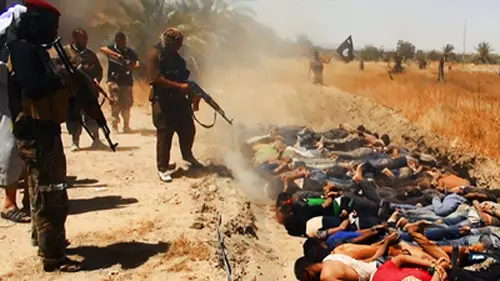
The brutality and barbarism of the Islamic State fighters has been staggering. The Islamic State has staged mass executions of security personnel and detractors throughout their storm of terror across Iraq and Syria. In the city of Tikrit IS claims that they executed over 1,700 Shia Muslims. According to witnesses and people who were lucky enough to escape, IS militants loaded Shia civilians onto trucks and drove them away for execution, satelite images show men women and children laying face down in ditches while IS militants spray their bodies with machine guns. Every Friday in occupied parts of Syria, Islamic State fighters hold amputations, lashings, and executions in public squares, with the bodies of the victims put on display for several following days. A 45 page report prepared by the UN High Commissioner on Human Rights released on August 27 2014 details the terrifying tactics of IS fighters, including how they force children to watch beheadings and shootings, and terrorize the population by dragging dead bodies behind their vehicles. Also detailed in this report is the Islamic State's use of child soldiers, some as young as 10 years old, in suicide bombing missions and other attrocities. The report shows how women have suffered public lashings and stonings at the hands of the Islamic State for not adhering to their strict dress code, and allegedly presents evidence that Syria's President Assad has been using chemical weapons on his citizens.
ISIS militants execute Yazidis in a ditch. Source:
Reuters
The Islamic State focused much of it's efforts in mid-late 2014 on terrorizing and trapping Yazidis, an Iraqi religious minority whose roots run deep and old through Iraq's history. To avoid persecution and murder by the Islamic State militants, thousands of members of the Yazidi community and other ethnic minorities fled to Mount Sinjar in Northwest Iraq. Without food, water, or medical care, these people faced grave danger. It is estimated that about 700,000 Yazidis exist today, mostly living in Northern Iraq. The IS fighters forced 40,000 people out of their homes and onto the mountain, where they stayed in 9 refugee camps. More ethnically Kurdish than Iraqi, the Yazidi worship a fallen angel named Melek Tawwus. This gives them the undeserved reputation of devil-worshippers, due to the fact that Melek Tawwus supposedly fell from heaven (but was later forgiven and returned to heaven). This reputation as devil-worshippers has turned life-threatening for the Yazidi people, as they flee from a massive extremist military force that seeks to wipe out their existance. They have been subject to genocidal ideals on multiple occasions: under Ottoman rule in the 18th and 19th centuries Yazidis were detested and there were multiple genocidal massacres against them, and recently in 2007 a series of car bombs killed almost 800 Yazidis. The Islamic State fighters have also abducted over 300 Yazidi women, whom the Yazidis claim they will impregnate in attempts to stop the ancient Yazidi bloodline from flowing. Evidence suggests that IS fighters have buried women and children alive as well. Iraqi air force and Kurdish peshmerga soldiers provided aid and escape for some of these lost and desperate people. Rescuers funneling out small groups of people with helicopters gave hope to the Yazidis still trapped on the mountain. United States air strikes on IS posts surrounding Mount Sinjar allowed over 20,000 people to escape during the weekend of August 8-10. The Yazidis who were rescued were able to seek shelter in Kurdistan after crossing through Syria. Air strikes carried out by the United States that weekend did significant damage to IS infrastructure and took out some top IS commanders. The siege of Mount Sinjar and the town of Sinjar itself continued until mid-December 2014, when Kurdish Peshmerga militants aided by US air strikes were finally able to break the siege and help hundreds of trapped individuals escape the terror of the Islamic State. Non-stop US air strikes battered the Islamic State positions for over 12 hours on December 20. Masrour Barzani, head of the Iraqi Kurdish region's national security council said that the Kurdish fighters had liberated a large area of land surrounding the mountain and allowed the individuals who had been trapped since August to escape. This liberated area opened up a corridor, and according to Barzani this was a strategic victory that he thinks will help free the rest of the Sinjar region. Most of the trapped individuals who were not rescued in August were rescued during this operation, the largest single operation in the fight against the Islamic State so far.
After news of the Yazidi massacres and IS capture of Kurdish territory, Kurdish and American forces took back Mosul dam from IS with air strikes and ground troops on Monday August 18, leaving the dam littered with IS vehicles and hardware and the dam under Kurdish control. Whoever controls Mosul dam controls the vast majority of Iraq's water, a significant strategic advantage in the desert-ridden Middle East, so this victory was extremely important.
In addition to the Yazidi and Shia communities the IS is also targetting Christians, forcing 200,000 Christians to flee for their lives out of Iraq's largest Christian city towards the Kurdish North. Christians who remained in the city and surrounding towns were given the option to convert to Islam or be murdered by the IS militant extremists. Most Christians have fled from IS extremism to Arbil, a town north of Baghdad.
The United Nations reported in mid August that the humanitarian crisis in Iraq is at "at the highest level" due to people being chased out of their homes and forced to flee to Mount Sinjar by IS militants. The United Nations declared a level 3 emergency after drones flying over Mount Sinjar showed there were significantly less people trapped than originally thought (thanks to US air strikes that freed over 20,000 people during the weekend of August 8). A level 3 humanitarian crisis means that additional goods, funds, and assets will continue to be sent to the affected population.
District 17 air base was overrun by IS fighters on July 25 2014 after a seige on the base that lasted almost a month. IS fighters detonated 2 suicide bombs at different points around the air base on Thursday July 24 and attacked from ground positions, eventually breaching the walls and killing the Syrian army soldiers within, parading their bodies and severed heads around the streets. On Friday the IS jihadists posted videos online of them inside the living quarters of the air base, and posted pictures of decapitated Syrian army members on Twitter.
The 93rd Brigade air base fell to ISIS fighters on August 6 2014, after a week of intense battle. The air base housed stragetic military equipment now being used by ISIS including tanks and missiles.
On August 25 the fighters of the Islamic State took over Tabqa airfield, a major Syrian air base. The air base is the third military base to succumb to the extremists in the past month, and is full of artillery, protective bunkers, warplanes, helicopters, and tanks that will now most likely be used by the militants to fight international efforts to stop them. After a relentless week-long offensive, IS fighters took Tabqa air base by finally breaching the walls on Sunday August 24. Analysts claim that IS lost around 100 men with 300 wounded, and the Syrian army defending the airbase suffered 170 casualties with another 150 supposedly captured. The province of Raqqa is now the first in Syria to fall completely into the hands of the Islamic State.
Islamic State fighters also made considerable advances towards Syria and Iraq's neighbor Turkey, capturing the strategic border towns of Akhtarin and Turkmanbareh in Syria's Aleppo province. The Islamic State militants staged a brutal attack against rebels residing in the towns, and also took neighboring villages during the battle. Experts say that the Islamic State was attempting to make it's way to the Bab al-Salama border crossing with Turkey, via the towns of Marea and Azaz.
On August 24 five rockets from Syria struck Israel and Israel retaliated with air strikes, and on September 1 two mortar shells fired from Syria exploded in open areas in the Golan Heights. It is thought that both of these instances were a result of stray fire.
Multiple groups of Syrian rebels headed by members of the al-Nusra Front stormed and took over the Quneitra crossing between Syria and the Golan Heights on August 28, getting dangerously close to Israeli territory. Syrian military units fought hard to retain the border crossing but video clips posted by the groups show the Al-Qaeda affiliated rebel groups in control of the crossing station. Syrian military carried out air strikes against the militants in the border crossing station but the rebels held their ground. It should be noted that the rebels in this case are not affiliated with ISIS explicitly, but are affiliated with the group al-Nusra Front, who hold close ties with ISIS and whose fighters often associate with ISIS. When the Syrian rebels took over the Quneitra crossing they also took a number of Fijan UN peacekeepers hostage who were stationed there. They also terrorized 70 Filipino UN peacekeepers who were stationed at the location, but they managed to escape. It was later reported the Qatar paid the groups $25 million to secure the release of the Fijan peacekeepers. Although Israel percieves the rebels at it's border to be a threat, they feel adequately prepared and have built up their border defenses in recent years in anticipation for such a moment. According to a Free Syrian Army (FSA) spokesperson, there are rebels affiliated with ISIS and Al-Nusra that are operating as sleeper agents and slowly trying to infiltrate the Golan Heights. Monday September 15 saw the Syrian rebels advance on the positions of the remaining peacekeepers on the Syria/Israel border, causing the peacekeepers to retreat to Israeli territory. The rebels took over their positions and stole their uniforms, armor, weapons, and vehicles. The rebels established a base of operations that they deemed a "safe zone" right on the Israel border that supposedly will be used to launch attacks against Assad's forces, or Israel. According to the Syrian ambassador the rebel members of the Al-Nusra front "succeeded in occupying all of the Syrian side" of the Golan Heights. Defense Minister Moshe Ya'alon was quoted on September 16 as saying that he did not believe that the activities of the Islamic State represent a threat to Israel at this point. (Yahoo News, September 16, 2014)
Islamic State members carried out a suicide bombing against the Iraqi army camp Camp Saqlawiyah and then overran the camp on the morning of September 21. Two trucks filled with explosives were driven up to the outside of the base and detonated, and two suicide bombers blew themselves up with bomb vests. Chaos ensued after the bombings, and the ISIS members were easily able to overpower the 820 Iraqi soldiers stationed at the camp. The Islamic State militants had seized/closed off the one supply bridge to the base in the days prior, so the Iraqi soldiers were already running low on food, water, ammunition, and other supplies when the ISIS members attacked.
The United States carried out it's first air strikes in Syria against ISIS on September 22. The US forces hit five spots and 14 seperate targets during the strikes including Raqqa, and also attacked a different Sunni extremist group in Aleppo known as Khorassan. The strikes were successful, and according to US officials the Jihadist forces were scattered following the attack and their infrastructure sustained significant damage. This attack involved over 50 cruise missiles and was significantly more powerful than the United States previous attacks on the Islamic State militants in Iraq. It was later reported that these airstrikes killed more than 120 jihadists, at least 70 from ISIS and 50 from Al-Qaeda. United States officials stated after the bombardment that it will be the first of many in a prolonged engagement against ISIS.
After these initial strikes in Syria, during the weekend of September 27 US forces in the air were joined by fighter jets from the UAE, Saudi Arabia, and Jordan. The strikes took out ISIS posts near the Kurdistan border in eastern Syria while Kurdish citizens watched from miles away hilltops. On September 30, Kurdish Peshmerga forces took back a strategic border crossing and surrounding villages from the Islamic State. The Rabia border crossing between Iraq and Syria had been a huge tactical advantage for the ISIS militants, as they used the crossing to move freely between the two countries. At least a dozen Islamic State fighters were killed by the Kurdish forces as they fought to take back the crossing, with support from the United States in the air. These Kurdish Peshmerga soldiers also liberated the surrounding towns from ISIS. During the following week US led air strikes including support from British Royal Air Force (RAF) jets continued decimating the Islamic State positions in Iraq and Syria, destroying multiple armored vehicles, observation posts, military positions, artillery pieces and rocket launchers. These included strikes on Mosul dam, Fallujah, and Aleppo.
After these air strikes it was reported that Mohsen al-Fadhli, the leader of the terrorist group Khorasan was one of the casualties. Khorasan has links to Al-Qaeda and the Islamic State, and their fighters have been fighting alongside the Islamic State during the conflict. His death was a large blow to the terrorist infrastructure in Syria and Iraq.
In his first televised speech since his election on Saturday October 18, Iraqi Defense Minister Khalid Al-Obeidi pledged to take back all parts of Iraq that have been taken over by the Islamic State. He also acknowledged the fact that US led air strikes including the international coalition have been the main reason behind the slowing of the spread of the Islamic State.
On October 7 it was reported that Islamic State militants had breached the borders of the strategic town of Kobani on the Syria-Turkey border. Kurdish forces fought for over two months to repel the Islamic State, staging intense gunfights in the streets and doing everything that they could to stop the ISIS menace. On Tuesday October 7 during a news interview Turkey's President Erdogan stated that "Kobani is about to fall". Late in the fight for Kobani the Kurdish forces were aided by US led air strikes against ISIS, which experts say were the most effective air strikes of the entire conflict but just should have happened sooner. The Kurdish forces were outmatched fighting with their average weapons against the tanks, rocket launchers, grenades, mortars, and other advanced weaponry that the Islamic State fighters had picked up along their bloody path. As of October 9, the Islamic State had taken over 1/3 of Kobani. The Kurdish fighters were successful in beating back the ISIS militants during the weekend of October 11, but ISIS forces continued to mass on Kobani's borders and the United States air strikes were getting less effective. On October 9 US Secretary of State Kerry clarified that preventing the fall of Kobani was "not a strategic goal" for US air strikes. Although it is a border town and Turkish fighters were able to see the battles from nearby hilltops across the border, Turkey chose not to get involved in the conflict at first which led to riots in the Turkish streets and clashes between Turkish Kurds and police. Turkish Foreign Minister Mevlut Cavusoglu stated that it was not feasable for Turkey to unilaterally conduct a ground operation against the Islamic State in Kobani on their own. In a shift in policy, on October 21 it was announced that Turkey would be allowing Kurdish soldiers to cross the border into Syria and aid the town of Kobani. The US led allies are considering instituting a buffer zone at the border between Turkey and Syria in order to slow the spread of ISIS. Secretary of State John Kerry has said that the institution of a buffer zone is something "worth looking at very closely". (BBC, October 9 2014)
After over one month of intense fighting, on October 16 it was reported that the Kurdish militants defending Kobani were gaining ground back and were becoming successful in driving out the terrorists of the Islamic State. During the week of October 14, US led air strikes killed hundreds of members of the Islamic State who were laying seige to Kobani. Over the weekend of October 18 US forces staged supply drops to Kurdish troops battling ISIS, delivering food, ammunition, medical supplies, and other necessities to the individuals defending their homes from the terrorist group. This effort represented a change in US policy during the battle, as they began to provide direct assistance to the Kurdish fighters instead of just providing air support. These supplies were provided by Kurdish groups outside of Kobani and simply delivered by US C-130 aircraft, and were not supplied by the United States. It was later reported that US planes carried out strikes on a pallet of supplies in order to prevent the ammunition and supplies inside from falling into the hands of ISIS. Despite this effort, the next day a video was posted online of ISIS militants in Kobani parading around with the US supplies. These include hand grenades, small rockets, ammunition, and medical supplies. On October 30 Iraqi peshmerga fighters arrived to aid the Kurdish fighters under seige in Kobani after almost 2 months of daily battles. The United States air strikes continued but were less effective as the ISIS fighters moved into the crowded residential areas of Kobani. Although the strikes killed hundreds of terrorist fighters, they were unsuccessful in breaking the seige.
The Syrian Observatory for Human Rights published a report on October 24 claiming that since the begining of the fight for Kobani, 481 ISIS fighters and 302 Kurdish fighters had been killed in the city.
The Kurdish militia completely expelled ISIS from the town of Kobani in January 2015, after more than four months of fighting to keep the town under their control. Nearly three quarters of the coalition air strikes were against ISIS fighters in Kobani, and alltogether the United States and allies carried out 700 air strikes before they were able to drive the Islamic State militants from the town borders.
The Islamic State reportedly used chemical weapons in the form of Chlorine gas against Iraqi police forces in Balad, a town on the outskirts of Baghdad in September. This attack was reported on October 23 after the United States opened an investigation into whether chemical weapons were indeed used by the terrorist group. If these reports are found to be true, it would be the first confirmed use of Chlorine gas by the Islamic State militants, although there have been other instances reported by Iraqi security forces. It is believed that they may have taken the gas from reserves left over from Bashar al-Assad, or others.
The Islamic State found it's first foothold outside of Iraq and Syria in the Libyan city of Darna where rule of law is scarce and the population lives under the control of extremist militants. On October 30 2014 a group of these militants gathered in Darna and pledged their collective allegiance to the Islamic State, effectively making the city they control the first city outside of Iraq and Syria to officially join the Islamic State's Caliphate. It was reported on December 3 that hundreds of individuals were undergoing training under ISIS militants in Libya. This group claimed responsibility for the execution of two Tunisian journalists in January 2015. Libya has many radical Islamist groups fighting for power following the overthrow of Gaddafi in 2011.
In a surprising turn of events, on November 13 it was revealed that during the previous week meetings were held at a farmhouse in northern Syria between leaders from the Islamic State and al-Qaeda. This was the first known face-to-face communication between leaders from the two groups in at least 6 months. During this meeting officials from the two terrorist organizations agreed to put aside their differences and stop fighting each other, instead focusing their mutual attention on their opponents. The groups agreed to focus on eliminating the US trained rebel faction the Syrian Revolutionaries Front, as well as any US forces in the region. Collaboration between the two groups may complicate US operations in the region, as they expand the fighting to new areas in Northern Syria and develop new battlefield strategies with their new allies.
The Islamic State's leader in Mosul, Radwan Taleb al-Hamdouni, was killed along with his driver when his car was hit by an air strike in Western Mosul on November 19.
US air strikes continued during November, causing heavy damage to Islamic State positions around areas like Kobani and Raqqa. In Iraq, the US led air strikes focused on Mosul, Asad, Baghdad, Ramadi, Tal Afar and Hit. During the weekend of November 22, the United States and allied forces carried out twenty four air strikes on Syrian and Iraqi ISIS strongholds.
On November 25 it was reported that fighters from the Islamic State had breached the core of Ramadi, the capital of Iraq's largest province. The terrorist extremists fought for two weeks to capture the town, cutting off supply lines and surrounding the government buildings. Ramadi is one of the last government controlled sections of the Anbar province, bordering Baghdad to the West. If the city of Ramadi falls completely under ISIS control, it would significantly improve their supply lines into Syria and position them for a massive and brutal assault on Baghdad. Individuals who fought to keep Ramadi out of the hands of the Islamic State cited that a lack of consistent air support and reinforcements made it impossible to hold their ground.
Syrian government air strikes killed at least ninety five militants and civilians in the ISIS stronghold of Raqqa on November 25. The air strikes targetted a market near a museum and an industrial neighborhood, causing many civilian casualties in addition to killing the militant targets. These strikes represent one of the bloodiest days of the conflict.
During the weekend of November 29, over fifty five air strikes were carried out against the Islamic State. Seventeen of these air strikes were levelled against jihadists fighting to take over the town of Kobani. The group of strikes was led by US fighter jets and accompanied by Syrian government planes, who struck the Daraa province and killed an estimated nineteen people. In addition to striking militants associated with the Islamic State, air strikes were also carried out against a Khorasan outpost near Aleppo.
Just days after the P5+1 deadline for a nuclear deal with Iran came and went without an agreement, it was reported that Iranian planes were participating in the bombing of the Islamic State, in the same airspace as planes from the United States. Some of these bombing runs were being made by F4 Phantom jets, manufactured by America and provided to Iran before their 1979 revolution. A senior US defense official confirmed Iranian and US planes sharing airspace on December 1 and stated that officials in Washington are "[not] necessarilly concerned with it" and "have [their] eyes on it". The Iranian bombing activity during the weekend of November 29 took place near the Iranian border in a different spot than most of the US and coalition air strike activities. Iranian strikes helped chase ISIS militants out of the towns of Saadiya and Jalawla in the Iraqi province of Diyala. The fact that the Obama administration or any other US official did not challenge this Iranian involvement in the fight against ISIS shows that they see Iran as a potential unspoken partner in certain aspects. These "dual but seperate" military operations were carried out supposedly without any sort of coordination between US and Iranian leaders.
The fight against ISIS continued into December 2014 as allied air strikes caused significant damage to the Islamic State but were not successful in slowing down the gains of the jihadist group. Battles continued to rage for the third month in the streets of Kobani between Kurdish Peshmerga fighters and ISIS militants, and the ISIS affiliated group the al-Nusra Front began making significant territorial gains in the Idlib and Hama provinces in Syria. Due to these gains made by al-Nusra and the intensity of battles elsewhere at the time, on December 8 it was reported that the pro-Western rebels fighting the Islamic State in Northern Syria were not being paid by the US government anymore and were not recieving the regular supply drops that they had in the past. The United States government was paying these rebels a stipend of $150 per month and supplying them with firearms, ammunition, food, and other materials while they fought the Islamic State. This cutoff is estimated to have affected 8,000 of the 10,000 fighters in Syria. A State Department representative clarified that supplies such as food and medical equipment would continue to be sent, but the fighters would not be paid or sent weaponry anymore.
The United States carried out at least twenty air strikes against the Islamic State positions during the week of December 10. The majority of these strikes focused on Kobani which had at the time been under seige for three months straight, and also hit Sinjar, Ramadi, Mosul, and Samarra.
During December the Islamic State militants began a terror campaign in the government stronghold of Baghdad, mounting multiple suicide attacks and killing over twenty people by December 11. Militants affiliated with the Islamic State stole an oil tanker truck and filled it with explosives before driving it to a checkpoint near the outskirts of Baghdad on December 10. Once they reached the checkpoint they orchestrated a suicide bombing attack that claimed the lives of ten Iraqi soldiers and multiple rebel fighters. Earlier in the week a roadside bomb and other attacks killed ten people and injured dozens right outside of Baghdad.
The Iraqi government's "lack of interest and support" caused the Islamic State militants to gain back strategic areas of the Anbar province including Hit and Haditha during the week of December 15. This reclamation of land in the Anbar province cut off multiple supply lines to Baghdad, which sits only 80 miles away. Multiple suicide attacks in Hit and Haditha terrified the residents, and the rebel tribes did not have enough weapons or supplies from the Iraqi government to fight off the Islamic State advance.
According to data provided by the US military, US planes carried out 97% of the total air strikes against the Islamic State in December 2014. US led air strikes against the Islamic State militants in Kobani continued into 2015, killing over 50 ISIS fighters within the first week of January.
The Islamic State ordered the closure of all schools in their territory while they reform the curriculum in January 2015, leaving over 670,000 children deprived of proper education.
A spate of suicide attacks were carried out by members of the Islamic State in the Iraqi city of Samarra during January 2015, targetting security checkpoints and public areas. Multiple car bombs were set off at these checkpoints on January 8, killing 2 policemen and one civilian, and injuring many others. The Islamic State intensified attacks against Samarra in late 2014 and early 2015 because of it's convenient vicinity to Baghdad.
Islamic State positions in Kobani, Deir Ezzour, Beiji, Ramadi, Tal Afar and Mount Sinjar were struck by air fire unleashed by the United States and allied forces in mid January 2015. These strikes focused on ISIS tactical fighting positions, artillery systems, patrol units, and oil refineries being operated by the terrorist organization. Nations conducting air strikes against ISIS in Iraq in January included the United States, Australia, Belgium, Canada, Denmark, France, the Netherlands and the United Kingdom. Air strikes in Syria during January were carried out by the United States, Bahrain, Jordan, Saudi Arabia and the United Arab Emirates.
In response to the continued bombardment of their positions by allied air strikes and international backlash against the group, Islamic State sympathizers somehow hacked into the United States military command Youtube and Twitter accounts on January 13. The group posted on the US military command twitter account "American soldiers, we are coming, watch your back, ISIS," and "In the name of Allah, the Most Gracious, the Most Merciful, the CyberCaliphate continues its CyberJihad." The individuals also posted the names of various US generals and military/defense officials along with their associated addresses in a 52 page spreadsheet. United States officials downplayed the effect of the "cyber-attack", stating that "hacking a Twitter is about the equivalent of spray-painting a subway car," and that they "view this as little more than a prank, or as vandalism." (Reuters, January 13 2015)
Adding to the Islamic State's international reach, a group in Libya identifying themselves as the Tripolitania Province of the Islamic State pledged their allegiance to ISIS on January 12 2015 after abducting 21 Egyptian Christians. After this announcement, all three of Libya's provinces have terror groups that have alligned themselves with the Islamic State. The 21 Christians that Tripolitania Province of the Islamic State abducted were all migrant workers who were abducted in two seperate large groups from the coastal city of Surt. Surt is dominated by the terrorist group Ansar al-Sharia of Surt, who are not affiliated with the other Libyan terror groups Ansar al-Sharia of Derna and Ansar al-Sharia of Benghazi.
During the second week of January 2015 Canadian soldiers fired upon ISIS militants in Iraq, in the first physical exchange of fire between Islamic State militants and Western troops on the ground. The soldiers were visiting Kurdish Peshmerga forces on their front lines when they were put under heavy fire from mortars and multiple machine guns. The Canadian soldiers fired back in self-defense and secured the area by neutralizing their targets, taking no casualties themselves. Canada currently has 69 special forces trained soldiers in Iraq and Syria, participating in the conflict in a "training and advisory" role.
A United Nations report published on January 20 2015 detailed the brutal execution style killings that members of ISIS had carried out during December 2014 and early January 2015. Individuals accused of theft were tied to crosses in a town square in Mosul, while three men accused of participating in homosexual acts were blindfolded and then thrown from an exceptionally tall rooftop. Other executions described in the report include the killing of four doctors in Mosul who refused to treat Islamic State fighters, the killing of three female lawyers, and and stoning to death of a woman accused of adultery. A large group of teenage boys were caught watching a soccer game between Iraq and Jordan during the second week in January, and were all then murdered in the street with machine guns. The Islamic State put on trails of the individuals strictly for show in which they were immediately pronounced guilty and sent off to be executed. Most of the accusations were unfounded. In addition to the ones listed, many other execution style killings were being investigated by the United Nations at the time. The report found that the Islamic State has a "monstrous disregard for human life".
Sinai province, an Egyptian group affiliated with the Islamic State, staged more than a dozen attacks on police and military targets on January 29, 2015, killing 30 security officers and injuring many more. The attack seemed to be extremely well coordinated, with car bombs going off outside of a military base while mortars were simultaneously being shot at the base as well. These attacks toppled buildings and left security forces scrambling in the rubble.
Foreign Fighters
Air strikes carried out by the United States and allied countries were successful in killing hundreds of jihadists and assisting Kurdish fighters, but these air strikes did not have any discernable effect on the influx of foreign fighters pouring into Syria to join ISIS. According to United States counterterrorism officials, despite US led air strikes, over 1,000 foreign fighters still cross into Syria each month to join the Islamic State. The number of jihadists continues to rise because the inflow of foreign fighters continues steadily, and as of November 1 2014 it was estimated that 16,000 foreign fighters were in Syria fighting for the Islamic State.
Rumors of a violent ISIS attack on Australian territory sparked counterterrorism raids that ended with the arrest of 15 people suspected of having communicated with ISIS. These individuals supposedly were coordinating a terrorist attack in Sydney Australia in which they were planning to grab a random passerby on the street and behead them in public draped in the ISIS flag. This attack, according to Australian officials, was clearly designed solely to shock and terrify citizens. The suspects are being charged with conspiracy to prepare for a terrorist attack. The Australian government knows of about 60 Australian citizens who are currently in the Middle East fighting for ISIS, and about 100 local supporters in Australia.
Turkish government reports and officials show the Islamic State is getting a steady stream of fighters coming from inside of Turkey. According to Turkish media over 1,000 Turkish citizens fled Turkey and joined IS. Most of these citizens represent dissafected youths drawn to the organization's radical extreme ideology and promises of $150 pay per day. The Islamic State released 49 Turkish hostages on September 20 who they had abducted in Mosul from the Turkish consulate there on June 11. The hostages were not rescued, they were released, and were taken to the Turkish capital Ankara immediately following their release. Turkish government officials have repeatedly denied that they paid any money for the release, and claim that they only used a strategy developed by their intelligence community to secure the hostages. The fact that they paid nothing for the hostages is unlikely, as ISIS makes most of it's money from exploitative measures such as collecting ransoms or imposing undue taxes. On October 13 Turkish police forces found a massive stockpile of weapons and explosive vests in the Turkish province of Gazientep, allegedly stored there by Islamic State members. According to Turkish officials, during the raid police seized 150 kilograms of C4 explosives, 20 vests for suicide attacks, and a number of guns and bullets. They believe the amount of explosives siezed was enough to destroy a small city. On November 22 Turkish President Erdogan met with US Vice President Joe Biden in Istanbul for discussions about the danger posed by the Islamic State and their mutual interest in defeating the militants. The two leaders met for four hours and although there were no firm mutual agreements made, according to officials the two countries were moving toward increased cooperation in the fight to defeat ISIS. The following day it was reported that Turkish and US officials had put aside their differences and were going to begin to work together in the fight against the Islamic State. The two countries have agreed to mutually arm and train opposition fighters in Syria, with Turkish soldiers providing on-the-ground training for fighters in the Free Syrian Army (FSA) and US forces providing equipment and logistical support. Turkey and the US will arm and train about 2,000 FSA fighters at the Hirfanli gendarmerie training camp in Anatolia.
German intelligence and security services believe that at least 400 German citizens have travelled to the Middle East to join ISIS, according to a report released September 22, 2014. This number includes 24 children, some as young as 13. Four young German women have also joined the group, with aspirations of marrying Jihadists that they reportedly met on the internet. The parents of the children had reported them missing, and only then was the situation addressed and recognized by police, German security services estimate that about 130 of these German citizens who trained and fought with ISIS have returned to the country. So far one German citizen identified only as a Turkish man has been arrested in Berlin after returning from an ISIS training camp.
The Islamic State militants called on their counterparts in Egypt's Sinai Peninsula on September 22nd to rise up against Egyptian security forces. ISIS spokesman Abu Muhammed al-Adnani encouraged the militants to "Attack their bases. Raid their homes. Cut off their heads". He also encouraged Islamic State supporters to kill members of any country involved in the US led coalition to stop their brutality. On November 4 Egypt's most active terrorist organization Ansar Bayt al-Maqdis swore allegiance to the Islamic State. According to a statement released by Ansar Bayt al-Maqdis leader, "After entrusting God we decided to swear allegiance to the emir of the faithful Abu Bakr al-Baghdadi, caliph of the Muslims in Syria and Iraq and in other countries". The group terrorized the Sinai Peninsula in late 2014, carrying out a spate of attacks that killed 33 Egyptian security personnel and causing the Egyptian government to declare a state of emergency in parts of Northern Sinai.
Israeli police have said that they will be cracking down hard on any public show of solidarity with or support for the Islamic State. This includes on social media and in public places. Israeli police chief Yohanan Danino stated that youth these days are not only affected by what they physically see and experience, but also what they see and are exposed to on the internet. Because of this, Israeli police began a social media monitoring campaign aimed at quelling Islamic State support within Israel's borders. The Islamic State has found some supporters in the Gaza Strip, and during the week of December 1 threatening pamphlets with Islamic State symbols began appearing in Gaza, as well as an increased number of Islamic State stickers on cars and flags flying from homes and businesses. These pamphlets threaten Palestinian poets, musicians, and writers; one of them reads ""We warn the writers and poets of their wanton sayings and atheist deeds. We give the apostates three days to retract their apostasy and wantonness and enter the religion of Islam anew." These pamphlets created panic in the Gaza Strip because they mention the targetted individuals by full name. Threats were also included against Palestinian women in general, providing an ultimatum that the women abide by the style of attire approved by the Islamic State or face Sharia punishment. Palestinian political analyst Naji Sharab stated that "there is no denying that Islamic State exists in the Gaza Strip as a small group or as individuals." In addition to these flyers, stickers, and flags, Palestinian individuals have also begun sending out wedding invitations featuring the iconic Islamic State flag and emblem.
At 11:30a.m. local time on January 7 2015 two gunmen dressed in black and armed with Kalishnakov assault rifles approached the headquarters of satirical French newspaper
Charlie Hebdo located in Rue Nicolas-Alpert, Paris. The two gunmen, later identified as Cherif and Said Kouachi, made their way into the building shooting maintenence staff and caretakers as they went. After forcing a terrified Charlie Hebdo writer to unlock the door to the second floor meeting room where an editorial meeting was currently underway, they entered the room and called out many of their victims by name before they began shooting wildly. The gunmen killed ten people in the meeting including all of their intended targets before fleeing the building shouting "We have avenged the Prophet Muhammad" and "Allahu Akbar." As the gunmen were in the process of fleeing the scene of the massacre, police arrived outside of the Charlie Hebdo offices.
A gun battle ensued between the gunmen and police officers, and eventually the gunmen escaped after killing Muslim Police Officer Ahmed Merabet.
During the search for the Charlie Hebdo suspects, a lone individual shot dead a policewoman and injured a man in a Paris suburb. Initially it was dismissed that the two attacks were related, but upon further investigation it seemed as if they were planned in conjunction. The lone gunman escaped the scene of the attack after a shootout with police and re-emerged a few hours later at a Kosher supermarket in Porte de Vincennes, Paris. The gunman was then identified as Amedy Coulibaly. Coulibaly had just begun to recite his evening prayers to Mecca when the supermarket was stormed by French special forces who immediately shot him dead and released the remaining 15 hostages. The French authorities recovered 4 dead bodies from the store, all of them Jewish individuals. The Jews killed while being taken hostage at the store were buried in Israel on January 13 2015. A video of Amedy Coulibaly was released posthumously in which he pledged allegiance to the Islamic State (ISIS). It is believed that this video was filmed sometime between when the Charlie Hebdo shootings began and when Coulibaly took the people hostage at the Kosher supermarket.
A report issued in mid January 2015 including US ordered and independent assessments concluded that the United State's (at the time of publication) 3 month long air strike campaign against ISIS had failed to slow the progress of the terrorist organization. Experts and analysts demonstrated in the assessment that the Islamic State militants had in fact expanded and increased their hold in Syria since the begining of the US and allied forces bombing campaign.
Although groups like Hamas and Fatah have continued to deny it, The Islamic State has begun to take a foothold in the Palestinian territories. Israeli security sources claim that in late 2014 and early 2015 hundreds of Hamas and Fatah supporters have defected to the Islamic State. Following the attack on the satirical French news magazine Charlie Hebdo in January 2015, thousands of supporters of the Islamic State crowded the streets of Gaza in protest of the publishing of images of Mohammed by the magazine, and in support of the violent attack that left twelve people dead. Similar demonstrations took place in Ramallah and Hebron. These protestors attempted to storm the the office of the French Cultural Center in Gaza, and burned French flags while chanting calls for the slaughter of French nationals. Palestinian security forces were dispatched to the protest area, where they arrested seven Islamic State supporters. Palestinian security forces have arrested in total fifteen supporters of the Islamic State, and have been fighting the rise of the Islamic State along with Israeli security forces. It was revealed on January 18 2015 that a number of would-be jihadists "training" to join the Islamic State had been arrested in November and December in Galilee, Northern Israel. The seven Arab Israeli citizens were apprehended by Israeli security forces after apparently participating in "training" sessions during which they slaughtered sheep, practiced riding horses, learned how to properly make and hurl a molotov cocktail, and participated in target shooting activities. The individuals arrested included Adnan Ala al-Din, a 40 year old prominent lawyer from Nazareth, and brothers who had had issues with Israeli security forces in the past. Ala al-Din presented himself to the security forces as the Senior Commander of the Islamic State in Palestine at the time of his arrest.
Use of Media
James Foley was an American freelance journalist born on October 18 1973. With a passion for getting the raw story, Foley often found himself in sticky situations and had been captured previously. He was captured in Libya in April 2011 and held for 44 days in a Libyan prison, after which he returned to Libya and was there to cover Muammar Gadaffi's capture. Foley was in Syria doing freelance reporting on the Syrian civil war when he was abducted along with his translator on November 12 2012. After his captors demanded a payment of $132 million (USD) for his ransom, the United States launched a rescue operation based on intelligence that Foley and others were being held at a specific location. The mission failed because the captors had allegedly moved the hostages from the location.
On August 19 2014, the Islamic State uploaded a video to their youtube account of Foley's execution, titled "A message to America". Although it was quickly taken down, the video and screenshots are being circulated around the internet. The video shows Foley in an orange jumpsuit with an IS fighter standing next to him. Foley reads from a script about how his real killers are the US government, and then he is brutally beheaded. The video does not show the specific moment of the beheading, appearing to be shot in multiple takes. After Foley is killed, the camera pans over and it can be seen that IS has another hostage, identified as journalist Steven Sotloff. The masked executioner explains that if US air strikes on ISIS do not cease, the other hostage will be killed as well. This video was meant as a deliberate and personal threat against the United States, and President Obama asserted that the terrorists would pay the ultimate price for their actions, claiming that "justice will be done" against the murderers of James Foley. The President said that the United States will "do what's necessary to go after those who harm Americans". (Business Insider, August 26 2014)
After a few days it was ascertained that Foley's executioner was a British born UK citizen named Abdel-Majed Abdel-Bary. Bary had travelled to Syria to join the Islamic State, and his father was believed to be a close friend of Osama Bin Laden.
Steven Sotloff was executed in a video released by the Islamic State on September 2 2014 after appearing in the background of the beheading video of James Foley. Sotloff was a 31 year old American journalist who was captured in Syria in 2013, and had roots in Israel. An American born Jew, after travelling to Israel in 2008 to pursue his undergraduate degree Sotloff became an Israeli citizen and began publishing articles for the Jerusalem Post and the Jerusalem Report, as well as Foreign Policy and Time Magazine. Steven's freelance journalism work took him all around the Middle East, but he went missing on August 4 2013 in Aleppo Syria and was held in Raqqa for a year. At the end of this video the brutal Islamic militants threatened to hand down the same fate to an unidentified at the time British man unless Western governments agree to cease their air-strikes and assaults against the Islamic State. It is speculated that this act of brutality was committed by the same masked executioner that appeared in the James Foley execution video, due to the fact that he has a similar British accent and states "I"m back, Obama" at the begining of the video.
The third execution video was released on September 13 and shows the execution by beheading of the terrorists British prisoner from the previous video. This prisoner identifies himself as British aid worker David Haines, who had been abducted in Syria 10 days after his arrival in early 2013 and had not been heard from since. Haines was 44 years old and leaves behind a wife and 4 year old daughter in Croatia and a 17 year old daughter from a previous marriage in Scotland. He was forced to read a script similar to Sotloff and Foley, in which his death was blamed on David Cameron and the British government. Haines changed careers to be an aid worker, helping individuals in the Balkans, Libya, and South Sudan after a long stint as an engineer in Britain's Royal Air Force. The executioner is believed to be the same one from the first two execution videos, as he has a similar British accent. The execution was reportedly a response to the British aiding of Kurdish fighters fighting against the Islamic State in Iraq. At the end of the video the executioner shows another man to the camera and threatens to execute him in the next video. The individual was identified as Alan Henning, who is a taxi driver from Britain who was abducted while working as a volunteer on an aid convoy in Syria.
Extremists aligned with ISIS in Algeria released a video on September 24 of them beheading French hostage Herve Gourdel. He was abducted on Sunday in response to France joining in on the US led airstrikes against ISIS, and was killed less than 72 hours later. Gourdel was a 55 year old hiking and mountaineering guide from Nice, France, and was in Algeria for a hiking trip. He had arrived just the previous day.
On October 1 it was reported that Islamic State militants had beheaded 9 Kurdish soldiers that they had captured during intense clashes near the border between Syria and Turkey, in the Northern Syrian town of Kobani. The individuals beheaded included 3 women. After the executions, the militants paraded around the town with the severed heads and posted pictures online of the grotesque display.
The Islamic State released a video online of the beheading of British aid worker Alan Henning on October 3, murdering him in the same fashion as James Foley, David Haines, and Steven Sotloff. It is believed that the same executioner with a British accent carried out this execution as well. Henning was an aid worker who was abducted in early 2014 while taking part in an aid convoy, delivering toys and supplies to Syrian children caught in the brutal crossfire of the civil war. In Britain, Henning held a job as a taxi driver in Manchester. In the weeks leading up to his execution, the terrorist group Al-Qaeda appealed to ISIS and asked them to release Alan Henning, stating that he was simply an aid worker and was genuinely attempting to better the situation of all Muslim individuals in the area. A local commander of the ISIS affiliated group the Al-Nusra Front confronted the ISIS militants just days after Henning's abduction and informed the ISIS militants that he believed they had gone too far, and that Henning's abduction was counter productive to their strategy. After Henning's execution the masked executioner threatens the life of an American hostage, Peter Edward Kassig. Kassig is a former US Army Ranger from Indiana who started a non-profit organization Special Emergency Response and Assistance (Sera) in 2012 to provide assistance to the Syrian refugees. He changed his name to Abdul-Raman Kassig and converted to Islam in captivity.
An ISIS affiliated group in the Sinai Peninsula of Egypt released a video on twitter of four individuals being murdered on October 6. The video shows three men being beheaded, accused of collaborating and providing intelligence to Israel, and one man being shot to death after being accused of working with the Egyptian Army. Before their execution the individuals called out to fellow "spies" to reveal themselves or face a similar fate.
Peter Kassig was a 26 year old US citizen who was kidnapped on October 1 2013 while travelling to the Syrian city of Dier al-Zor as an aid worker. Kassig was beheaded by an Islamic State militant in a video released on Sunday November 16 on Islamic State twitter channels and jihadist websites. His parents stated that he had a "love for the Syrian people and [a] desire to ease their suffering," and President Barack Obama praised Kassig's humanitarian efforts on his way back from the G20 Summit in Australia. The individual who beheaded Kassig spoke with the same British accent and is believed to be the same person who carried out the beheadings of James Foley, Steven Sotloff, David Haines, and Alan Henning. The video differed from the other execution videos, in that this one was about 10 minutes longer and included propaganda as well as video of other beheadings in addition to Peter Kassig's (The LA Times, November 17, 2014).
Two Japanese hostages held by the Islamic State were displayed in a video released on January 20 2015. The militants demanded a $200 million ransom for the hostages, identified as Kenji Goto and Haruna Yukawa, and stated that the Japanese government had 3 days to save their citizens. In this case the ransom was not an arbitrary amount, but is estimated to be the equivalent of the non-military aid that Tokyo pledged to countries affected by the Islamic State. The Islamic State militants executed Haruna Yukawa in a video released on January 24 2015. Japanese Prime Minister Shinzo Abe publicly expressed his grief to the Yukawa family while at the same time assuring the people of Japan that the government was doing everything that they could to rescue the remaining hostage. The video that showed Yukawa's execution did not include the "Jihadi John" ISIS fighter with a British accent. The second Japanese hostage, Kenji Goto, was beheaded on January 30, 2015, in a video that was released by ISIS media accounts. The executioner who speaks English with a British accent and has come to be known as "Jihadi John" carried out Goto's execution.
Militants from the Islamic State carried out their first video execution by burning their victim to death in a video released on February 3, 2015. The Jordanian pilot, 26 year old First Lt. Moaz al-Kasasbeh, was captured on December 24, 2014, after his F-16 went down in Northern Syria. Al-Kasabeh came from a wealthy and prominent tribe in Jordan, and the Jordanian government attempted for many weeks to negotiate al-Kasabeh's safe release. During negotiations, Jordanian officials attempted to trade al-Kasabeh for Sajida al-Rishawi, an Iraqi woman jailed in Jordan for her role in a 2005 bombing attack on Amman. The Islamic State would not accept the trade however, and al-Kasabeh was burned alive in a cage in a video released on ISIS media accounts. Apparently the video had been recorded over a month beforehand, and al-Kasabeh had been long dead during negotiations to secure his safe return home. In response to the brutal murder of al-Kasabeh, Jordanian officials executed Sajida al-Rishawi along with another convicted terrorist on the morning of February 4, 2015.
The Islamic State has released dozens of videos of their opponents being beheaded, tortured, or just plain shot in a ditch, and they have made pertinent use of social and world media to disseminate their message. The IS militants make use of twitter, facebook, and other social media to get their messages across, including running "hashtag campaigns" on twitter. According to experts, the Islamic State uses social media extremely effectively, moreso than some large companies, and puts a very large emphasis on their image in the media.
International Response & Analysis
The relative success of the Islamic State so far lies within the weakness of the region that they are involved in. The territorial gains made by IS so far have been impressive, but they have only expanded within the failed states of Iraq and Syria. The IS fighters are able to operate in the outlying areas where the rule of law is scarce and people will bend to their whim in fear of being murdered. The emptiness left by the inneffective governments of Iraq and Syria has allowed the Islamic State fighters to run wild with little opposition. The IS fighters have not yet captured a large city with a decent police force and a significant Shiite population such as Baghdad. According to the Pentagon, since the begining of heavy US involvement in the conflict in August 2014 the United States has hit and/or destroyed 3,222 Islamic State targets. This number includes 980 buildings, 673 fighting positions, 58 tanks, and 184 Humvees. Between August 8 2014 and January 7 2015, the United States carried out 1,676 air strikes against ISIS positions.
Air strikes have been the method of choice for US involvement in the fight against ISIS, but without boots on the ground the West is fighting a losing battle. A small group of Syrian rebels known as the Mujahideen Army has been given US training and weaponry already, and the members say that they can tell the difference. Fifty fighters from the Mujahideen Army were trained in Syria by US forces in September 2014, and learned how to fire mortars and heavy machine guns, as well as taught battlefield tactics. The United States announced plans in late 2014 to arm and train more Syrian rebels to fight against the Islamic State, but this training is not expected to begin until at least mid 2015. The United States has made mistakes in past conflicts by arming rebel groups who have turned around and used the weaponry and training against US forces, so the Syrian rebels will be subjected to a much more rigorous and thorough testing and evaluation process before they begin their training. According to US officials this screening process will include (but is not limited to) cross-checking potential trainee names with US and foreign intelligence databases, collecting biometric data on the potential trainees, conducting interviews with locals about the general behavior and demeanor of the individuals, and seeking other information from their home communities. The training program will be based on a levels system, with continuous and constant evaluations possibly leading to the rebels recieving more specialized training and "moving up" to different weapons and training programs. (The Washington Post, November 28 2014)
On January 15 2015 it was announced that the Pentagon will be sending an additional 400 US military trainers and hundreds of other support personnel to Syria in order to aid the rebel forces in stabalizing Syria and defeating the Islamic State. These military trainers will put the rebel forces through a 6-8 week training cycle, with the hopes that these soldiers will be well equiped to fight the Islamic State due to their grasp on the local terrain and battlefield dynamics.
President Barack Obama referred to the Islamic State as a "cancer" on August 26 and stated that the time has come to "take the fight to these barbaric terrorists". The United States launched more air strikes against the IS militants and has authorized 1,100 troops into Iraq. US forces were given a mission to seek out and eliminate IS leaders, effectively "cutting the head off of the snake" and leaving the IS flailing and unorganized. The United States assembled a team of allies to formulate a plan and provide support in defeating the IS, and these allies include: Australia, Britain, Jordan, Qatar, Saudi Arabia, Turkey and the United Arab Emirates. Britain and Australia are expected to aid the US in an aerial campaign, Turkey has strategically placed military installations that will give US forces bases to launch operations out of, and Jordan has inteligence information that will prove useful for defeating the Islamic State menace. Egyptian President Abdel Fattah Al-Sisi has also thrown his support behind US led efforts to decimate the Islamic State.
The United States expanded air strikes to help Iraqi troops on the ground take back territory from the militants. After the Iraqi Parliament's approval on September 8 of the new Iraqi Prime Minister Haider al-Abadi, the United States felt more comfortable carrying out increased air strikes and military operations against IS in Iraq because of increased political stability in the country.
On September 10 President Barack Obama addressed the United States in a special speech specifically dedicated to the threat posed by the Islamic State. The President vowed that "we will degrade, and ultimately destroy, ISIS through a comprehensive and sustained counterterrorism strategy". This strategy includes expanding air strikes (as of the speech 150 air strikes had been carried out), and supporting Iraqi and Kurd focres on the ground. The President assured the American people that there is not going to be another large scale ground war against the Islamic State, but troops are being sent in to provide training, equipment, and support to the international troops fighting the terrorists. The United States will also provide assistance to innocent civilians in the combat zones, and continue to do everything in it's power to stop IS funding sources. To read the full statement, please click here. (The White House, September 10 2014)
In response to growing criticism regarding the civilian casualties inflicted by these US led air strikes, the Obama administration released a statement on October 1 that the strict "near certainty" operations standards that were imposed by them in the previous year to prevent civilian casualties from drone strikes will not apply to the current situation. The voice of criticism became too loud for the administration to ignore after an estimated dozen civilians were killed by a Tomahawk missile in Syria's Idlib province on September 23. The statement released by the administration details that the "near certainty" policy was only to apply to areas that are outside of the current hot zone of the conflict, when the United States takes military action in areas "outside of direct hostilities". (Yahoo News, October 1, 2014)
Secretary of State John Kerry has repeatedly stated that the United States will not send in ground troops for combat during this situation.
David Cameron stated in response to the video released of David Haines execution that members of the Islamic State are "not Muslims, they are monsters". The British Prime Minister vowed on September 14 to "drive back, dismantle, and ultimately destroy ISIL and what it stands for". The release of this execution video prompted the British officials to heavily consider increased involvement in the fight to combat the Islamic State. On Monday October 20, Britain authorized surveilance missions over Syria in order to protect their own national interests. These surveilance missions were carried out by unmanned and armed drones and spy planes. The armed drone operators require special permission from higher-ups in order to use the firepower on their drones. . (The LA Times, September 14 2014)
The leader of the Islamic Movement in Israel expressed shame in and verbally attacked the Arab countries who have supported US actions against the Islamic State. Sheikh Raed Salah referred to the US led coalition that includes multiple Arab countries in the region as "a coalition of evil aimed at destroying what is left of Syria and Iraq". Although Salah condemned the actions of the Islamic State he claims that the actions taken by IS do not warrant the response that the US is laying out. (Haaretz, September 13 2014)
According to US diplomats, Israel aided the United States in carrying out air strikes against the Islamic State by providing intelligence information to US forces operating in the region. Israeli satelites over Iraq have provided anti-Islamic State forces with vital information to plan their strategy. The Israeli intelligence community also provided a list of Western citizens who reportedly have travelled to Iraq to join the Islamic State, after analyzing travel record databases.
On October 3, 2014, the United States State Department and Department of Defense launched seperate informational websites aimed at countering the Islamic State. These sites provide the most up to date public information on the coalition to defeat ISIS, and the military aspects of this operation. The State Department website can be found here, and the Department of Defense site can be found here.
It was revealed in early November 2014 that during the nuclear negotiations between Iran and the P5+1 President Obama wrote a secret letter to Iranian leader Ayatollah Khamenei expressing their mutual interest in defeating the Islamic State. Cooperation between the United States and Iran is extremely rare, and the nuclear negotiations during 2014 represent the most sustained period of diplomacy between the two countries since 1979's Islamic Revolution. This is the fourth letter that Obama has written to Khamenei, and these suggest that the United States is genuinely interested in pursuing a mutually beneficial relationship with Iran with further cooperation if the nuclear issue is sorted out.
On Friday November 7 President Barack Obama authorized a doubling of the number of US troops in Iraq, bringing the number to 3,100. This announcement of an additional 1,500 troops to be sent into Iraq comes amid a shift in the United States strategy in dealing with the Islamic State. President Obama announced that the US was going to be going on the offensive against the Islamic State now that air strikes have degraded some of their capabilities, but stood by the fact that US troops will not be involved in combat against ISIS. These additional troops will serve to advise and assist Iraqi security forces in planning counteroffensives to the brutal Islamic State militants. In order to pay for this, the White House announced that they are asking Congress for an additional $5.6 billion in supplimental funding for 2015. Congress must agree to fund this request before any troops can be sent in.
In response to the attacks on the Charlie Hebdo magazine offices in France that left 12 people dead and terrified the country for three days, on January 13 the French Parliament overwhelmingly approved the continuation of air strikes against the Islamic State forces in Syria and Iraq. The French Prime Minister Manuel Valls urged Parliament to approve the continued engagement of ISIS, saying that "our mission is not over... we are faced with a war against terrorism." The vote to continue fighting ISIS passed 488-1 in the French Parliament and recieved 327 votes in favor with 19 abstaining in the Senate. (Yahoo News, January 13 2015)
Top representatives from 21 countries convened in London on January 22 2015 to strategize about how to defeat the Islamic State and deal with the growing threat of "homegrown jihadis" around the world. The forum was co-hosted by US Secretary of State John Kerry and British Foreign Secretary Phil Hammond, and was the first meeting of the coalition fighting against ISIS since the Charlie Hebdo attacks in early January. A main focus of the meeting was the discussion of how to stop the flow of foreign fighters pouring into Syria and Iraq. At the meeting Kerry announced that the US led coalition had killed 50% of ISIS top commanders, and the number of Islamic State militants killed was in the "single-digit thousands." (Ynet News, January 22, 2015)
As it currently stands the Islamic State is the largest threat to international peace that exists today. On October 14 2014 President Barack Obama made it clear that the fight against the Islamic State would take years. With billions of dollars in the bank and foreign extremists lining up to join their ranks, the Islamic State is a formidable opponent of justice, freedom, and democracy. In order to stop their goal of erecting a massive Islamic Caliphate, the United States and other nations are attempting to deal with the Islamic State menace in the quickest and most effective way possible. This strategy includes direct military action, counterterrorism operations against foreign fighters, disruption of financing, humanitarian assistance, and media activities to “delegitimize” the extremists. So far calculated air strikes have proven effective, giving the US and Kurdish troops a decisive victory at Mosul dam, slowing the flow of IS fighters into the strategic border town of Kobani, and freeing 20,000 Yazidi refugees from the cliffs of Mount Sinjar. Air strikes seem like the best option right now, with the other options being a ground invasion or arming the rebel fighters fighting against the Islamic State. The United States has observation drones that patrol IS's safe haven in Syria, in preparation for an operation aimed at crippling their organizational structure and killing their leaders. According to US officials IS is the most well funded, well organized, and advanced terror group the world has ever known, and the way things look they will soon have the capacity to pose a direct threat to the United States.