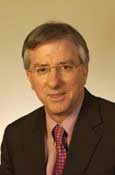
Dennis Ross is a Jewish American diplomat and author.
Ross was born on November 26, 1948 in San Francisco
and grew up in Marin County, California where his Jewish mother and Catholic step-father raised him in a non-religious atmosphere. He became religiously
Jewish following the Six Day
War and in 2002 he co-founded the Kol Shalom synagogue in Rockville, Maryland.
Ross graduated from UCLA in 1970 and wrote his doctoral
dissertation on Soviet decision-making.
He has received UCLA's highest medal and has been named UCLA alumni
of the year. He has also received honorary doctorates from the Jewish
Theological Seminary and Syracuse University.
During President
Jimmy Carter's administration, Ross worked under Deputy Assistant
Secretary of Defense Paul
Wolfowitz in the Pentagon. There, he co-authored a study recommending
greater US intervention in “the Persian Gulf Region because of
our need for Persian Gulf oil and because events in the Persian Gulf affect the Arab-Israeli
conflict.” During the Reagan
administration, Ross served as director of Near East and South Asian
affairs in the National Security Council and Deputy Director of the
Pentagon's Office of Net Assessment from 1982 to 1984. From 1984 to
1986, Ross served as the executive director of the Berkeley-Stanford
program on Soviet International Behavior. In the mid-1980s, Ross co-founded
with Martin Indyk the American
Israel Public Affairs Committee-sponsored Washington Institute for
Near East Policy.
In the President
George H.W. Bush administration, Ross was director of the United
States State Department's Policy Planning Staff, working on U.S. policy
toward the former Soviet Union, the unification of Germany and its integration into NATO,
arms control, and the 1991
Gulf War. He also worked with Secretary of State James Baker on
convincing Arab and Israeli leaders to attend the 1991 a Middle East
peace conference in Madrid,
Spain.
In the summer of 1993, President Bill Clinton named
Ross Middle East envoy, making him the first "non-Arabist" envoy. He
helped the Israelis and Palestinians reach the 1995
Interim Agreement on the West Bank and the Gaza Strip and brokered
the Protocol Concerning the Redeployment
in Hebron in 1997. He also facilitated the 1994 Israel-Jordan
peace treaty and worked to bring Israel
and Syria together. He was awarded the Presidential Medal for Distinguished
Federal Civilian Service by President Clinton, and Secretaries Baker
and Albright presented him with the State Department's highest award.
After leaving his position as envoy, Ross returned
to the Washington Institute for Near East Policy as counselor and Ziegler
distinguished fellow. He became chair of the Jerusalem-based
think tank, the Jewish People Policy Planning Institute, funded and
founded by the Jewish Agency in
2002. He also taught classes at Brandeis University, Georgetown University,
and the Kennedy School of Government at Harvard University and worked
as a foreign affairs analyst for the Fox News channel.
According to the Wall Street Journal, Ross, James Steinberg,
and Daniel Kurtzer were
among the principal authors of then-presidential candidate Barack
Obama's address on the Middle East to AIPAC in June 2008. Due to
Ross's extensive influence in the 2008 election cycle, he was widely
expected to help re-elect President
Obama in November 2012, but as of August 2012 has decided to sit
out the election cycle to focus on his duties as Counselor
at the Washington Institute, according to an email he sent.
Ross served in the Obama Administration as Special Adviser for the
Gulf and Southwest Asia to Secretary of State Hillary
Clinton, Special Assistant to President Obama and National Security Council senior director for the Central Region. He left government in 2011 and returned to the Washington Institute where he is counselor and William Davidson Distinguished Fellow.
Ross has published extensively on the former Soviet
Union, arms control, and the greater Middle East, contributing numerous
chapters to anthologies. In the 1970s and 1980s, his articles appeared
in World Politics, Political Science Quarterly, Orbis, International Security, Survival, and Journal of Strategic
Studies. Since leaving the government in 2001, he has published
in Foreign Policy and National Interest. Ross also frequently contributes to such publications as the Washington Post, Wall Street Journal,
Los Angeles Times, and New York Times. His 2004 book, The
Missing Peace: The Inside Story of the Fight for Middle East Peace (Farrar, Straus and Giroux), offers a comprehensive look at the Middle
East peace process. His 2007 book, Statecraft:
And How to Restore America's Standing in the World(Farrar,
Straus and Giroux), criticizes the administration
of President George W. Bush for its failure to use the tools of
statecraft to advance U.S. national interests. Ross's most recent book
(2009) is Myths,
Illusions, and Peace: Finding a New Direction for America in the Middle
East and was co-authored by David
Makovsky. He authors Washington Institute publications from time to time, such as "Obama II and the Middle East: Strategic Obectives for U.S. Policy," which he wrote with James F. Jeffrey in 2013.