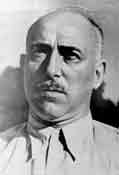
Wilhelm Leuschner was born June 15, 1888, in Bayreuth.
He joined the Social Democratic Party (SPD) while still a teenager and
assumed executive responsibilities in the labor union movement. As Hessian
minister of the interior from 1928 to 1933,
he neutralized the National
Socialists. Because of this, he was attacked after Hitler's rise to power and arrested on May 2, 1933, after the labor union movement
is crushed.
Leuschner was sent to the Lichtenberg concentration
camp for two years for refusing to support international recognition
of the Deutsche Arbeitsfront (German Labor Front). After his
release, Leuschner ran a small business and established contacts with
former political friends and the resistance circles around Beck and Goerdeler while traveling on business. He doubted the Nazi state could be overthrown, but reached out to the conspirators in the
military and maintained close contact with Canaris, Oster, Olbricht, Beck, Goerdeler,
and Stauffenberg.
The other conspirators called him "uncle".
Leuschner was experienced in the formation of cells
and underground tactics and built a network of allies throughout the
Reich labor world. He tried to win over the large labor unions and associations,
and reached understandings with various left and right-wing labor unions.
He was to assume the office of vice chancellor in the event the assassination
attempt on Hitler of July
20, 1944, should succeed.
When the coup failed, Leuschner surrendered to the Gestapo, which had already
arrested his wife. On September 9, 1944, he was sentenced to death and
murdered the same day at the execution site in Berlin-Plötzensee.