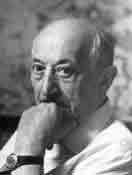
Simon Wiesenthal was born
on December 31, 1908, in Buczacz, in what
is now the Lvov Oblast section of the Ukraine.
When Wiesenthal's father was killed in World
War I, Mrs. Wiesenthal took her family and
fled to Vienna for a brief period, returning to Buczacz
when she remarried. The young Wiesenthal
graduated from the Gymnasium in 1928 and
applied for admission to the Polytechnic
Institute in Lvov.
Turned away because of quota restrictions
on Jewish students, he went instead to the
Technical University of Prague, from which
he received his degree in architectural
engineering in 1932.
In 1936, Simon married Cyla Mueller and worked in an
architectural office in Lvov. Their life together was happy until 1939
when Germany and Russia signed
their "non-aggression" pact and agreed to partition Poland between them; the Russian army soon occupied Lvov, and shortly afterward
began the Red purge of Jewish merchants, factory owners and other professionals.
In the purge of "bourgeois" elements that followed the Soviet
occupation of Lvov Oblast at the beginning of World War II, Wiesenthal's
stepfather was arrested by the NKVD (People's Commissariat of Internal
Affairs - Soviet Secret Police) and eventually died in prison, his stepbrother
was shot, and Wiesenthal himself, forced to close his business, became
a mechanic in a bedspring factory. Later he saved himself, his wife,
and his mother from deportation to Siberia by bribing an NKVD commissar.
When the Germans displaced the Russians in 1941, a former employee of
his, then serving the collaborationist Ukrainian Auxiliary police, helped
him to escape execution by the Nazis. But he did not escape incarceration.
Following initial detention in the Janwska concentration camp just outside
Lvov, he and his wife were assigned to the forced labor camp serving
the Ostbahn Works, the repair shop for Lvov's Eastern Railroad.
Early in 1942, the Nazi hierarchy formally decided on the "Final
Solution" to the "Jewish problem" — annihilation.
Throughout occupied Europe a terrifying genocide machine was put into
operation. In August 1942, Wiesenthal's mother was sent to the Belzec death camp. By September, most of his and his wife's relatives were
dead; a total of eighty-nine members of both families perished.
Because his wife's blonde hair gave her a chance of
passing as an "Aryan," Wiesenthal made a deal with the Polish
underground. In return for detailed charts of railroad junction
points made by him for use by saboteurs, his wife was provided with
false papers identifying her as "Irene Kowalska," a Pole ,
and spirited out of the camp in the autumn of 1942. She lived in Warsaw for two years and then worked in the Rhineland as a forced laborer,
without her true identity ever being discovered.
With the help of the deputy director, Wiesenthal himself
escaped the Ostbahn camp in October 1943, just before the Germans began
liquidating all the inmates. In June 1944, he was recaptured and sent
back to Janwska where he would almost certainly have been killed had
the German eastern front not collapsed under the advancing Red Army.
Knowing they would be sent into combat if they had no prisoners to justify
their rear-echelon assignment, the SS guards at Janwska decided to keep the few remaining inmates alive. With
34 prisoners out of an original 149,000, the 200 guards joined the general
retreat westward, picking up the entire population of the village of
Chelmiec along the way to adjust the prisoner-guard ratio.
Very few of the prisoners survived the westward trek
through Plaszow, Gross-Rosen
and Buchenwald, which
ended at Mauthausen in
upper Austria. Weighing
less than 100 pounds and lying helplessly in a barracks where the stench
was so strong that even hardboiled SS guards would not enter, Wiesenthal
was barely alive when Mauthausen was liberated by an American armored unit on May 5, 1945.
As soon as his health was sufficiently restored, Wiesenthal
began gathering and preparing evidence on Nazi atrocities for the War
Crimes Section of the United States Army. After the war, he also worked
for the Army's Office of Strategic Services and Counter-Intelligence
Corps and headed the Jewish Central Committee of the United States Zone
of Austria, a relief and welfare organization. Late in 1945, he and
his wife, each of whom had believed the other to be dead, were reunited,
and in 1946, their daughter Pauline was born.
The evidence supplied by Wiesenthal was utilized in
the American zone war crime
trials. When his association with the United States Army ended in
1947, Wiesenthal and thirty volunteers opened the Jewish Historical
Documentation Center in Linz, Austria, for the purpose of assembling
evidence for future trials. But, as the Cold War between the United
States and the Soviet Union intensified, both sides lost interest in
prosecuting Germans, and Wiesenthal's volunteers, succumbing to frustration,
drifted away to more ordinary pursuits. In 1954, the office in Linz
was closed and its files were given to the Yad
Vashem Archives in Israel, except
for one - the dossier on Adolf
Eichmann, the inconspicuous technocrat who, as chief of the Gestapo's Jewish Department, had supervised the implementation of the "Final
Solution."
While continuing his salaried relief and welfare work,
including the running of an occupational training school for Hungarian
and other Iron Curtain refugees, Wiesenthal never relaxed in his pursuit
of the elusive Eichmann who had disappeared at the time of Germany's
defeat in World War II. In 1953, Wiesenthal received information that
Eichmann was in Argentina from people who had spoken to him there. He passed this information
on to Israel through the Israeli embassy in Vienna and in 1954 also
informed Nahum Goldmann,
but the FBI had received information that Eichmann was in Damascus, Syria. It was not until 1959
that Israel was informed by Germany that Eichmann was in Buenos Aires
living under the alias of Ricardo Klement. He was captured there by
Israeli agents and brought to Israel for trial.
Eichmann was found guilty of mass murder and executed on May 31, 1961.
Encouraged by the capture of Eichmann, Wiesenthal reopened
the Jewish Documentation Center, this time in Vienna, and concentrated
exclusively on the hunting of war criminals. One of his high priority
cases was Karl Silberbauer, the Gestapo officer who arrested Anne
Frank, the fourteen year-old German-Jewish girl who was murdered
by the Nazis after hiding in an Amsterdam attic for two years. Dutch
neo-Nazi propagandists were fairly successful in their attempts to discredit
the authenticity of Anne Frank's famous diary until Wiesenthal located
Silberbauer, then a police inspector in Austria, in 1963. "Yes,"
Silberbauer confessed, when confronted, "I arrested Anne Frank."
In October 1966, sixteen SS officers, nine of them found by Wiesenthal, went on trial in Stuttgart,
West Germany, for participation in the extermination of Jews in Lvov.
High on Wiesenthal's most-wanted list was Franz Stangl, the commandant
of the Treblinka and Sobibor concentration
camps in Poland.
After three years of patient undercover work by Wiesenthal, Stangl was
located in Brazil and remanded
to West Germany for imprisonment in 1967. He was sentenced to life imprisonment
and died in prison.
Wiesenthal's book of memoirs, The Murderers Among
Us, was published in 1967. During a visit to the United States to
promote the book, Wiesenthal announced that he had found Mrs. Hermine
Ryan, nee Braunsteiner, a housewife living in Queens, New York. According
to the dossier, Mrs. Ryan had supervised the killings of several hundred
children at Majdanek. She was extradited to Germany for trial as a war
criminal in 1973 and received life imprisonment.
The Jewish Documentation Center in Vienna is a nondescript,
sparsely furnished three-room office with a staff of four, including
Wiesenthal. Contrary to belief, Wiesenthal does not usually track down
the Nazi fugitives himself. His chief task is gathering and analyzing
information. In that work he is aided by a vast, informal, international
network of friends, colleagues, and sympathizers, including German World
War II veterans, appalled by the horrors they witnessed. He has even
received tips from former Nazis with grudges against other former Nazis.
A special branch of his Vienna office documents the activities of right-wing
groups, neo-Nazis and similar organizations.
Painstakingly, Wiesenthal culls every pertinent document
and record he can get and listens to the many personal accounts told
him by individual survivors. With an architect's structural acumen,
a Talmudist's thoroughness, and a brilliant talent for investigative
thinking, he pieces together the most obscure, incomplete, and apparently
irrelevant and unconnected data to build cases solid enough to stand
up in a court of law. The dossiers are then presented to the appropriate
authorities. When, as often happens, they fail to take action, whether
from indifference, pro-Nazi sentiment, or some other consideration,
Wiesenthal goes to the press and other media, for experience has taught
him that publicity and an outraged public opinion are powerful weapons.
The work yet to be done is enormous. Germany's war
criminal files contain more than 90,000 names, most of them of people
who have never been tried. Thousands of former Nazis, not named in any
files, are also known to be at large, often in positions of prominence,
throughout Germany. Aside from the cases themselves, there is the tremendous
task of persuading authorities and the public that the Nazi Holocaust
was massive and pervasive. In the final paragraph of his memoirs, he
quotes what an SS corporal told him in 1944: "You would tell the
truth [about the death camps] to the people in America. That's right.
And you know what would happen, Wiesenthal? They wouldn't believe you.
They'd say you were mad. Might even put you into an asylum. How can
anyone believe this terrible business - unless he has lived through
it?"
Among Mr. Wiesenthal's many honors include decorations
from the Austrian and French resistance movements, the Dutch Freedom
Medal, the Luxembourg Freedom Medal, the United Nations League for the
Help of Refugees Award, the U.S. Congressional Gold Medal presented
to him by President Jimmy Carter in 1980, and the French Legion of Honor
which he received in 1986. Wiesenthal was a consultant for the motion
picture thriller, The
Odessa File (Paramount, 1974). The
Boys From Brazil (Twentieth Century Fox, 1978), a major motion
picture based on Ira Levin's book of the same name, starring Sir Laurence
Olivier as Herr Lieberman, a character styled after Wiesenthal.
In 1981, the Wiesenthal Center produced the Academy
Award-winning documentary, Genocide, narrated by Elizabeth Taylor
and the late Orson Welles, and introduced by Simon Wiesenthal.
Simon and Cyla Wiesenthal live in a modest apartment
in Vienna and have little social life. Wiesenthal spends his evenings
answering letters, studying books and files, and working on his stamp
collection.
As is to be expected, Simon Wiesenthal has received
numerous anonymous threats and insulting letters. In June 1982, a bomb
exploded at the front door of his house causing a great deal of damage.
Fortunately, no one was hurt. Since then, his house and office have
been guarded by an armed policeman. One German and several Austrian
neo-Nazis were arrested for the bombing. The German, who was found to
be the main perpetrator, was sentenced to five years in prison.
Wiesenthal is often asked to explain his motives for
becoming a Nazi hunter. According to Clyde Farnsworth in the New
York Times Magazine (February 2, 1964), Wiesenthal once spent the Sabbath at the home of
a former Mauthausen inmate,
now a well-to-do jewelry manufacturer. After dinner his host said, "Simon,
if you had gone back to building houses, you'd be a millionaire. Why
didn't you?" "You're a religious man," replied Wiesenthal.
"You believe in God and life after death. I also believe. When
we come to the other world and meet the millions of Jews who died in
the camps and they ask us, 'What have you done?', there will be many
answers. You will say, 'I became a jeweler', Another will say, I have
smuggled coffee and American cigarettes', Another will say, 'I built
houses', But I will say, 'I didn't forget you.'"
Wiesenthal died on September
20, 2005, at his home in Vienna.
He was 96. Wiesenthal's biographers credited
him with ferreting out 1,100 of Adolf
Hitler's major
and minor killers and other Nazi war criminals
since World
War II. “When
history looks back,” Wiesenthal said,
“I want people to know the Nazis weren't
able to kill millions of people and get
away with it.”