
At a January 30 meeting with Middle East think tank experts and leaders from five Jewish organizations, Saudi Defense Minister Prince Khalid bin Salman privately urged President Trump to carry out his threats against Iran, warning that failure to act would only embolden the regime. The remarks marked a sharp departure from Saudi Arabia’s public calls for restraint and from Crown Prince Mohammed bin Salman’s earlier request to delay any strike.
Escalation With Iran
Inaugurating the Board of Peace
Allies Balk
Kushner’s Vision
Big Obstacles
Trump Still Opposes Annexation
Trump Removes Guardrails for Saudi Nuclear Program
War With Iran
Trump Again Attacks Herzog
Mixed Messages on War
Trump Calls Off Attack and Announces Talks
Trump Forces Israel to Stop Lebanon Campaign – Again
U.S.-Iran Negotiations in Pakistan
Trump Extends Ceasefire
Lebanon Peace Talks
Stalemate With Iran
Anti-Semitism
Trump Attempts to Expand Abraham Accords
Congress Tries to Limit Trump on Iran
Iran Escalates
Trump Ups the Ante
U.S. and Iran Sign MOU
All About Oil
The Trilateral Framework for Lebanon
Escalation With Iran
The Wall Street Journal reported that President Trump is seeking what he describes as “decisive” options regarding the Islamic Republic. According to the report, Pentagon and White House officials were reviewing a range of scenarios, including the overthrow of the Islamic Republic and more limited options such as strikes on Islamic Revolutionary Guard Corps (IRGC) facilities. U.S. officials said Trump had not yet ordered an attack on Iran and that a final decision had not been made.
Former U.S. officials and experts cited in the report raised questions about whether a foreign regime can be overthrown solely through airstrikes and whether the United States is prepared for a long-term military campaign. The report notes that such a campaign, particularly if protests resume inside Iran and demonstrators call for Trump’s support, could extend for weeks or months.
“A decapitation strategy may create the pretense of a window of opportunity, but there’s no opposing force on the ground or over the horizon to overtake the regime let alone stabilize the country,” Ramzy Mardini, a geopolitical risk analyst in the Middle East, told the Journal. “Who polices the streets? Who secures the weapons and military installations and nuclear sites? Who patrols the border with Iraq and Afghanistan? The protesters?”
Iran’s foreign minister, Seyed Abbas Araghchi, wrote in the Wall Street Journal, “Unlike the restraint Iran showed in June 2025, our powerful armed forces have no qualms about firing back with everything we have if we come under renewed attack.” He claimed that Iran and the U.S. had been close to reaching agreements three times, but they didn’t work out “because of Israel’s proxies in the White House.”
Trump and Iranian officials continued to trade threats. After a few weeks of moving military assets to the region, the president posted on January 28:
A massive Armada is heading to Iran. It is moving quickly, with great power, enthusiasm, and purpose. It is a larger fleet, headed by the great Aircraft Carrier Abraham Lincoln, than that sent to Venezuela. Like with Venezuela, it is, ready, willing, and able to rapidly fulfill its mission, with speed and violence, if necessary. Hopefully Iran will quickly “Come to the Table” and negotiate a fair and equitable deal - NO NUCLEAR WEAPONS - one that is good for all parties. Time is running out, it is truly of the essence! As I told Iran once before, MAKE A DEAL! They didn’t, and there was “Operation Midnight Hammer,” a major destruction of Iran. The next attack will be far worse! Don’t make that happen again.
Iran responded: “Last time the U.S. blundered into wars in Afghanistan and Iraq, it squandered over $7 trillion and lost more than 7,000 American lives. Iran stands ready for dialogue based on mutual respect and interests—BUT IF PUSHED, IT WILL DEFEND ITSELF AND RESPOND LIKE NEVER BEFORE!”
On January 31, Trump said, “(Iran is) talking to us, and we’ll see if we can do something, otherwise we’ll see what happens…We have a big fleet heading out there.”
The following day, Iran’s Supreme Leader Ayatollah Ali Khamenei said, “The Americans should know that if they start a war, this time it will be a regional war.” He added, “We are not the initiators and do not want to attack any country, but the Iranian nation will strike a strong blow against anyone who attacks and harasses them.”
Iran and the U.S. held talks on February 6 in Oman. Iran rejected U.S. demands to stop uranium enrichment, insisting enrichment on Iranian soil is nonnegotiable. Tehran signaled openness only to discussing limits on enrichment levels and purity, or to a regional consortium. A diplomat said U.S. negotiators appeared somewhat flexible but expect Iran to offer a major concession at the next meeting. Missile issues were not raised. The talks were mostly indirect, mediated by Oman, though an in-person meeting reportedly took place between Kushner, Witkoff, and Iran’s foreign minister. Iran was angered by the presence of CENTCOM commander Gen. Brad Cooper, comparing it to negotiating “with a gun on the table.”
Later, Trump said, “We… had very good talks on Iran...Iran wants to make a deal, and they should make a deal. They know the consequences if they don't... One thing which is right upfront is that there are no nuclear weapons. We would have made that deal years ago if we could have, but they were not willing to do that, and now they are...”
It was unclear what Trump’s optimism was based on. The Iranians appeared more interested in pursuing their historic strategy of stringing out negotiations with no intention of making a deal, hoping to delay, if not prevent, a U.S. attack.
More concerning for Israel was Trump’s response when asked about Iran’s demand that the talks only be about nuclear weapons. Trump said, “That would be acceptable.” That message contradicted Secretary of State Marco Rubio’s earlier remarks that “in order for talks to actually lead to something meaningful, they will have to include certain things, and that includes the range of their ballistic missiles, that includes the sponsorship of terrorist organizations across the region, that includes the nuclear program, and that includes the treatment of their own people.”
Netanyahu announced the urgent meeting with Trump, less than two months after they last met at Mar-a-Lago, with a statement that said: “The Prime Minister believes any negotiations must include limitations on ballistic missiles and a halting of the support for the Iranian axis.”
Meanwhile, as a warning to Israel, a giant billboard displaying a map of potential targets in Israel’s Tel Aviv area, along with a warning message reading “You start, we finish!” was erected in Palestine Square in Tehran. It was part of an almost daily series of threats exchanged between Israel and Iran. During rallies in Tehran marking the anniversary of the 1979 Islamic Revolution, demonstrators symbolically threw Trump’s messages into the trash, displayed coffins representing senior American generals, and signaled an unwillingness to compromise on the issues Trump and his team insist must be addressed.
With Netanyahu on the way to Washington, Trump said on February 10 that it was a “no-brainer” for any deal to cover Iran’s nuclear program, and agreed with the prime minister that it should also address Iran’s ballistic missile stockpiles.
“We can make a great deal with Iran,” Trump insisted.
Trump also told Axios he doesn’t think Netanyahu is nervous about the U.S.-Iran negotiations. “He also wants a deal. He wants a good deal.”
In his seventh meeting with Trump since his second inauguration, Netanyahu told Trump, “We’ve come this far, Donald. We have to finish what we started.” Iran was playing for time, Netanyahu said, and would race toward a bomb in secret. “After they got hit the last time, they thought they had nothing to lose,” an Israeli official told Time, arguing that Tehran would see the development of nuclear weapons as the only way to prevent such an onslaught from happening again.
Reports suggested he failed to convince Trump of the urgency to take military action against Iran. Trump instead “insisted that negotiations with Iran continue” to secure a deal. Trump posted on social media that “nothing definitive” came out of the meeting with and that he preferred a deal with Iran. Still, he warned that without one, “we will just have to see what the outcome will be.” To back up the threat, he said he was considering sending a second aircraft carrier group to the region.
CBS reported that during the December meeting at Mar-a-Lago, Trump told Netanyahu he would back Israeli strikes on Iran’s ballistic missile program if U.S.-Iran negotiations fell through. Two months later, senior U.S. military and intelligence officials began internal discussions about how to support such strikes — focusing not on whether Israel could carry them out, but on practical assistance, such as aerial refueling and securing overflight rights from countries along the flight path.
After months of rejecting regime change, President Trump said on February 13 that it “seems like that would be the best thing that could happen.” During the protests, he had called on demonstrators to “take over” government institutions but was vague about who should lead Iran, saying only, “there are people.”
In addition to his comments about regime change, Trump also confirmed he sent a second aircraft carrier to the Middle East “in case we don’t make a deal.”
Trump’s statements diverged from those of Vice President JD Vance, who said, “If the Iranian people want to overthrow the regime, that’s up to them. What we’re focused on is ensuring Iran can’t have a nuclear weapon.”
Iran and the United States held a second round of nuclear talks in Geneva on February 17, with Iranian Foreign Minister Abbas Araghchi saying the sides reached an initial understanding on the main “guiding principles,” though major work remains. He described the negotiations as “constructive” and said that while progress has begun, “the path has started,” but “no date has been set” yet for a third round.
Araghchi told Iranian state TV that “we were able to reach broad agreement on a set of guiding principles,” and confirmed that “both sides would work further on draft texts for a potential agreement,” which would later be exchanged before the next round was scheduled.
Unmoved by the growing buildup of U.S. forces, Iran declared that no country could “deprive” it of its “right” to nuclear enrichment.
Trump was furious when the New York Times published details of the military operation’s planning on February 17, according to Time. Two days later, “The President then told reporters he would decide on strikes within ‘10, 15 days,’ although he knew the U.S. was planning to attack much sooner. ‘He was intentionally engaged in public misdirection to protect the mission,’” a White House official told Time.
To intensify the pressure on Iran to make a deal, Trump ordered the greatest buildup of military assets into the region since the Gulf War. He also took the unprecedented step of deploying F-22 Raptor fighter jets and refueling aircraft to Israel. This represented a dramatic break with the long-dominant foreign-policy doctrine promoted by Washington’s Arabists, who had convinced presidents for eight decades that such close strategic cooperation with Israel would undermine America’s standing in the Arab world. Trump, however, recognized when planning operations against Iran, only Israel was prepared to stand with the United States. Gulf states hosting American bases — nations that had received decades of arms sales and security guarantees — refused their use against Tehran. Contrary to Arabist belief, the deployment did not cause any adverse reactions in Arab countries.
Negotiations continued with Omani mediation. Iran offered phased concessions — lowering enrichment levels, restoring international inspections, and transferring highly enriched uranium abroad — in exchange for sanctions relief and recognition of its right to peaceful nuclear energy. But the core disputes ran far deeper than enrichment. Washington demanded that Iran not only end or sharply curtail its uranium enrichment but also rein in its ballistic missile program and cut support for the network of regional proxy groups — Hezbollah, Hamas, the Houthis, and allied militias — that Tehran had spent decades building into instruments of power across the Middle East. Iran refused to link these issues, insisting that its missile capabilities and regional relationships were sovereign matters entirely separate from the nuclear file. Tehran wanted sanctions lifted first and its enrichment rights guaranteed; Washington wanted verifiable dismantlement before any relief.
Mediators suggested a breakthrough might be within reach, with proposals involving strict verification and limits on enriched uranium stockpiles. Iran signaled continued openness to talks but cautioned that any attack would provoke regional retaliation.
On February 27, Trump said he was “not happy with the negotiation” because the Iranians “don’t want to quite go far enough. It’s too bad.” Trump added, “I say no enrichment. Not 20 percent, 30 percent, they always want 20 percent, 30 percent, they want it for civilian, you know, for civil. I think it’s uncivil.”
The same day, Oman’s foreign minister told Vice President JD Vance, “Peace is within our reach.”
Witkoff later told Fox News that negotiations with Iran collapsed after Iranian officials openly declared their intent to enrich uranium at weapons-grade levels. “The Iranians made it clear from the start that they believe they have an undeniable right to enrich all the uranium they possess,” Witkoff said.
Iran rejected a U.S. proposal for a ten-year enrichment freeze, even with Washington offering to supply nuclear fuel at its own expense. “That was the moment we understood they had no intention of doing anything other than enriching uranium for nuclear weapons,” Witkoff said. He revealed that two Iranian negotiators openly acknowledged possessing roughly 460 kilograms of uranium enriched to 60% — enough, they admitted, for as many as 11 nuclear bombs. “They weren’t hiding it. They were proud,” Witkoff said.
“President Trump sent us to see if Iran was serious,” Witkoff stated. “But by the second meeting, it was clear a deal was impossible. We came to the third meeting in good faith, and they wanted us to project optimism. There was nothing optimistic about it.”
The diplomatic track collapsed before another round of talks could convene. The United States concluded Tehran was stalling. Intelligence reportedly indicated imminent Iranian military threats. And the talks had never come close to resolving the missile and proxy dimensions that Washington considered inseparable from any deal.
On February 28, 2026, Trump announced that the United States had launched “major combat operations in Iran.” He accused Tehran of continuing to advance its nuclear program and developing missiles capable of reaching the American homeland and issued a direct appeal to the Iranian people to “take over your government.”
“Operation Epic Fury” was launched as a synchronized effort with Israel’s “Operation Roaring Lion.” Under this joint framework, U.S. and IDF forces coordinated precision strikes against Iranian leadership, strategic military assets, and key components of their nuclear infrastructure.
Inaugurating the Board of Peace
On January 22, 2026, President Donald Trump stood before a packed room at the World Economic Forum in Davos, Switzerland, to inaugurate his Board of Peace and issue a stark warning to Hamas. The moment marked a pivotal juncture in his administration’s ambitious effort to reshape the Middle East, though the grand vision presented would immediately face skepticism from key American allies.
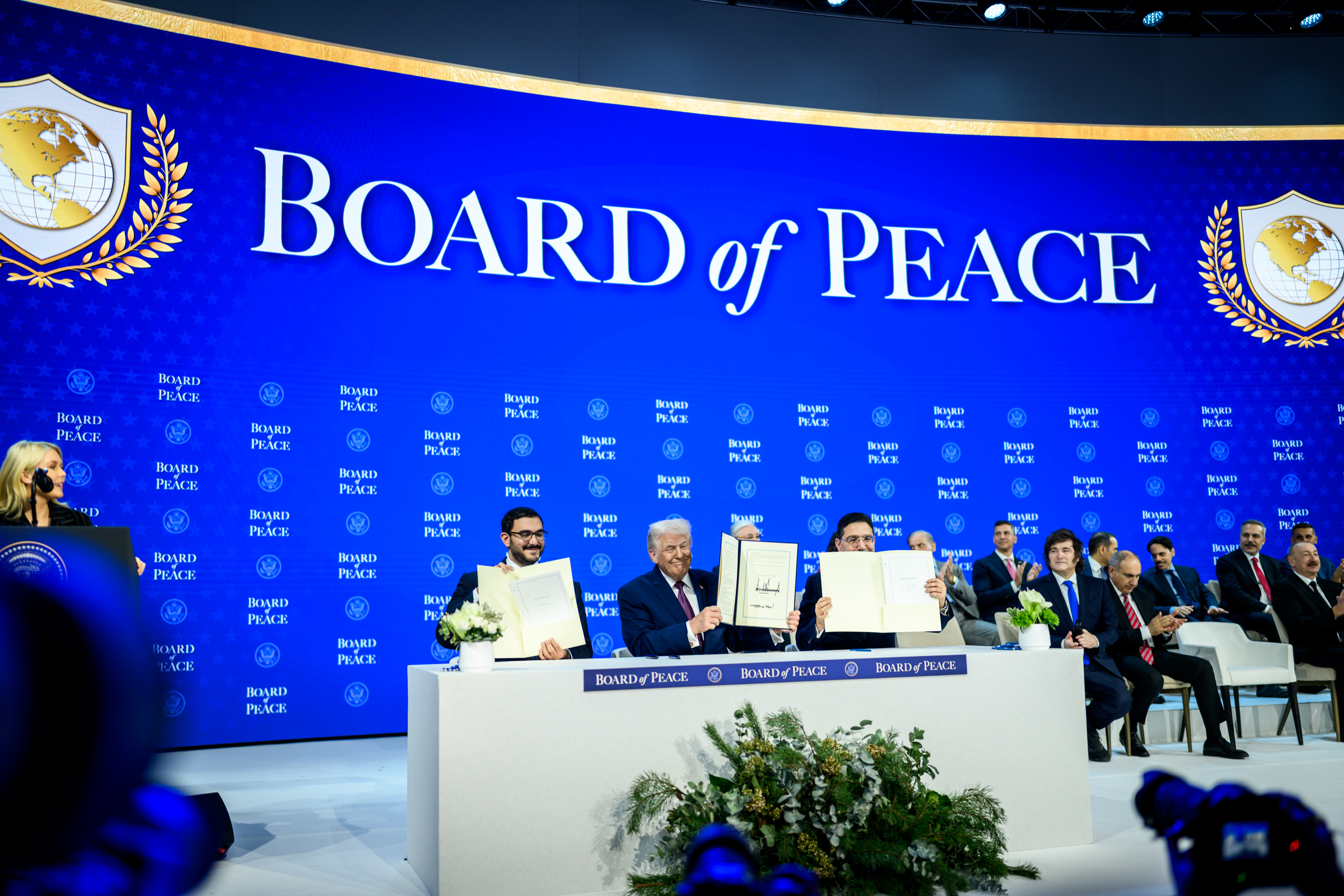
Trump’s message to Hamas was unequivocal and threatening. “Hamas has agreed to give up their weapons,” the president declared to the assembled world leaders and business executives. “If they don’t do it, they’ll be blown away very quickly.” The threat was not open-ended; Trump established a concrete timeline for determining Hamas’s compliance. “They’ve got to do it, and we’re going to know over the next two or three days, certainly over the next two or three weeks, whether or not they’re going to do it,” he said.
The president acknowledged the difficulty of what he was demanding, noting that disarmament is “not an easy thing” for Hamas. He offered a cultural observation about the militant group, saying that its members are “born with a weapon in their hands.” Later in his remarks, he rephrased this as “they were born with rifles in their hands.” Despite recognizing the challenge, Trump remained adamant: “They have to give up their weapons, and if they don’t do that, it’s gonna be the end of them.”
Trump boasted of international support for potential military action against Hamas, claiming, “We have 59 countries that are part of that whole peace deal, and some of those countries aren’t even near the Middle East, and they want to come in and take out Hamas. They want to come in and they want to do whatever they can.” He repeated this theme later, asserting that “many countries have told me we want to go in and do it.”
The administration was one week into Phase 2 of Trump’s 20-point Gaza peace plan, which, according to White House Special Envoy Steve Witkoff, moves from “ceasefire to demilitarization, technocratic governance, and reconstruction.”
The centerpiece of the Davos event was the formal signing ceremony for Trump’s Board of Peace, an organization he first proposed as part of the Gaza ceasefire agreement, which had since evolved into something far more ambitious. Trump framed the initiative in grandiose terms: “We’re going to have peace in the world, and boy, wouldn’t that be a great legacy for all of us.”
The president made clear this was not merely an American initiative. “This isn’t the United States, this is for the world,” he said, adding, “I think we can spread it out to other things as we succeed in Gaza.” Trump expressed confidence about the board’s eventual power, declaring, “Once this board is completely formed, we can do pretty much whatever we want to do.”
Trump claimed impressive participation numbers, stating that “59 countries” had signed onto the board and telling attendees, “You’re the most powerful people in the world.” However, the actual attendance at the signing ceremony told a different story. Only 19 countries, plus the United States, sent representatives to the event. The attendees included Bahrain, Morocco, Argentina, Armenia, Azerbaijan, Bulgaria, Hungary, Indonesia, Jordan, Kazakhstan, Kosovo, Pakistan, Paraguay, Qatar, Saudi Arabia, Turkey, United Arab Emirates, Uzbekistan, and Mongolia. According to Reuters, 35 of the 50 invited countries had agreed to join.
The Trump administration’s team in Davos—Chief of Staff Susie Wiles, Secretary of State Marco Rubio, Special Envoy Steve Witkoff, informal advisor Jared Kushner, and diplomatic advisor Josh Gruenbaum—had spent the hours leading up to the event working to bring more countries on board.
The Board of Peace’s charter established Trump in an unprecedented position of authority. He would serve as the inaugural chairman, a position with no end date and sweeping executive powers. According to the charter, the chairman could only be replaced “following voluntary resignation or as a result of incapacity, as determined by a unanimous vote of the Executive Board.”
This chairman’s role carried extensive authority, including the power to invite and remove members, veto decisions, set the agenda, and choose a successor. The charter granted the chairman “exclusive authority to create, modify, or dissolve subsidiary entities as necessary or appropriate to fulfill the Board of Peace’s mission.”
Trump would serve not only as chairman but also as the United States’ representative. While the charter specified that each country would be represented by its head of state or government, Trump held both roles simultaneously.
Board membership came in two tiers: a free three-year term or permanent membership for $1 billion. The Executive Board included Secretary of State Marco Rubio, Special Envoy Steve Witkoff, Jared Kushner, and former UK Prime Minister Tony Blair, with Josh Gruenbaum and Aryeh Lightstone serving as diplomatic advisors.
Though Trump had initially conceived the Board of Peace as a supervisory body for the Gaza ceasefire, its charter described something far more expansive. The document outlined “a body concerned with peace worldwide and does not mention Gaza or Israel.” Its mission was to “promote stability, restore dependable and lawful governance, and secure enduring peace in areas affected or threatened by conflict.”
The charter’s preamble made clear that the board was born of dissatisfaction with existing international institutions, “declaring that durable peace requires pragmatic judgment, common-sense solutions, and the courage to depart from approaches and institutions that have too often failed.” It emphasized “the need for a more nimble and effective international peace-building body.”
Trump’s rhetoric about the United Nations vacillated between criticism and cooperation. “The UN has got tremendous potential, and it has not used it,” he told the gathering, having commented earlier in the week that the Board of Peace “might” replace the UN. Yet at the Davos ceremony, he struck a more diplomatic tone: “We’ll do it in conjunction with the United Nations,” he said, even as he denigrated the UN for not doing enough to resolve global conflicts.
Trump fed concerns about mission creep and potential UN replacement. Earlier in the week, he had said the Board of Peace “might” replace the UN. At the signing ceremony, he declared that the board “has a chance to be one of the most consequential bodies ever created, and it’s my honor to serve as its chairman. I take it very seriously.”
Trump’s comments about Iran at the ceremony added another layer of complexity to the board’s potential scope. He said that the U.S. bombing in June was because “they were two months from having a nuclear weapon, and we can’t let them have that. Iran does want to talk, and we’ll talk.”
According to Bloomberg, U.S. diplomats had been instructed to say that the Board of Peace was meant to complement the UN, not replace it—though Trump’s own words suggested otherwise.
Allies Balk
Trump insisted, “Just about every country” wanted to be part of the Board of Peace, though attendance figures and European rejections suggested otherwise. The ambitious scope and structure of the Board of Peace created immediate friction with some of America’s closest allies. Major European democracies expressed serious reservations about joining an organization that appeared designed to rival or replace the United Nations and that granted permanent leadership to a single foreign leader.
Britain’s Foreign Secretary Yvette Cooper explained her country’s decision not to participate: “This is about a legal treaty that raises much broader issues.” She added a pointed concern about one of the board’s potential members: “And we do also have concerns about President Putin being part of something which is talking about peace, when we have still not seen any signs from Putin that there will be a commitment to peace in Ukraine.”
France declined after its officials expressed concern that the board’s charter “goes beyond the framework of Gaza alone” and “raises major questions, particularly regarding respect for the principles and structure of the United Nations, which must under no circumstances be called into question.”
Norway and Sweden indicated they would not participate. Canada, Ukraine, China, and the European Union’s executive arm had not committed. Italy faced a unique constitutional problem: joining might violate its constitution because it would mean joining a body led by a single foreign leader in which Italy would not have equal standing with other countries.
The invitation to Russian President Vladimir Putin proved particularly controversial. Putin said Russia was “still consulting with Moscow’s ‘strategic partners’“ before deciding whether to commit. The Kremlin revealed that Putin, while hosting Palestinian President Mahmoud Abbas in Moscow on Thursday, planned to discuss a proposal to send $1 billion to the Board of Peace for humanitarian purposes—if Russia could use assets the U.S. had previously blocked.
Even Israel, the primary beneficiary of the Gaza peace plan, sent mixed signals. Netanyahu agreed to join the Board of Peace, but his office had “earlier criticized the makeup of the board’s committee tasked with overseeing Gaza.” Despite Israeli PresidentIsaac Herzog and Economy Minister Nir Barkat being present in Davos, Israel sent no representative to the Thursday signing ceremony. The premier’s office explained that the Board of Peace was under Netanyahu’s remit, not Herzog’s.
An Arab diplomat, speaking on condition of anonymity in a European capital, revealed that Middle Eastern governments had coordinated their response to Trump’s invitation. The diplomat said the acceptance was crafted to limit it to the Gaza plan as mandated by the UN Security Council. The announced acceptance was “preliminary,” the diplomat explained, noting that the charter presented by the U.S. administration “contradicts in some parts the United Nations’ mission.” The diplomat predicted that other major powers were unlikely to support the board in its current form.
Secretary of State Rubio tried to put a positive spin on the absences, saying that some countries’ leaders had indicated they planned to join but still needed parliamentary approval. The Trump administration also claimed to have received inquiries about membership from countries that hadn’t yet been invited to participate.
He also attempted to reassure skeptics about the board’s mission. At the ceremony, he stated that the board’s focus was “first and foremost on making sure that this peace deal in Gaza becomes enduring.” He vouched for Trump’s commitment: “Trump will give it everything he has to make sure this is successful.”
The Board of Peace was a “board of action,” Rubio asserted, saying the new body would “serve as an example of what’s possible in other parts of the world without losing focus on what’s before us right now.”
Kushner’s Vision
The most visually striking element of the Davos presentation came from Kushner, who unveiled an ambitious master plan for Gaza’s reconstruction, featuring slides depicting gleaming skyscrapers rising along Gaza’s coast and the construction of entirely new cities. The plan included a seaport and an airport.
Kushner explained his approach with characteristic confidence: “We said, ‘Let’s plan for catastrophic success.’ There is no Plan B.” The reconstruction would require an investment of at least $25 billion in the devastated Palestinian enclave.
The implementation would follow a phased approach from south to north. “It will start with Rafah, then move northward in phases until Gaza City,” Kushner explained. The southern city of Rafah, which Israel had largely razed during its war against Hamas, would be rebuilt in two to three years.
Kushner outlined his economic philosophy for Gaza, saying the White House wanted to bring “free market economy principles to Gaza,” reflecting the “same mindset, same approach” that Trump was implementing in the U.S.
The next 100 days, Kushner stated, would focus on “aid and reconstruction.” He announced that a conference on investment for Gaza would be held in Washington in the coming weeks. He made a request to critics: “Calm down for 30 days” in criticism of countries like Israel, Turkey, and Qatar.
Kushner framed the ultimate objective in humanitarian terms: “Our goal here is peace between Israel and the Palestinian people. Everyone wants to live peacefully. Everyone wants to live with dignity.”
Kushner’s presentation also addressed the critical issue of Hamas’s disarmament. According to his slides, the next phase would “work with Hamas on demilitarization.” The plan called for Hamas’s “heavy weapons” to be decommissioned immediately, while small arms would be decommissioned by sector by the new Palestinian police force.
The presentation made clear that reconstruction and disarmament would be directly linked: “Reconstruction will only begin in sectors with full disarmament,” according to Kushner’s slide.
In a controversial element of the plan, Hamas members would be “rewarded with amnesty and reintegration, or safe passage.” Even more controversially, some terrorists would be “integrated” into the new Palestinian police force after “rigorous vetting,” according to the plan.
Once demilitarization was completed and verified, Kushner said, the IDF would withdraw to the security perimeter around Gaza.
Central to the governance transition was Ali Shaath, the head of the National Committee for the Administration of Gaza (NCAG). In a video message played at the ceremony, Shaath emphasized the conditionality of success: “This transition will succeed only if it delivers real tangible improvements in daily life for Gazans.”
The arrangement with Hamas, however, remained incomplete. While Hamas had agreed to hand over day-to-day governance to Shaath’s committee, it had not agreed to hand over control of the enclave’s security. Most critically, Hamas had not agreed to lay down its arms and disband its battalions of fighters.
Shaath made a major announcement that caught many by surprise: the Rafah border crossing would reopen next week in both directions. This was significant because Israel had vowed to keep the border closed until Hamas returned the body of Ran Gvili, the last Israeli captive whose remains were still in Gaza.
Israeli authorities initially did not confirm the reopening plan. An anonymous Israeli official, speaking on behalf of Prime Minister Netanyahu’s office, told reporters: “A special effort is underway to return the body of the late Ran Gvili, while making full use of the information in our possession. The security cabinet will discuss this issue and the matter of opening the Rafah crossing at the beginning of next week.”
Later, Board of Peace High Representative Nickolay Mladenov announced that “an agreement has been reached” on the matter, indicating that Jerusalem had been consulted and was privately on board with the reopening.
Analysts noted that the committee’s success would partly depend on whether Israel eased the restrictions it had imposed on Gaza. In recent months, Israel had kept the Rafah border crossing all but closed, even though it had agreed to open it as part of the truce agreement.
Big Obstacles
Despite the glossy presentations and confident pronouncements, significant gaps remained between the Trump administration’s ambitious plans and the situation on the ground. As one report noted bluntly, “At this point, however, those sweeping ideas exist mostly on paper.”
The fundamental challenges were substantial:
First, Hamas had not agreed to disarm—the cornerstone requirement for the entire plan to proceed. Israel saw disarmament as non-negotiable, but the militant group that had controlled the Palestinian territory since 2007 showed no signs of surrendering its weapons.
Second, the United States had struggled to convince countries to contribute soldiers to a proposed peacekeeping force for Gaza. The yet-to-be-established International Stabilization Force remained largely hypothetical. Azerbaijan, one of the two countries Washington had publicly touted as participants, announced earlier in January 2026 that it would not be participating.
Third, it remained unclear who would provide the billions of dollars required by the Trump administration’s reconstruction plans. The $25 billion investment Kushner described remained aspirational rather than committed.
Fourth, months into the ceasefire, Gaza’s more than 2 million Palestinians continued to suffer the humanitarian crisis unleashed by more than two years of war. Violence in Gaza continued despite the truce.
Despite the significant obstacles remaining, Trump expressed optimism about the trajectory of events in Gaza. “The war in Gaza is really coming to an end,” he declared, though he acknowledged, “We have little fires that we’ll put out. But they’re little,” adding that they had been “giant, giant, massive fires.”
Trump reiterated his administration’s commitment: The U.S. is “committed to Gaza being fully demilitarized, properly governed and properly rebuilt.” Looking to the future, he predicted, “We’re going to be very successful in Gaza; it’s going to be a great thing to watch.”
Israel recovered the body of Ran Gvili on January 26, 2026. He was the last hostage taken into Gaza on October 7. This cleared a key obstacle to advancing the peace plan. Israel subsequently agreed to proceed with a limited reopening of the Rafah crossing under Israeli security oversight, fulfilling central conditions of the plan’s first phase, allowing talks to move toward the next stage, which calls for Hamas’s disarmament and an Israeli troop withdrawal from most of Gaza—steps Hamas has resisted. Netanyahu reiterated that Gaza would be demilitarized, while Trump hailed the recovery as the conclusion of the hostage crisis and a major foreign-policy achievement.
Meanwhile, in January 2026, the State Department approved more than $6.5 billion in potential military sales to Israel. This included Joint Light Tactical Vehicle and related equipment at an estimated cost of $1.98 billion, AH-64E Apache helicopters at $3.8 billion, and a third contract for unspecified equipment at $740 million.
Trump Still Opposes Annexation
In a February 10 interview with Axios, President Trump explicitly stated his opposition to Israeli annexation in the West Bank, declaring, “I am against annexation.”
The statement followed the Israeli Security Cabinet’s approval of measures to expand control over the West Bank, including areas under Palestinian Authority jurisdiction. These measures—such as easing land purchases for settlers and facilitating the demolition of homes—were viewed as steps toward “de facto” annexation and as violations of the Oslo Accords.
Trump called the issue an unnecessary distraction, stating, “We have enough things to think about now. We don’t need to be dealing with the West Bank.” This stance underscores growing friction between the Trump administration and Netanyahu’s government, and directly contradicts requests by Trump’s envoys, Jared Kushner and Steve Witkoff, who met Netanyahu in December to urge de-escalation in the territory.
Trump also reiterated his belief that Netanyahu should be pardoned and said Israeli President Isaac Herzog “should be ashamed of himself” for not doing so.
Ahead of the first meeting of the Board of Peace, Trump urged Hamas to move forward with disarmament under his plan for postwar Gaza, and said members of the BoP had pledged $5 billion to the Palestinian territory’s reconstruction. “Very importantly, Hamas must uphold its commitment to Full and Immediate Demilitarization,” Trump posted on February 15.
Shortly afterward, U.S. Ambassador to Israel Mike Huckabee caused a furor when he suggested in an interview that “it would be fine” if Israel took over a large swath of the Middle East. His comment had sparked diplomatic protests from Arab countries and prompted Rubio to send a memo to all U.S. ambassadors cautioning them against making comments that could “inflame regional audiences.”
Trump Removes Guardrails for Saudi Nuclear Program
Given Saudi Arabia’s explicit warning that it would seek a nuclear weapon if Iran acquires one, reports that President Trump is preparing to sign a civil nuclear agreement without traditional nonproliferation safeguards are deeply troubling.
For decades, U.S. policy has required strict guardrails in such agreements, including prohibiting uranium enrichment and the reprocessing of spent fuel—two key pathways to a bomb. Arms control advocates, many Democrats, and prominent Republicans — including Marco Rubio during his time in the Senate — have argued that any deal must also require Saudi acceptance of the International Atomic Energy Agency’s Additional Protocol, which permits intrusive inspections and snap visits to undeclared sites.
The Trump administration, however, reportedly does not intend to require Riyadh to adopt the Additional Protocol. While the proposed “123 Agreement” would anchor U.S. companies in Saudi Arabia’s civilian nuclear program and nominally maintain oversight, it appears to leave open the possibility that the kingdom could develop its own uranium enrichment capability — a step that would significantly narrow the distance between civilian nuclear energy and weapons capacity.
War With Iran
On February 26, Trump convened the final Situation Room meeting. He went around the table, heard from each adviser, and then delivered his conclusion: “I think we need to do it.” He said the United States had to ensure that Iran could not acquire a nuclear weapon and could not continue firing missiles at Israel and across the wider region.
At 3:38 p.m. on February 27, Central Command received the final go-ahead from President Trump via the defense secretary. “Operation Epic Fury is approved. No aborts. Good luck!” the president’s message said.
Israel launched strikes on Iranian targets, including sites in and around Tehran, on February 28. Hours later, in an eight-minute video posted to Truth Social at roughly 2:30 a.m. (EST), Trump announced that the United States had begun “major combat operations in Iran.” Netanyahu made his own video announcement at 10:58 a.m. (EST)
The joint operation — dubbed “Operation Epic Fury” by the Pentagon and “Roaring Lion” by Israel — was far more expansive than the June 2025 strikes. Trump declared its aims: to eliminate Iran’s nuclear threat, destroy its ballistic missile arsenal, degrade its proxy terror networks, annihilate its navy, and — for the first time explicitly — change its leadership.
“We are going to destroy their missiles and raze their missile industry to the ground. It will be totally, again, obliterated,” Trump said, adding, “We’re going to annihilate their navy.” He appealed directly to the Iranian people: the country “will be yours to take. This will be probably your only chance for generations.”
Originally set for late March or early April to build public support, Operation Epic Fury’s timetable was ultimately accelerated after months of intensive coordination between Trump and Netanyahu. According to Axios, the two leaders met twice and spoke by phone 15 times.[84]
Trump wanted to strike in January, but Netanyahu requested a delay to ensure missile defenses were prepared. The U.S. and Israel considered a strike a week earlier but postponed it due to intelligence, operational issues, and bad weather.
On February 23, Netanyahu called Trump with critical intelligence: Khamenei would be at his central Tehran compound with top Iranian officials on February 28. Netanyahu said a strike could kill them all. By February 26, the CIA confirmed the gathering. A source told Axios, “These people would all be together, and we needed to take advantage.”
Officials said Trump made a “deliberate decision” not to focus excessively on Iran in his State of the Union speech so as not to spook the ayatollah and drive him underground before the strike could be executed. The original plan for a nighttime operation was scrapped in favor of a daylight decapitation strike after the intelligence confirmed Khamenei’s schedule.
Later that day, Trump confirmed the death of Khamenei, 86. Iranian state media acknowledged his passing and declared 40 days of mourning.
Referring to two alleged Iranian-backed Trump assassination attempts, Trump said: “I got him before he got me. They tried twice. Well, I got him first.”
Trump said that a diplomatic solution was now “easily” possible. “Much easier now than it was a day ago, obviously, because they are getting beat up badly.” He said he knew who was running Iran but would not be specific, adding that “there are some good candidates.”
Iran’s retaliation was immediate and broad. Tehran launched missiles and air strikes not only against Israel but across the region — Bahrain, Jordan, Saudi Arabia, Qatar, the United Arab Emirates, and Iraq. The United States issued a joint statement with those Arab countries strongly condemning the Iranian regime’s “indiscriminate and reckless missile and drone attacks against sovereign territories across the region.”
According to Time, Iran’s reaction caught the administration by surprise. “Key Trump officials, including Defense Secretary Pete Hegseth, were surprised by the barrage of retaliatory attacks Tehran launched against U.S. and Israeli targets across the region, including in countries long assumed to be off-limits: Kuwait, Bahrain, Saudi Arabia, the United Arab Emirates, and Qatar, a state that had both harbored Iran’s terrorist proxies and served as a conduit for backchannel diplomacy between the U.S. and Hamas. The response shattered the assumption that Tehran would confine itself to performative retaliation. In internal deliberations before the war’s launch, Hegseth had pointed to Iran's muted reaction to Trump’s past attacks as evidence that calibrated force could impose costs on Tehran without triggering a broader war.”
In his first public remarks since Operation Epic Fury began, Trump said on March 2 that the campaign had been projected to last four to five weeks but could extend further. “We're already substantially ahead of our time projections. But whatever the time is, it's okay. Whatever it takes,” he said. He made no mention of regime change, framing the war narrowly as necessary to prevent Iran from acquiring nuclear weapons and long-range missiles: “An Iranian regime armed with long-range missiles and nuclear weapons would be an intolerable threat to the Middle East, but also to the American people.”
That marked a notable shift from February 28, when Trump had urged Iranians to “take back your country” and implied a goal of toppling the regime. By March 1, he told The Atlantic he was open to talks with whoever emerged to lead Iran, and told the New York Times that his January operation to capture Venezuelan President Nicolás Maduro was a model for Iran's future — though he acknowledged that U.S. and Israeli strikes had eliminated many of those who could step in to take power.
His timeline shifted repeatedly. He first told the Daily Mail the operation could take “four weeks, or less,” then told the Times four to five weeks, before leaving the endpoint open on both March 1st and 2nd. In his formal notification to Congress, obtained by Politico, he provided no timeline at all: “Although the United States desires a quick and enduring peace, it is not possible at this time to know the full scope and duration of military operations that may be necessary.”
Trump also posted on Truth Social that U.S. munitions stockpiles “have never been higher or better” — a day after the Wall Street Journal reported the U.S. was racing to destroy Iran’s missile force before running out of interceptors. “Wars can be fought ‘forever,’ and very successfully, using just these supplies,” he wrote, openly flirting with the notion of an indefinite conflict he had once campaigned against.
On March 2, Defense Secretary Pete Hegseth said, “This operation is a clear, devastating, decisive mission. Destroy the missile threat. Destroy the Navy. No nukes.” The following day, Hegseth rejected the idea of an “endless” war with Iran. But Trump insisted there was no fixed timeline.
Senate Republicans blocked a War Powers resolution on March 4 that would have limited Trump's authority to continue military operations against Iran without congressional approval, in a 53-to-47 vote that fell almost entirely along party lines. The vote represented Congress's first clear test of resolve since Operation Epic Fury began four days earlier.
Senators Tim Kaine, a Virginia Democrat, and Rand Paul, a Kentucky Republican, invoked a provision of the 1973 War Powers Act to expedite consideration of the measure. Paul was the only Republican to support the resolution, with no other GOP senators joining him. On the Democratic side, Senator John Fetterman of Pennsylvania was the sole defection, voting against the resolution.
The following day, the House of Representatives rejected a similar Democratic-led resolution by a 212-to–219 vote. Four Democrats joined Republicans, giving the GOP enough votes to defeat the measure.
In a March 5 interview with Axios, Trump responded to reports that Khamenei’s son, Mojtaba Khamenei, would become Iran’s new leader. “They are wasting their time. Khamenei’s son is a lightweight. I have to be involved in the appointment, like with Delcy [Rodriguez] in Venezuela.” He added, “Khamenei's son is unacceptable to me. We want someone that will bring harmony and peace to Iran.” Someone who continued Khamenei’s policies, he said, would force the U.S. back to war “in five years.”
Before the attacks, the administration had identified possible leaders of a post-Khamenei Iran, but the Israeli strike killing 40 senior officials changed that. “The attack was so successful it knocked out most of the candidates,” Trump said. “It’s not going to be anybody that we were thinking of because they are all dead. Second or third place is dead.”
On March 8, Trump hinted to the Times of Israel that a decision on when to end the war with Iran will be made together with Netanyahu. “I think it’s mutual… a little bit. We’ve been talking. I’ll make a decision at the right time, but everything’s going to be taken into account.”
Trump also claimed that “Iran was going to destroy Israel and everything else around it… We’ve worked together. We’ve destroyed a country that wanted to destroy Israel.”
The Trump administration invoked emergency authority to bypass congressional review and approve the sale of more than 20,000 bombs to Israel valued at about $650 million. Secretary of State Rubio said on March 6 that an emergency justified the immediate transfer amid the ongoing U.S.–Israeli air campaign against Iran. The package includes 12,000 BLU-110A/B 1,000-pound bomb bodies requested by Israel and additional BLU-111 500-pound bombs as part of an amended weapons sale. In addition, Israel will purchase another $298 million in critical munitions through direct commercial sales.
Trump Again Attacks Herzog
Trump also lashed out again at Israeli President Isaac Herzog on March 5, calling his failure to pardon Netanyahu a “disgrace.” He told Axios, “Every day I talk to Bibi about the war. I want him to focus on the war and not on the f*cking court case. I want the only pressure on Bibi to be the fighting against Iran.”
The president claimed Herzog had repeatedly promised to do so but failed to follow through. Trump said Herzog had “told me he would give it to him,” but instead “held it over Bibi’s head for a year,” adding: “Tell him I am exposing him. That president better damn well give him the pardon right now.” Trump argued Netanyahu “should not be on trial over wine and cigars” and insisted a wartime leader “should not be in jail,” even saying he would refuse to meet Herzog until a pardon is granted.
Israeli officials denied Trump’s claim, saying Herzog had never promised a pardon and that any decision would follow legal procedures. Herzog’s office stressed that Israel, as a sovereign state, is governed by the rule of law and that the president acts solely in the interests of the state and the rule of law, free from outside influence. Legal experts cautioned that yielding to public foreign pressure could trigger legal challenges in Israel’s Supreme Court.
Trump attacked Herzog again on March 11, saying he was “weak and pathetic.” Responding to Herzog’s insistence on getting a recommendation from the Justice Ministry, Trump said, “He doesn’t need any legal opinions,” Trump said. “He is full of crap. He is a weak and pathetic guy. I want Bibi [Netanyahu] to be focused on the war — not on bullshit.”
Herzog was indignant and lambasted Netanyahu for failing to defend what he called “a blatant attack on the symbols of governance and sovereignty of the State of Israel.” Netanyahu had responded that “U.S. presidents are entitled to say what’s in their hearts.”
“I am not seeking my own honor, but the honor of the state,” Herzog said. “Our dignity, independence and sovereignty are not for sale to anyone.”
Mixed Messages on War
On March 9, President Trump presented contradictory timelines for the war. In a call with CBS News, he declared the conflict nearly over: “The war is very complete, pretty much. They’ve got no navy, no communications; they’ve got no air force. Their missiles are down to a scatter. Their drones are being blown up all over the place, including the manufacturing of drones… There’s nothing left in a military sense.” He added: “We’re very far ahead of schedule.”
That same day, the Department of Defense posted on X that “we have only just begun to fight,” alongside a graphic of a missile interceptor and the text: “No Mercy.”
Later in the day, Trump said in a speech to House Republicans in Florida, “We’ve already won in many ways, but we haven’t won enough....We go forward more determined than ever to achieve ultimate victory that will end this long-running danger once and for all.”
Asked to reconcile his statements with Hegseth’s suggestion that the war was just beginning, Trump responded: “I think you could say both. It’s the beginning of building a new country. We could call it a tremendous success right now, or we could go further.” He added: “And we’re going to go further.”
In the same CBS interview, he suggested Iran had no means to fight anymore. Iran has “no navy, no communications, they’ve got no air force,” Trump said. He added, “They’ve shot everything they have to shoot....If you look, they have nothing left. There’s nothing left in a military sense.”
In his news conference, he also said, “They have no radar, they have no telecommunications. … It’s all gone.” But elsewhere at that event, he cast the same capacities as greatly diminished rather than gone.
While he previously said that Iran had “no navy,” he instead said, “Most of Iran’s naval power has been sunk.”
Trump also said repeatedly that Iran was going to “take over the Middle East” and would have obtained a nuclear weapon “within weeks” had he not ordered the operation. He later indicated he was ready to wind down: “It’s going to be ended soon, and if it starts up again they’ll be hit even harder.” His comments caused an immediate fall in oil prices, though the pace of attacks on both sides did not materially change.
Trump’s advisers were pressuring him to find a way out of the war due to rising oil prices and growing political risks. A senior U.S. official told the Wall Street Journal that it will be very difficult for Trump to exit the war as long as Iran continues attacking Gulf countries and Israel continues striking Iran.
The Washington Post assessed Trump’s strategic posture: “Trump shows no concern about chaos. He is giving the Iranians a chance to take control away from the ayatollahs. Trump sees that as a gift—he doesn’t think the U.S. owes Iranians an on-the-ground effort to prevent chaos or to make their country stable, let alone democratic and prosperous. The president’s goal is to deprive Iran of the power to hurt the U.S. and its interests. If dangers develop down the road, he expects to be able to deal with them far more easily than if he had left in place the Islamic regime that was pursuing nuclear weapons and developing ever-longer-range missiles.”
Netanyahu made comments suggesting Israel does not intend to continue fighting until the Iranian regime completely collapses. He said: “Our aspiration is to bring the Iranian people to throw off the yoke of tyranny. Ultimately it depends on them. But there is no doubt that through the actions taken so far we are breaking their bones—and our arm is still outstretched.” He added, “If we succeed together with the Iranian people, we will bring a permanent end.”
Iran’s foreign minister said the country will continue fighting “as long as necessary,” rejecting Trump’s claim the war would end soon. Security chief, Ali Larijani, also dismissed Trump’s “empty” threats, warning that Iran would not be intimidated. Just days before Israel assassinated Larijani, he warned Trump: “Watch out for yourself — lest you be eliminated.”
In his almost-daily comments, Trump made confusing remarks about the length of the operation. On March 11, Trump said, “We don’t want to leave early, do we?...We got to finish the job. We don't want to go back every two years.” The next day, commenting on the rise in gas prices, he argued the short-term increase was worth eliminating the Iranian threat to the region.
Also on March 11, the UN Security Council voted to condemn Iranian aggression by 13-0. Russia and China, Iran’s allies, abstained.
On March 13, Axios reported that Trump rejected an offer by Russian President Vladimir Putin to transfer Iran’s highly-enriched uranium to Russia as part of a deal to end the war.
The United States struck Iranian military infrastructure on Kharg Island on March 13, in part to degrade Iran’s ability to threaten shipping in the Strait of Hormuz. Trump announced that American forces “totally obliterated every MILITARY target in Iran’s crown jewel, Kharg Island.” He said he had chosen not to destroy the island’s oil infrastructure “for reasons of decency,” but warned he would “immediately reconsider this decision” if Iran interfered with the Strait of Hormuz. “Iran has NO ability to defend anything that we want to attack—There is nothing they can do about it!”
The president also expressed frustration that no allies accepted his call to join the United States in opening the Strait. “WE DON’T NEED THE HELP OF ANYONE!” he subsequently posted on social media. Trump said on March 17 that NATO is making a "very foolish mistake" by not helping to escort tankers through the Strait of Hormuz. This was after France said it is ready to help escort ships through the Strait of Hormuz, but only once the situation has become “calmer.”
On the 18th, the Israeli Air Force struck Iranian naval vessels in the Caspian Sea and a vital Iranian gas field for the first time. Trump backed Israel’s strike on Iran’s South Pars gas field as a warning over threats to the Strait of Hormuz, but later opposed further attacks on energy infrastructure. Iran condemned the strike and warned of “uncontrollable consequences,” while the IRGC threatened Gulf energy sites. Fearing escalation, facilities in Qatar, Saudi Arabia, and the UAE were evacuated. Iran then struck Qatar’s Ras Laffan liquefied natural gas facility, sparking a fire that caused “extensive” damage before it was extinguished, and prompting Doha to expel Iranian military officials and warn against further violations.
Trump later said he would block further Israeli strikes on Iran’s South Pars gas field, claiming Israel “violently lashed out” and that the U.S. “knew nothing about this particular attack,” despite reports of coordination. He warned that “NO MORE ATTACKS WILL BE MADE” unless Iran targets Qatar again, after Tehran “unjustifiably and unfairly attacked” Ras Laffan. Trump added that if Iran strikes Qatar, the U.S. would “massively blow up the entirety of the South Pars gas field,” though he said he does not want to authorize “this level of violence and destruction.”
On March 20, Iran attempted to strike the joint UK-U.S. base at Diego Garcia, about 2,500 miles (4,000 km) from Iran, with two ballistic missiles but failed, with one missile malfunctioning and the other likely intercepted. The strike revealed that Iran likely possesses longer-range missile capabilities than previously acknowledged—potentially putting much of Europe within reach.
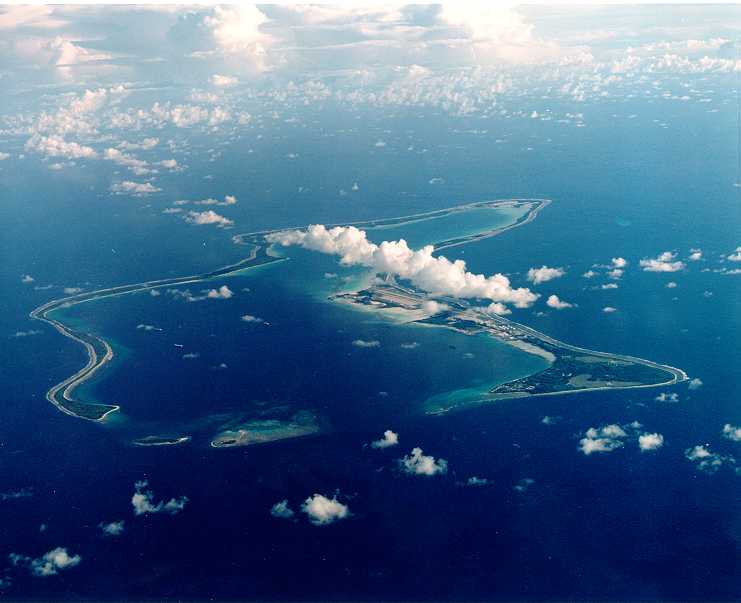
Diego Garcia (Public Domain)
Trump Calls Off Attack and Announces Talks
On March 21, Trump threatened to bomb Iranian power plants in 48 hours unless Tehran agreed to fully reopen the Strait of Hormuz. Iran responded with its own threat to hit Israeli and Gulf power plants. Then, as the deadline was expiring, he announced on March 23 a five-day moratorium on U.S. attacks on Iranian energy sites and that negotiations were underway for a “total resolution of our hostilities in the Middle East.”
According to Israel Hayom, Trump reversed course because of a surge in global energy prices and a message from the shah’s son urging Trump to reconsider because targeting Iran’s electrical infrastructure would not weaken the regime so much as deepen the suffering of an already burdened Iranian population.
Trump said Kushner and Witkoff were leading the talks, but did not specify who the Iranian interlocutors were. “We have had very, very strong talks,” Trump said. “We’ll see where they lead. We have major points of agreement.”
Regarding the Strait of Hormuz, Trump said, “That’ll be open very soon, if this works,” adding the flow of oil would be jointly controlled by "me and the Ayatollah, whoever the Ayatollah is."
Sources told the New York Times Witkoff had spoken to Iran’s foreign minister, Abbas Araghchi, but the Iranians denied they were engaged in any negotiations. The speaker of the Iranian Parliament, Mohammad Bagher Ghalibaf, said claims of negotiations were being used to “manipulate the financial and oil markets and escape the quagmire in which the U.S. and Israel are trapped.”
Other sources indicated, however, that Iran had said it would hold talks only with Vice President JD Vance, who was considered an opponent of the war, though he publicly expressed support for the president. A Gulf source told The Guardian, “They don’t want to work with Jared and Witkoff because they stabbed them in the back.”
The White House responded that President Trump decides who negotiates on behalf of the U.S. But Trump had said earlier that Vance was one of “several people” taking part in negotiations, along with Kushner, Witkoff, and Rubio.
The U.S. sent Iran a 15-point plan to end the war through Pakistan. The reported terms called for a month-long ceasefire during which the parties would negotiate a peace agreement. Iran would be required to dismantle its existing nuclear capabilities, permanently abandon efforts to acquire nuclear weapons, and transfer all enriched uranium out of the country. Tehran would also have to accept limits on the range and capability of its missile program, reopen the Strait of Hormuz as a free maritime corridor, and cease financing and arming proxy forces across the region. In return, international sanctions on Iran would be lifted.
Trump told reporters on March 24, “We’re actually talking to the right people, and they want to make a deal so badly, you have no idea how badly they want to make a deal.” He added, “There won’t be any nuclear weapons. Iran has agreed to that. We’re in a good bargaining position. We’re way ahead of schedule, and they have no navy, air force, or missile protection. Most of their launches we’ve killed.”
Netanyahu said that Trump told him it was possible to “leverage” the allies’ military gains to “realize the objectives of the war in an agreement.” The prime minister added that Israel was continuing its campaign of targeted killings in Iran and had eliminated two more nuclear scientists.”
The Iranians publicly rejected the U.S. plan and issued their own demands, knowing they would be unacceptable to the United States. According to the Wall Street Journal, Iran’s terms were:
- The closure of all U.S. bases in the Gulf.
- Reparations for damage caused by attacks on Iran.
- Guarantees that the war wouldn’t restart and an end to Israel’s strikes on the Iran-aligned Lebanese militia Hezbollah.
- Lifting all sanctions on Iran.
- Permitting Iran to keep its missile program with no negotiations to limit it.
Not mentioned in that report was the previous Iranian insistence on the right to enrich uranium. This remains a serious issue. The head of the IAEA, Rafael Grossi, said that while U.S. and Israeli strikes have significantly damaged Iran’s nuclear program, they have not eliminated it, noting that “a lot has survived.” He acknowledged the attacks were “quite effective” and had “rolled back the program considerably,” but cautioned that “we will still inherit a number of major issues” once fighting ends. Grossi emphasized that Iran retains critical capabilities, including enriched uranium stockpiles, warning that “they have the capabilities, they have the knowledge, they have the industrial ability” to rebuild, and that fully removing nuclear materials would be “a very challenging operation.”
Despite diplomatic signals, fighting continued, and U.S. forces were building up in the region. An expeditionary force of 2,200 Marines was about to arrive in the region, and Trump ordered an additional 2,500 Marines aboard three warships to head to the Middle East.
Administration sources told CBS News on March 23 that Iran had deployed as many as a dozen mines in the strait. U.S. forces had destroyed 44 minelaying vessels and were continuing to target and destroy mine storage facilities and naval ammunition depots. Following the CBS report, Trump posted on Truth Social: “If Iran has put out any mines in the Hormuz Strait, and we have no reports of them doing so, we want them removed, IMMEDIATELY!”
The foreign minister of Oman said his country was working to establish “safe passage arrangements for the Strait of Hormuz.”
Meanwhile, in Washington, Republicans continued to stymie efforts by Democrats to pass legislation that would force Trump to get congressional approval for continuing the war.
Trump said on March 29 that the strikes against the top leadership of the Islamic Republic effectively amount to regime change. “The one regime was decimated, destroyed, they’re all dead. The next regime is mostly dead, and the third regime — we’re dealing with different people than anybody’s dealt with before… and frankly, they’ve been very reasonable,” he told reporters.
The president continued to project optimism about peace talks. “We’re doing extremely well in that negotiation. But you never know with Iran, because we negotiate with them and then we always have to blow them up,” he said.
“I think we’ll make a deal with them, but it’s possible that we won’t,” Trump continued. “I do see a deal in Iran. It could be soon.”
Trump claimed that Iran has agreed to most of the U.S. demands despite Iran’s public messaging to the contrary.
“They’re going to give up nuclear weapons. They’re going to give us the nuclear dust,” Trump said. “They’re going to do everything that we want to do, [and] they’re going to go on and maybe have a great country again. But if they don’t do that, they’re not going to have a country,” Trump warned.
In an interview with the Financial Times, Trump said, “To be honest with you, my favorite thing is to take the oil in Iran but some stupid people back in the US say: ‘Why are you doing that?’ But they’re stupid people.”
“Maybe we take Kharg Island, maybe we don’t. We have a lot of options,” Trump told the Financial Times. “It would also mean we had to be there for a while.” He added, “I don’t think they have any defense. We could take it very easily.”
As evidence of the progress in negotiations, Trump said, Iran had agreed to allow some ships to pass through the Strait of Hormuz in a goodwill gesture.
“They gave us 10” Pakistani-flagged tankers. Now they’re giving 20.”
The president said Parliament Speaker Mohammad Bagher Ghalibaf, who approved the ships’ movement, revealed that someone considered a hardliner closely associated with the IRGC, which he had commanded, was the interlocutor.
“He’s the one who authorized the ships to me,” Trump acknowledged. “Remember I said they’re giving me a present? And everyone said: ‘What’s the present?’ … When they heard about that they kept their mouth shut and the negotiations are going very well.”
Meanwhile, Trump expressed frustration with NATO for failing to help secure the Strait of Hormuz. “So easy for them to do, with so little risk. COWARDS, and we will REMEMBER!” Trump posted on Truth Social, accusing NATO of failing to join the “fight to stop a Nuclear Powered Iran.”
“Without the USA, NATO IS A PAPER TIGER!”
Further aggravating tensions was Spain’s decision on March 30 to close its airspace to U.S. military aircraft. This followed an earlier refusal by Spain to allow the U.S. to use the Rota naval base and Moron air base.
Spain was not the only ally making the war effort more difficult. “France wouldn’t let planes headed to Israel, loaded up with military supplies, fly over French territory,” Trump said on March 31. “France has been VERY UNHELPFUL with respect to the ‘Butcher of Iran,’ who has been successfully eliminated! The U.S.A. will REMEMBER!!!,” he posted.
Trump also lashed out at Britain, as he had several times previously. “All of those countries that can’t get jet fuel because of the Strait of Hormuz, like the United Kingdom, which refused to get involved in the decapitation of Iran, I have a suggestion for you,” Trump wrote. “Number 1, buy from the U.S., we have plenty, and Number 2, build up some delayed courage, go to the Strait, and just TAKE IT.”
“You’ll have to start learning how to fight for yourself, the U.S.A. won’t be there to help you anymore, just like you weren’t there for us. Iran has been, essentially, decimated. The hard part is done. Go get your own oil!,” he added.
Trump surprisingly signaled he might end the U.S. military campaign against Iran even if the Strait of Hormuz remains largely closed, prioritizing a shorter conflict timeline over reopening the key waterway. Officials said the administration aims to weaken Iran’s navy and missile capabilities, then shift to diplomacy, potentially leaving allies to handle reopening the strait later.
Trump has also urged other countries to take action themselves, writing on March 31: “Build up some delayed courage, go to the Strait, and just TAKE IT… the U.S.A. won’t be there to help you anymore.”
Iranian officials revived a proposal to allow American companies into Iran’s oil and gas sector as an economic incentive, but tied it to broader demands—especially an immediate ceasefire—which Washington rejected.
U.S. officials believed Iran’s worsening situation could force it to accept American terms within weeks. However, negotiations were hindered by opposition from the IRGC, creating a major internal obstacle.
Meanwhile, Trump threatened strikes on Iran’s energy infrastructure if talks failed, while the Treasury coordinated with Gulf states to freeze Iranian assets. Additional sanctions targeting major IRGC-controlled conglomerates were aimed at hitting the financial interests of key power brokers resisting an agreement.
As Trump vacillated between ending the war quickly and escalating, the Gulf states—led by Saudi Arabia and the United Arab Emirates—argued that the operation had not sufficiently weakened Tehran. As fighting reached the 30-day mark, they insisted that the U.S. must not squander the “historic opportunity” to deal a decisive blow to Iran’s clerical regime. This marked a shift from their initial frustration at not having advance notice of the U.S.-Israeli strikes and their earlier warnings about possible regional destabilization. In private, officials from Saudi Arabia, the UAE, Kuwait, and Bahrain urged Washington to continue military operations until there were major changes in Iran’s leadership or a dramatic shift in its regional behavior. They warned that stopping prematurely would allow Iran to recover.
Trump made clear that he would not allow Israel to continue fighting after the U.S. ends its campaign. “They'll do what I tell them,” Trump told Time. “They've been a good team player. They'll stop when I stop. They'll stop unless they're provoked, in which case, they'll have no choice, but they'll stop when I stop.”
As reports indicated negotiations were at an impasse, Trump issued more threats. On April 4, he said, “Remember when I gave Iran ten days to MAKE A DEAL or OPEN UP THE HORMUZ STRAIT. Time is running out - 48 hours before all Hell will reign down on them. Glory be to GOD!”
The following day, his frustration seemed to boil over as he posted, “Tuesday will be Power Plant Day, and Bridge Day, all wrapped up in one, in Iran. There will be nothing like it!!! Open the Fuckin’ Strait, you crazy bastards, or you’ll be living in Hell - JUST WATCH! Praise be to Allah.”
The same day (April 5), Pakistan proposed a 45-day ceasefire as part of a mediated effort to halt the war and reopen the Strait of Hormuz. Netanyahu reportedly lobbied Washington against accepting the plan, but the concern proved unnecessary: the proposal gained no traction. The United States tied any pause to Iran reopening the strait, while Iran rejected a temporary truce outright, insisting instead on a permanent end to the war. Still, Trump told Netanyahu that a ceasefire could be possible if Iran accepted U.S. terms, but emphasized he would not back down from his core demands that Tehran surrender its enriched uranium and commit to ending enrichment permanently.
Iran’s response to U.S. ceasefire proposals, delivered through Pakistani mediators after two weeks of internal deliberation, went well beyond a simple pause in fighting. Tehran’s demands made clear it was seeking a comprehensive settlement, not a temporary arrangement, and the gap between what Iran wanted and what the U.S. was prepared to offer represented the central obstacle to any deal.
Iran’s core demand was a permanent end to the war, not the 45-day ceasefire the U.S. was proposing as a first step toward negotiations. This was the critical sticking point, with mediators scrambling to find language that could bridge the two positions. Beyond that, Iran insisted that any agreement cover not just its own territory but all active hostilities in the region — explicitly including Lebanon, where Israel was conducting an ongoing ground operation. Tehran was effectively demanding that a deal with the U.S. bind Israel’s hand on a separate front, a condition Israel would almost certainly resist. Iran also demanded a formal protocol guaranteeing safe passage through the Strait of Hormuz, financial compensation for reconstruction, and the lifting of all U.S. and international sanctions.
Trump described the Iranian response as “significant” but insufficient, and made clear his own non-negotiable demands remained in place. Nevertheless, he offered a one-day extension of his prior deadline. He now said the Strait must be opened by 8:00 PM on April 7. The Iranians responded that the Strait would remain closed to most ships and threatened to retaliate in kind if the United States or Israel attacked infrastructure. “If attacks on civilian targets are repeated, the subsequent phases of our offensive and retaliatory operations will be carried out much more crushingly and extensively,” Ebrahim Zolfaghari, an Iranian military spokesman, said on April 6. Iran also rejected an offer to reopen the Strait of Hormuz in exchange for a ceasefire, and has declined to meet with U.S. officials.
On April 6, Trump reiterated: “We have a plan, because of the power of our military, where every bridge in Iran will be decimated by 12 o’clock tomorrow night, where every power plant in Iran will be out of business, burning, exploding and never to be used again.” If the attacks take place, he added, “It will take them 100 years to rebuild.”[201]
He told Fox News, “You will see bridges and power plants collapsing across Iran. If Iran does not quickly reach a deal with us, I am considering the option of destroying everything and seizing the oil.”
He further stated: “The reconstruction of Iran will take 20 years if they are lucky — and if they still have a country left at all.”
Trump added: “If the Iranians don’t want to sign an agreement, their entire country will be destroyed.”
He also said: “I do not rule out sending ground forces to Iran if an agreement is not reached.”
In another statement, he added: “I think I will be able to get a deal by tomorrow.”
If not, he said it is “highly unlikely” that he will extend his deadline for the Iranian regime to reopen the Strait of Hormuz.
“They’ve had plenty of time,” Trump said. “They asked for an extension of seven days... they have until tomorrow... and after that, they’re going to have no bridges, they’re going to have no powerplants.”
A White House official told Bloomberg that Iran will not be allowed to establish a permanent system to control access to the Strait of Hormuz.
Iran reportedly produced a 10-point peace proposal that was unacceptable to the United States.
On the morning of his deadline, Trump posted:
A whole civilization will die tonight, never to be brought back again. I don’t want that to happen, but it probably will. However, now that we have Complete and Total Regime Change, where different, smarter, and less radicalized minds prevail, maybe something revolutionarily wonderful can happen, WHO KNOWS? We will find out tonight, one of the most important moments in the long and complex history of the World. 47 years of extortion, corruption, and death, will finally end. God Bless the Great People of Iran!
Later in the day, Trump said he was studying a new Pakistani proposal for a two-week ceasefire “to allow diplomacy to run its course.” Pakistani Prime Minister Shehbaz Sharif said he had asked Iran to open the Strait of Hormuz for two weeks “as a goodwill gesture.”
It was unclear who was conducting negotiations on Iran’s behalf and who was running the country. American and Israeli intelligence sources report that Iran’s Supreme Leader, Mojtaba Khamenei, has been incapacitated and is unable to govern. According to a memo obtained by The Times of London, Khamenei, who was wounded in the strike that killed his father, is in critical condition and receiving treatment in Qom, leaving him unable to participate in any regime decision-making.
An effort to stop the fighting at the UN also failed when Russia and China vetoed a UN Security Council resolution aimed at protecting commercial shipping in the Strait of Hormuz from Iranian interference, citing bias against Iran. The proposal had received support from 11 members and warned that Iran’s actions threatened international peace and security, while demanding an immediate end to disruptions of maritime navigation. The vetoes came even after the resolution was weakened to remove any authorization of force to open the strait.
U.S. ambassador to the UN, Mike Waltz, said the vetoes marked “a new low” when Iran's shutting of the strait was preventing medical aid and supplies from reaching humanitarian crises in the Congo, Sudan, and Gaza.
Meanwhile, Iranian officials urged “all young people, athletes, artists, students and university students and their professors” to form human chains around power plants. President Masoud Pezeshkian claimed that more than 14 million Iranians had vowed to “sacrifice their lives” in defense of the country.
Less than two hours before his deadline, Trump announced the U.S. would suspend bombing for two weeks on the condition that Iran agree to reopen the Strait of Hormuz.
Based on conversations with Prime Minister Shehbaz Sharif and Field Marshal Asim Munir, of Pakistan, and wherein they requested that I hold off the destructive force being sent tonight to Iran, and subject to the Islamic Republic of Iran agreeing to the COMPLETE, IMMEDIATE, and SAFE OPENING of the Strait of Hormuz, I agree to suspend the bombing and attack of Iran for a period of two weeks. This will be a double sided CEASEFIRE! The reason for doing so is that we have already met and exceeded all Military objectives, and are very far along with a definitive Agreement concerning Longterm PEACE with Iran, and PEACE in the Middle East. We received a 10 point proposal from Iran, and believe it is a workable basis on which to negotiate. Almost all of the various points of past contention have been agreed to between the United States and Iran, but a two week period will allow the Agreement to be finalized and consummated. On behalf of the United States of America, as President, and also representing the Countries of the Middle East, it is an Honor to have this Longterm problem close to resolution.
A White House official said Israel had also agreed to the ceasefire.
Trump Forces Israel to Stop Lebanon Campaign – Again
On April 14, Israel and Lebanon held their first direct talks since 1993, a symbolic but significant meeting brokered by Washington that Secretary of State Rubio framed not as a ceasefire negotiation but as “a historic opportunity” to bring “a permanent end to 20 or 30 years of Hezbollah’s influence.” Rubio was careful to temper expectations, saying “this is a process, not an event,” while expressing hope that the talks could “outline the framework upon which a permanent and lasting peace can be developed” for both Israelis and Lebanese alike.
A joint statement issued after the meeting said the three sides had held “productive discussions” toward “launching direct negotiations between Israel and Lebanon.” The U.S. expressed support for the Lebanese government’s stated goal of restoring its monopoly on force and ending “Iran’s overbearing influence,” and noted that successful negotiations could “unlock significant reconstruction assistance and economic recovery for Lebanon.” Israeli Ambassador Yechiel Leiter said the Lebanese government had made clear “they will no longer be occupied by Hezbollah,” and offered a striking vision of what normalization could look like: a clearly delineated border where the only reason either side would need to cross would be “in business suits to conduct business, or in bathing suits to go on vacation.”
The Israeli approach, as one official described it, was to “negotiate with Lebanon as if there is no Hezbollah, and to fight Hezbollah as if there are no peace negotiations.” That dual-track strategy was visible in real time: even as the talks took place, approximately 40 rockets were fired into northern Israel, and Hezbollah drones continued striking communities, including Nahariya. A security official acknowledged that more than 50 percent of Hezbollah’s attacks were still being launched from south of the Litani River, underscoring how far the military campaign remained from achieving full demilitarization.
Ambassador Leiter set out Israel’s three interrelated goals: “the complete dismantlement of Hezbollah, the freeing of Lebanon from Iran’s terror proxy, and the achievement of a real, lasting and mutually-celebrated peace.” He declared that “Naim Qassem and Hezbollah belong to the past. We are here for the future.” The U.S. was understood to be aiming at a “shelf agreement” — a framework ready for implementation once Hezbollah was disarmed — though most analysts cautioned that real progress with Lebanon would only be possible once Washington had resolved its broader conflict with Tehran. France, despite its historic role in Lebanese affairs, was notably absent from the process, reflecting how firmly the talks were being driven by Washington.
Two days later, for the second time, Trump compelled Israel to halt its military operation in Lebanon before achieving its objectives, announcing on April 16 that Israel and Lebanon had agreed to a 10-day ceasefire. Although he had initially aligned with Israel in its dispute with Iran—maintaining that the ceasefire did not obligate Israel to end its campaign against Hezbollah—he appears to have reversed course, likely due to the delicate nature of negotiations with Iran and his interest in bringing that conflict to a close.
“When Israel’s greatest friend, President Trump, is acting alongside us in close coordination, Israel cooperates with him,” Netanyahu said, according to Ynet.
“I just had excellent conversations with the Highly Respected President Joseph Aoun, of Lebanon, and Prime Minister Bibi Netanyahu, of Israel,” Trump posted on Truth Social. “These two Leaders have agreed that in order to achieve PEACE between their Countries, they will formally begin a 10 Day CEASEFIRE at 5 P.M. EST.”
He later said that he was inviting both Aoun and Netanyahu to the White House for “the first meaningful talks between Israel and Lebanon since 1983, a very long time ago.”
He added: “Both sides want to see PEACE, and I believe that will happen, quickly!”
The announcement came just a day after Netanyahu told the country that he had instructed the army to deepen its fighting against Hezbollah.
“We have an opportunity to reach a historic peace agreement with Lebanon,” Netanyahu told Israelis in a video statement announcing the truce.
Lebanese Prime Minister Nawaf Salam welcomed the ceasefire; however, Aoun said he would not meet with Netanyahu.
To further emphasize his position and control over Israeli behavior, Trump posted on April 17, “Israel will not be bombing Lebanon any longer. ?They are PROHIBITED from doing so by the U.S.A. Enough is enough!!!”
The Jerusalem Post reported that Netanyahu was “personally stunned and alarmed” by the post. The Israelis insisted the ceasefire agreement preserved their right to self-defense, but Trump told Axios, “Israel has to stop. They can’t continue to blow buildings up. I am not gonna allow it.”
U.S.-Iran Negotiations in Pakistan
Iran submitted a “new” and “modified” peace proposal on April 8 that the U.S. Government said would serve as the basis for negotiations. Trump described it as “a workable basis on which to negotiate,” and unspecified mediators told the Wall Street Journal that Iran had softened several demands, including those related to nuclear enrichment, the withdrawal of U.S. forces from the Middle East, and war reparations.
Despite the initial optimism, talks in Islamabad on April 11 and 12 ended without an agreement. Trump said on April 12 that Iran’s delegation had not made compromises on its nuclear program but that he believed Iran would return to the table. Three core disputes drove the breakdown: Iran’s stockpile of highly enriched uranium, control of the Strait of Hormuz, and access to $27 billion in frozen funds. The Iranians also wanted a commitment that it would not be attacked in the future by either Israel or the United States. The U.S. demanded Iran reopen the strait immediately and “hand over or sell” its enriched uranium stockpile. Iran insisted maritime access would come only after a final deal and refused to yield on enrichment. Washington also rejected Iran’s demand for the release of frozen oil revenues as reparations. ISW also noted that internal divisions within Iran’s delegation — between hardline IRGC figures and more pragmatic officials — further undermined the talks.
On April 13, CENTCOM announced a blockade on vessels entering or departing Iranian ports and coastal areas, including in the Persian Gulf and Gulf of Oman, while stating that it would not impede freedom of navigation for vessels transiting the Strait of Hormuz to non-Iranian ports. Trump said he expected unspecified countries to assist with enforcement. The United Kingdom and France said they would not participate, though Trump claimed they were aiding mine-clearing efforts. The U.S. decision not to renew a 30-day sanctions waiver on Iranian oil exports, set to expire April 19, added further economic pressure.
Joint Chiefs Chairman General Dan Caine said on April 16 that 12 vessels had been turned around since the blockade began without any boardings, and that the blockade had prevented Iran’s shadow fleet from delivering oil in violation of U.S. sanctions. In addition, the Treasury Department’s Office of Foreign Assets Control sanctioned more than 25 individuals, companies, and vessels linked to oil shipping magnate Mohammad Hossein Shamkhani’s network.
Pakistani mediators traveled to Tehran to help preserve a fragile U.S.-Iran ceasefire ahead of its expiration. Trump signaled optimism on April 16, praising Pakistani Prime Minister Shehbaz Sharif and army chief Asim Munir as great mediators and saying Iran was “willing to do things today that they weren’t willing to do two months ago.” He even floated attending a deal-signing in Islamabad: “If the deal is signed in Islamabad, I might go… They want me.” He claimed the war “is going swimmingly” and dismissed economic concerns, calling predictions of soaring oil prices “fake inflation.” Trump also claimed Iran had agreed to surrender its highly enriched uranium stockpile, saying, “They’ve agreed to give us back the nuclear dust.” Iranian sources linked to the IRGC repeatedly denied reports of progress or concessions.
Significant gaps remained on the nuclear question. The U.S. proposed a 20-year pause on enrichment; Iran offered three to five years. The U.S. wanted all highly enriched uranium removed from Iran entirely; Iran proposed down-blending part of its stockpile or transferring only a portion abroad. Experts noted that retaining even a fraction of the stockpile, combined with a short pause, could allow Iran to improve its centrifuge capacity and rebuild relatively quickly.
On April 17, Trump said the U.S. would work with Iran to recover its enriched uranium and bring it back to the United States. “We’re going to get it together. We’re going to go in with Iran, at a nice leisurely pace, and go down and start excavating with big machinery...We’ll bring it back to the United States,” Trump said.
Earlier, the Institute for Science and International Security reported that Iran appeared to be restricting access to a tunnel complex at the Esfahan Nuclear Technology Center, likely to delay or complicate any ground operation to seize its enriched uranium stockpile. ISW also assessed that Iran was exploiting the ceasefire to reorganize its ballistic missile forces and reopen tunnel entrances at missile bases.
The United States reportedly conditioned any new round of talks on two requirements: Iran must fully reopen the Strait of Hormuz, and its negotiating team must have “full authority” to finalize an agreement. The demands underscored Washington’s conclusion that it was dealing with a fragmented Iranian leadership split between hardliners and more pragmatic officials.
On April 17, Iran declared the Strait of Tiran completely open for the remainder of the ceasefire. Trump said, “Thank you!” but added that the blockade of Iranian ports would continue until a peace agreement was finalized. He also posted, “THIS PROCESS SHOULD GO VERY QUICKLY IN THAT MOST OF THE POINTS ARE ALREADY NEGOTIATED.”
A day later, however, Iran declared the Strait closed and fired on ships entering the area. Trump subsequently claimed that it was the U.S. that had closed the Strait and warned: “We’re offering a very fair and reasonable DEAL, and I hope they take it because, if they don’t, the United States is going to knock out every single Power Plant, and every single Bridge, in Iran. NO MORE MR. NICE GUY!”
Even as Trump was talking tough in public, his administration was reportedly considering unfreezing $20 billion in Iranian assets as part of a peace deal. The report surprised many who remember that Trump had excoriated President Obama for a $400 million cash delivery to Iran the same day the country released four American prisoners and implemented the JCPOA nuclear deal.
Trump claimed he had good news about the negotiations and posted on the 17th that “Iran has agreed to never close the Strait of Hormuz again.” This appeared true when a convoy of ships transited the Strait, prompting a swift decline in oil prices. However, the Institute for the Study of War reported on April 18 that IRGC Commander Major General Ahmad Vahidi and his inner circle likely seized at least temporary control over both Iran’s military response and its negotiating posture. That assessment was reinforced when the IRGC Navy attacked multiple commercial vessels and abruptly declared that no vessel of “any type or nationality” could pass through the Strait—directly contradicting Foreign Minister Abbas Araghchi’s statement just one day earlier that the waterway was “completely open” to commercial traffic.
Trump said Iran “got a little cute” by reimposing its closure on the Strait, but the dialogue is “working out really well.”
ISW concluded that the IRGC’s consolidation of power has effectively stripped civilian negotiators of real authority, indicating that the officials engaging with Washington cannot independently set Iran’s negotiating positions. Instead, more pragmatic figures appear to have been sidelined as the IRGC tightens its grip over decision-making. ISW also reported that Ghalibaf publicly supported diplomacy—arguing it should complement military power—while clashing with hardliners, particularly Vahidi and his allies, who oppose talks. Ghalibaf’s push for diplomacy, ISW suggested, may be driven in part by efforts to preserve his political standing, as hardliners consolidate control and sideline more pragmatic figures. Meanwhile, U.S. officials said negotiators in Islamabad were later overruled by the IRGC.
The U.S. Navy’s blockade of Iranian ports remained in place as CENTCOM said it had forced 23 ships to turn back since the United States began the blockade. On April 19, U.S. forces seized a previously sanctioned Iranian-flagged container ship for the first time after it attempted to pass the blockade line.
Vance, Witkoff, and Kushner were expected to travel to Islamabad for another round of negotiations on April 21. Iran’s Supreme National Security Council said Pakistan’s army chief had presented a new American proposal; however, IRGC-affiliated media signaled a hardening stance, announcing that Iran would not participate in another round of talks with the United States because of “excessive” U.S. demands.
Israel Hayom reported on April 19 that Iran agreed to transfer all of its enriched uranium, though it remained unclear who would ultimately take custody. Potential recipients include Russia—which signaled its willingness—the International Atomic Energy Agency, which would need to identify a secure site for storage and processing, or the United States. However, Washington insisted on participating directly in locating and securing the material, while Iran said it would permit only IAEA personnel to carry out that role.
The ceasefire was due to end on April 22 if no agreement was reached, and all sides were reportedly preparing to resume fighting. According to the New York Times, U.S. intelligence officials believed Iran retained roughly 40% of its prewar drone arsenal and access to about 50% of its missile launchers. Since the ceasefire, it recovered roughly 100 additional systems from caves and bunkers, restoring launcher capacity to approximately 60% of prewar levels. Iran was also working to recover missiles buried in damaged depots. Once that effort is complete, U.S. estimates suggest Iran could regain up to 70% of its prewar missile arsenal.
President Trump said on April 21, “I do not want to extend the ceasefire. I think we are going to end up with a great deal. They have no choice.” He added, “We are totally loaded up; we are much more powerful than we were before the ceasefire. We used the ceasefire to restock, and they have probably done a little restocking. We totally control the Strait of Hormuz.”
Trump told PBS, “We're not negotiating anything other than the fact that they will not have a nuclear weapon and that if the ceasefire expires without a deal, then “lots of bombs start going off.” If Iran didn’t negotiate, he warned in another interview, “they’re going to see problems like they’ve never seen before.”
Trump also said, "We caught a ship yesterday that had some things on it that weren't very nice. A gift from China, perhaps — I don't know. I am surprised. I thought I had an understanding with President Xi.”
As Vance and the negotiating team were preparing to leave for Islamabad, the Iranians indicated they would not be sending negotiators. Nevertheless, Trump announced an extension of the ceasefire. He posted on April 21:
Based on the fact that the Government of Iran is seriously fractured, not unexpectedly so and, upon the request of Field Marshal Asim Munir, and Prime Minister Shehbaz Sharif, of Pakistan, we have been asked to hold our Attack on the Country of Iran until such time as their leaders and representatives can come up with a unified proposal. I have therefore directed our Military to continue the Blockade and, in all other respects, remain ready and able, and will therefore extend the Ceasefire until such time as their proposal is submitted, and discussions are concluded, one way or the other.
Later, he posted: “Iran is collapsing financially! They want the Strait of Hormuz opened immediately- Starving for cash! Losing 500 Million Dollars a day. Military and Police complaining that they are not getting paid. SOS!!!”
Meanwhile, Iran’s Parliament Speaker Mohammad Bagher Qalibaf said: “We do not accept negotiations under the shadow of threat, and that over the past two weeks, preparations have been made to reveal new cards on the battlefield.”
Trump Extends Ceasefire
The United States reportedly informed Israel on April 22 that the ceasefire would end on April 26. A source told Israel Hayom the U.S. and Israel would then launch a much larger strike than before, expected to last several days. Toward that end, the USS George H.W. Bush and other assets were being moved to the region. Only a major Iranian nuclear concession could prevent this operation, though Trump said the Iranians had made a positive gesture in responding to his request to cancel the planned execution of eight female protestors.
Meanwhile, Iran’s public stance grew more defiant. Iranian state media broadcast videos ridiculing Trump’s outreach, asserting that Iran never negotiated with him.
A Western diplomat said Trump avoided striking Iran’s energy targets due to concerns about oil prices. Still, U.S. and Israeli officials argued that dismantling Iran’s military required destroying its supporting infrastructure, making strikes on energy and national assets inevitable.
Multiple U.S. officials and Trump associates said Trump had effectively decided he wanted out of the Iran war. He believed the U.S. had achieved what it could militarily and would not resume strikes unless he had exhausted all other options first. His negotiators believed a deal covering what remained of Iran’s nuclear program was still reachable, but faced a significant obstacle: it was unclear whether anyone in Tehran was actually empowered to say yes. Supreme Leader Khamenei was barely communicating, and the IRGC generals who effectively controlled the country were openly at odds with Iran’s civilian negotiators over strategy. As one U.S. official described it: “There is an absolute fracture inside Iran between the negotiators and the military — with neither side having access to the supreme leader, who is not responsive.”
The immediate focus was on whether Pakistani mediators could bring Iran back to the table within Trump’s timeframe. U.S. officials and the mediators were watching for Khamenei to break his silence and give Iranian negotiators a clear directive to return to talks.
Trump had extended the ceasefire at some cost to his leverage, but believed the naval blockade he kept in place compensated for it, claiming Iran was “starving for cash” and could not pay its own military and police.
The Washington Post reported that Pentagon officials told Congress that clearing Iranian naval mines from the Strait of Hormuz could take up to six months, and likely would not begin until the U.S. war with Iran ends—raising the prospect that economic disruptions could persist well beyond any ceasefire.
The estimate underscored concerns that oil and gasoline prices could remain elevated long after fighting stops, frustrating lawmakers from both parties in advance of midterm elections.
Lebanon Peace Talks
President Trump hosted Israel's ambassador to Washington, Yechiel Leiter, and Lebanese ambassador to the U.S., Nada Moawad, in the Oval Office for a second round of U.S.-facilitated talks on April 23. Vice President JD Vance, Secretary of State Marco Rubio, U.S. Ambassador to Israel Mike Huckabee and U.S. Ambassador to Lebanon Michel Issa also attended the meeting.
Afterward, Trump announced that the 10-day Israel-Lebanon ceasefire would be extended by three weeks following White House talks involving senior U.S., Israeli, and Lebanese officials.
The extension, requested by Lebanon, came as the U.S. sought to help stabilize the situation and support Lebanon in addressing Hezbollah. Trump expressed optimism about reaching a broader resolution and said he planned to host Israeli Prime Minister Benjamin Netanyahu and Lebanese President Joseph Aoun for further discussions.
He framed the move as part of a broader effort to de-escalate regional tensions, alongside ongoing negotiations with Iran.
He also toned down his earlier position that Israel was “prohibited” from bombing Lebanon. “Israel is going to have to defend itself if they are shot at,” he said, “but they’re going to do it carefully, and they’ll be surgical.”
“Hezbollah's strategy is clear: provoke, attack, and then blame Israel in order to kill the negotiations and make the Lebanese government look bad. We cannot feasibly expect Israel to just take the hits. This is not the Biden administration,” a U.S. official told Axios.
The paradox, Firas Maksad, managing director for Middle East and North Africa at Eurasia Group, explained to Axios was that, “It’s difficult to say ‘no’ to President Trump and risk his wrath, but it is also increasingly difficult to sustain direct negotiations with Israel, let alone meeting Netanyahu at the White House, when the destruction of villages and loss of Lebanese lives continues.”
Stalemate With Iran
Pushing back against reports suggesting that Israel had drawn him into the conflict, Trump took to social media on April 20 to insist that his decision was driven by his own long-held views and the events of October 7—not by Israeli influence. “Israel never talked me into the war with Iran, the results of Oct. 7th, added to my lifelong opinion that IRAN CAN NEVER HAVE A NUCLEAR WEAPON, did.”
The following day, the State Department provided a legal analysis to quiet the furor. It said, “the United States is acting well within the recognized contours of international law relating to the use of force and self-defense. This legal assessment is grounded in facts demonstrating Iran’s malign aggression over decades, particularly in Iran’s escalatory attacks against the United States, Israel, and others in the region for years.”
The rationale also said “the United States is engaged in this conflict at the request of and in the collective self-defense of its Israeli ally, as well as in the exercise of the United States’ own inherent right of self-defense,” which was more likely to fuel the claims that Netanyahu had convinced Trump to start the war.
On April 26, Iran proposed a two-step deal to end the war: first, reopen the Strait of Hormuz and lift the U.S. blockade, with nuclear negotiations postponed. The proposal reflected divisions within Iran’s leadership over nuclear concessions and sought a quicker path to a ceasefire.
The idea emerged during talks in Islamabad, where Iranian Foreign Minister Abbas Araghchi met with Pakistani, Turkish, Egyptian, and Qatari mediators but made little progress. Planned meetings with Witkoff and Kushner were canceled after Iran signaled it was not ready to engage directly, underscoring the stalemate.
“I see no point of sending them on an 18-hour flight in the current situation. It's too long. We can do it just as well by telephone. The Iranians can call us if they want. We are not gonna travel just to sit there,” Trump said.
The U.S. remained cautious, since ending the blockade would reduce Trump’s leverage to force limits on Iran’s uranium enrichment—one of his main war aims. Trump indicated he preferred to maintain pressure while weighing next steps.
Trump told advisers he was not satisfied with Iran’s latest proposal, and Secretary of State Rubio rejected it because “What they mean by opening the straits is, ‘yes, the straits are open, as long as you coordinate with Iran, get our permission, or we’ll blow you up and you pay us.’“
“That’s not opening the straits. Those are international waterways. They cannot normalize, nor can we tolerate them trying to normalize, a system in which the Iranians decide who gets to use them,” Rubio added.
Vahidi and his inner circle have consistently thwarted efforts by Ghalibaf and other so-called pragmatists to steer the regime toward a more flexible negotiating posture. Vahidi now appears to have won this internal power struggle and is likely to dictate Iran’s approach to both the war and diplomacy with a hardline, maximalist stance.
On April 28, Trump posted, “Iran has just informed us that they are in a “State of Collapse.” They want us to “Open the Hormuz Strait,” as soon as possible, as they try to figure out their leadership situation (Which I believe they will be able to do!).”
All indications were that Trump was unwilling to resume military operations and hoped to simply declare victory. That was impossible, however, so long as Iran kept the Strait of Tiran closed. By continuing to squeeze Iran’s economy and oil exports by preventing shipping to and from its ports, Trump hoped to force the regime to capitulate. Trump told aides that Iran’s three-step offer to reopen the Strait of Hormuz and save nuclear talks for the final phase proved Tehran wasn’t negotiating in good faith. The New York Times noted, however, that “continuing the blockade also prolongs a conflict that has driven up gas prices, hurt Trump’s poll numbers and further darkened Republicans’ prospects in the midterm elections.”
Meanwhile, cargo ships and planes from the U.S. carrying 6,500 tons of military equipment arrived in Israel at the end of April to replenish stockpiles. The shipments contained “thousands of air munitions, ground munitions, military trucks, JLTV combat mobility vehicles, and additional equipment,” the Israeli Defense Ministry said, with the ministry’s director general adding that the shipments “will continue and intensify in the coming weeks.”
Since the conflict with Iran began on February 28, more than 115,600 tons of military equipment have arrived in Israel on 403 flights and 10 ships.
Israeli Defense Minister Israel Katz said the goal is “to ensure that the IDF receives all the necessary means so that it can return to operating at full strength against our enemies at any time and in any place required.”Mojtaba Khamenei declared on April 30 that Iran would not relinquish control of shipping through the Strait of Hormuz or compromise on its nuclear and missile programs—underscoring Tehran’s refusal to yield on core strategic assets.
At the same time, Iran was pursuing a dual-track strategy. Regionally, it was working to drive a wedge between the Gulf states and the United States in a bid to pressure them to expel American forces. Militarily, it used the ceasefire to rebuild, recovering hidden or buried missile systems and drones in preparation for a potential renewal of hostilities.
Economically, the regime was attempting to shift blame for its deteriorating conditions onto U.S. pressure, even as structural mismanagement remains a central factor. To cope with the U.S. naval blockade, Iran began scaling back oil production as storage fills, a calculated move to avoid long-term damage to its fields.
Diplomatically, Tehran’s counterproposal outlined a three-phase plan: first, a rapid end to the war, guarantees against future joint strikes, and arrangements for the Strait of Hormuz; second, deferred negotiations over the nuclear program, including possible limits on enrichment and steps involving its highly enriched uranium stockpile. The sequencing reflected a clear effort to secure immediate relief while postponing any binding nuclear concessions. Previously, Tehran demanded concessions up front before talks.
“They want to make a deal, but I’m not satisfied with it,” President Trump said in response on May 1.
On May 3, Trump announced that “Project Freedom” would begin on May 4. He said the U.S. Navy would begin to escort ships and their crews out of restricted waterways near the Strait of Hormuz, focusing on vessels from countries uninvolved in the current Middle East conflict whose crews indicated they would not return until the area was safe for navigation. While U.S. representatives were simultaneously engaged in discussions with Iran, Trump said the ship movements were intended as a humanitarian gesture to relieve innocent people, companies, and countries caught as victims of circumstance, particularly given that many vessels are running low on food and essential supplies needed to keep large crews healthy and sanitary. The initiative was framed as an act of goodwill on behalf of the United States, Middle Eastern nations, and especially Iran, meant to demonstrate positive intent after months of intense fighting, with a clear warning that any interference with this humanitarian process would be dealt with forcefully.
Iranian state media published a map on May 4 showing the Revolutionary Guard’s area of control over the strait, which encompassed the U.A.E. port of Fujairah, the end of a pipeline that the Gulf country uses to circumvent the blockage in the strait. The IRGC warned it would stop unauthorized vessels by force and asserted continued control over the strait.
The Pentagon said May 4 that it successfully guided two U.S.-flagged commercial ships through the strait, but the captain of the Marshall Islands-flagged JV Innovation said it was at anchor, waiting to cross the strait, when it was hit by a drone. A second ship was also hit later in the day.
The UAE confirmed a drone hit sparked a fire at the oil hub of Fujairah, which the country used to pump petroleum and circumvent the Strait. The UAE also condemned an Iranian drone attack on a tanker used by the state-owned oil company of Abu Dhabi, Adnoc. Two drones targeted the ship while it was transiting the strait, causing no injuries.
Trump announced on May 4 that he was pausing “Project Freedom” while keeping the naval blockade of Iranian ports in place, citing progress toward a deal and requests from international partners. The White House believed it was close to a preliminary deal with Iran centered on a one-page memorandum of understanding (MOU) to end the war and launch broader nuclear negotiations—the closest the sides had come to agreement since the conflict began. The framework reportedly included a temporary halt to Iran’s uranium enrichment, gradual U.S. sanctions relief and release of frozen funds, and reciprocal steps to reopen transit through the Strait of Hormuz. However, many provisions were conditional on a final agreement, leaving open the risk of renewed conflict or a prolonged interim period without full resolution. The proposed 30-day process would aim to finalize terms on limiting Iran’s nuclear program, lifting sanctions, and restoring maritime access. Key sticking points remained, including the length of the enrichment moratorium, verification measures, and the potential removal of Iran’s highly enriched uranium stockpile, with U.S. officials still wary that internal divisions in Iran could derail an agreement.
As Trump appeared willing to sign a peace deal with Iran to avoid additional unpopular military action and stem rising gas prices, Netanyahu was desperately trying to influence negotiations to ensure Israeli priorities were included. In a call with the president on May 6, Netanyahu emphasized Israel’s top demands: the complete removal of Iran’s enriched uranium and the dismantling of its enrichment capabilities. While both countries share these objectives, Israel believes additional military pressure may be necessary, whereas the Trump administration appears more focused on economic sanctions and diplomacy.
Israel was also concerned that the U.S. would narrow the scope of negotiations to the nuclear issue alone, potentially dropping demands related to Iran’s ballistic missile program and support for proxy groups. Despite doubts that Iran would accept the core demands, Israel was pushing to secure them in any agreement while preserving its freedom of action to act against future threats. At the same time, U.S.-Israel coordination produced at least one concrete outcome: expanded Israeli operational flexibility in Lebanon, allowing more targeted actions beyond the security zone it had established.
Anti-Semitism
In May 2026, the U.S. Department of Justice announced two new initiatives to combat anti-Semitism nationwide: the forthcoming Anti-Semitism Advisory Committee (ASAC), which will provide recommendations to the Attorney General and DOJ leadership on coordinated responses to anti-Semitism, and a 15-city National Awareness & Action Tour led by Leo Terrell, Chair of the DOJ Task Force to Combat Anti-Semitism. The DOJ said the tour would seek to increase reporting of anti-Semitic incidents, strengthen cooperation among local law enforcement, federal agencies, and Jewish communities, build interfaith opposition to anti-Semitism, and address anti-Semitism in K-12 schools and teacher unions. DOJ officials said the measures were part of the Trump administration’s broader effort to use federal civil rights enforcement tools to protect Jewish Americans from discrimination, harassment, intimidation, and violence.
Later the month, the United States removed Francesca Albanese from its sanctions list after a federal judge temporarily blocked the measures, finding that the Trump administration likely violated her free-speech rights by sanctioning her over criticism of Israel’s war in Gaza. The sanctions, imposed in July 2025, had barred her from entering the U.S. and using the U.S. banking system. Days later, the D.C. Circuit temporarily allowed the Trump administration to enforce Francesca Albanese’s designation, while protecting existing OFAC licenses for Massimiliano Cali and L.C. and leaving the merits undecided.
Trump Attempts to Expand Abraham Accords
U.S. Central Command announced on May 7 that U.S. forces had “eliminated inbound threats” and struck Iranian military facilities responsible for attacks on U.S. forces after Iran targeted U.S. naval assets in and around the Strait of Hormuz. CENTCOM stated the United States “does not seek escalation.” President Trump subsequently canceled a planned May 19 strike against Iran at the request of Qatari, Emirati, and Saudi leaders, who asked him to suspend the strike “for two or three days” amid ongoing negotiations. Trump nonetheless instructed the U.S. military to remain prepared to launch a “full, large-scale assault” on short notice if talks failed, and stated on May 23 that he would decide by May 24 whether to resume strikes.
U.S.-Iran negotiations remained fundamentally deadlocked. Iran’s counterproposals consistently frontloaded its core demands — an end to the war “on all fronts,” withdrawal of U.S. forces from the region, lifting of the naval blockade, release of frozen assets, and formalized Iranian control over the Strait of Hormuz — while deferring nuclear discussions to a later stage. Iran demanded that the U.S. immediately release the first half of frozen Iranian assets upon signing any agreement and the second half within 60 days. Iranian Foreign Affairs Ministry Spokesperson Esmail Baghaei stated on May 9 that Iran was still reviewing the U.S. proposal and would “pay no attention to…deadlines.” Trump declared Iran’s counterproposal “totally unacceptable” on May 10, saying any deal must be “great and meaningful” and explicitly rejecting “anything like the Joint Comprehensive Plan of Action (JCPOA).”
Iran’s highly enriched uranium (HEU) stockpile and the Strait of Hormuz remained the two principal sticking points. A senior U.S. official told Axios on May 18 that Iran’s counterproposal contained no commitment “about suspending uranium enrichment or handing over its existing stockpile of highly enriched uranium (HEU).” Iranian officials said on May 25 that they were unwilling to discuss their nuclear program at all, and Iranian regime media insisted the United States recognize Iran’s “right” to enrich uranium on Iranian territory. As of May 26, the two sides had not bridged their differences on any major issue. ISW assessed that Iran’s proposed sequencing would require the United States to surrender key sources of leverage before nuclear negotiations even began, significantly weakening the U.S. position.
Mediators, including Qatar, the UAE, Saudi Arabia, Pakistan, Oman, Egypt, Turkey, and Jordan, worked to preserve momentum, but Iranian reporting suggested Iran had rejected efforts to defer its core demands. Conflicting U.S., Iranian, and regional reporting indicated that the contours of any memorandum of understanding remained unresolved. IRGC-affiliated outlets identified frozen assets, sanctions relief, the naval blockade, Lebanon, and the Strait of Hormuz as the main unresolved issues — effectively every issue in the first stage of any agreement.
Iran’s most consistent and unified demand was formalized control over the Strait of Hormuz. ISW assessed that Iran viewed control of the waterway as its most important remaining tool of deterrence after the degradation of its ballistic missile capabilities in the war. Iranian officials framed the strait as sovereign territorial waters under the administration of “coastal states,” excluding the UAE despite its bordering the waterway — a claim that contradicted the UN Convention on the Law of the Sea (UNCLOS).
Iran imposed a protection racket requiring vessels to obtain Iranian “permission” and pay fees disguised as “maritime insurance policies” to transit the strait — effectively insuring vessels against attacks by the very Iranian forces threatening them. The IRGC Navy claimed on May 22 that 35 vessels had transited the strait in the prior 24 hours after obtaining Iranian “permission” and “security.” Some regional states appeared to be complying. Iraq and Pakistan reached bilateral transit agreements with Iran, and commercially available maritime data appeared to show that other vessels were following Iranian transit procedures, thereby normalizing Iran’s claims. Iran also used force to maintain its illegitimate traffic separation scheme, attempting to deploy mines in the strait on May 25.
ISW warned that any arrangement under which vessels required Iranian approval to transit — with or without tolls — was unacceptable because it implied Iranian sovereignty over an international waterway and set a dangerous precedent for global freedom of navigation. The UAE announced on May 15 that it would accelerate efforts to double the export capacity at Fujairah to bypass the strait, reflecting a broader Gulf strategy to reduce dependence on the chokepoint. Some NATO countries reportedly supported a plan to escort ships through the strait beginning in early July if Iran continued its blockade, though there was not unanimous NATO support.
Iran actively used the ceasefire period to reconstitute its military capabilities. Russia reportedly sent drone components to Iran via the Caspian Sea, and confidential Russian documents seen by The Economist revealed a Russian proposal to supply Iran with several thousand drones and training for drone operators, raising concerns about the proliferation of fiber-optic drone technology to Iran and its proxies. PRC companies were reportedly discussing arms sales routed through third-party countries with Iranian officials, and PRC officials reportedly sent missile components to Iran, though there was no evidence that the components had arrived. Russia and the PRC had also provided Iran with satellite imagery of U.S. and allied bases during the war itself.
Iran deployed 10,000 first-person view (FPV) drones to its Artesh Ground Forces since the 12-Day War in June 2025 and was likely providing Hezbollah and Iranian-backed Iraqi militias with FPV drone technology. Satellite imagery published by an Israeli open-source intelligence analyst showed reconstitution efforts at the Yazd Missile Base in Yazd Province since the April 2026 ceasefire. ISW noted that Iran’s drone program was far more difficult to degrade over time than its ballistic missile program, as drones relied on less complex and more easily produced systems. Iran was also attempting to circumvent the U.S. naval blockade by expanding overland and rail trade routes through China, Pakistan, and Iraq, though ISW assessed these were unlikely to replace maritime trade at scale.
Iran reportedly analyzed U.S. military aircraft flight patterns during the war to improve its ability to intercept and target U.S. and allied aircraft. A U.S. military official cited by the New York Times confirmed awareness of the risk of predictable flight patterns, suggesting the U.S. military was working to diagnose the issue.
Iranian regime media highlighted meetings between Supreme Leader Mojtaba Khamenei and President Masoud Pezeshkian, likely to project unity amid reports of internal divisions. Pezeshkian reportedly sought an emergency meeting with Mojtaba to ask him to stop IRGC attacks on the UAE, but the absence of any public disclosure of what was discussed suggested Pezeshkian had failed to alter regime policy. Iranian officials appeared divided over nuclear concessions, particularly whether to send the HEU stockpile abroad, though they had coalesced around demands to formalize control of the Strait of Hormuz. The Tehran Province IRGC conducted internal security exercises on May 12, reflecting the regime’s parallel focus on suppressing potential domestic unrest alongside external military preparations.
On May 26, Supreme Leader Mojtaba Khamenei released a statement reaffirming Iran’s commitment to the destruction of Israel, the expulsion of U.S. forces from the region, and the formation of a “new Islamic civilization” united against the United States, declaring “Death to America” remained the slogan of Iran and the Islamic world. Iranian media outlet Nour News published an op-ed emphasizing the need for Iran to convert its recent “military victory” into broader political success — reflecting a regime belief that it had emerged from the conflict in a position of strength and was entitled to remake the regional order on its own terms.
Trump surprised everyone on May 27 when he suggested he may not sign a deal with Iran if neighboring Gulf countries do not normalize ties with Israel under the Abraham Accords. “I’m not sure we should make the deal if they don’t… join the Abraham Accords,” Trump said. He specifically pointed to Saudi Arabia and Qatar as countries that should “immediately” join, alongside Pakistan, Turkey, Egypt, and Jordan (the latter three already have normalized relations with Israel, though relations soured in recent years). Trump argued that Gulf states “owe it” to the United States after Washington launched the war against Iran. However, he later declined to say whether normalization would be a formal condition of the Iran deal, saying he would not specify “what’s contingent, and what’s not.”
Witkoff said the administration was “definitely pushing it.” Saudi officials, however, reiterated that Riyadh would only normalize relations with Israel if Israel agreed to an irreversible pathway to a Palestinian state, a position Prime Minister Benjamin Netanyahu has rejected.
The ceasefire was tested again when the United States struck a ground control station in the southern port area of Bandar Abbas, shot down four Iranian attack drones, and hit the station before a fifth could launch on May 28, after Iran fired drones at four ships trying to cross the Strait of Hormuz without coordinating with Iranian security forces. Iran then fired missiles and drones at a U.S. base in Kuwait that were intercepted.
The altercation occurred a day after Trump said he was unsatisfied with the negotiations for a deal as Iran demanded the unconditional release of all Iranian assets blocked by the United States.
Even as Trump claimed that Iran had agreed to open the Strait, Iran announced the formation of a state agency tasked with overseeing the waterway, which was seen by many as a mechanism that will be used to collect tolls from ships, a practice Trump repeatedly said was unacceptable.
“The Iranian military’s latest attempt to extort global maritime trade is proof that Economic Fury has left the regime desperate for cash,” Treasury Secretary Scott Bessent said, referring to the U.S. blockade on Iranian maritime shipping. The Treasury Department imposed sanctions on the Persian Gulf Strait Authority and said that anyone cooperating with the authority could also be sanctioned.
Western media reported on May 28 that U.S. and Iranian negotiators had reached a 60-day memorandum of understanding, but the proposed arrangement had not yet been approved by the two leaders whose consent ultimately matters most: Donald Trump and Mojtaba Khamenei. The substance of the reported agreement also remained murky, with leaks offering conflicting and incomplete details about what either side had actually conceded.
Moreover, even if Iranian negotiators signaled some flexibility, it remained unclear whether Tehran’s senior leadership—particularly Khamenei and Vahidi—was willing to make meaningful compromises. Public statements by Khamenei strongly suggested that Iran had no intention of relinquishing control over the Strait of Hormuz, underscoring the gap between diplomatic reporting and the regime’s publicly stated red lines.
President Trump stated on June 1, as he has repeatedly despite all evidence to the contrary: “Iran really wants to make a deal, and it will be a good one for the U.S.A. and those that are with us.” He blamed “Dumocrats, and various seemingly unpatriotic Republicans,” for making it more difficult for him to reach a deal. “Just sit back and relax,” he advised, “It will all work out well in the end - It always does!”
Earlier, Trump reportedly demanded revisions to a draft U.S.-Iran memorandum of understanding focusing on how and when the United States would take custody of Iran’s highly enriched uranium stockpile and on language concerning the Strait of Hormuz. Separate reports also indicated Trump was uneasy about provisions that would require the United States to unfreeze Iranian assets. Trump said on May 29 that “no money will be exchanged until further notice,” upsetting Iranian officials who repeatedly stated that the United States must unfreeze frozen Iranian assets for Iran to accept any potential agreement.
Meanwhile, CNN reported on May 31 that satellite imagery showed that Iran rapidly restored access to many underground missile bases damaged by U.S. and Israeli strikes, highlighting the limits of bombing campaigns aimed at crippling Tehran’s missile arsenal. Iran reportedly reopened 50 of the 69 tunnel entrances targeted at 18 missile facilities and repaired damaged roads and infrastructure. Experts told CNN that Iran likely possessed around 1,000 missiles stored deep underground, largely protected from surface-level attacks.
Analysts quoted in the report argued that while U.S. and Israeli strikes achieved tactical successes by temporarily suppressing missile launches, they failed to eliminate Iran’s long-term missile capability. Iran has also reportedly resumed rebuilding missile production and drone manufacturing capacity faster than expected.
The report underscored concerns that Iran could quickly resume large-scale missile attacks if fighting restarts, while demonstrating the difficulty of permanently neutralizing hardened underground facilities with airpower alone.
On June 1, Iran threatened to withdraw from negotiations and end the ceasefire if Israeli attacks on Lebanon did not stop.
In comments analysts did not take seriously, Trump told CNBC on June 1 that negotiations were starting “to get very boring.” He said, “I don’t care if they’re over, honestly. I really don’t care. I couldn’t care less. If they’re over, they’re over.”
There was good reason to ignore the comments since he later called Netanyahu to lambaste him for escalating fighting in Lebanon, which his advisers said was threatening to unravel the deal they were negotiating with Iran. The Iranians had said they were suspending talks after Israel attacked a target in Beirut and was planning further strikes to respond to Hezbollah’s drone and missile attacks.
According to Axios, Trump called Netanyahu the same day and said, “You’re fucking crazy. You’d be in prison if it weren’t for me. I’m saving your ass. Everybody hates you now. Everybody hates Israel because of this.”
Afterward, Trump posted, “I had a very productive call with Prime Minister Bibi Netanyahu, of Israel, and there will be no Troops going to Beirut, and any Troops that are on their way, have already been turned back. Likewise, through highly placed Representatives, I had a very good call with Hezbollah, and they agreed that all shooting will stop — That Israel will not attack them, and they will not attack Israel.”
Some supporters of Netanyahu and journalists disputed the content of the call, but Trump confirmed the language he used in a subsequent interview. “I was a little bit perturbed at his constantly fighting with Lebanon,” he said, while noting, “I like Bibi a lot. And I work very well with him.”
Trump also used the interview to reiterate that Israel did not talk him into the war with Iran and that the Iranians had agreed not to pursue a nuclear weapon. “I’m the one that started it, because, again, I don’t want to bore anybody, but, I started because we can’t let them [Iran] have a nuclear weapon. That pertains to Israel because they probably would have been the first one to get hit. There would be no Israel. If there wasn’t me, there would be no Israel.”
“We can’t let them have a nuclear weapon. And they’ve already agreed they’re not gonna have a nuclear weapon,” Trump said.
Meanwhile, Iran appeared determined to save Hezbollah and found Trump willing to sacrifice Israeli security to keep negotiations to end the U.S. war with Iran alive. Hezbollah and Iranian leaders continued to reject ceasefire proposals in Lebanon that fell short of their demand for a complete Israeli withdrawal and acceptance of their terms. This position appeared designed not only to shape the outcome in Lebanon but also to delay negotiations on broader disputes between Iran and the United States—particularly over Iran's efforts to assert influence over the Strait of Hormuz—while improving Tehran's leverage in future talks.
The Wall Street Journal editorial board noted, “Anytime it wants, Iran could tell Hezbollah to stop shooting and end the war, which Israel has no desire to wage. Instead, it encouraged Hezbollah’s fire, so it could cut off U.S. talks when Israel inevitably responded in force. The regime has two interests here: Protecting its terror proxy while it attacks Israel and resisting the U.S. changes to the draft memorandum of understanding.”Congress Tries to Limit Trump on Iran
The U.S. House of Representatives voted 215–208 on June 3, 2026, to approve a war powers resolution to end U.S. military involvement in the conflict with Iran, marking the first time the House passed such a measure during the three-month war. The vote was a significant rebuke of President Trump, with four Republicans joining Democrats in support.
The resolution was led by Rep. Gregory Meeks (D-NY), who argued that Americans are suffering economically from the war through higher gas prices and increased costs of living. House Speaker Mike Johnson (R-LA) had previously tried to block the vote but was unable to stop growing opposition.
Although the resolution reflected increasing congressional dissatisfaction with the war, its practical impact was uncertain. Trump was expected to ignore or veto any attempt to limit his authority as commander in chief, and the measure would not immediately end military operations.
The resolution moved to the Senate, where there were signs of bipartisan concern about the conflict. Meanwhile, Secretary of State Marco Rubio warned that passing such a measure could weaken the administration's leverage by signaling to Iran that the United States' military options are constrained.
According to the Wall Street Journal, Trump has told aides privately that he would consider ending the ceasefire with Iran if Tehran kills American troops.
Iran Escalates
On June 6, the U.S. shot down four Iranian attack drones that had been launched toward the Strait of Hormuz. The military said it also struck what it called surveillance and radar sites along Iran’s coast to diminish Tehran’s ability to launch further attacks. The IRGC said it opened fire to stop four oil tankers from transiting the waterway without its permission. After the U.S. attacked Iranian communications towers, Iran fired missiles at Kuwait and Bahrain that were shot down by the U.S.
Ignoring warnings that attacks on northern Israel would trigger broader retaliation, Hezbollah fired a barrage of rockets toward northern Israel on June 7. Israel responded by conducting an airstrike against a Hezbollah headquarters in the southern suburbs of Beirut. Iran then launched two waves of ballistic missiles targeting the Ramat David Air Base in northern Israel in what it said was retaliation for Israel’s strike.
Trump told Netanyahu not to retaliate. “Each of them had their fun. Israel had its strike, and Iran had its strike. We don't need another one," Trump told Axios.
Netanyahu did not agree that Israel could accept such a brazen attack on its territory and ordered the Israeli Air Force to strike several targets at the petrochemical complex in Mahshahr on June 8. According to the IDF, the targeted facilities were used by the Iranian regime to manufacture and export raw materials for weapons production. The military says the infrastructure produced unique materials used as critical components in Iran’s ballistic missile program. Airstrikes also hit nine strategic defense systems in Western and central Iran that had been recently deployed to restore detection and defense capabilities degraded during Operation Roaring Lion.
Iran then fired another volley of missiles that were intercepted. The IDF said, “There is ‘full coordination’ with the U.S. Central Command,” and that the American military participated in the interceptions of missiles fired by Iran at Israel.
In between, the Houthis launched two ballistic missiles at central Israel. One was intercepted, the second didn’t reach Israeli territory. The group announced a “complete and total ban on Israeli maritime navigation in the Red Sea,” declaring what it called “all enemy movements” to be legitimate military targets.
“Israel and Iran must immediately stop ‘shooting,’” Trump posted.
Later, he posted again, “Both sides, Israel and Iran, are looking to do an immediate CEASEFIRE! Final negotiations on ‘Peace’ are proceeding, subject to ignorance or stupidity getting in its way.”
Trump added: “The Blockade will remain in place, and in full force and effect, until a ‘Final Deal’ is reached. Things should move quickly.”
“The cessation of armed forces operations is announced,” Khatam al-Anbiya, Iran’s emergency military command, said in a statement carried by Iranian media.
The statement added: “However, it is emphasized that if the aggression and acts of malice continue, including in southern Lebanon, much more severe and crushing measures than before will be forthcoming.”
IDF Spokesperson Brig. Gen. Defrin said, “The [Iranian] regime is trying to create a new equation, when it directly fires at our territory in response to IDF attacks on the Dahiya Quarter. We will not allow this. We attacked the Dahiya Quarter following Hezbollah’s endless fire on communities in northern Israel. The IDF will continue to operate throughout Lebanon and will intensify its strikes on the Hezbollah terrorist organization. We will not allow fire to continue at the citizens of the State of Israel.”
Trump sent a message to Tehran in an interview with Fox News. “You’ve shot your missiles, that’s enough, get back to the table and make a deal.”
Meanwhile, Trump also made clear that Netanyahu would have no say in the U.S. negotiations with Iran and would have to accept whatever deal he negotiates. “He won’t have any choice,” Trump told the Financial Times, “I call the shots. I call all the shots. He [Netanyahu] doesn’t call the shots.”
Trump insisted the exchange of fire between Iran and Israel wouldn’t affect his plans. “It’s not going to have any impact on the deal,” he said. “We’ll see how it ends up. But they [the missile strikes on Israel] were attacks that did not kick at all. It’s one of those things that’s been going for 3,000 years, or 47 years, depending on how you count.”
“I think the deal is going on,” Trump added. “We’ll see what happens…. The deal may make it on its own merit, or not, but this will not have any effect on it.”
He reiterated his oft-repeated warning of military action if Iran does not make a deal. “Number one, it would mean that possibly we would go in and take care of the rest of the place that we didn’t take care of militarily. Or it would just mean that we would keep the blockade on Iran, because the blockade has been probably more powerful than any attack that was ever made on that country.”
According to AP, “The U.S. told Iran there would be no more attacks by Israel if Iran halted its missile strikes, and that Israel has agreed to halt attacks for now.”
In a message to the Israeli public, Netanyahu declared, “At the moment, the fire on this front is being held because after we struck the terrorist regime in Iran, it stopped attacking us. If the terrorist regime makes the mistake of attacking us again, we will respond with force, because Israel has the full right to self-defense, and we exercise it whenever necessary.”
Israeli analyst Amit Segal blamed Trump for the escalation:
Two months of projected American weakness and a blind obsession with securing a deal have brought us straight to this moment. The collapse started when Washington chose to look the other way during Iranian missile and drone launches in the Gulf. It accelerated every time the U.S. conceded ground just to keep Tehran from abandoning the talks, culminating in the immense pressure to hold Israel back from striking Beirut and the forcing of a hasty, fragile “ceasefire” in southern Lebanon. Tehran smells the desperation and knows exactly what the U.S. is terrified of losing.
Even before Trump forced Israel to again prematurely halt its operations in Iran, confidence in the president among Israelis was declining. Overall, only 44% of Israelis in the Israel Democracy Institute survey taken between May 31 and June 5 said Israel’s security was a central concern for Trump, down from 60% in March during the joint U.S.-Israeli campaign against Iran. The decline was especially pronounced among Jewish Israelis, where the figure fell from 64% to 41%.
On June 8, a U.S. helicopter was brought down by an Iranian drone in what may have been an inadvertent confrontation. Nevertheless, Trump said the U.S. had to respond, and on June 9, U.S. forces targeted “air defense, ground control stations, and surveillance radar sites,” in what CENTCOM described as “a proportional response to unjustified Iranian aggression.”
The Institute for the Study of War (ISW) said Iran appeared to be pursuing a strategy of carefully calibrated military pressure to extract concessions from the United States while avoiding a broader conflict. This approach likely reflects Tehran’s assessment that Washington is reluctant to become re-engaged in a major war.
As part of this strategy, Iran has targeted U.S. military assets near the Strait of Hormuz, apparently seeking to discourage American operations in the area and reinforce its influence over the strategic waterway. The helicopter incident suggested an effort by Tehran to assert control over the Strait of Hormuz while testing U.S. resolve without provoking a full-scale military response.
Trump continued to vacillate between threats and promises that a deal was within reach. On June 10, he said Iran had “taken too long to negotiate a deal that would have been great for them. Now they will have to pay the price!”
He later suggested he might order strikes against Iranian bridges and power plants. “They had a chance to sign a deal and survive,” he said, adding, “We hit them hard yesterday and we’re going to hit them again hard today... And we’ll see what happens with the deal. We were really close to a deal — but they keep tapping us along.”
Even after Iran shot down the U.S. helicopter and launched attacks on U.S. bases in Jordan, Kuwait, and Bahrain, Trump insisted, “They have been completely defeated. Iran is all talk and no action. The bully of the Middle East is DEAD!”
He also vented against the media, which he said refused to report on what he called “the most successful Blockade in the history of Naval Warfare.” He said, “NOTHING GETS THROUGH unless we want it to. IT IS A STEEL WALL! Iran is doing ZERO business, not paying their military, or any of their bills, and quickly becoming a FAILED NATION!”
Meanwhile, Israelis were furious with what many commentators viewed as Trump’s hypocrisy in telling Israel not to retaliate when Iran attacked but ordering U.S. forces to strike back after Iran downed the U.S. helicopter. He gave the order despite saying earlier that it “wasn’t a big deal,” since “the pilot is fine.”
Trump Ups the Ante
The U.S. conducted its second consecutive night of strikes on Iran, with CENTCOM stating they began at 5:15 am ET on June 10 and concluded roughly four hours later. The operation was described as more intense and widespread than the previous night. Targets across southern Iran included air defense systems, radar installations, drone command-and-control units, and military surveillance and communications infrastructure. CENTCOM framed the strikes as a response to “Iran’s unwarranted and continued aggression.”
On June 11, the U.S. Navy fired missiles to disable a tanker attempting to transport Iranian oil — the ninth merchant vessel disabled since the blockade began. An Indian official separately confirmed that a U.S. strike on a different merchant ship earlier in the week killed three Indian sailors, raising the civilian cost of the operation.
Trump claimed U.S. forces covertly helped move more than 100 million barrels of oil through the Strait of Hormuz — aided by the destruction of Iranian radar equipment — though that figure was unconfirmed.
Iran responded to the latest American strikes by targeting the U.S. Navy’s 5th Fleet headquarters in Bahrain with drones. Jordan intercepted approximately 20 Iranian missiles fired toward an area hosting U.S. troops; no American casualties were reported. In Bahrain, an 11-year-old girl was injured, and homes and vehicles were damaged by debris from interceptions.
Iran’s Tasnim News Agency cited a military source promising “heavy responses,” and Iran’s president characterized Trump’s threats as a sign of “desperation” rather than strength. Iran also announced the Strait of Hormuz was closed, though CENTCOM disputed the claim. In practice, traffic through the strait had already been severely restricted since the conflict began.
On June 11, Trump posted on social media, threatening to hit Iran “VERY HARD TONIGHT” and announcing U.S. intentions to assume “total control” of Iran’s oil and gas industries — including the strategically critical Kharg Island terminal — “in the not too distant future.” He drew a direct parallel to the U.S. seizure of Venezuela’s oil sector following Nicolás Maduro’s capture in January. Trump also accused Tehran of “playing us for suckers” in negotiations, and Defense Secretary Hegseth bluntly summarized the administration’s posture: “If we need to negotiate with bombs, we’ll negotiate with bombs.”
After threatening a major military escalation, Trump abruptly announced later that day that the airstrikes had been canceled. The reversal came after negotiations with Iranian leaders appeared to make significant progress toward what Trump described as an emerging framework agreement, although Iranian officials subsequently stated that no final agreement had yet been reached.
According to Politico, the leaders of Pakistan, the UAE, and Qatar urgently contacted him and said a preliminary agreement with Tehran was within reach. The New York Times reported that President Trump spoke with Pakistani mediators shortly before calling off the strikes, who told the president they had reached a deal with Iran. Those assurances convinced Trump to cancel the planned attack and continue pursuing negotiations.
Trump said discussions and final points had been approved “in both concept and great detail” by the United States, Israel, and other regional allies.
He said the naval blockade would remain in effect until the “Transaction is finalized,” and that the agreement could be completed within the next few days.
When asked if Iran’s Supreme Leader had approved the deal, Trump replied: “I understand the answer is yes.”
Asked if there was a deadline, the president said, “I don’t want to say a deadline because then you’ll say I didn’t meet the deadline. It is not going to matter much because it is going to get signed.”
The president said the signing would happen on June 14. Since he was celebrating his 80th birthday in Washington, Trump said Vance would sign it in at a location in Europe, likely Geneva. Iranian state media said this claim was false.
Trump added that when the deal is signed, the U.S. would immediately lift the blockade.
Also, despite all evidence to the contrary, Trump maintained that the Strait of Hormuz “has been open for a number of months already, but you just didn’t know about it.”
Trump later stated: “We ended the war with Iran today.” He added, “They will not have a nuclear weapon, they’ve agreed to that. They will not only not have, they will not purchase, develop in any way, any shape, in any way, shape or form a nuclear weapon.”
CNN noted that Trump had claimed a deal with Iran was close 39 times since the war began.
Israel’s Prime Minister’s Office said President Trump spoke with Prime Minister Netanyahu about the emerging memorandum of understanding with Iran to enter negotiations.
According to the statement, Israel is not a party to the memorandum of understanding. Netanyahu expressed appreciation for President Trump’s commitment that any final agreement would include the removal of enriched material, the dismantling of enrichment infrastructure, limitations on missile production, and an end to Iranian support for regional terrorist proxies.
On June 11, President Trump called Israeli Prime Minister Benjamin Netanyahu with news he did not want to hear: he expected to sign a deal with Iran within days.
“This is the deal. It’s a great deal, and it’s time to end this war,” Trump told Netanyahu, according to a senior U.S. official.
Four months before an election, Netanyahu’s rivals accused him of making Israel a “vassal state” by simply accepting Trump’s terms for peace. Earlier that week, as exchanges with Iran ratcheted up, Netanyahu had planned massive strikes against energy and infrastructure facilities before Trump stopped him at the last moment. After that, Netanyahu found himself largely out of the loop, calling allies in Washington for intelligence about Trump’s negotiations.
On June 14, Trump’s post claiming a deal had been reached caught Netanyahu by surprise, according to a source with knowledge of the matter. About an hour later, when Trump called, Netanyahu did not push back hard or argue much. The Israeli leader told Trump he trusted him to ensure the final agreement addressed their shared concerns around Iran’s nuclear program. “Bibi probably understood that a deal was about to happen and that he could not stop it,” a U.S. official said.
On June 15, the Israeli military announced it had struck a Hezbollah target on the outskirts of Beirut. The attack threatened to imperil U.S. peace talks with Iran and drew the ire of President Trump.
Hours after the attack, Trump wrote on Truth Social: “This morning’s attack on Beirut should not have happened, particularly on a special day when we are so close to a Peace Deal with Iran.” He acknowledged that “Israel has the right to defend itself against threats, but the attack it was responding to was very small and meaningless, nobody was hurt, injured, or killed, and should not disrupt this important process.”
This statement was particularly galling to Israelis because Trump had ordered a retaliatory attack on Iran after its downing of a helicopter, which had caused no injuries.
An angry Trump said Netanyahu had shown “no judgment” in ordering the strikes and called on all sides to “stand down.” “He’s a very difficult guy,” Trump said of the Israeli prime minister, “and to be honest with you, he should be very thankful to us for doing this. Because if Iran had a nuclear weapon, Israel wouldn’t be around for two hours.”
Axios reported that Trump had another angry phone call with Netanyahu after learning about the Israeli attack on Beirut. “It is so bad — I couldn’t believe it. An hour before we are supposed to sign the deal,” Trump said. “Why did Bibi have to do a fucking attack? I was so pissed off. I let him know. He has no fucking judgment. I let him know that,” Trump said.
Iran’s lead negotiator, Mohammad Bagher Ghalibaf, condemned Israel’s strike on Dahiya and suggested the attack had undermined the credibility of the United States. “If you neither have the will nor the ability to execute your commitments, talking about the continuation of the path is not possible,” Ghalibaf wrote on X.
A last-minute flurry of negotiations, led by Qatar, eased tensions, and the final agreement appeared to come together late that night in Tehran. Fars News Agency, affiliated with Iran’s Revolutionary Guards, reported that Iran had decided not to attack Israel after Trump proposed an Israeli withdrawal from southern Lebanon and the immediate removal of the naval blockade. Iran held off agreeing until the early hours of Monday, allowing it to claim it had not signed on Trump’s birthday on Sunday, as he had wanted, according to two Iranian officials who spoke on condition of anonymity.
Trump told the New York Times that the agreement he had reached with Iran would ultimately assure that the Strait of Hormuz was “permanently toll-free,” and asserted that, despite Netanyahu’s objections, he had saved Israel from nuclear obliteration. He also said that if Iran failed to reach a final nuclear accord with the United States—a process his aides said they expected would begin Friday in Switzerland—he would restart military attacks on Tehran or make the United States “the guardian of the Middle East” in return for 20% of the region’s revenues.
U.S. and Iran Sign MOU
Pakistan announced that a Memorandum of Understanding between the United States and Iran had been reached and would be signed in Switzerland on Friday, June 19. Pakistan stated: “Both sides have declared an immediate and permanent cessation of military operations on all fronts — including in Lebanon. The official signing ceremony will take place on Friday in Switzerland.”
“The Deal with the Islamic Republic of Iran is now complete,” Trump said in a post on social media. Iran’s Supreme National Security Council said in a statement that the country had finalized a memorandum of understanding with the United States after “months of long and difficult negotiations.” Trump said the deal would reopen the Strait of Hormuz and announced he had authorized “the immediate removal of the United States Naval blockade” on Iranian ports.
The deal was widely understood to stipulate a sixty-day period for the United States and Iran to reach an agreement on Iran’s nuclear program. At the start of that period, the Strait of Hormuz would be reopened to shipping and the U.S. blockade of Iranian ports lifted. The issues addressed upfront included an Iranian commitment not to develop nuclear weapons and to abide by the Treaty on the Non-Proliferation of Nuclear Weapons, the immediate opening of the Strait of Hormuz to commercial shipping, the end of the U.S. blockade of Iranian ports, and a cessation of armed hostilities for the duration of the negotiation period.
Among the issues to be addressed during the sixty-day negotiation period were Iran’s nuclear facilities, limitations on Iranian enrichment capacities—earlier U.S. demands had called for a twenty-year moratorium on all enrichment followed by a permanent cap no higher than 3.67%—and the fate of Iran’s stockpile of enriched uranium. Trump hinted he might be willing to accept a fifteen-year moratorium but would still insist on the permanent cap. “They can only enrich for nonmilitary purposes. Forever,” he said, while declining to specify the precise enrichment level. Critics warned that if Iran could enrich uranium to 3%, it could eventually enrich to 90%, with the only question being how long it would take and how Iran would again conceal its activity.
After initially considering sending troops to remove the uranium, Trump later said the United States would join with Iran in “down-blending” the enriched nuclear material over time, though he offered no deadline and sounded vague about the timing. Meanwhile, Iran was reported to have mined the entrance to the Isfahan nuclear complex to prevent the U.S. from sending troops to seize the material.
According to reports, the memorandum included a roughly $300 billion reconstruction plan for Iran to be presented by the United States and mediating parties. The United States committed not to interfere in Iran’s internal affairs, to lift the naval blockade within thirty days, and to withdraw its forces from areas surrounding Iran. It also committed not to deploy additional forces to the region or to impose new sanctions on Iran during negotiations and agreed to suspend sanctions on Iranian oil exports. Iran’s ballistic missile program, its support for regional proxies, and its internal repression were not addressed in the interim agreement.
Trump also posted: “This Great Deal will bring Peace and Security to the whole Region. Many presidents have tried to make Peace with Iran, and all have failed before me. The Leaders of the Region have, for the first time, found a President who can help them achieve real Peace.” He added: “With the opening of the Strait upon the signing of the Deal on Friday, for purposes of mine removal, oil will flow on both ends again for the Region, and the World!”
He later wrote: “The Deal with the Islamic Republic of Iran is now complete. Congratulations to all! I hereby fully authorize the toll free opening of the Strait of Hormuz, and, simultaneously herewith, authorize the immediate removal of the United States Naval blockade.”
The memorandum of understanding suspended tolls in the strait for only sixty days and promised a regional dialogue about the future, though Iran had never charged tolls before the war. That meant Trump was essentially celebrating a return to the prewar status quo.
On June 15, Trump posted that ships were beginning to move. “Ships are starting to move, many loaded up with Oil, out of the Strait of Hormuz,” he wrote.
While an in-person signing ceremony was set for June 19 in Switzerland, Vice President Vance said the MOU had been signed “digitally” on June 14.
Trump repeatedly denied that any money would be unfrozen by the United States but did not say others would not make payments—a distinction he used to differentiate his deal from the one he had criticized Obama for making. Media reports claimed the UAE had already delivered more than $3 billion to Iran and agreed to release as much as $20 billion, payments meant to halt Iranian attacks on the UAE after the U.S. had failed to retaliate. The U.S. denied it, but Iran had claimed weeks earlier that Iranian assets held in Qatar had already been unfrozen.
Despite Iranian claims that the MOU required an end to fighting in Lebanon, Netanyahu and Katz insisted that “Israel will not tolerate firing at its territory,” and Netanyahu reportedly informed Trump that Israel would not pull IDF forces from Lebanon and did not consider itself bound by the Lebanon clause in the U.S.-Iran agreement.
Neverthl
Trump declared that should negotiations fail, the United States would return to war, a threat he had made repeatedly in the run-up to the agreement—one that Iranians had come to see as increasingly empty.
Iranian Deputy Foreign Minister Kazem Gharibabadi declared victory over Israel, citing concessions Trump had made. “The military strength Iran demonstrated, along with the threats of retaliation that were made, helped finalize the text of the agreement and advance several of the remaining issues that still needed to be resolved,” he said. He added that “Trump also took positions critical of the Israeli government, while Hezbollah delivered a firm and decisive response to the Israeli regime’s terrorist attack.”
The Trump administration refused to release the MOU it “digitally” signed with Iran to the consternation of Israel and members of Congress. The official signing involving Witkoff, Kushner, Vance, Araghchi, and Ghalibaf was scheduled for June 19 at the Burgenstock mountaintop resort in central Switzerland.
Media outlets published the terms of the MOU in advance, though Trump claimed they were not final. On June 17, the administration finally published an official version.
The United States of America and the Islamic Republic of Iran have jointly agreed in good faith on [ __ date] on the following:
1 — The United States of America and the Islamic Republic of Iran and their allies in the current war are signing this MOU to declare the immediate and permanent termination of military operations on all fronts, including in Lebanon, and undertake from now on not to initiate any war or any military operation against each other, and to refrain from the threat or use of force against each other, and ensuring the territorial integrity and sovereignty of Lebanon. The final deal will confirm the permanent termination of the war on all fronts, including in Lebanon and other provisions of this paragraph.
2 — The United States of America and the Islamic Republic of Iran undertake to respect each other’s sovereignty and territorial integrity and to refrain from interfering in each other’s internal affairs.
3 — The United States of America and the Islamic Republic of Iran commit to negotiating and achieving the final deal in maximum 60 days, extendable with mutual consent.
4 — Immediately upon the signing of this MOU, the United States of America will begin the removal of its naval blockade and any disturbances or impediments against the Islamic Republic of Iran, and will fully end the naval blockade within 30 days. During this period, the traffic of vessels will be in proportion to the numbers of pre-war traffic being restored by the Islamic Republic of Iran. The United States of America further undertakes to remove its forces from the proximity of the Islamic Republic of Iran within 30 days after the final deal.
5 — Upon the signing of this MOU, the Islamic Republic of Iran will make arrangements using its best efforts for the safe passage of commercial vessels with no charge, for 60 days only, from the Persian Gulf to the Sea of Oman and vice versa. The traffic of commercial vessels will immediately start, and considering the need for removing the technical and military obstacles, and demining by the Islamic Republic of Iran will be instated within 30 days. The Islamic Republic of Iran will conduct dialogue with the Sultanate of Oman to define the future administration and maritime services in the Strait of Hormuz, in consultation with other Persian Gulf littoral states, in line with applicable international law and the sovereign rights of the coastal states of the Strait of Hormuz.
6 — The United States of America undertakes with regional partners to develop a definitive, mutually agreed plan with at least USD 300 billion for the reconstruction and economic development of the Islamic Republic of Iran. The mechanism for the implementation of this plan will be finalized as part of a final deal within 60 days. All required licenses, waivers and permissions needed for the relevant financial transactions will be granted by the United States of America.
7 — The United States of America undertakes to terminate all types of sanctions against the Islamic Republic of Iran, including the United Nations Security Council resolutions, IAEA Board of Governors resolutions, and all unilateral US sanctions, primary and secondary, in an agreed upon schedule as part of the final deal. The Islamic Republic of Iran and the United States of America acknowledge the critical importance of the sanctions termination issue above mentioned, and expressed their intentions to immediately address these issues in the negotiations in order to achieve mutual agreement on them.
8 — The Islamic Republic of Iran reaffirms that it shall not procure or develop nuclear weapons. The United States of America and the Islamic Republic of Iran have agreed to resolve the disposition of stockpiled enriched material pursuant to a mechanism that will be mutually agreed upon in accordance with the schedule mentioned in paragraph seven, with the minimum methodology to be down blended on site under the supervision of the IAEA. The two parties also agreed to discuss the issue of enrichment and other mutually agreed matters related to the Islamic Republic of Iran’s nuclear needs, based on a satisfactory framework being agreed upon in the final deal. The final deal will confirm the provisions of this paragraph. The United States of America and the Islamic Republic of Iran acknowledge the critical importance of the nuclear issues above mentioned. They express their intention to immediately address these issues in the negotiations in order to achieve mutual agreement on them.
9 — Pending the final deal, the United States of America and the Islamic Republic of Iran agree to maintain the status quo. The Islamic Republic of Iran will maintain the current status quo of its nuclear program, and the United States of America will not impose any new sanctions and will not deploy additional forces in the region.
10 — The United States of America undertakes that immediately upon the signing of this MOU and until the termination of sanctions, US Department of Treasury will issue waivers for the export of Iranian crude oil, petroleum products and derivatives, and all associated services, including banking transactions, insurances, transportation, etc.
11 — The United States of America undertakes to make fully available for use the frozen or restricted funds and assets of the Islamic Republic of Iran upon the implementation of this MOU. The United States of America and the Islamic Republic of Iran will mutually agree on the procedures related to the release of these funds during negotiations. Such funds, whether retained in the original account or transferred, shall be made fully usable for payment to any ultimate beneficiary designated by the Central Bank of the Islamic Republic of Iran. The United States of America undertakes to issue all necessary licenses and authorizations accordingly.
12 — The United States of America and the Islamic Republic of Iran agree that an executive mechanism will be established to monitor the successful implementation of this MOU and the future compliance of the final deal.
13 — After signing this MOU, and subject to the beginning of the implementation of paragraphs 1, 4, 5, 10 and 11 of this MOU, and the continuing implementation of these measures, the United States of America and the Islamic Republic of Iran will start negotiations regarding the final deal exclusively on the other paragraphs.
14 — The final deal will be endorsed by a binding UNSC resolution
The Institute for the Study of War’s (ISW) analysis was that the MoU granted Iran significant economic relief, which Iran would likely use to try to reconstitute its missile, drone, and nuclear programs, as well as the “Axis of Resistance.” The MoU stated that Iran could receive further economic relief by fulfilling its commitments and reaching a final agreement that addressed key nuclear issues. ISW-CTP (Critical Threats Project), however, had not observed any indication that Iranian decision-makers were willing to make concessions on the nuclear issues to be included in a final agreement.
Iran, it said, would likely try to exploit the agreement’s seemingly ambiguous language about the Strait of Hormuz to enforce its control over shipping through the strait. The reported text of the agreement did not explicitly bar Iran from “managing” the strait, and Iran could therefore continue to insist on vessels using its illegal traffic separation scheme in Iranian territorial waters and paying “fees” to the IRGC Navy.
The Iranian regime interpreted the clause in the agreement concerning a ceasefire “on all fronts” as requiring Israel to cease operations against Hezbollah and withdraw from Lebanon. This interpretation formed part of a broader Iranian effort to preserve Hezbollah by seeking Israel’s capitulation in Lebanon. According to Asharq Al-Awsat, Iran promised Hezbollah that after the initial agreement was signed, Israel would have to gradually withdraw from Lebanon within the 60-day framework, and that it would not sign a nuclear agreement unless the Israeli withdrawal from Lebanon is completed.
On June 18, Trump posted, “The United States is committed to PEACE, and we encourage everyone in the Middle East Region to maintain their commitment to allowing our negotiations to beautifully unfold. The Markets are loving what is happening with Oil Prices way down, and Stocks way up. We expect a complete Ceasefire on all fronts, including Lebanon, Hezbollah, and Israel.”
The reported terms of the MoU indicated that Iran had structured the agreement to limit the United States’ ability to impose renewed pressure during the sixty-day negotiation period, thereby making it more difficult for the United States to extract concessions from Iran.
Iranian officials and media largely framed the U.S.-Iran MoU as an Iranian victory that codified Iran’s military achievements. The Iranian regime’s English-language media outlet, Press TV, argued on June 16 that the MoU was not simply a ceasefire, but rather represented the “political codification of a battlefield reality.”
By agreeing to “refrain from interfering in each other’s internal affairs,” Trump signed away U.S. support for the Iranian people and gave up the original goal of regime change.
Like Obama’s agreement, the MOU was silent on several key issues, including Iran’s development of ballistic missiles, its sponsorship of terrorism, and its support for proxy groups. In the case of the “Axis of Resistance,” Trump had already taken several steps that critics argued helped preserve it. He forced Israel into a ceasefire with Hamas, which had refused to disarm as required under his peace plan. He agreed to a ceasefire with the Houthis without eliminating their missile capabilities, which they subsequently used to attack Israel. He also prevented Israel from striking Hezbollah strongholds in Beirut, allowing Iran to assist the group’s reconstruction efforts. Separately, he compelled Israel to stand down before completing its military operations in Iran.
At the G7 Summit, Trump insisted the MOU was a “very strong deal,” but threatened to resume bombing if “if they don’t behave.”
When asked about excluding Iran’s ballistic missile program from the MOU, Trump said, “I mean, they have to have some, because other people have some. You got to have some,” Trump said. He continued by imitating critics. “‘Sir, you shouldn’t let them have any missile’” and Trump’s response was, “‘Well, what am I going to do? Am I going to let Saudi Arabia have missiles, but they can’t have them?’” He continued, “It doesn’t work that way,” adding incredulously, “Missiles aren’t the problem. Missiles, they hurt a little location, but they don’t blow up the planet.”
Stung by criticism that the deal is like the one Obama negotiated that he tore up and castigated, Trump defended it by saying, “Nobody knows what it is, but it’s very strong,” and based his judgment of its wider approval on investor sentiment. “Who’s really happy is the market,” he said.
While insisting he had not agreed to unfreeze billions in assets as Obama had done, Vance had earlier said Iran could be given access to a $300 billion reconstruction fund. Trump appeared to believe people would be fooled if the money came from Gulf states rather than from the United States. “What am I going to do, say no one is ever allowed to invest? We’re not investing, we’re not putting up 10 cents, and people can decide to do it. That’s up to them.”
Administration officials have said, however, that the U.S. would release frozen funds as Iran meets its obligations.
Trump continued to insist that it is “a wall to a nuclear weapon” even though the MOU only marks the beginning of a 60-day period during which the details of the dismantling of Iran’s nuclear program are to be negotiated. Rubio and Hegseth reportedly opposed the agreement because they did not believe Iran would give up its nuclear weapons program, which was also the view of the intelligence community, according to CIA director John Ratcliffe. A senior U.S. official told Axios that the U.S. would know in two to three weeks if Iran is serious about nuclear concessions. If not, the process would stop.
In the meantime, the U.S. had already lost leverage after Trump ended the blockade of Iranian ports and issued waivers for sanctions on exports of Iranian oil, as well as banking, transportation, and insurance needed to facilitate the sales.
All About Oil
Iran’s supreme leader, Mojtaba Khamenei, said Trump had made the deal “out of desperation” and warned that Iran would not submit to “excessive demands” from the United States in the second round of talks. Trump responded, “We didn’t meet out of desperation, Iran did. They are FINISHED! We’ll play out the 60 days. They get no money, not ten cents!”
Earlier, however, Trump admitted to feeling desperate due to economic realities. The Wall Street Journal noted that Trump’s decision to sign the MOU was driven by fear of high oil prices and a falling stock market going into the midterm elections, as evident from his comments at a press conference on June 17, where he insisted “the alternative would be a worldwide depression.” After previously saying he wasn’t concerned about the rising oil prices, he said that if the war continued, the market “would go down at levels that nobody ever saw before, maybe except for 1929,” adding, “The one President I did not want to be was the late, great Herbert Hoover.”
The next day, he posted, “These fools who think I haven’t been tough enough on Iran, when the Stock Market Just Hit A RECORD HIGH, and Oil prices are ‘tumbling’ down, are either jealous, bad people, or stupid.”
Vice President Vance became the principal defender of the MOU, and Trump made clear he would be the scapegoat if the deal failed. “If it works out, I’m going to take the credit. If it doesn’t work out, I’m blaming JD.”
Although Trump said it jokingly, no one would be surprised if that were his reaction.
Many observers noticed that Secretary of State Rubio was not the point person for the negotiations or their defense. That role fell to Vance, who held a press conference on June 18 that the New York Times described as relying on “vague and misleading claims.”
As Trump did in his own press conference, Vance revealed Trump’s main motivation for striking a deal that failed to secure the total surrender he had originally called for: falling gas prices.
In response to criticism about the sanctions relief that Iran is set to receive, Mr. Vance said Iran would have to “change their behavior” first — even though the deal lays out several benefits, including some sanctions waivers that begin “upon the implementation of this M.O.U.”
Those terms include the United States unfreezing assets and releasing restricted funds, and both sides committing to reopening the Strait of Hormuz, a critical waterway whose closure roiled global supply chains and prices. Iran also immediately receives waivers from the Treasury Department on sanctions for the export of oil and other petroleum products that have long been restricted.
Other elements of the agreement, such as broader sanctions relief, would take place on “an agreed-upon schedule as part of the final deal.”
Vance claimed that lifting oil sanctions on Iran was “not a new benefit”s for the country, even though severe economic restrictions in place before the war meant that Iran had to sell its oil at a steep discount. Lifting sanctions will allow it to fetch higher prices, sell to a wider array of buyers, and receive payment in more currencies.
When asked about Iran’s ballistic missiles, Vance echoed comments made earlier by Trump, suggesting that it was impossible to tell any country that they’re not allowed to maintain a self-defense capacity.
Sounding much like President Obama, whom Trump has repeatedly attacked for his deal with Iran, and echoing suggestions that the regime might change to be less antagonistic toward the United States, Vance said it was “worth trying” to see whether the Iranians might change their behavior.
At the end of his press conference, Vance launched a blistering attack on Israel after public criticism of the MOU by some members of the Israeli cabinet. He said, “Donald J. Trump is the only head of state in the entire world who is sympathetic to the nation of Israel at this moment in time.” He claimed that two-thirds of the weapons “that have protected your homeland” were American-made and paid for by Americans’ tax dollars, and added, “If I was in the cabinet of the Israeli government, I might not be attacking the only powerful ally that I have anywhere left in the entire world.”
He was likely referring to Israeli national security minister Itamar Ben Gvir and finance minister Bezalel Smotrich, who both criticized the deal and insisted that Israel should continue its operations in Lebanon and pursue the campaign against Iran in “creative ways.” Netanyahu diplomatically remained silent, but the reaction in Israel from his supporters, and even his opponents, left no doubt about the anger and disappointment over what many saw as a betrayal. As a result, the agreement accomplished none of Israel’s objectives: regime change, destruction of Iran’s nuclear capability, eradication of its ballistic missile threat, or cessation of support for terror and its proxies.
Trump responded to criticism from Israel by accusing Netanyahu of refusing to help the United States kill Qassem Soleimani. “For all of those so-called geniuses who want to show me how smart they are, ask them why didn’t they blow up General Soleimani,” Trump said. “They were all set the night before the attack. Then [Israel told] me they didn’t want to do it,” Trump added.
He also took Netanyahu to task for his approach to Lebanon. “We have a little dispute over Lebanon. I say, ‘You can do a little softer touch, Bibi. You don’t have to knock down a building every time somebody walks into it that’s from Hezbollah,’” Trump said.
Trump said Israel should be thrilled with the MOU because it means “they’re not going to be nuked.” He told Netanyahu, “‘The most important thing that you were asking for is that.’”
Yediot Ahronot columnist Ben-Dror Yemini wrote, “Trump reneged on every promise, turned Iran into a superpower, strengthened Hezbollah, and for dessert gave Israel a kick and humiliation.”
Meanwhile, commercial transit out of the Strait of Hormuz picked up, even as Iran was threatening to reclose the Strait because of Israel’s continued attacks in Lebanon.
After Trump digitally signed the agreement on June 13, Vance was scheduled to sign it in person on June 19 in Switzerland. Instead, Trump signed the document again on June 17 in France, where he was attending the G7 summit. Iranian President Masoud Pezeshkian signed it separately. Vance was still supposed to travel to Switzerland to begin talks on implementing the final deal, but his trip was canceled.
Senator Roger Wicker (R-MS), the chairman of the Armed Services Committee, was one of a number of Republicans who were critical of the deal, saying he was “concerned that the memorandum of understanding negotiates away the victories of Operation Epic Fury in ways that are completely out of step with the president’s goals.” He also said, “The Iranian regime has not renounced its ultimate goal—‘Death to America, Death to Israel.’ The regime will invest every penny it receives to further that aim.”
Wicker asserted that the $300 billion fund for the reconstruction and economic development of Iran included in the memorandum, “though not funded by U.S. taxpayers, would make Iran’s payoff under President Obama’s 2015 deal look like a pittance by comparison.”
Talks between U.S. and Iranian officials began in Switzerland on June 21, but conflicting reports immediately circulated. Iran said it was reclosing the Strait of Hormuz because of Israeli attacks in Lebanon. Trump then threatened to renew military action, and the Iranians said they were leaving the talks. The U.S. said it never did, and mediators from Pakistan and Qatar said early on June 22 that “encouraging progress” had been made toward a peace agreement.
The United States was reportedly working with Qatar on a proposal to give Iran access to an initial $6 billion in frozen assets for humanitarian purchases such as food and medicine, using funds held in Qatar. The mechanism, which still requires Iran’s approval, could serve as a model for the release of additional frozen Iranian assets worldwide.
Iranian officials said they expected the release of some of the $24 billion in frozen assets, while Vance insisted that any unfrozen Iranian assets would have to be spent on U.S. goods, such as soy and wheat, and would be prohibited from funding terrorism. “If Iranian assets are ever unfrozen, they’re going to go to make American farmers richer and to feed the Iranian people,” Vance said.
The Treasury Department issued a 60-day license on June 21 permitting the production, sale, and export of Iranian oil. The waiver could provide Iran with a substantial economic windfall and mark a significant shift in U.S. policy. Most notably, it opens the door for Iran to sell its oil at prevailing market prices after years of relying on discounted sales to attract buyers willing to risk violating U.S. sanctions.
Vance left Switzerland after indirect negotiations with the Iranian delegation led by Ghalibaf. Vance said the two sides had agreed to a structure for the technical negotiations, with U.S. and Iranian negotiators remaining in Switzerland. Vance said Iran had already agreed to allow nuclear inspectors from the International Atomic Energy Agency to return to the country, but did not specify what they would be allowed to inspect. No agreement was reached on what to do about Iran’s stockpile of enriched uranium, and Pezeshkian once again ruled out giving up the right to enrich uranium.
The vice president also said that an agreement had been reached to coordinate the demining of the Strait of Hormuz and to oversee the ceasefire in Lebanon. The latter excluded Israeli participation.
Iran declared victory over the United States. “The Islamabad understanding was not the result of pressure and coercion, but rather the result of the resistance and authority of the brave Iranian nation,” Ghalibaf asserted. “That is why, the Islamabad memorandum of understanding became a declaration of America’s defeat.”
The Trilateral Framework for Lebanon
The United States, Israel, and Lebanon signed a framework agreement on June 26 to end fighting, after four days of negotiations mediated by the United States.
Among the 14 points, the agreement calls for:
- Mutual recognition between Israel and Lebanon.
- Restoring Lebanon’s sovereignty over all its territory, including by disarming Hezbollah and dismantling its infrastructure.
- Direct, immediate dialogue will begin between Lebanon and Israel through designated channels.
- Lebanon “explicitly commits to prevent reconstruction funds from flowing to non-state armed groups and connected entities.”
- The parties cease acting against each other in the international political and legal arenas.
- Work to locate the remains of missing persons (possibly a reference to IDF serviceman Ron Arad) and the release of prisoners.
- Israel and Lebanon will establish working groups to draft the full comprehensive peace and security agreement.”
Netanyahu described the signing of the framework agreement as a "major blow" to Iran. "Iran is trying to force us, by means of force, to withdraw from southern Lebanon. In effect, Israel, Lebanon and the United States are telling them: this is none of your business. You have no role in Lebanon," he said.
Lebanese Ambassador to the United States Nada Hamadeh Moawad described the agreement as "a first step on the road to restoring Lebanese sovereignty and territorial integrity, securing a permanent and final cessation of hostilities, enabling our people to go back to their land and allowing all Lebanese to live in peace, security, and prosperity."
Fouad Makhzoumi, a Sunni leader and parliament member, wrote, “For the first time in Lebanon’s history, Lebanon and Israel have signed an official trilateral framework.” He termed it “a historic milestone and a decisive step on the path to achieving a just and sustainable peace with Israel, to resolving longstanding issues through diplomacy, to strengthening the authority of the Lebanese state, to ensuring the state’s exclusive right to bear arms, and to ending the existence of Hezbollah’s weapons and those of all militias, thus creating the necessary conditions for security, stability, and prosperity.”
Hezbollah Secretary-General Naim Qassem said the government had “stabbed the resistance in the back,” and that the agreement “is null and void.”
Secretary of State Rubio said the agreement establishes a trilateral group for military coordination to implement the framework. He said the United States will “remain fully engaged and commit significant resources,” including an immediate $100 million in humanitarian assistance in coordination with the UN.
The secretary also pledged $30 million in American support to the Lebanese Army, to improve its military capabilities and help it more effectively establish sovereignty throughout Lebanese territory.
Netanyahu said that the Israeli army will continue to remain in the vast majority of the “buffer zone” it holds in southern Lebanon, and it would retain “operational freedom” in the area until Hezbollah is disarmed.
He added that Israel and Lebanon had agreed on two areas for a pilot program to dismantle Hezbollah infrastructure and transfer control to the Lebanese Army. The army must prove it can take over locations when the IDF withdraws and ensure Hezbollah does not return.
According to Netanyahu, the IDF recommended two areas: one south of the Litani River, outside Israeli-held territory, and the other north of the Litani, which also includes “a small part of the expanded security zone.”
Sources: Seyed Abbas Araghchi, “Iran’s Government Defends Its Crackdown,” Wall Street Journal, (January 20, 2026).
Alexander Ward, Michael R. Gordon, and Shelby Holliday, “Trump Seeks ‘Decisive’ Options for Iran as Assets Move Into Middle East,” Wall Street Journal, (January 20, 2026).
Matthew Shea, “Trump: Hamas must disarm or ‘be blown away,’” Jewish Insider, (January 21, 2026).
Aaron Boxerman, “U.S. Lays Out a Glittering Plan for Gaza, Including Skyscrapers,” New York Times, (January 22, 2026).
Lahav Harkov, “Trump officially launches Board of Peace at ceremony in Davos,” Jewish Insider, (January 22, 2026).
Josh Boak, Aamer Madhani, and Will Weissert, “Trump rolls out his Board of Peace at the Davos forum, but many top US allies aren’t participating,” AP, (January 22, 2026).
Lazar Berman, Jacob Magid, and Nava Freiberg, “Flanked by world leaders in Davos, Trump launches his Board of Peace,” Times of Israel, (January 22, 2026).
Anat Peled, Feliz Solomon, and Summer Said, “Israel Says It Will Reopen Gaza Border Crossing as Last Hostage’s Remains Are Found,” Wall Street Journal, (January 26, 2026).
@realDonaldTrump, (January 28, 2026).
@Iran_UN, (January 28, 2026).
“US approves more than $6.5 billion in potential military sales to Israel, Pentagon says,” Reuters, (January 30, 2026).
Barak Ravid and Zachary Basu, “Scoop: Saudi defense minister says Trump not bombing Iran would embolden regime,” Axios, (January 30, 2026).
Jacob Magid, “Trump says Iran ‘seriously talking’ with US as Tehran looks to avert strikes,” Times of Israel, (February 1, 2026).
“In direct threat, Khamenei warns of regional war if US attacks Iran,” Times of Israel, (February 1, 2026).
“Trump: US had ‘very good’ talks with Iran, next round to be held early next week,” Times of Israel, (February 7, 2026).
Emanuel Fabian, “Diplomat: At talks with US, Iran refuses to end enrichment; missile capabilities not discussed,” Times of Israel, (February 7, 2026).
Philissa Cramer, “Map of Israeli targets goes up in Tehran as tensions simmer ahead of Netanyahu’s White House visit,” JTA, (February 9, 2026).
Barak Ravid, “Exclusive: Trump says he might send second carrier to strike Iran if talks fail,” Axios, (February 10, 2026).
Barak Ravid, “Exclusive: Trump says he opposes Israeli annexation steps in West Bank,” Axios, (February 10, 2026).
Aaron Boxerman, “Trump Says ‘Nothing Definitive’ Came Out of Meeting With Netanyahu on Iran,” New York Times, (February 11, 2026).
Jacob Magid, “Trump says Herzog should be ‘ashamed of himself’ for not pardoning Netanyahu,” Times of Israel, (February 1, 2026).
Jacob Magid, “Trump: Regime change in Iran ‘would be the best thing that could happen,’” Times of Israel, (February 1, 2026).
Margaret Brennan and James LaPorta, “Trump told Netanyahu he would support Israeli strikes on Iran's ballistic missile program, sources say,” CBS News, (February 15, 2026).
“Trump tells Hamas to proceed with ‘full and immediate’ disarmament,” AFP, (February 15, 2026).
“Iran’s FM says ‘guiding principles’ agreed on with US after 2nd round of nuclear talks,” Times of Israel, (February 17, 2026).
“Trump: Iran has ’10, 15 days’ to make nuclear deal, ‘or it’s going to be unfortunate for them’,” AFP, (February 19, 2026).
“Trump told Congress Saudi nuclear pact won’t include safeguards against bomb, document shows By Reuters,” Reuters, (February 20, 2026).
“Arab and Muslim states fume after Huckabee says Israel has biblical right to much of Mideast,” Times of Israel, (February 21, 2026).
“Trump demands ‘no enrichment’ for Iran: ‘They want it for civilian. I think it’s uncivil’,” Times of Israel, (February 27, 2026).
“Oman’s FM says ‘peace within reach’ after briefing Vance on US-Iran negotiations,” Times of Israel, (February 27, 2026).
“Rubio tells ambassadors to avoid inflammatory remarks after Huckabee sparks regional fury,” Times of Israel, (February 28, 2026).
“Fact-checking statements made by Trump to justify U.S. strikes on Iran,” PBS, (February 28, 2026).
“Iran’s supreme leader, Ayatollah Ali Khamenei, has been killed,” NPR, (February 28, 2026).
“Gauging the Impact of Massive U.S.-Israeli Strikes on Iran,” Council on Foreign Relations, (February 28, 2026).
Mark Mazzetti, Julian E. Barnes, Tyler Pager, Edward Wong, Eric Schmitt, and Ronen Bergman, “How Trump Decided to Go to War,” New York Times, (March 2, 2026).
“Secretary of War Pete Hegseth and Chairman of the Joint Chiefs of Staff Gen. Dan Caine Hold a Press Briefing,” U.S. Department of War, (March 2, 2026).
Jeffrey H Mason, Patrick Sykes, and Christine Burke, “Trump Pledges ‘Whatever It Takes’ on Iran as War Widens,” Bloomberg, (March 3, 2026).
Chris Panella, “Epic Fury's opening days: The top US general reveals the moves and firepower behind the assault on Iran,” Business Insider, (March 2, 2026).
Jonathan Karl, “Iran operation could last weeks, Trump tells ABC News, saying of Khamenei, ‘I got him before he got me,’” ABC News, (March 2, 2026).
“‘Iran could have produced 11 nuclear bombs:’ Witkoff reveals details from negotiations,” i24 News, (March 3, 2026).
“As Trump justifies Iran war, goals and timeline keep shifting,” Times of Israel, (March 3, 2026).
Marc Caputo and Barak Ravid, “Exclusive: The Trump-Netanyahu call that changed the Middle East,” Axios, (March 3, 2026).
Robert Jimison, “Senate Thwarts Bid to Curb Trump’s War Powers on Iran,” New York Times, (March 4, 2026).
Barak Ravid and Zachary Basu, “Exclusive: Trump says he must be involved in picking Iran's next leader,” Axios, (March 5, 2026).
Jacob Kornbluh, “House defeats Iran war powers resolution as Democrats wrestle with Israel,” Forward, (March 5, 2026).
Barak Ravid, “Exclusive: Trump demands immediate pardon for Netanyahu to focus on Iran,” Axios, (March 5, 2026).
“US bypasses congressional review to approve munitions sale to Israel,” Times of Israel, (March 8, 2026).
Jacob Magid, “Trump to Times of Israel: It’ll be a ‘mutual’ decision with Netanyahu regarding when Iran war ends,” Times of Israel, (March 9, 2026).
Weijia Jiang, “Trump says ‘the war is very complete,’ and he’s considering taking over Strait of Hormuz,” CBS News, (March 9, 2026).
Aaron Blake, “Trump contradicts himself on Iran repeatedly in just a few hours,” CNN, (March 9, 2026).
Andrew Roth, “Vague and contradictory Trump says Iran war ‘won’, but not ‘won enough’,” The Guardian, (March 9, 2026).
Elise Hammond, “Trump claims Iran was going to ‘take over the Middle East,’” CNN, (March 9, 2026).
Alexander Ward, Josh Dawsey, and Alex Leary, “Trump Advisers Urge Him to Find Iran Exit Ramp, Fearing Political Backlash,” Wall Street Journal, (March 9, 2026).
Douglas J. Feith, “Trump is trying something new in Iran. Hold on tight,” Washington Post, (March 9, 2026).
Jacob Magid, “Trump: Iran war could be over soon, but not this week; oil disruption would trigger harsher strikes,” Times of Israel, (March 10, 2026).
Lazar Berman, “PM: End of Iranian regime depends on Iranian people’s will to ‘throw off the yoke of tyranny’,” Times of Israel, (March 10, 2026).
Sam Sokol, “Iran vows to fight ‘as long as it takes,’ threatens Trump with ‘elimination,’” Times of Israel, (March 10, 2026).
Lazar Berman and Jeremy Sharon, “Trump: Herzog is ‘weak and pathetic’ for not granting Netanyahu a pardon,” Times of Israel, (March 11, 2026).
The Editorial Board, “Will Trump ‘Fight to Win’ in Iran?” Wall Street Journal, (March 12, 2026).
Lazar Berman, “After Trump insults, Herzog decries PM’s non-response to ‘attack’ on Israeli sovereignty,” Times of Israel, (March 13, 2026).
Barak Ravid and Marc Caputo, “Scoop: Trump rejected Putin offer to move Iran's uranium to Russia,” Axios, (March 13, 2026).
Jacob Magid, “Trump says US ‘obliterated every military target’ on Iran’s Kharg Island, oil infrastructure spared for now,” Times of Israel, (March 14, 2026).
Louis Oelofse, Wesley Dockery, Mark Hallam, Shakeel Sobhan, Kieran Burke, and Felix Tamsut, “Iran war: NATO making 'mistake' on Hormuz, Trump says,” DW, (March 17, 2026).
Jon Gambrell, Samy Magdy and Julie Watson, “Both sides in Iran war ratchet up attacks on energy facilities, as oil prices surge,” AP, (March 18, 2026).
Jacob Magid, “Trump: Israel won’t again strike Iran gas field but US will if Qatar energy sites attacked,” Times of Israel, (March 19, 2026).
Melissa Quinn, “U.N. nuclear watchdog chief says ‘a lot has survived’ of Iran’s nuclear capabilities,” CBS News, (March 19, 2026).
Shelby Holliday and Andrew Dowell, “Iran Targeted Diego Garcia Base With Ballistic Missiles,” Wall Street Journal, (March 20, 2026).
Luke Broadwater, Aaron Boxerman, Erika Solomon, and Thomas Fuller, “Trump Says U.S. Is Negotiating End to War, but Iranians Push Back,” New York Times, (March 23, 2026).
“Statement by PM Netanyahu,” Prime Minister’s Office, (March 23, 2026).
James LaPorta and Jennifer Jacobs, “Amid Iran talks, Strait of Hormuz dotted with about a dozen Iranian mines, U.S. officials say,” CBS News, (March 23, 2026).
Ellen Mitchell, “Senate shoots down Iran war powers measure; Fetterman, Paul cross aisle,” The Hill, (March 24, 2026).
Summer Said and Robbie Gramer, “Iran Sets High Bar in Cease-Fire Talks: Here’s What Tehran Is Asking For,” Wall Street Journal, (March 24, 2026).
Caitlin Doornbos and Emily Goodin, “VP JD Vance emerges as key player in Iran war off-ramp discussions,” New York Post, (March 24, 2026).
Connor Stringer and Joe Barnes, “Iran refuses peace talks with Trump’s ‘backstabbing’ negotiators,” The Guardian, (March 24, 2026).
Ariel Kahana, “Trump drops Iran ultimatum after realizing he had nothing to gain,” Israel Hayom, (March 24, 2026).
Goldie Katz, “US sends Iran 15-point proposal for ending war in Middle East,” Jerusalem Post, (March 24, 2026).
Paulin Kola, “Iran rejects US 15-point peace plan, state media report,” BBC, (March 25, 2026).
Aaron Boxerman and Adam Rasgon, “What to Know About U.S.-Iran Talks to End the War,” New York Times, (March 25, 2026).
Jacob Magid, “Trump insists killing of Iran’s leaders ‘truly is regime change,’ deal to end war ‘could be soon,’” Times of Israel, (March 30, 2026).
“Spain closes airspace to US planes involved in Iran war,” Times of Israel, (March 30, 2026).
Danny Zaken, “Iran tries to lure US with oil as regime rifts threaten deal,” Israel Hayom, (March 30, 2026).
Alexander Ward and Meridith McGraw, “Trump Tells Aides He’s Willing to End War Without Reopening Hormuz,” Wall Street Journal, (March 31, 2026).
Holly Ellyatt and Kevin Breuninger, “Top News Trump lashes out at UK and France, telling allies ‘the U.S.A. won’t be there to help you anymore’,” CNBC, (March 31, 2026).
Aamer Madhani, Samy Magdy, Matthew Lee, and Sam Mednick, “Gulf allies privately make the case to Trump to keep fighting until Iran is decisively defeated,” AP, (March 31, 2026).
Eric Cortellessa, “Inside Trump's Search for a Way Out of the Iran War,” Time, (April 2, 2026).
@WhiteHouse, (April 4, 2026).
@realDonaldTrump, (April 5, 2026).
Erika Solomon, New York Times, (April 6, 2026).
Zolan Kanno-Youngs, Erika Solomon, and Richard Pérez-Peña, “Iran War Live Updates: Trump Renews Threat of Attacks on Bridges and Power Plants,” New York Times, (April 6, 2026).
Barak Ravid, “Iran sends ‘maximalist’ peace plan response as Trump deadline looms,” Axios, (April 6, 2026).
Nava Freiberg, Lazar Berman, and Jacob Magid, “Netanyahu said to ask Trump not to move forward with Iran ceasefire at this stage,” Times of Israel, (April 6, 2026).
Gabrielle Weiniger and David Charter, “Iran’s supreme leader ‘unconscious and receiving treatment in Qom,’” The Times, (April 6, 2026).
@realDonaldTrump, (April 7, 2026).
“Iran calls on citizens to form human chains around power plants amid Trump threats,” Fox News, (April 7, 2026).
“Pakistan asks for 2-week ceasefire amid diplomatic efforts,” CBS News, (April 7, 2026).
Josh Christenson, “Russia, China reject resolution to reopen Strait of Hormuz, as Iran’s ambassador warns of retaliation against US for ‘egregious war crimes,’” New York Post, (April 7, 2026); David Brunnstrom, “China and Russia veto UN resolution on protecting Hormuz shipping,” Reuters, (April 7, 2026).
@realDonaldTrump, (April 7, 2026).
Alayna Treene, “Israel has also agreed to temporary ceasefire, White House official says,” CNN, (April 7, 2026).
David Albright, Sarah Burkhard, and Spencer Faragasso, “Imagery Update: Makeshift Roadblocks Installed in Front of the Esfahan Underground Complex Tunnel Entrances,” ISIS, (April 9, 2026);
“Iran Update Special Report,” ISW, (April 12, 2026).
“Iran Update Special Report,” ISW, (April 13, 2026).
“Iran Update Special Report,” ISW, (April 15, 2026).
“Lebanese and Israeli representatives meet in Washington,” BICOM, (April 15, 2026).
Grace Gilson, “Israel agrees to 10-day halt in fighting in Lebanon, after Trump announces ceasefire,” JTA, (April 16, 2026).
“Trump says Israel banned from bombing Lebanon,” Reuters, (April 17, 2026).
Michael Birnbaum and Susannah George, “Trump says Iran agrees to hand over ‘nuclear dust,’” Washington Post, (April 16, 2026).
Julia Manchester, “Trump says he may go to Islamabad if Iran war deal signed in Pakistan,” The Hill, (April 16, 2026).
Eli Stokols and Phelim Kine, “‘More compromises’: Trump wants an end to Iran war,” Politico, (April 16, 2026).
“Iran Update Special Report,” ISW, (April 16, 2026).
Jacob Magid, “Trump says 2nd round of Iran talks could be this weekend, war ‘should’ end soon,” Times of Israel, (April 17, 2026).
Jennifer Calfas, “Trump Says U.S. Will Work With Iran to Remove Enriched Uranium,” Wall Street Journal, (April 17, 2026).
“Trump: Strait of Hormuz completely open for business, but US blockade of Iran's ports will remain in place,” BBC, (April 17, 2026).
Alayna Treene and Kevin Liptak, “Trump administration considers unfreezing $20 billion in Iranian assets — after lambasting Obama for a similar move,” CNN, (April 17, 2026).
“Netanyahu shocked Trump 'prohibited' strikes on Lebanon, believes it inconsistent with ceasefire,” Jerusalem Post, (April 18, 2026).
“Iran reimposes Hormuz closure after US maintains blockade; IRGC gunboats fire at ships,” Times of Israel, (April 18, 2026).
Benoit Faucon, “Iran’s Hard-Liners Flex Their Muscle With a U-Turn Over Hormuz,” Wall Street Journal, (April 18, 2026).
@realDonaldTrump, (April 19, 2026).
“Iran Update Special Report, April 18, 2026, ISW, (April 18, 2026).
“Trump: Iran ‘got a little cute’ by blocking Hormuz again, but talks going ‘really well,’” Times of Israel, (April 18, 2026).
Mark Mazzetti, Adam Entous, and Julian E. Barnes, “For Iran, Flexing Control Over Waterway Is New Deterrent,” New York Times, (April 18, 2026).
Danny Zaken, “Iran agrees to hand over enriched uranium, but not to the US,” Israel Hayom, (April 19, 2026).
“Iran Update Special Report,” ISW, (April 20, 2026).
Liz Landers, “Trump tells PBS News that 'lots of bombs start going off' if Iran ceasefire expires,” PBS, (April 20, 2026).
“Trump: Israel never talked me into war with Iran,” Reuters, (April 20, 2026).
Manmath Nayak, “Trump rules out ceasefire extension, says the US will end up with a great deal with Iran,” India TV, (April 21, 2026).
“US, Iran exchange threats as fragile ceasefire set to expire,” Al Jazeera, (April 21, 2026).
Donald Trump, “STATEMENT OF PRESIDENT DONALD J. TRUMP,” @realDonaldTrump, (April 21, 2026).|
Donald Trump, @realDonaldTrump, (April 21, 2026).
“Qalibaf: We do not accept negotiations under threat,” Pars Today, (April 21, 2026).
Ariel Kahana, “Trump plans next blow against Iran after ceasefire ends,” Israel Hayom, (April 22, 2026).
Itamar Eichner, “US informed Israel that Iran ceasefire extended to Sunday, officials say,” Ynet, (April 22, 2026).
Barak Ravid, “Trump gives Iran days to end power struggle, return to peace talks,” Axios, (April 22, 2026).
Simon Lewis, Steve Holland, Maya Gebeily, and Ryan Patrick Jones, “Lebanon-Israel ceasefire extended by three weeks after Oval Office meeting,” Reuters, (April 23, 2026).
Jacob Magid, “Trump stresses Israel can strike Hezbollah in self-defense: ‘They’re going to do it carefully, and they’ll be surgical’,” Times of Israel, (April 24, 2026).
“Hezbollah lawmaker calls on Lebanon to ‘withdraw’ from talks ‘with the Zionist enemy,’” AFP, (April 24, 2026).
Barak Ravid, “Iran offers U.S. deal to reopen strait but postpone nuclear talks,” Axios, (April 26, 2026).
Jacob Magid, “Rubio rejects new Iranian proposal to reopen Strait of Hormuz, with future of talks in limbo,” Times of Israel, (April 27, 2026).
Tyler Pager and Julian E. Barnes, “Trump Is Dissatisfied With Iran’s Plan to Reopen Strait of Hormuz,” New York Times, (April 27, 2026).
“Iran Update Special Report, April 25 2026,” ISW, (April 25, 2026).
@realDonaldTrump, (April 28, 2026).
Alexander Ward, “Trump Skeptical of Iran’s Strait of Hormuz Proposal,” Wall Street Journal, (April 28, 2026).
Alexander Ward, Laurence Norman, and Summer Said, “Trump Tells Aides to Prepare for Extended Blockade of Iran,” Wall Street Journal, (April 28, 2026).
Barak Ravid, “Trump tells Netanyahu only 'surgical' Lebanon strikes as ceasefire falters,” Axios, (April 29, 2026).
Emanuel Fabian, “Shipments from US carrying 6,500 tons of military gear arrived in Israel in past day,” Times of Israel, (April 30, 2026).
Laurence Norman, Summer Said, and Benoit Faucon, “Iran Softens Conditions for Resuming Peace Talks With the U.S.,” Wall Street Journal, (May 1, 2026).
@realDonaldTrump, (May 3, 2026).
Lara Seligman, Costas Paris, Shelby Holliday, Rebecca Feng, and Jared Malsin, “Fighting Flares Up in Iran War as U.A.E. and Ships Are Attacked,” Wall Street Journal, (May 4, 2026).
Jacob Magid, “Claiming ‘great progress’ in Iran talks, Trump pauses US naval escorts in Hormuz,” Times of Israel, (May 6, 2026).
Barak Ravid, “Exclusive: U.S. and Iran closing in on one-page memo to end war, officials say,” Axios, (May 6, 2026).
Shirit Avitan Cohen, “These are Israel's red lines for Iran deal,” Israel Hayom, (May 7, 2026).
“Justice Department Announces Formation of Advisory Committee on Anti-Semitism,” U.S. Department of Justice, (May 19, 2026).
“Federal Task Force to Combat Anti-Semitism Announces 15-City National Awareness & Action Tour,” U.S. Department of Justice, (May 19, 2026).
“US removes UN expert Francesca Albanese from sanctions list,” Reuters, (May 20, 2026).
@HillelNeuer, (May 23, 2026).
“Trump pushes for Abraham Accords expansion as part of Iran deal,” BICOM, (May 27, 2026).
Jacob Magid, “Trump: I’m not sure I’ll make deal with Iran if Gulf countries don’t join Abraham Accords,” Times of Israel, (May 27, 2026).
“Iran Update Special Report,” ISW, (May 7-27, 2026).
Jacob Magid, “Trump says US ‘not satisfied’ in talks with Iran, days after claiming deal imminent,” Times of Israel, (May 27, 2026).
“Ceasefire rattled as Iran targets 4 ships at Hormuz, US fires on Iran, which then targets US base,” Times of Israel, (May 28, 2026).
Barak Ravid, “https://www.axios.com/2026/05/28/iran-peace-deal-trump-approval,” Axios, (May 28, 2026).
Donald Trump, @realDonaldTrump, (May 29, 2026).
Marc Caputo and Barak Ravid, “Trump requests edits to Iran deal his envoys negotiated,” Axios, (May 30, 2026).
Luke Broadwater, Ronen Bergman, and Tyler Pager, “Trump Sends Tougher Terms to Iran for Peace Framework, Officials Say,” New York Times, (May 30, 2026)
“Iran Update Special Report, May 31, 2026,” ISW, (May 31, 2026).
Donald Trump, @realDonaldTrump, (June 1, 2026).
Thomas Bordeaux and Tamara Qiblawi, “Iran’s reopened underground missile sites show limits of US bombing plan,” CNN, (May 31, 2026).
Nava Freiberg, “Iran freezing exchange of messages with US over Israeli attacks in Lebanon – Tasnim,” Times of Israel, (June 1, 2026).
Donald Trump, @realDonaldTrump, (June 1, 2026).
Barak Ravid and Marc Caputo, “‘You're fucking crazy’: Trump fumes at Netanyahu in call on Lebanon,” Axios, (June 1, 2026).
Editorial Board, “Iran Gets Trump to Rescue Hezbollah,” Wall Street Journal, (June 1, 2026).
David E. Sanger, “High-Wire Negotiations With Iran? Trump Finds It ‘Very Boring.’,” New York Times, (June 1, 2026).
Nava Freiberg, “Trump confirms calling Netanyahu ‘f***ing crazy’ during their recent phone call,” Times of Israel, (June 3, 2026).
Alexander Ward, Laurence Norman, and Robbie Gramer, “Trump Tells Aides He Won’t Resume All-Out War With Iran Unless U.S. Troops Are Killed,” Wall Street Journal, (June 3, 2026).
“US House backs symbolic resolution aiming to halt Iran war, in rebuke of Trump,” AP, (June 4, 2026).
Andrew Dowell, “U.S., Iran Exchange Fire as Hormuz Tensions Persist,” Wall Street Journal, (June 6, 2026).
Barak Ravid, “Trump tells Axios he will ask Netanyahu not to strike back at Iran,” Axios, (June 7, 2026).
Donald Trump, @realDonaldTrump, (June 8, 2026).
Donald Trump, @realDonaldTrump, (June 8, 2026).
Amit Segal, “Israel vs. Iran: Round 3,” It’s Noon In Israel, (June 8, 2026).
“Israel responds to Iranian escalation,” BICOM, (June 8, 2026).
Nava Freiberg, “Trump: Netanyahu ‘won’t have any choice’ but to accept US-Iran deal, ‘I call the shots,’” Times of Israel, (June 8, 2026).
Jon Gambrell and Melanie Lidman, “Israel and Iran trade strikes, threatening to drag the region back into full-scale war,” AP, (June 8, 2026).
Nabih Bulos, “Iran and Israel trade fire then halt after Trump intervenes,” Los Angeles Times, (June 8, 2026).
Shira Silkoff, “Most Israelis no longer think Israel’s security a main concern for Trump, poll finds,” Times of Israel, (June 9, 2026).
U.S. Central Command, @CENTCOM, (June 9, 2026).
“Iran Update Special Report, June 9, 2026,” ISW, (June 9, 2026).
@RapidResponse47, (June 10, 2026).
Donald Trump, @realDonaldTrump, (June 10, 2026).
Donald Trump, @realDonaldTrump, (June 10, 2026).
Barak Ravid, “U.S. bombs Iran for second straight night,” Axios, (June 10, 2026).
Lara Jakes, Eric Schmitt, Leo Sands, Anupreeta Das, and Jonathan Swan, “Iran War Live Updates: U.S.-Iran Strikes Risk Dangerous New Phase,” New York Times, (June 11, 2026).
Jon Gambrell and Aamer Madhani, “Trump threatens to take ‘total control’ of Iran’s oil industry as ceasefire teeters,” AP, (June 11, 2026).
Humeyra Pamuk and Parisa Hafez, “Iran says no final decision made on deal that Trump hopes could be signed soon,” Reuters, (June 11, 2026).
Dasha Burns and Felicia Schwartz, “After Trump threatened to attack Iran, a scramble to stop him,” Politico, (June 11, 2026).
Max Bearak, Anupreeta Das, Michael Levenson, and Jonathan Swan, “Trump, in Latest Pivot, Retracts Threat to Strike Iran Again and Widen the War,” New York Times, (June 11, 2026).
Jon Gambrell and Aamer Madhani, “Trump says he has called off latest threats to strike Iran, citing progress in talks,” AP, (June 11, 2026).
“Trump believes Iran's supreme leader signed off on the emerging deal,” AP, (June 11, 2026).
“Iran state media says reports of Sunday signing ceremony in Vienna are false,” Times of Israel, (June 12, 2026).
Milena Wälde, “Trump says Iran war has ended. Tehran isn’t so sure,” Politico, (June 12, 2026).
Scarlett O'Toole, “Donald Trump humiliated as CNN airs montage of 39 times he's announced deals with Iran,” Irish Star, (June 12, 2026).
Barak Ravid, “Trump's pending Iran deal is bitter pill for Netanyahu,” Axios, (June 12, 2026).
Barak Ravid, “Trump to Axios: Netanyahu has ‘no fucking judgment,’ but Iran deal still on,” Axios, (June 14, 2026).
Isabel Kershner and Christina Goldbaum, “Israel Strikes Beirut Outskirts as Fighting With Hezbollah Escalates,” New York Times, (June 14, 2026).
David E. Sanger, “Trump Claims Strait Will Be ‘Permanently Toll-Free’ Under Agreement With Iran,” New York Times, (June 14, 2026).
“U.S. and Iran Reach Framework for Peace,” New York Times, (June 14, 2026).
Ben Samuels, “U.S.-Iran Deal Reached, Includes ‘Immediate Termination’ of Fighting in Lebanon,” Haaretz, (June 15, 2026).
Steven Erlanger, “Nuclear Questions Deferred as U.S. Pulls Back on Iran War,” New York Times, (June 15, 2026).
“Iran said to have mined entrance to bombed nuclear site to deter raid on enriched uranium,” Times of Israel, (June 13, 2026).
“U.S.-Iran Deal Excludes Missiles, Support for Proxies, Iranian Media Reports,” Haaretz, (June 15, 2026).
Andrew Mills, Marwa Rashad, and Ahmad Ghaddar, “Report says UAE to release billions of dollars to Iran, in major shift meant to halt attacks,” Times of Israel, (June 12, 2026). @DropSiteNews, (June 14, 2026).
Alayna Treene, Kevin Liptak, and Mostafa Salem, “US releases official agreement with Iran. Read the 14-point text,” CNN, (June 17, 2026).
“Iran Update Special Report, June 16, 2026,” ISW, (June 16, 2026).
Barak Ravid, “Scoop: CIA director doubts Iran's intentions on deal, sources say,” Axios, (June 15, 2026).
Dov Lieber, Summer Said, and Alexander Ward, “The Trump-Iran Deal Allows Tehran to Immediately Sell Oil,” Wall Street Journal, (June 16, 2026).
Jeanna Smialek, “Live Updates: Trump to Speak After Renewing Threats on Iran at G7 Summit,” New York Times, (June 17, 2026).
Leo Sands, Erica L. Green, Zolan Kanno-Youngs, and Jeanna Smialek, “Live Updates: Trump to Speak After Renewing Threats on Iran at G7 Summit,” New York Times, (June 17, 2026).
Erica L. Green and Zolan Kanno-Youngs, “Trump angrily defends the U.S.-Iran deal and belittles the one that Obama signed.,” New York Times, (June 17, 2026).
Filip Timotija, “Trump defends letting Iran maintain missile arsenal,” The Hill, (June 17, 2026).
Shirin Hakim and Pranav Baskar, “Vance Issues Blunt Warning to Israel as He Defends Trump’s Deal,” New York Times, (June 18, 2026); Donald Trump, @realDonaldTrump, (June 19, 2026).
Editorial Board, “Trump Explains Why He Cut a Deal With Iran,” Wall Street Journal, (June 18, 2026).
Julia Manchester, “Trump jokes he’ll blame Vance if Iran dealdefeat doesn’t work out,” The Hill, (June 17, 2026).
Shirin Hakim and Pranav Baskar, “Vance Issues Blunt Warning to Israel as He Defends Trump’s Deal,” New York Times, (June 18, 2026).
Jacob Magid, “Trump suggests Israel in no place to criticize Iran deal since it backed out of 2020 strike on Soleimani,” Times of Israel, (June 18, 2026).
Ben-Dror Yemini, @BDYemini, (June 18, 2026).
Lara Jakes, Alan Rappeport, Rebecca F. Elliott, and Shirin Hakim, “Mideast Live Updates: U.S. Eases Sanctions on Iranian Oil, but Progress on Nuclear Issues Is Muddy,” New York Times, (June 22, 2026).
“Memorandum of understanding a ‘declaration of US defeat,’ says Iran’s chief negotiator,” AFP, (June 24, 2026).
Photos - Portrait and Board of Peace public domain.