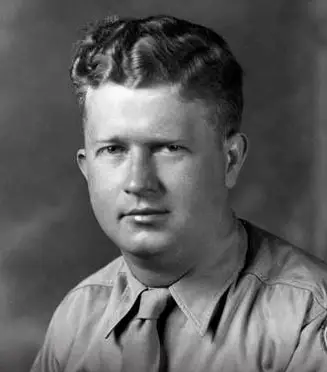
Roderick W. “Roddie” Edmonds was born on August 20, 1919, in South Knoxville, Tennessee, and graduated from Knoxville High in 1938. He was one of four brothers, Thomas “Shake” Edmonds Jr., Leon Edmonds, and Robert Edmonds.
Edmonds was a master sergeant in the 106th Infantry Division, 422nd Infantry Regiment in the United States Army when he was sent to Belgium in December 1944. During what became known as the Battle of the Bulge, Edmonds was captured by German forces.
Edmonds and his men were stationed along the Siegfried Line near Bastogne, approximately ten miles from division headquarters in St. Vith, when the German Army launched its massive Ardennes counteroffensive in December 1944. The Battle of the Bulge would result in the largest capture of American forces during World War II. Encircled by overwhelming German firepower, including tanks, Edmonds’ company was ultimately forced to capitulate. He and thousands of other American soldiers were taken prisoner and transported in cattle cars—rail cars similar to those used to deport Jewish prisoners to concentration and death camps.
Paul Stern, one of the Jewish POWs later saved by Edmonds, was also taken prisoner during the fighting. He said the prisoners were forced to march for four days to a railway station where those who survived the trip were loaded into boxcars and driven for several days, without food, to Stalag IX-B. Stern said the Jewish POWs were segregated into special barracks, but this is not supported by evidence of what happened at IX-B because the Germans were not sure who was Jewish. Nevertheless, Stern said he and the other Jewish noncommissioned officers were taken to the nearby camp of Ziegenhain – Stalag IX-A.
Conditions in captivity were brutal. At Stalag IX-A, the American POWs survived on meager rations, reportedly one loaf of bread for every ten men. Prisoners described constant hunger; one survivor later recalled losing more than sixty pounds during three months in captivity. Edmonds kept a diary during this period, but like many veterans, he rarely spoke about his wartime experiences after returning home.
As the senior noncommissioned officer at the new camp, Edmonds was responsible for the camp’s 1,292 American POWs. On their first day in Ziegenhain, January 26, 1945, Major Siegmann from Nazi High Command ordered Edmonds to tell the Jewish soldiers to present themselves at the next morning’s assembly so they could be separated from the other prisoners.
Instead, Edmonds ordered all 1,292 POWs to assemble outside their barracks. The Major rushed up to Edmonds in a fury, placed his pistol against Edmonds’s head and demanded that Edmonds identify the Jewish soldiers under his command. Instead, Edmonds responded, “We are all Jews here,” and told the Nazi that if he wanted to shoot the Jews, he’d have to shoot all of the prisoners. Edmonds then warned Major Siegmann that if he harmed any of Edmonds’s men, the Major would be investigated and prosecuted for war crimes after the conflict ended – since the Geneva Conventions required prisoners to give only their name, rank, and serial number; religion was not required. Major Siegmann backed down.
Stern witnessed the exchange as did Lester Tanner who said the soldiers were aware the Nazis were killing the Jews. “There was no question in my mind or that of M/Sgt Edmonds that the Germans were removing the Jewish prisoners from the general prisoner population at great risk to their survival,” Tanner recalled. “The U.S. Army’s standing command to its ranking officers in POW camps is that you resist the enemy and care for the safety of your men to the extent possible. M/Sgt Edmonds, at the risk of his immediate death, defied the Germans with the unexpected consequences that the Jewish prisoners were saved.”
Interestingly, some POWs told a similar story about what happened at Stalag IX-B, the camp Edmonds and the Jewish prisoners had left. There, too, the Jews were shielded, but the Germans still found 350 men who either were Jews or thought to be, and sent them to the Berga concentration camp.
Edmonds’ defiance did not end with the January 26, 1945, confrontation. In March 1945, as Allied forces advanced and the war neared its conclusion, German authorities ordered a forced evacuation march of the camp. Weakened by months of starvation and harsh conditions, many prisoners feared the march would amount to a death sentence. Edmonds instructed the American POWs to break ranks and repeatedly return to their barracks despite German orders to assemble for evacuation. After hours of this standoff, the guards relented, leaving the Americans behind. On March 30, 1945, the camp was liberated by the advancing U.S. 6th Armored Division.
Edmonds survived 100 days of captivity, and returned home after the war, but never told his family of what had occurred at the POW camp. He later served in the Korean War.
He died on August 8, 1985, having never received any official recognition, citation or medal for his defense of the Jewish POWs.
After he died in 1985, Edmonds’s wife gave his son, Baptist Rev. Chris Edmonds, a couple of the diaries his father had kept while in the POW camp. Rev. Edmonds began researching his story and, in the late 2000s, encountered a brief reference in a 2008 New York Times article that mentioned one of the former POWs and the defiant stand taken by a master sergeant, which prompted him to investigate further. The younger Edmonds located several of the Jewish soldiers his father saved, who provided witness statements to Yad Vashem, helping secure official recognition for his father’s actions.
On February 10, 2015, Yad Vashem recognized Edmonds as one of the “Righteous Among the Nations” for saving as many as 200 American Jewish soldiers from possible death. Of the more than 27,000 people to receive Israel’s highest honor for non-Jews who risked their lives to save Jews during the Holocaust, Edmonds was the fifth of five Americans, and the only one of the five who was an active serviceman during World War II.
The ceremony was held January 27, 2016, at the Israeli embassy in Washington, D.C., where President Barack Obama praised Edmonds for action “above and beyond the call of duty.” Chris accepted the Righteous medal and certificate of honor on his father’s behalf. In 2019, President Donald Trump also recognized Edmonds’ story during the Veterans Day Parade in New York.
Chris believes his father also deserves the Medal of Honor. “It’s truly a unique American story, a unique soldier story, and a unique army story,” Chris said. “I think it would honor dad, the army, and POWs for him to get this award. And I believe it would even honor future generations, because if the US military says this man deserves the Medal of Honor, then his story is going to be told for generations to come. I just want to get dad’s leadership and legacy out there for everyone to be inspired by.”
The U.S. Army, however, says that Edmonds is ineligible because his actions were not in combat. To overcome this obstacle, legislation was introduced to recognize Edmonds with a civilian award, the Congressional Gold Medal. The legislation was later changed to authorize the President to award him the Medal of Honor.
However, in 2026, Master Sgt. Roddie Edmonds, a World War II soldier from Knoxville, Tennessee, posthumously received the Medal of Honor, the nation’s highest award for valor, more than four decades after his death. President Donald Trump bestowed the honor in recognition of Edmonds’ extraordinary courage in a Nazi POW camp during the Battle of the Bulge, where he defied German orders and protected nearly 200 Jewish American soldiers. The long-awaited recognition followed years of advocacy by his family and supporters to secure the military’s highest distinction for his actions.
Sources: “At Veterans Day Parade, Trump Praises Commander Who Saved 200 Jewish Soldiers at World War II POW Camp,” Algemeiner, (November 11, 2019);
“Roddie Edmonds,” Wikipedia;
Correspondence with Chris Edmonds;
“Edmonds, Roddie,” The Righteous Among the Nations Database, Yad Vashem.
Derricke Dennis, “World War II Army Hero to Posthumously Receive Medal of Honor,” military.com, (February 17, 2026).
Claire Barrett, “‘We are all Jews’: Soldier who defied his German captors to be awarded Medal of Honor,” Military Times, (February 19, 2026).
Photo courtesy of Chris Edmonds.